
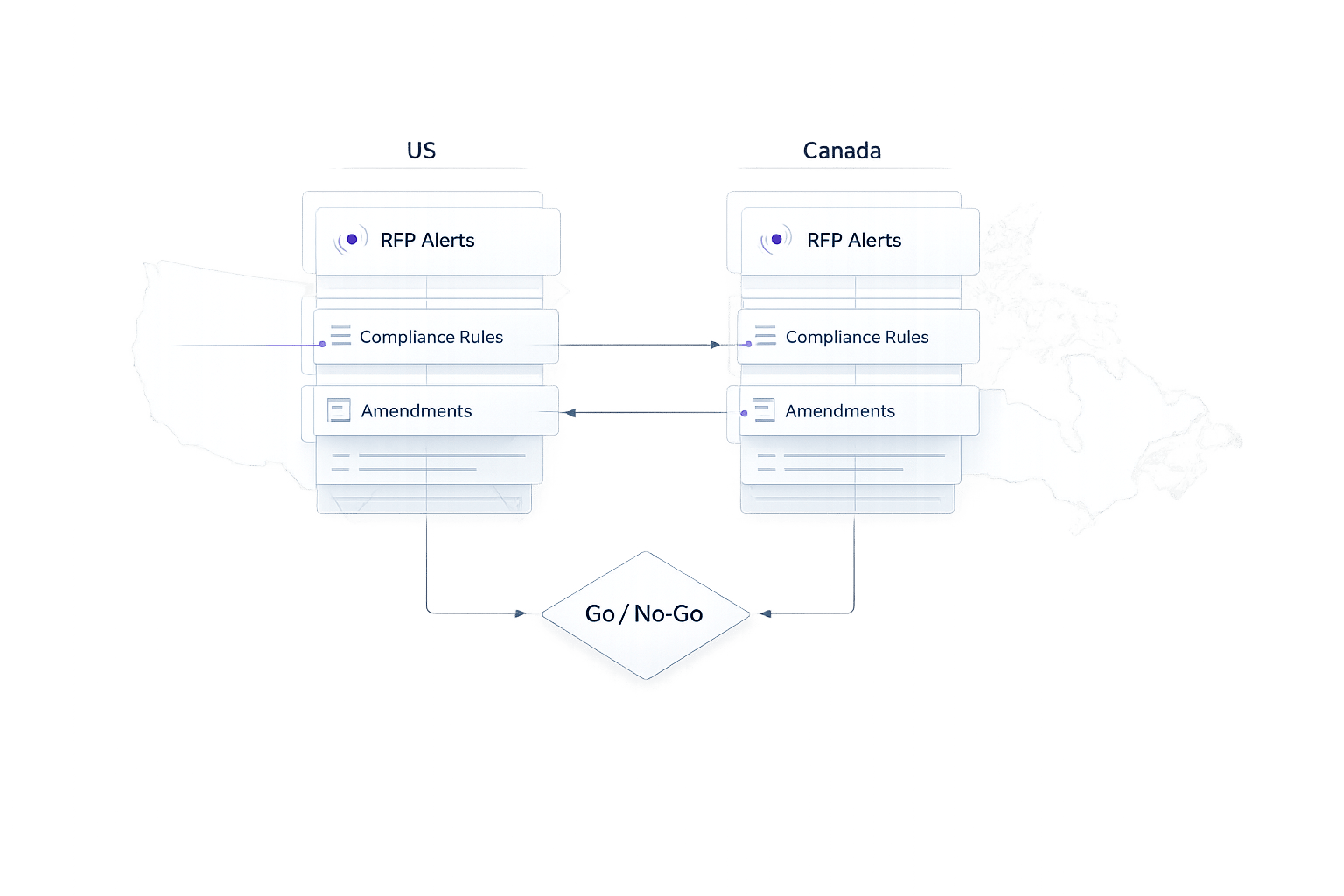
Real-time RFP alerts notify businesses about new government contract opportunities within minutes of publication. In the US, federal bids are centralized on SAM.gov, simplifying discovery but requiring strict compliance with FAR regulations. Canada, however, has a fragmented system with over 30 portals like CanadaBuys, Alberta Procurement Connection, RampLA, and BC Bid, making tracking bids more complex.
Key challenges include:
- US: Centralized but requires adherence to FAR rules and tracking frequent amendments.
- Canada: Decentralized, requiring monitoring multiple platforms and meeting bilingual compliance.
Narwin.ai addresses these issues by using AI to scan both systems, match opportunities to your expertise, and provide instant go/no-go recommendations. With 72% of opportunities missed due to manual monitoring and 38% of RFPs receiving fewer than five submissions, automated alerts save time and increase competitiveness.
Quick Comparison:
| Feature | US (SAM.gov) | Canada (CanadaBuys & others) |
|---|---|---|
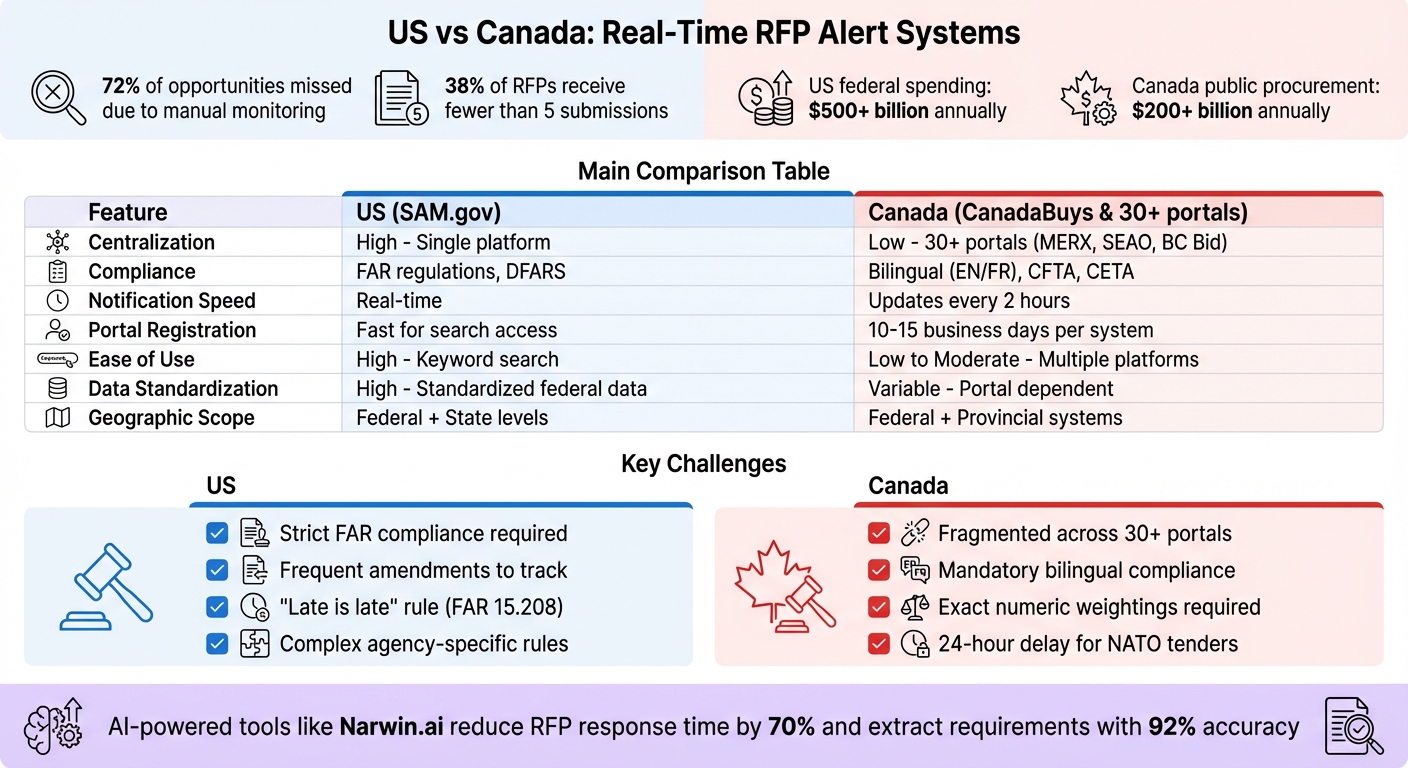
| Centralization | High (single platform) | Low (30+ portals) |
| Compliance | FAR regulations | Bilingual compliance, CFTA |
| Notification Speed | Real-time | Updates every 2 hours |
| Ease of Use | High | Moderate to low |
Automated tools like Narwin.ai simplify monitoring, ensuring vendors don’t miss lucrative opportunities in either market.
US vs Canada RFP Alert Systems Comparison
1. US Real-Time RFP Alert Systems
Procurement Ecosystem
The US federal procurement system revolves around SAM.gov (System for Award Management), the primary hub for federal contract opportunities. These opportunities fall into several categories:
- Sealed Bidding (IFB): Awards go to the lowest-priced, responsible bidder.
- Negotiated Procurement (RFP): Allows for discussions and evaluates “best value” by balancing price and quality.
- Simplified Acquisitions (RFQ): For purchases under $150,000.
Real-time alert systems gather data from SAM.gov, filtering opportunities by keywords, regions, and NAICS codes. This is essential for managing the large volume of bids and identifying the most relevant ones. These systems also track notices like “Sources Sought” and “Advisory Multi-step”, giving vendors a chance to influence technical specifications before the final RFP is released.
The micro-purchase thresholds are $3,500 (or $2,000 for construction), while simplified acquisitions are capped at $150,000. Vendors can use alert systems to stay ahead of the competition by identifying and acting on opportunities early in the process.
Compliance Requirements
Strict compliance is a cornerstone of federal procurement. The FAR 15.201(f) rule ensures that if a contracting officer shares essential proposal preparation information with one vendor, it must be made public promptly. Real-time alert systems are vital here, as they ensure all vendors receive updates simultaneously, preventing unfair advantages.
“Contractors MUST be registered in the Central Contractor Registration (CCR) database now located on the System for Award Management (SAM), before they can be awarded a U.S. government contract.” – Trade Commissioner
Under FAR 15.206, any changes to requirements or terms must be reflected in amended solicitations. Real-time systems flag these amendments immediately, keeping vendors informed. Additionally, the “late is late” rule under FAR 15.208 means even minor delays in proposal submissions can lead to disqualification. Accurate time-stamping and instant notifications from alert systems help vendors meet these strict deadlines.
Amendment Tracking
Real-time alert systems are designed to help vendors differentiate between new opportunities and updates to existing ones. Alerts are categorized as “NEW OR UPDATED”, ensuring vendors receive notifications only when relevant changes occur. SAM.gov also allows users to follow specific opportunities, triggering automated updates whenever modifications are made. This eliminates the need for constant manual monitoring.
Tools like Narwin.ai enhance this process by scanning federal sources in real time and using AI to notify users of any changes instantly. Whether it’s updates to closing dates or technical specifications, this system ensures vendors stay informed. It also tracks updates to Title 48 of the Electronic Code of Federal Regulations (Federal Acquisition Regulations System), ensuring compliance with the latest amendments.
Notification Speed and Relevance
Speed is everything in federal procurement, as agencies often impose tight response deadlines. Manual checks can lead to missed opportunities, so advanced search tools are crucial. These tools allow vendors to create precise alerts using comma-separated phrases (e.g., “engineering services, project management”), ensuring notifications are highly relevant and reducing unnecessary noise.
AI-powered systems can reduce RFP response times by over 70% by matching opportunities to a company’s profile instantly. For example, Narwin.ai provides instant go/no-go recommendations and preliminary match scores, helping teams decide whether to pursue an opportunity without wasting time and resources. This level of speed and precision ensures businesses can focus on the most relevant opportunities and respond effectively to federal procurement demands.
2. Canadian Real-Time RFP Alert Systems
Procurement Ecosystem
Canada’s federal procurement system revolves around CanadaBuys.canada.ca, the main platform for federal tender opportunities governed by trade agreements like CETA, WTO-AGP, and CFTA. A key feature of this system is its bilingual compliance requirement, ensuring all information is available in both English and French. Data is standardized into two columns for consistency. Additionally, the system is transitioning from the Goods and Services Identification Number (GSIN) to the United Nations Standard Products and Services Code (UNSPSC) for classifying goods and services.
Unlike the centralized approach used in the U.S., Canada’s procurement system is more fragmented. Vendors must track multiple provincial portals, such as SEAO (Quebec), BC Bid (British Columbia), SaskTenders (Saskatchewan), and MERX (Manitoba). This decentralized structure makes compliance and monitoring more challenging for businesses.
Compliance Requirements
Real-time alert systems must adhere to trade agreement rules, which require competitive procurements to be posted on the Government Electronic Tendering Service (GETS). With the switch to UNSPSC classification, vendors need to identify the correct commodity codes to ensure they receive relevant notifications. Federal award notices from the Automated Buyer Environment (ABE) are transferred to CanadaBuys monthly, meaning vendors must track solicitation numbers carefully to maintain accurate records.
Staying on top of amendments and updates is equally important to meet regulatory requirements.
Amendment Tracking
CanadaBuys offers a feature to “follow” specific tender notices by clicking a bell icon, which activates automated email notifications for any amendments. Additionally, the “New tender notices” file updates every 2 hours, giving vendors frequent access to newly published opportunities throughout the day.
However, tenders published via SAP Ariba are only added to CanadaBuys open data files the following day after a nightly update. NATO tender notices, meanwhile, experience a 24-hour delay compared to the NSPA eProcurement portal, requiring vendors to verify these notices separately.
Notification Speed and Relevance
Real-time systems in Canada provide updates primarily through email and feed readers, with feeds generally offering faster notifications. To refine relevance, vendors can use advanced search filters, including keywords (with quotation marks for exact matches), solicitation numbers, trade agreements, and government department names.
The UNSPSC classification system ensures vendors receive alerts tailored to their specific commodity codes, helping them focus on opportunities that match their expertise. Narwin.ai takes this a step further by scanning both federal and provincial portals in real time. Using AI, it matches opportunities to a company’s profile and provides instant go/no-go recommendations. This eliminates the need for manual monitoring of multiple provincial portals, helping vendors stay competitive in Canada’s fragmented procurement landscape. As with the U.S., speed and accuracy in notifications are essential for success in this fast-moving market.
Pros and Cons
When comparing the real-time RFP alert systems in the US and Canada, it’s clear that each has its own set of strengths and hurdles. These differences can significantly impact how businesses discover and respond to government opportunities. For vendors, understanding these trade-offs is crucial when choosing the right tools and strategies for each market.
In the US, centralization is a major advantage. Platforms like SAM.gov consolidate federal opportunities into a single hub, making it easier for vendors to find relevant bids. However, this simplicity comes with a catch: vendors must navigate complex regulatory requirements, such as the FAR and agency-specific rules like DFARS. On top of that, frequent amendments to RFPs mean businesses need to stay on their toes to avoid missing critical updates.
Canada, on the other hand, has a fragmented procurement landscape. Opportunities are spread across more than 30 different portals, such as MERX, SEAO (for Quebec), and BC Bid (for British Columbia). This decentralization makes manual monitoring a daunting task, often leading to missed opportunities. Additionally, businesses must meet bilingual compliance requirements, as federal documents are required to be available in both English and French.
Here’s a quick comparison of the two systems:
| Feature | US Real-Time Alert Systems | Canadian Real-Time Alert Systems |
|---|---|---|
| Portal Centralization | High; SAM.gov aggregates federal opportunities | Low; scattered across 30+ portals |
| Compliance Complexity | High; FAR updates and agency-specific rules | High; lengthy RFPs with strict criteria |
| Notification Accuracy | High; standardized federal data | Variable; depends on portal and aggregator efficiency |
| Ease of Use | High; keyword-based search | Low to Moderate; multiple platforms to navigate |
| Registration Speed | Fast for search access | Slower; requires supplier registration |
| Geographic Scope | Federal and state levels | Federal (CanadaBuys) and provincial systems |
AI-powered platforms like Narwin.ai are stepping in to bridge these gaps. By monitoring both US and Canadian portals, these tools use natural language processing to analyze lengthy RFP documents and provide instant recommendations. For Canada, this means overcoming the challenges of fragmented data and bilingual compliance. In the US, AI helps vendors navigate FAR complexities and track regulatory updates that could affect their eligibility.
The bottom line: while the US benefits from centralized systems and standardized data, Canada’s fragmented approach requires more extensive monitoring. Tools like Narwin.ai are designed to handle these challenges, offering vendors a way to navigate both markets efficiently – without the burden of manual intervention.
Conclusion
Navigating RFP alerts in the US and Canada means dealing with two very different systems. In the US, centralized discovery through SAM.gov simplifies the search process, but staying on top of frequent FAR amendments and agency-specific regulations is critical. Canada’s decentralized setup, combined with strict “Contract-A” rules, leaves no room for non-compliant bids. With stats showing that 72% of qualified opportunities are missed due to manual monitoring and 38% of RFPs attract fewer than five bidders, having an efficient notification system can give vendors a serious edge.
The differences go beyond just finding opportunities. Canadian RFPs demand exact numeric weightings and detailed technical proposals – what Alex McPhail, President & CEO of EXA Consulting Group, describes as focusing on “the steak” rather than “the sizzle.” Meanwhile, US proposals often thrive on persuasive win themes that leverage evaluators’ discretionary judgment. This contrast means businesses must adjust their proposal strategies significantly based on the market they’re targeting. It also highlights why relying on manual tracking is no longer practical.
For businesses working in both countries, manual monitoring quickly becomes unmanageable. Registering on multiple platforms can take up to 10–15 business days per system. Add to that the daily grind of checking portals, sorting irrelevant opportunities, and pulling requirements from lengthy documents, and the inefficiency becomes clear.
Narwin.ai tackles these challenges head-on by consolidating opportunities from both countries into one streamlined platform. Its AI scans federal, state, provincial, and municipal sources, automatically matching opportunities to your company profile. It delivers instant go/no-go recommendations, ensuring compliance for Canadian bids and tracking FAR updates for US projects. With natural language processing that extracts requirements with 92% accuracy, the platform can cut proposal drafting time by as much as 70%.
Whether you’re chasing a $500,000 IT contract or a $2 million construction project, success hinges on using tools that meet the unique demands of each market. With Canada’s public procurement market exceeding $200 billion and US federal spending topping $500 billion annually, the potential is enormous for vendors who can efficiently identify and act on opportunities.
FAQs
How does Narwin.ai make tracking RFPs in the US and Canada easier and more effective?
Narwin.ai makes tracking RFPs across the US and Canada a breeze by leveraging AI-powered tools to handle tedious tasks like finding opportunities, qualifying leads, and analyzing documents. The platform continuously monitors procurement portals and public bid sources, sending you real-time alerts for RFPs, RFIs, and tenders that align with your business profile. This way, you stay on top of every relevant opportunity without lifting a finger.
On top of that, Narwin.ai examines complex RFP documents, predicts win probabilities, and offers personalized recommendations to help you make fast, informed decisions. By cutting down on manual work and simplifying proposal preparation, it not only saves time but also boosts your chances of standing out in the competitive bidding landscape.
What challenges do vendors face with Canada’s decentralized RFP system?
Navigating Canada’s decentralized Request for Proposal (RFP) system can feel like an uphill battle for vendors. The system is spread across federal, provincial, and municipal levels, with over 30 separate tender portals run by different government entities. This fragmented setup makes it tough to keep track of opportunities and avoid missing out on potential bids. Vendors often find themselves juggling multiple platforms, each with its own set of eligibility criteria.
On top of that, compliance adds another layer of complexity. Procurement policies and documentation requirements vary significantly between government levels, creating a maze of rules to follow. Analyzing lengthy RFPs and crafting tailored proposals takes a lot of time and effort, which can be especially overwhelming for smaller vendors trying to stay competitive.
This is where tools like Narwin.ai come into play. By automating tasks like bid discovery, qualification, and proposal drafting, these tools can help vendors save time, streamline their efforts, and improve overall efficiency. It’s a game-changer for those looking to navigate the challenges of Canada’s procurement system more effectively.
How can real-time RFP alerts help businesses comply with FAR regulations?
Real-time RFP alerts play a crucial role in helping businesses adhere to FAR (Federal Acquisition Regulation) by ensuring they receive timely notifications about relevant procurement opportunities. This gives companies the chance to meet tight submission deadlines and provide all necessary documentation, minimizing the risk of falling out of compliance.
These alerts also promote openness and fairness by giving businesses prompt access to bid opportunities. This allows them to craft proposals that align with regulatory standards. Tools like Narwin.ai make this process even smoother, offering AI-driven features such as bid searches and instant go/no-go signals. These capabilities enable faster, more precise decision-making, making federal contracting less daunting while ensuring compliance with FAR requirements.