
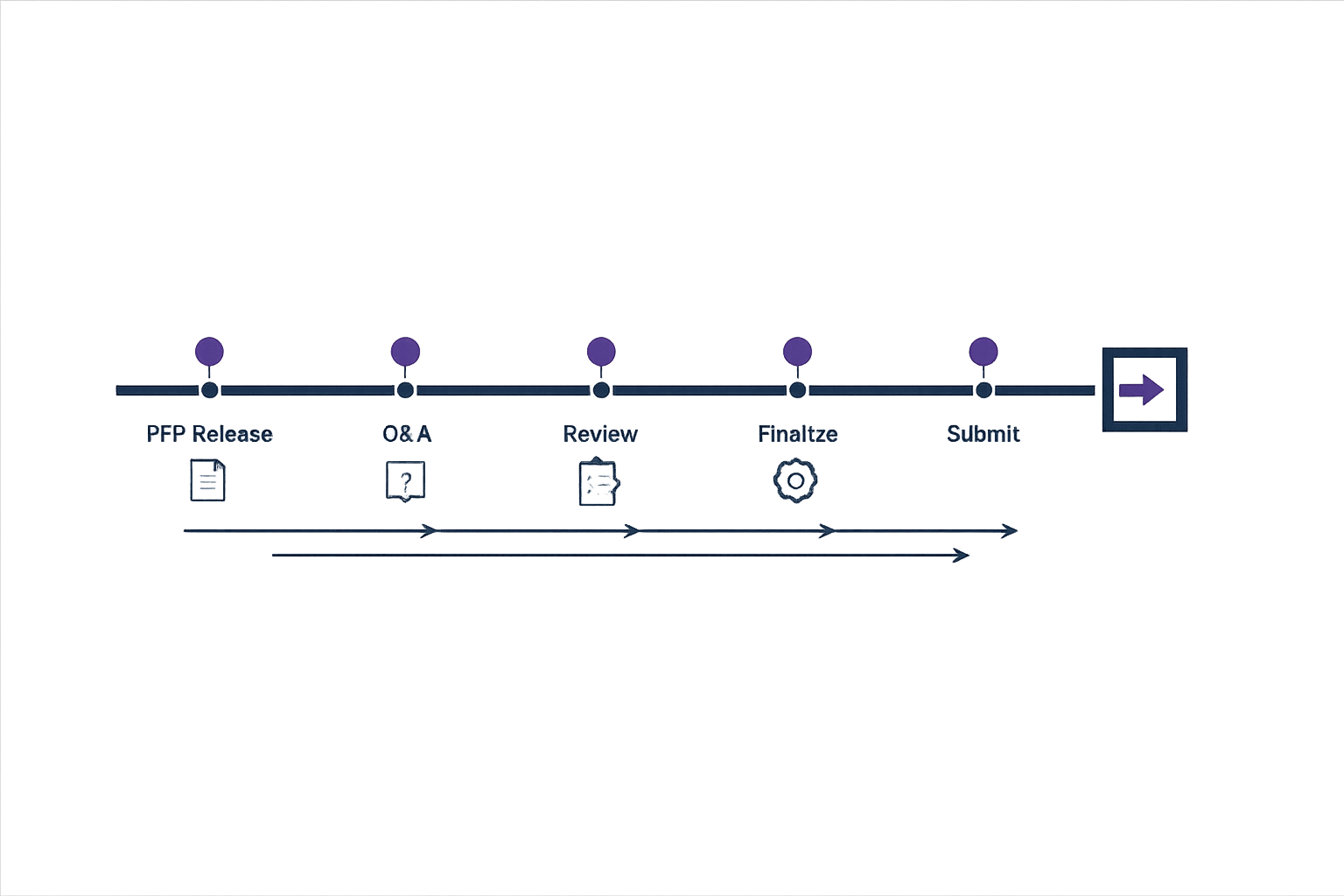
Federal RFPs are unforgiving when it comes to deadlines. Missing a submission – even by a minute – means automatic disqualification. Here’s what you need to know:
- Deadlines are strict: Federal Acquisition Regulation (FAR) mandates compliance with submission times, typically 4:30 PM local time unless stated otherwise.
- Backward planning works best: Start from the submission deadline and allocate time for planning, writing, reviews, and a buffer for unexpected delays.
- Key sections to focus on: Sections L (Instructions) and M (Evaluation Criteria) are critical for compliance and evaluation.
- Coordinate your team: Use tools like a RACI matrix to assign roles and maintain progress.
- Q&A deadlines matter: Submit clarification questions early to avoid missteps.
- Use technology: Tools like Narwin.ai can automate deadline tracking, compliance checks, and streamline the entire process.
Effective timeline management ensures your proposal is complete, compliant, and submitted on time, increasing your chances of success in the competitive federal contracting space.
How to Build a Backward-Planning Timeline
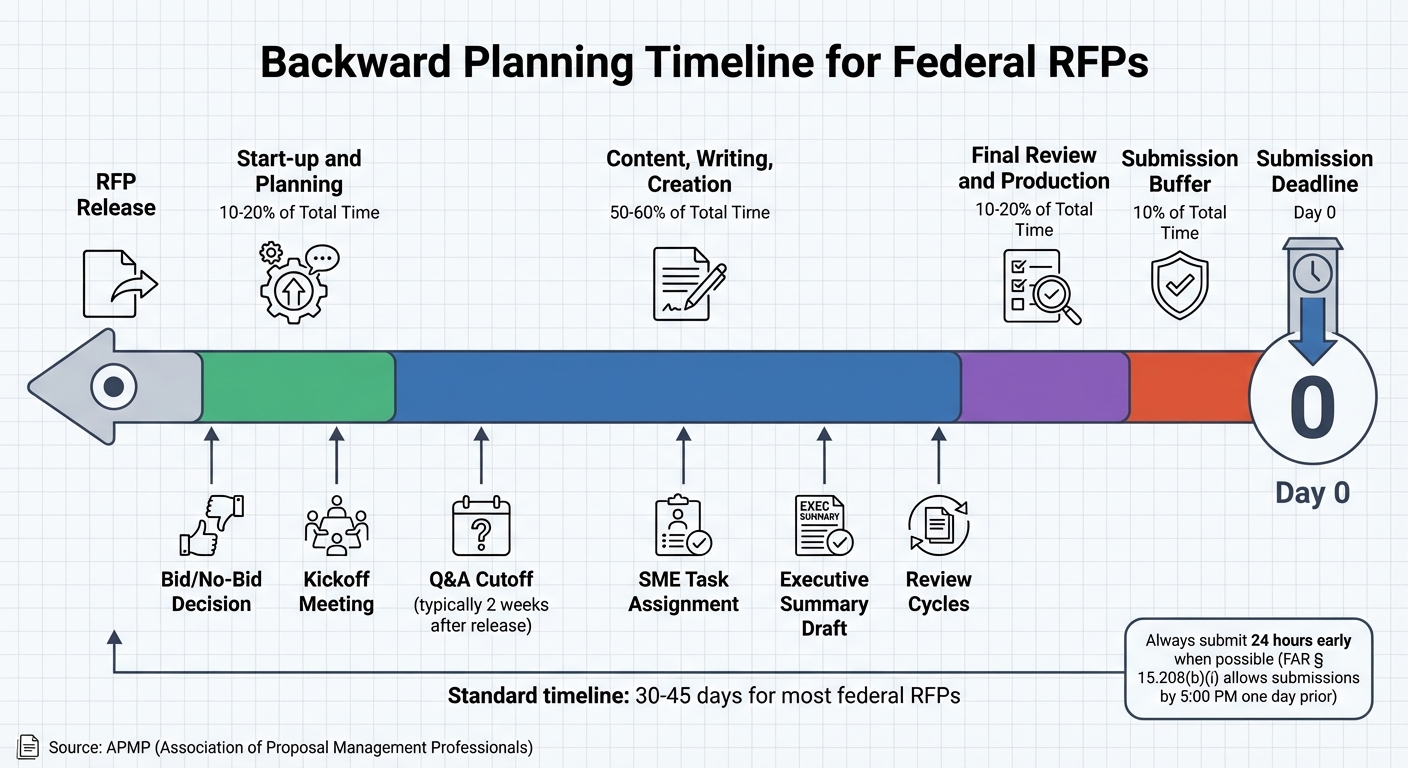
Federal RFP Backward Planning Timeline with Phase Allocations
Backward planning flips the script on traditional scheduling. Instead of starting from today and moving forward, you begin with the final submission deadline and work backward step by step. This approach ensures every phase gets the time it truly requires, rather than squeezing tasks into whatever time remains. By planning this way, you can avoid rushing through critical steps and maintain a smooth workflow.
The Association of Proposal Management Professionals (APMP) suggests breaking your timeline into these phases: 10–20% for start-up and planning, 50–60% for content creation and writing, and 10–20% for final review and production. Additionally, set aside the last 10% of your total time as a buffer for unexpected delays, like technical hiccups or last-minute adjustments.
Start with the Contract Execution Date
Anchor your timeline to the submission deadline and immediately subtract the 10% buffer. This ensures you have a safety net for any unforeseen issues.
Next, divide the remaining time using the APMP model. This breakdown helps your team focus on each phase without overcommitting to one step and neglecting others. It also ensures you have enough time for quality checks before the final submission.
Add Key Milestones
Once your major phases are mapped out, it’s time to set milestones to track progress. Early on – within the first 10–20% of your timeline – schedule a bid/no-bid decision and a kickoff meeting to finalize the schedule. Don’t forget external deadlines, like the Q&A cutoff (usually two weeks after the RFP release) and amendment review periods.
Internal milestones are equally critical. Plan for assigning tasks to Subject Matter Experts (SMEs), drafting the executive summary, and conducting several review cycles. While standard RFP responses might run on a 30-day timeline, larger federal contracts often require much longer schedules.
| Milestone Phase | Recommended Time Allocation |
|---|---|
| Start-up and Planning | 10–20% |
| Content, Writing, Creation | 50–60% |
| Final Review and Production | 10–20% |
| Submission Buffer | Final 10% of total time |
Coordinate Across Teams
Even the best timeline won’t work without a well-synced team. A coordinated effort ensures each phase of your backward-planning timeline stays on track. To achieve this, use a RACI matrix to assign roles clearly: identify who’s Responsible, who’s Accountable, who needs to be Consulted, and who should be Informed. This clarity prevents confusion and ensures no task is overlooked.
Kickoff meetings are the perfect place to align everyone. Present the timeline visually – Gantt charts are a great tool – and get feedback to confirm deadlines are realistic. If the schedule is tight, be transparent about it. Highlight the urgency so every team member understands the importance of hitting their deadlines.
Another way to save time is by maintaining a managed content library. This allows SMEs to pull from pre-approved materials rather than starting from scratch, speeding up the process. Regularly track progress and address any delays immediately during team check-ins. Waiting until the final week to uncover problems is a surefire way to derail the entire project.
sbb-itb-bb3960c
Main Phases in Federal RFP Timelines
Managing each stage of a federal RFP process effectively is critical – not just for meeting compliance requirements, but also for staying on track with deadlines. Typically, contractors are given 30 to 45 days to develop a proposal, although more complex contracts might allow additional time.
RFP Release and Initial Review
When an RFP is released, the first step is to carefully review Section L (Instructions), Section M (Evaluation Criteria), and Section C (Statement of Work). These sections outline the proposal’s requirements, scoring criteria, and formatting rules – key elements for staying compliant with the timeline.
Section C is particularly important as it includes “shall” statements – non-negotiable legal requirements for fulfilling the contract. Section A, meanwhile, provides essential details like the solicitation number, issue date, and the all-important closing date and time. Submission deadlines are often set for 4:30 p.m. local time unless electronic submissions require earlier delivery.
“Government customers can be very particular with the RFP response format from page number, font type and font size, as well as structure. If you use the wrong font and margins or do not meet the submission requirements, they can toss your response into the trash without reading it.” – Stephanie Hagan, Training and Communications Manager, Winvale
To stay organized, create a compliance matrix during this initial review. This tool helps track every requirement and ensures nothing gets overlooked. Assign specific sections of the RFP to team members, and have them present their findings during a kickoff meeting. Keep Section L visible – post it on a whiteboard or similar space – so everyone stays mindful of formatting and delivery rules throughout the process.
Once the initial review is complete, shift your focus to the Q&A period. This is where you can refine your strategy and address any uncertainties.
Q&A Period and Amendments
The Q&A period, typically lasting one to two weeks after the RFP is released, is your opportunity to clarify vague requirements, challenge restrictive terms, or request changes to unfavorable clauses. Keep in mind, any adjustments to evaluation factors or requirements must come through formal amendments, so your questions should aim to prompt those changes.
Establish a schedule for generating, reviewing, and submitting questions. To increase the likelihood of a favorable response, structure your questions clearly: reference the specific RFP section, outline the requested action, and explain how it benefits the government.
“A Q&A submission deadline should be viewed just as importantly as the government proposal submission deadline itself.” – Sonja Roberts, Public Sector Director, Winvale
Be cautious about what you disclose in your questions. Since Q&A responses are generally made public, avoid revealing proprietary strategies like design features, staffing plans, or pricing details. Instead, focus on clarifying the “shall” statements in Section C to confirm your ability to meet all requirements before investing time in drafting the proposal. Also, keep an eye out for amendments using Standard Form 30, as the government may update requirements even after the initial release.
Once the Q&A period ends and amendments are addressed, it’s time to dive into the proposal preparation and submission stages.
Proposal Submission and Post-Submission Activities
After submitting your proposal, the evaluation period begins. This stage can vary in length, but your ability to respond quickly to clarification requests is crucial. Submissions are scored based on technical merit, past performance, and cost reasonableness. Occasionally, the government may request additional information, requiring a fast turnaround.
The fourth quarter of the federal fiscal year (July through September) sees a surge in contract awards, often leading to tighter timelines and faster decision-making. Be ready to mobilize resources quickly during this period. Once a winner is chosen, the agency issues a formal award notice and offers debriefings to unsuccessful bidders.
If you’re not selected, always request a post-award debriefing. These sessions are invaluable for identifying areas to improve in future proposals. They can highlight weaknesses in your technical approach, gaps in past performance, or pricing issues that may have cost you points.
| Phase | Typical Duration / Timing | Key Activities |
|---|---|---|
| RFP Release | Day 1 | Public notification, document release, initial review |
| Q&A Period | First 1–2 weeks of release | Pre-proposal conferences, formal clarification requests |
| Proposal Preparation | 30–45 days (standard) | Technical/cost development, compliance checks |
| Evaluation & Selection | Varies (weeks to months) | Scoring, clarifications, competitive range determination |
| Award & Debriefing | Post-selection | Formal award notice, unsuccessful bidder feedback |
| Contract Execution | Multi-year (typically) | Project kickoff, performance monitoring, annual assessments |
How to Stay Compliant and On Schedule
When it comes to federal contracting, staying compliant and meeting deadlines isn’t optional – it’s mandatory. With federal agencies spending over $700 billion annually on goods and services through the RFP process, missing a deadline means automatic disqualification. The FAR 15.208 “late is late” rule is strict: if your proposal doesn’t arrive by the specified time (defaulting to 4:30 PM local time if not explicitly stated), it won’t even be considered.
Set Realistic Internal Deadlines
Plan your internal deadlines to align with the final submission date, but always include time buffers. Break the proposal process into phases: an initial review, compliance checks, content creation, internal reviews, and final approval. Assign clear responsibilities to avoid bottlenecks and ensure smooth progress.
Add buffer time for unexpected revisions or technical hiccups with submission portals. A good practice? Submit your proposal one day early. According to FAR § 15.208(b)(i), electronic submissions received by the government’s entry point by 5:00 PM one working day before the deadline are considered timely. This approach safeguards against last-minute technical issues.
Use pre-approved templates and maintain a resource library to save time on repetitive sections. Start with a compliance matrix to track how every RFP requirement is addressed – this avoids frantic last-minute fixes. Daily check-ins can help identify and resolve roadblocks early.
Use Parallel Workstreams
Federal proposals are typically divided into distinct volumes – Administrative, Management, Technical, Past Performance, and Cost/Pricing. By assigning different teams to work on these volumes simultaneously, you can make the most of your time and meet tight deadlines.
Organize files to align with specific evaluation teams. For instance, while your technical team focuses on developing the approach, your finance team can handle pricing, and your contracts team can manage certifications and representations. Use a crosswalk matrix to ensure all RFP requirements are addressed consistently across different volumes.
“Inconsistencies… can be a result of various groups of personnel developing different RFP sections without adequate coordination and review.” – AFARS 2.3
Keep technical and pricing workstreams separate to avoid mixing data, which is often required for independent government evaluations. Once all workstreams are complete, conduct a thorough integration review to ensure all volumes align and meet requirements.
To further streamline the process, consider incorporating automation tools.
Use Technology for Deadline Management
Tools like Narwin.ai can simplify deadline management by extracting key dates, tracking compliance, and providing real-time updates. This eliminates the need to manually sift through lengthy solicitations to identify critical deadlines like Q&A periods, amendment postings, and submission times.
“Every bid we have used the AI on, we have won thus far. Complete game-changer.” – Top 100 GovCon company
AI solutions can go beyond deadline tracking. They can analyze requirements, create compliance matrices, and even draft initial responses, helping you meet tight timelines. Narwin.ai’s instant go/no-go signals allow you to quickly evaluate whether a bid is worth pursuing, saving time and resources on low-probability opportunities. Integration with tools like Google Drive and Slack ensures your team stays connected, with automated reminders keeping everyone on track. Combined with built-in time buffers, these tools can help you hit every milestone without breaking a sweat.
Common Mistakes and How to Avoid Them
Managing federal RFP timelines can be tricky, and even small missteps can lead to missed opportunities or disqualification. Knowing the common pitfalls – and how to sidestep them – can make all the difference.
Spotting Unrealistic Deadlines
One of the most frequent errors is underestimating the time it takes to secure a contract. While some expect to wrap things up in two months, the reality is that awards often take eight months or longer.
“The time from your decision to pursue a DoD contract to the time you receive full payment for your work can be longer than you’re used to with non-Government customers.” – MITRE AiDA
Even though contracting officers are required by FAR 11.401 to set realistic delivery schedules, not every RFP timeline will align with your team’s capacity. Unrealistic deadlines can limit competition, drive up costs, and conflict with small business policies. When evaluating a timeline, think about factors like industry norms, production schedules, and the time needed for government evaluations.
To address this, challenge deadlines during the pre-solicitation phase. Once the final RFP is released, your ability to influence the timeline is greatly reduced. Historical data from similar contracts can also help you gauge whether a timeline is realistic. Tools like Narwin.ai can analyze Procurement Acquisition Lead Time (PALT) data to flag problematic timelines before you commit resources to a bid.
Another key to staying on track is avoiding scope creep.
Preventing Scope Creep
Scope creep occurs when unapproved changes or extra requirements sneak into your proposal process, often derailing your timeline. In federal contracting, this issue is frequently tied to inconsistencies between the Statement of Work (SOW), instructions to offerors (Section L), and evaluation criteria (Section M).
“RFP inconsistencies can create ambiguity and result in less advantageous offers, require RFP amendments, cause delays in the acquisition, and result in litigation.” – AFARS 2.3
To avoid this, create a crosswalk matrix that maps every PWS requirement to Section L instructions and Section M evaluation factors. This ensures your proposal stays focused and aligned with the RFP. Limit page counts to prevent unnecessary additions, and avoid including information that won’t be evaluated – it wastes time and increases the risk of missing deadlines.
If government requirements change, they must be formally amended, which resets the timeline. If you notice changes during your internal process, immediately assess how they impact your schedule and adjust your plan accordingly.
Finally, using AI tools can help reduce risks and streamline your efforts.
Reducing Risks with AI Assistance
Tracking timelines manually often involves combing through lengthy documents, juggling spreadsheets, and relying on calendar reminders. This approach is error-prone, especially when managing multiple bids at once. AI-assisted tools can automate many of these tedious tasks, reducing the risk of mistakes.
Here’s a quick comparison of manual tracking versus AI-assisted tracking:
| Feature | Manual Timeline Tracking | AI-Assisted Tracking (e.g., Narwin.ai) |
|---|---|---|
| Deadline Identification | Requires manual RFP review; prone to errors. | Automatically extracts key dates and milestones. |
| Compliance Checks | Time-consuming manual cross-referencing. | Generates real-time compliance matrices and alerts. |
| Alerts & Notifications | Relies on manual calendar entries. | Sends automated alerts for upcoming deadlines. |
| Historical Data Comparison | Dependent on scattered spreadsheets. | Leverages historical PALT data for better predictions. |
| Collaboration | Limited to emails or static documents. | Centralized platform for real-time updates and teamwork. |
AI tools can also perform compliance checks to catch formatting errors or missing forms before submission – issues that could otherwise lead to immediate disqualification. Real-time alerts ensure you never miss critical deadlines like Q&A periods or amendment postings. Most importantly, AI can help you identify unrealistic timelines early by comparing RFP requirements with historical data, saving time and resources when deciding whether to pursue a bid.
Using Narwin.ai for Timeline Automation
Managing federal RFP timelines can feel like an endless cycle of document reviews and deadline tracking. Narwin.ai simplifies this process with advanced automation and data tools, allowing your team to focus on building strong, competitive proposals instead of chasing dates.
Automated Deadline Identification
With Narwin.ai, you no longer need to sift through pages of RFPs to pinpoint critical deadlines. Using Natural Language Processing (NLP), the platform extracts key dates – like submission deadlines, Q&A cutoffs, and milestone requirements – and presents them in a centralized dashboard.
The system also sends real-time alerts for mandatory responses or inquiries from contracting authorities, ensuring you never miss a critical deadline. Additionally, middleware integration with procurement APIs keeps you updated on new RFPs and amendments from sources like SAM.gov and CanadaBuys as soon as they’re posted.
This automation not only saves time but also sets the stage for a smoother, more efficient RFP process.
End-to-End RFP Lifecycle Management
Narwin.ai doesn’t stop at deadlines – it manages the entire RFP lifecycle from start to finish. By pulling data from over 30 tender portals, including federal and municipal systems, the platform matches opportunities to your company’s strengths, certifications, and geographic areas of interest.
Once a suitable opportunity is identified, Narwin.ai tracks over 120 compliance factors, such as document expiration dates, insurance renewals, and financial disclosures. Its AI proposal generator can pre-fill roughly 60% of standard responses using your organization’s knowledge base, including past proposals, certifications, and technical documents. This reduces repetitive tasks and allows your team to focus on crafting tailored, impactful responses.
Better Decision-Making with Go/No-Go Insights
Narwin.ai also helps you make smarter decisions about which bids to pursue. One of the biggest risks in RFP management is dedicating resources to opportunities that aren’t a good fit. The platform’s go/no-go insights let you prioritize bids effectively before committing significant time and effort.
Conclusion
Managing federal RFP timelines requires a structured approach to ensure compliance and improve team efficiency. The stakes are incredibly high – federal agencies allocate over $700 billion each year for goods and services. Under FAR 15.208, even being late by one minute can disqualify your proposal, making disciplined planning and execution absolutely critical.
Top contractors aim to submit proposals at least 24 hours before the deadline, often using parallel workstreams to handle the tight 30–45 day response window. They also understand that effective timeline management begins well before the RFP is issued – during the pre-solicitation phase, when there’s still a chance to shape the acquisition strategy.
Automation tools like Narwin.ai can simplify this process by removing the burden of manually tracking deadlines and monitoring compliance. These tools allow your team to focus on crafting stronger, more competitive proposals, aligning perfectly with the timeline strategies outlined in this guide.
The federal marketplace is highly competitive but full of opportunity. For example, in FY2022, small businesses secured over $162.9 billion in federal contracts, accounting for more than 26% of all eligible contracting dollars. By adopting the right timeline management practices and leveraging tools like Narwin.ai, your organization can position itself to compete effectively in this lucrative space.
FAQs
How does backward planning help streamline the federal RFP submission process?
Backward planning simplifies the federal RFP submission process by beginning with the final deadline and working backward to map out key tasks and milestones. This method helps ensure that no step is overlooked, minimizing the risk of missed deadlines or last-minute scrambling.
By dividing the process into smaller, focused phases and setting clear timelines for each, teams can better prioritize compliance, maintain quality, and coordinate effectively. This structured approach boosts efficiency and helps create a stronger, more polished proposal, giving you a better shot at success.
What sections of a federal RFP are most important for ensuring compliance?
When examining a federal RFP, it’s crucial to zero in on the requirements and instructions outlined in the solicitation. Carefully study sections that detail customer needs, formatting rules, submission procedures, and deadlines. These elements are key to ensuring your proposal meets compliance expectations.
Also, take note of any mentions of federal acquisition regulations. These often provide guidelines on how proposals must be organized and submitted. Overlooking or misunderstanding these requirements can result in disqualification, making attention to detail absolutely critical.
What role does technology play in managing federal RFP timelines efficiently?
Technology, particularly AI-driven tools, has become a game-changer in handling federal RFP timelines. By simplifying intricate processes, these tools make it easier to centralize critical data, spot compliance risks, and create customized proposal drafts in record time. The result? Less time spent on manual tasks and more focus on strategy.
Platforms like Narwin.ai take this a step further by offering features such as instant go/no-go decisions, risk assessments, and competitive insights. These capabilities help businesses stay aligned with deadlines, minimize mistakes, and improve their odds of succeeding in the federal RFP process.