
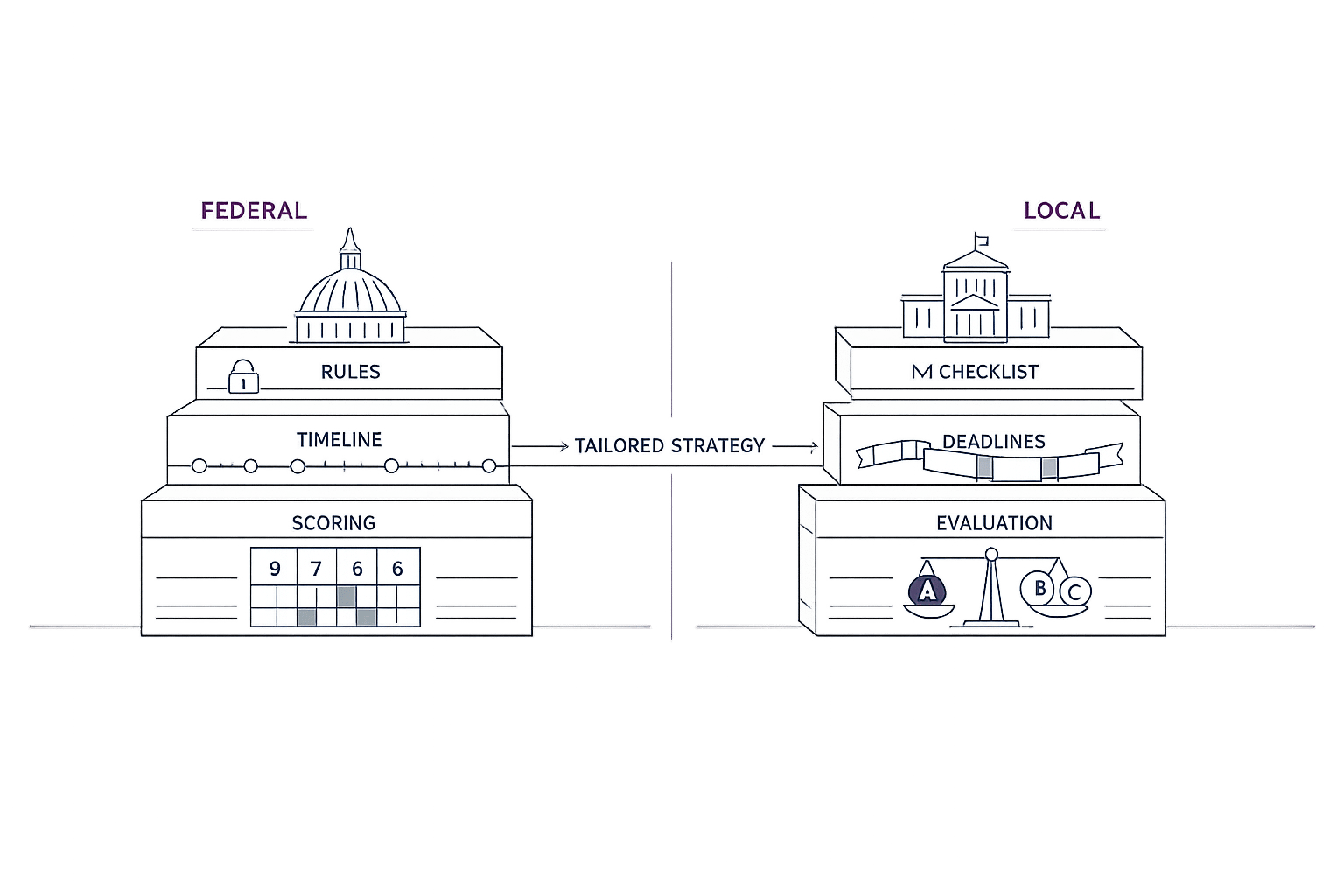
Federal and local RFPs (Requests for Proposals) differ significantly in their rules, structure, and evaluation processes. Federal RFPs follow strict guidelines under the Federal Acquisition Regulation (FAR), ensuring uniformity across agencies like NASA or the Department of Defense. These proposals require detailed documentation, specific formatting, and compliance with rigid deadlines. Evaluation focuses on overall value, including technical expertise and past performance.
Local RFPs, on the other hand, vary widely depending on state or municipal rules. Submission requirements are often simpler, with a focus on cost and community impact. Organizations can also leverage an AI based RFP Writer to streamline these localized applications. Deadlines and evaluation criteria are more flexible, but the lack of standardization means businesses must carefully review each solicitation.
Key Differences:
- Regulations: Federal RFPs follow FAR; local RFPs depend on state or municipal laws.
- Structure: Federal proposals use a standardized format (UCF); local formats vary.
- Evaluation: Federal awards prioritize value; local awards often favor the lowest bid.
- Deadlines: Federal deadlines are fixed; local timelines can be adjusted.
- Small Business Programs: Federal set-asides (e.g., 8(a), HUBZone); local programs emphasize local hiring and community benefits.
Quick Comparison:
| Criteria | Federal RFPs | Local RFPs |
|---|---|---|
| Regulation | FAR | State/municipal laws |
| Structure | Uniform Contract Format (UCF) | Varies by jurisdiction |
| Evaluation | Value-based (technical, past performance) | Cost-focused, with some flexibility |
| Deadlines | Fixed, no extensions | Flexible, may adjust |
| Small Business Focus | National programs (e.g., 8(a), HUBZone) | Local hiring preferences |
Understanding these differences is critical for tailoring proposals to meet federal or local requirements effectively.
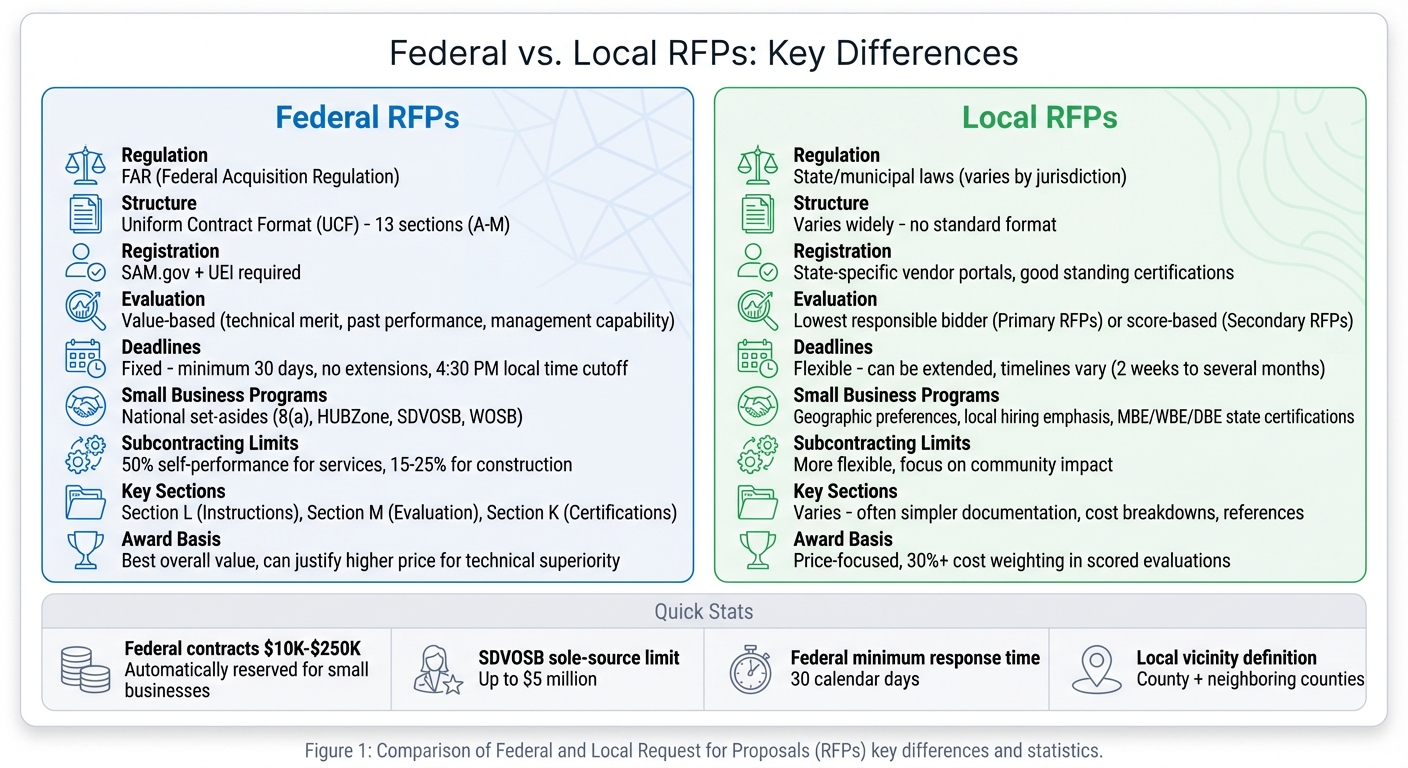
Federal vs Local RFPs: Key Differences Comparison Chart
Regulatory Framework and Compliance Requirements
Federal RFPs: FAR and Standardized Rules
Federal procurement operates under a unified guideline known as the Federal Acquisition Regulation (FAR). This rulebook ensures consistent policies and procedures across all executive agencies. It’s managed collaboratively by the Secretary of Defense, the Administrator of General Services (GSA), and the Administrator of NASA.
“The Federal Acquisition Regulations System is established for the codification and publication of uniform policies and procedures for acquisition by all executive agencies.” – FAR 1.101
Because of FAR, whether you’re bidding on a Department of Defense project or a NASA contract, you’ll encounter the same Uniform Contract Format (UCF). This standardized structure organizes federal solicitations into 13 sections grouped into four parts: Schedule, Contract Clauses, Attachments, and Representations/Instructions. Key sections include:
- Section L: Details how to format your proposal.
- Section K: Lists required certifications.
- Section M: Outlines evaluation criteria.
This uniformity simplifies the process, reducing ambiguity for bidders. Additionally, federal RFPs adhere to strict timelines. For instance, if a synopsis is required, the government must allow at least 30 calendar days for responses. While individual agencies may have their own supplemental rules, these must align with FAR, ensuring consistency across the board. This predictability sets federal RFPs apart from local ones.
Local RFPs: Varied State and Municipal Rules
Unlike the federal system, local procurement operates under a patchwork of rules that differ by state, city, or even county. Each jurisdiction follows its own laws and procedures, creating wide variability in how RFPs are structured and evaluated. However, when local agencies use federal grant funds, they must comply with basic financial standards outlined in 41 CFR Part 105-71.
“A State must expand and account for grant funds in accordance with State laws and procedures for expending and accounting for its own funds.” – 41 CFR 105-71.120
This autonomy means that submission requirements, evaluation criteria, and documentation formats can differ significantly. For example, one city might request a detailed technical narrative, while another might only ask for a cost breakdown and references. Bidding timelines also vary, as there’s no universal minimum like the federal 30-day rule. While local RFPs are often shorter and more flexible, this flexibility can lead to unpredictability. Each solicitation needs careful review to ensure compliance with its specific requirements, as there’s no single standard to rely on.
sbb-itb-bb3960c
Proposal Structure and Documentation Standards
Federal RFP Documentation: Detailed Requirements
Submitting proposals for federal contracts comes with strict guidelines and documentation standards. First and foremost, every submission must include a Unique Entity Identifier (UEI) – which has replaced the old DUNS number – and proof of active registration in SAM.gov. Without these, your proposal won’t even make it past the initial screening.
Federal proposals follow the Uniform Contract Format (UCF), which is divided into four parts and 13 sections (labeled A through M). The most critical sections are Section L (Instructions for Offerors) and Section M (Evaluation Factors for Award). These sections outline exactly how your proposal should be structured and how it will be evaluated. Contractors often use a crosswalk matrix to ensure every requirement from the Statement of Work is addressed and properly referenced by page number.
“The use of a uniform contract format facilitates preparation of the solicitation and contract as well as reference to, and use of, those documents by offerors, contractors, and contract administrators.” – 48 CFR § 15.204
Federal proposals also require separate volumes for technical details, past performance, and cost information. This separation ensures that technical evaluations remain unbiased. Additionally, Section K must be completed, as it includes standardized legal and ethical disclosures required by all federal agencies. Formatting rules are equally strict: many agencies mandate 12-point font, one-inch margins, and specific page limits. Any content exceeding those limits may simply be ignored.
On the other hand, local RFPs tend to be less rigid, offering more flexibility in structure and requirements.
Local RFP Documentation: Shorter and More Flexible
Local and municipal RFPs operate under a different set of expectations. Unlike the federal UCF structure, local RFPs are typically shorter, less formal, and vary widely depending on the jurisdiction. For example, one city might ask for a detailed technical narrative with appendices, while another may only require a straightforward cost breakdown.
Instead of SAM.gov, local governments often use vendor portals or state-specific systems for registration. In California, for instance, businesses must confirm they’re in “good standing” with the Secretary of State. Additional certifications may also be required, such as California’s Disabled Veteran Business Enterprise (DVBE) documentation or compliance with the Darfur Contracting Act.
Local RFPs also offer more flexibility in proposal formats. Some use Primary RFPs, which resemble sealed bids, while others use Secondary RFPs, allowing for more creative and open-ended responses when the scope of work isn’t clearly defined. This flexibility can be an advantage but also requires vendors to adapt their strategies based on the specific requirements of each jurisdiction.
Understanding and navigating these structural differences is key to crafting successful proposals, whether you’re targeting federal or local opportunities.
Evaluation Criteria and Award Standards
Federal Evaluation: Merit-Based Selection
Federal agencies rely on a value-based evaluation process when assessing competitive proposals. Instead of defaulting to the lowest bid, they evaluate factors like technical merit, past performance, and management capability alongside price. The goal is to award contracts based on the proposal that offers the best overall value.
“The objective of source selection is to select the proposal that represents the best value.” – FAR 15.302
Each federal RFP clearly outlines the evaluation factors and subfactors, along with their relative importance. For instance, an agency might specify that the technical approach carries more weight than cost or that all non-cost factors combined are equally important as price. This transparency ensures contractors know exactly how their proposals will be judged. Importantly, the Source Selection Authority (SSA) can justify choosing a higher-priced proposal if its technical advantages warrant the additional cost – this decision must be supported with a well-documented rationale.
Past performance is another critical factor in federal evaluations. It helps predict how effectively a contractor will perform the required work. This goes beyond the basic “responsibility” check, which merely confirms that a bidder is capable and financially stable – a pass/fail test. Instead, past performance reflects the federal focus on ensuring contractors deliver proven results.
Local Evaluation: Lowest Responsible Bidder
Local and state governments take a more straightforward, cost-driven approach: lowest responsive, responsible bidder. For routine services and standard procurements (commonly referred to as Invitations for Bid or “Primary RFPs”), contracts are awarded to the bidder offering the lowest price, provided they meet the minimum requirements. “Responsive” means the submission is timely and compliant, while “responsible” ensures the bidder is capable and trustworthy. Once these basic thresholds are met, price becomes the sole deciding factor, with no additional credit given for superior technical solutions or creativity.
For more complex or unique projects, however, local governments may use a different model. “Secondary RFPs” involve a score-based evaluation similar to the federal approach. Here, technical criteria are assigned point values and combined with cost scores to determine the highest overall score. Even in this scenario, cost often accounts for at least 30% of the total score to encourage competitive pricing. This hybrid method balances the simplicity of low-bid awards with the depth of merit-based evaluations but is typically reserved for specialized procurements rather than routine contracts.
Procurement Timelines and Submission Requirements
Federal Deadlines: Fixed and Firm
Federal procurement follows a rigid, no-exceptions timeline. Once an agency issues a solicitation, bidders are given at least 30 calendar days to prepare and submit their proposals. The deadline is non-negotiable – if your proposal arrives even a minute late, it’s automatically disqualified.
“Any proposal, modification, or revision, that is received at the designated Government office after the exact time specified for receipt of proposals is ‘late’ and will not be considered…” – FAR 15.208(b)
Submissions must reach the designated government office by 4:30 p.m. local time, with “local time” referring to the office’s location – not the bidder’s. The only exceptions are if government mishandling occurs or if a natural disaster disrupts operations. In such cases, the deadline automatically shifts to the same time on the first business day when operations resume. Otherwise, late proposals are out – no appeals, no do-overs.
For electronic submissions, there’s a slight cushion: if your proposal reaches the government’s initial entry point by 5:00 p.m. the day before the deadline, it might still qualify – even if internal delays occur within government systems. To avoid last-minute issues, submitting at least 24 hours early is a smart move.
On the other hand, state and local agencies tend to approach deadlines with more flexibility.
Local Deadlines: More Flexible Schedules
Unlike federal deadlines, local agencies often adopt more adaptable timelines. While submission deadlines remain firm, the overall procurement process is less rigid. Agencies can adjust decision dates without prior notice or extend deadlines to attract more bidders or suit local needs. This flexibility stems from the diverse procurement rules across municipalities and state agencies.
The length of bidding windows varies depending on the project. Routine service contracts might allow just two weeks, while large-scale projects could extend for several months. Unlike the federal government’s standardized 30-day minimum, local agencies set their own timelines based on what they deem reasonable. For contractors, this means keeping a close eye on opportunities and being prepared to act quickly, especially for smaller projects with faster turnaround times.
Preference Programs and Small Business Initiatives
Federal Programs: Small Business Set-Asides
Federal agencies operate under FAR Part 19, which outlines small business set-aside programs, including 8(a), HUBZone, SDVOSB, and WOSB. Whether a business qualifies depends on industry-specific NAICS size standards, which are updated every five years. These standards set limits based on revenue or employee count for each industry.
The “Rule of Two” plays a key role here. If at least two small businesses can offer competitive bids at fair market prices, the contract must be set aside for them. Additionally, all federal contracts between $10,000 and $250,000 are automatically reserved for small businesses. For SDVOSBs, sole-source contracts can go up to $5 million. To support small business participation, each federal agency has an Office of Small and Disadvantaged Business Utilization (OSDBU), which reviews acquisitions for set-aside opportunities.
Federal rules also enforce strict subcontracting limits. For service contracts, small business primes must perform at least 50% of the work themselves or with “similarly situated entities” (businesses with the same small business program status). For general construction, the self-performance requirement is 15%, and for specialty construction, it’s 25%. These restrictions ensure small businesses handle a significant portion of the work, setting federal programs apart from local initiatives that focus more on community involvement.
Local Programs: State and Municipal Preferences
Unlike federal programs, local governments emphasize geographic proximity and community impact over broader socioeconomic categories. Many state and municipal programs define “vicinity” as the county where the project is located and its neighboring counties, giving businesses in those areas a clear advantage.
Local programs often use simpler criteria than federal NAICS standards. For instance, businesses might receive a 5% price preference or bonus points for employing local residents. These preferences are often factored into source selection criteria, where agencies assess how well your hiring plans align with local workforce goals. State certifications for Minority Business Enterprises (MBE), Women Business Enterprises (WBE), and Disadvantaged Business Enterprises (DBE) also exist alongside federal programs but follow state-specific definitions and are overseen by local procurement or diversity offices. Tailoring your proposals to these local priorities can make a significant difference when competing for contracts.
Using Technology to Manage Federal and Local RFPs
AI-Powered RFP Discovery and Analysis
Tracking opportunities across federal and local jurisdictions used to mean juggling multiple portals – a time-consuming and error-prone process. AI platforms simplify this by consolidating everything into one dashboard, saving you from manually scouring different sources.
Take Narwin.ai (https://narwin.ai) as an example. This tool continuously scans federal systems like SAM.gov alongside various state-specific portals. With its natural language search, you can type something as straightforward as “construction contracts in Florida” and get results. Once you set up your company profile, the system learns what you’re looking for and sends you daily updates with relevant matches.
One standout feature is its win probability analysis. Federal RFPs often rely on detailed scoring systems, while local bids usually go to the “lowest responsible bidder.” Narwin.ai evaluates these criteria to assign a match score, helping you prioritize efforts. Plus, it extracts requirements from RFP documents and matches them to your capabilities, giving you instant feedback on whether an opportunity is worth pursuing.
But finding the right opportunities is just the first step. Managing compliance and crafting tailored proposals are equally critical.
Automated Compliance and Proposal Drafting
Technology doesn’t just stop at discovery – it also takes the pain out of compliance and proposal creation. Federal proposals follow the Uniform Contract Format, organized into 13 sections (A through M), covering everything from certifications to evaluation factors. Local proposals, while often shorter, still demand jurisdiction-specific disclosures like non-collusion affidavits. Missing even one requirement can disqualify your submission.
Narwin.ai helps by automating compliance checks. It parses federal FAR requirements and local municipal rules, maintaining a library of mandatory disclosures. Based on the solicitation type, it automatically includes the necessary information in your proposal. For drafting, the platform uses retrieval-augmented generation (RAG), drawing from your past wins, certifications, and case studies to create responses that match your company’s tone while addressing RFP-specific questions. This is especially useful given the tight deadlines – federal submissions often close at 4:30 p.m. local time with no extensions, and local deadlines, though sometimes more flexible, still demand complete and accurate submissions.
Conclusion
Federal and local RFPs operate under distinct rules, and understanding these differences is essential for crafting winning proposals. Federal proposals require strict adherence to the FAR and the Uniform Contract Format, leaving no room for error – any deviation can result in disqualification. On the other hand, local RFPs focus more on practical fit and alignment with community needs, with evaluation criteria that differ widely across jurisdictions. While federal deadlines are rigid, local agencies may offer extensions, though they still expect complete, tailored documentation.
The evaluation process also varies significantly. Federal reviews emphasize technical quality and past performance, demanding precise compliance. Local evaluations, however, often prioritize price and community impact, rewarding flexibility but penalizing overlooked details.
Success lies in tailoring your strategy to meet these differing demands. Federal bids require meticulous attention to Section L instructions and Section M evaluation factors, while local proposals benefit from clear, straightforward language that highlights community benefits. Small business programs add another layer of complexity – federal set-asides like 8(a) and HUBZone focus on national designations, whereas local programs may offer regional preferences, which can provide a scoring edge.
Technology can simplify these processes. Tools like Narwin.ai (https://narwin.ai) streamline proposal management by consolidating federal and local opportunities into a single dashboard, checking compliance with FAR clauses and local rules, and even customizing content to meet jurisdiction-specific requirements. A modular content library can also help you adapt quickly to the varying criteria of federal and local solicitations – whether it’s the technical rigor of a federal bid or the community-focused narrative of a local one.
Ultimately, businesses that succeed consistently are those that understand these regulatory and procedural nuances and build systems to address them. Whether you’re aiming for a $50 million federal contract or a $500,000 municipal project, knowing the rules, evaluation standards, and submission requirements for each level of government is what sets apart successful bidders from those who fall short.
FAQs
What’s the biggest mistake that disqualifies federal proposals?
The biggest pitfall for federal proposals? Not following the rules. Missing required formats, skipping sections, exceeding page limits, or ignoring other technical guidelines can lead to immediate rejection. Even minor mistakes in compliance can cost you the opportunity. Attention to detail is non-negotiable.
How can I tailor one proposal for both federal and local RFPs?
To create a proposal that works for both federal and local RFPs, it’s essential to adjust specific sections to meet the unique demands of each. Federal RFPs typically require strict adherence to detailed rules and guidelines, while local RFPs often highlight local processes and priorities. Tools like Narwin.ai can simplify this process by identifying the differences and providing customized suggestions for each type of RFP, helping you balance consistency with tailored adjustments.
Which small business preferences should I highlight to score higher?
To stand out in RFPs targeting small business preferences, make sure to spotlight your small business designation and emphasize your local presence. Many local agencies prioritize working with businesses in their region, so this can give you an edge.
Additionally, align your proposal with applicable federal or local procurement guidelines, such as those outlined in the Federal Acquisition Regulation (FAR) or other local rules. Show that you understand these standards and are fully compliant.
Lastly, demonstrate your capability to meet small business set-asides or any preference criteria. This not only shows your eligibility but also strengthens your proposal’s appeal to agencies focused on supporting small businesses.