
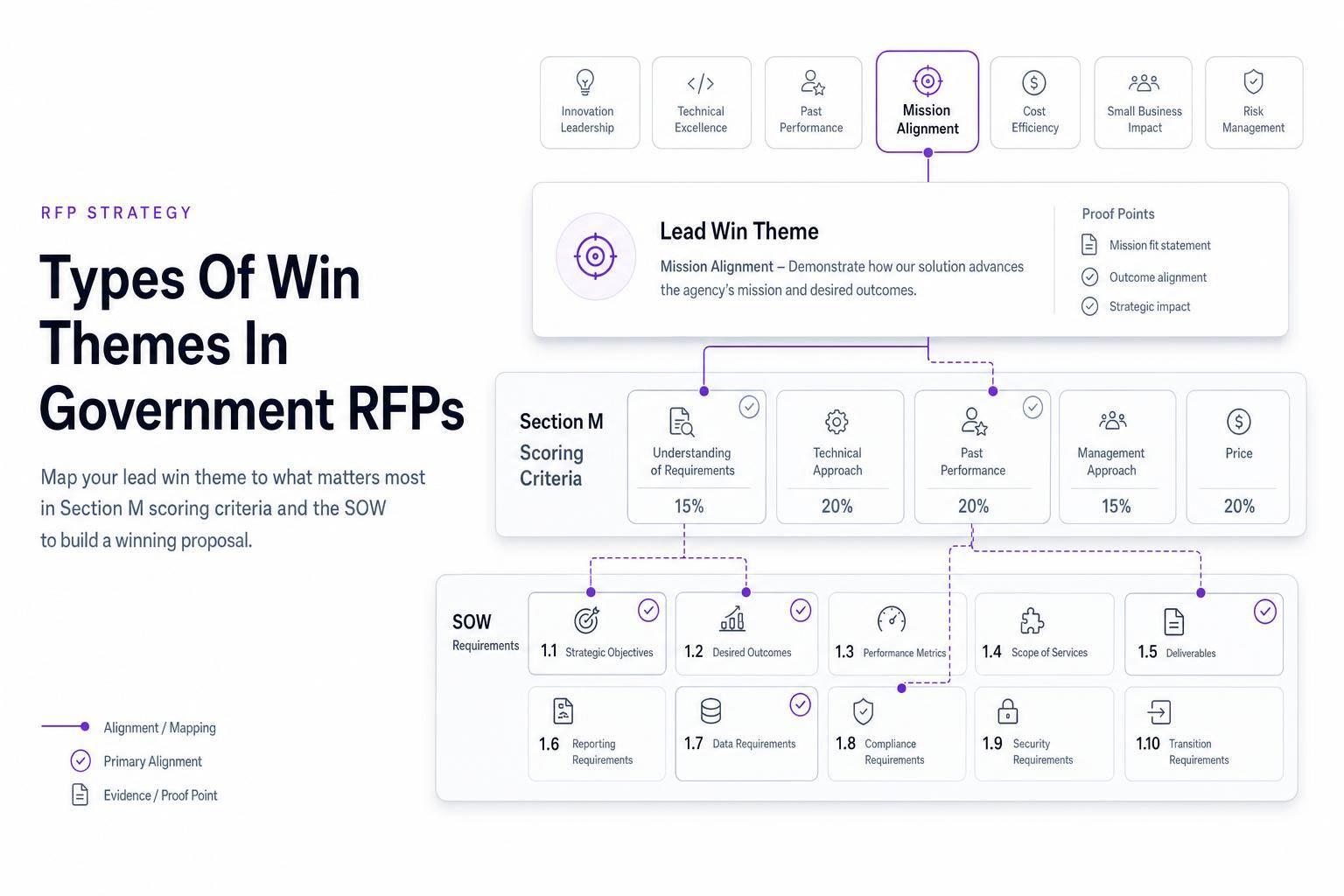
The short answer: the best government proposal win themes usually fall into 7 types, and most strong proposals use 1 lead theme plus 2 to 4 support themes.
If I had to boil the full article down fast, I’d say this:
- A win theme is not a slogan
- It must tie to Section M and the SOW
- It needs proof, like CPARS ratings, staffing data, uptime numbers, or cost results
- The main 7 types are:
- Technical
- Cost
- Past performance
- Management
- Risk reduction
- Innovation
- Compliance and mission alignment
A simple example: saying “we have an experienced team” does little. Saying “our team kept 99.99% uptime and moved transition from 90 days to 30 days on a similar contract” gives evaluators something they can score.
Quick Comparison
| Win theme type | Best when the buyer cares most about | Best proof |
|---|---|---|
| Technical | Performance, security, scale | Test data, uptime, certifications |
| Cost | Budget, price realism, total cost | Cost savings, labor data, accounting support |
| Past performance | Low risk, proven delivery | CPARS, delivery rates, similar references |
| Management | Staffing, transition, control | Retention rates, cleared staff, PM history |
| Risk reduction | Continuity, schedule, failure prevention | Transition metrics, ratings, clearances |
| Innovation | Better methods, modernization | Pilot results, cycle-time cuts, labor-hour cuts |
| Compliance & mission alignment | Rules, audit posture, mission fit | CMMC/NIST status, accounting system, direct mission fit |
Bottom line: I’d pick win themes by starting with the highest-weighted evaluation factor, then I’d repeat those themes across the proposal with facts the evaluator can point to in scoring.
What Win Themes Are and Why They Matter
A win theme is a customer-specific reason your proposal should score higher. It’s not a catchphrase. It’s a clear point that tells the evaluator, here’s why this offer helps this customer. In most cases, three to five win themes is the right range. Add too many, and the message starts to lose force.
How Win Themes Differ from Slogans and Generic Claims
A slogan is broad on purpose. A win theme is specific, provable, and tied to one solicitation.
Here’s the practical difference:
| Element | Slogan / Generic Claim | Genuine Win Theme |
|---|---|---|
| Focus | Company-centric ("We are the best") | Customer-centric ("You get X benefit") |
| Evidence | None or vague ("Years of experience") | Specific and quantified ("94% on-schedule rate") |
| Connection | Broad industry standards | Specific RFP section or evaluation factor |
| Evaluator Impact | Hard to score; ignored by reviewers | Directly maps to scoring factors |
Use this table to pick the kind of theme that lines up with the RFP’s scoring priorities.
"Trusted partner with a proven approach" fits almost any proposal. "Ten years of incumbent performance with zero negative CPARS findings reduces transition risk" works as a win theme because it is specific and verifiable.
Why Evaluators Respond to Clear, Repeated Themes
Evaluators read a lot of proposals, often under tight deadlines. That matters more than many teams think. If a theme shows up in the executive summary, technical volume, management approach, past performance narrative, and price narrative, it becomes easier for reviewers to connect your strengths to the scoring factors.
That repetition isn’t filler. It helps evaluators move fast and still defend their scoring. Put simply, if they can spot the same backed-up point across the proposal, they can more easily explain the selection to supervisors or auditors.
What Makes a Win Theme Credible
A win theme without proof is just a claim. For a theme to hold up, every statement needs evidence that an evaluator can check.
Common proof points include:
- Past performance ratings: CPARS scores of Exceptional or Very Good on similar contracts
- Metrics: Quantified outcomes such as reduced system downtime or better on-schedule completion rates
- Certifications: CMMC posture, ISO standards, or SF 1408 accounting system adequacy
- Key personnel: Direct agency experience or specific clearance levels, such as TS/SCI
- Risk controls: Documented transition management or integration checkpoints
Give evaluators facts they can cite in scoring. Those proof points also help you decide which theme type fits the RFP.
Quick Comparison of the Main Win Theme Types
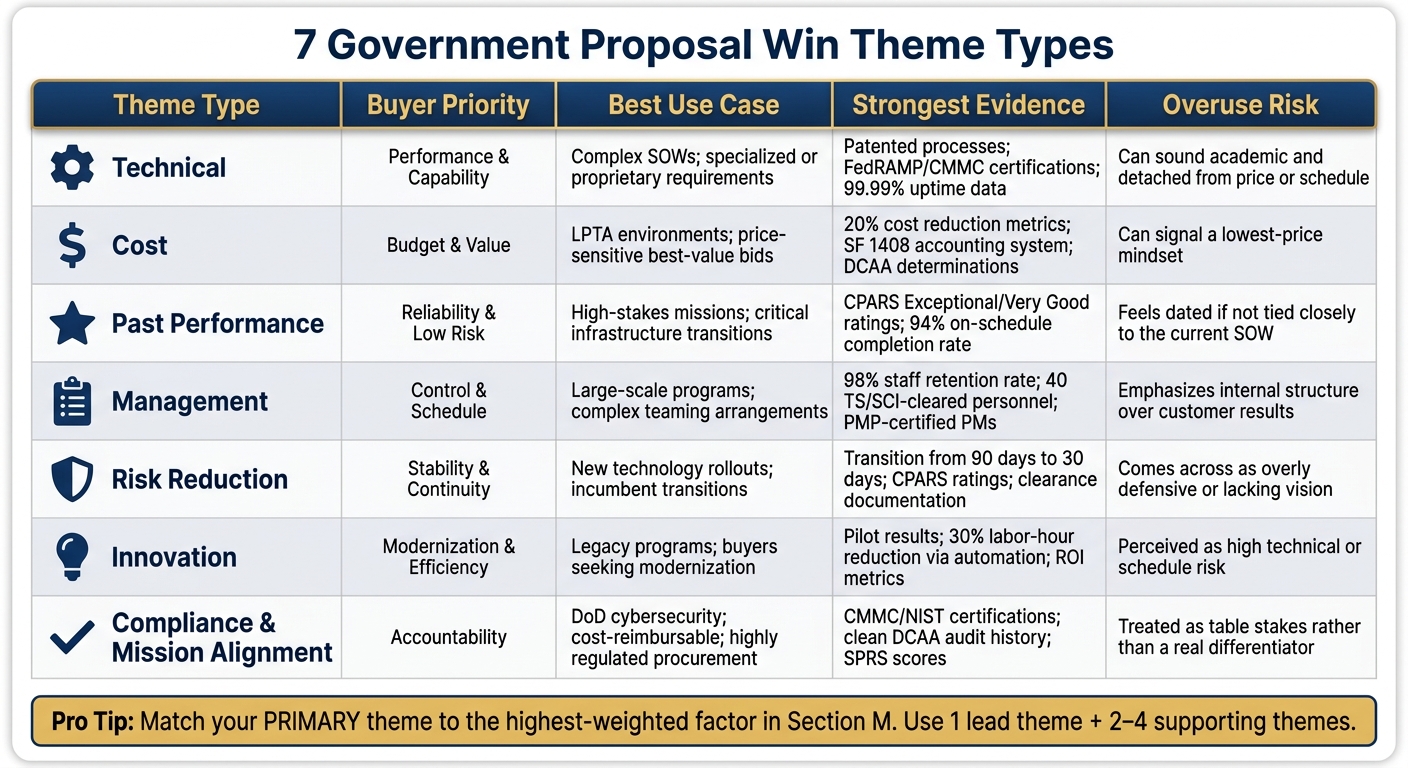
7 Government Proposal Win Theme Types: Quick Reference Guide
The best theme comes down to three things: what the buyer cares about most, how strong your proof is, and how much contract risk is in play. This table helps you narrow the field to the two or three strongest themes before you start drafting.
These seven theme types aren’t just different labels. Each one proves something different. The next sections dig into each type in more detail.
Comparison Table: 7 Win Theme Types at a Glance
| Theme Type | Buyer Priority | Best Use Case | Strongest Evidence | Overuse Risk |
|---|---|---|---|---|
| Technical | Performance & Capability | Complex SOWs; specialized or proprietary requirements | Patented processes; unique methodologies; R&D data | Can sound academic and detached from price or schedule |
| Cost | Budget & Value | LPTA environments; price-sensitive best-value bids | Efficiency metrics; low wrap rates; automated tooling | Can signal a lowest-price mindset |
| Past Performance | Reliability & Low Risk | High-stakes missions; critical infrastructure transitions | CPARS Exceptional/Very Good ratings; case studies with exact metrics | Feels dated if not tied closely to the current SOW |
| Management | Control & Schedule | Large-scale programs; complex teaming arrangements | Org charts; PMP-certified PMs; transition success rates | Emphasizes internal structure over customer results |
| Risk Reduction | Stability & Continuity | New technology rollouts; incumbent transitions | Mitigation plans; ISO/CMMC certifications; safety records | Comes across as overly defensive or lacking vision |
| Innovation | Modernization & Efficiency | Legacy programs; buyers seeking modernization | Pilot results; ROI from prior implementations; AI/automation metrics | Perceived as high technical or schedule risk |
| Compliance & Mission Alignment | Accountability | Highly regulated environments such as defense or healthcare procurement | CMMC/NIST certifications; clean audit history; DCAA determinations | Treated as table stakes rather than a real differentiator |
Use the overuse risk column as a gut check during review. If a theme looks strong on paper but clashes with the buyer’s priorities, this column will often show you where it goes off track.
A smart next step is to match each theme type to the evaluation factors in Section M of the RFP. That makes it easier to see which themes deserve the most space and which ones should stay in the background.
1. Technical Win Themes
Use technical themes when the solicitation puts more weight on performance, security, or scalability than price.
Buyer Priority Addressed
Technical win themes tell the evaluator your solution can meet the requirement, scale when needed, and protect the mission with less performance and transition risk.
A simple way to frame them:
- Outcome first
- Capability second
- Proof third
That order matters. Lead with what the agency gets, then show how you deliver it, then back it up with evidence.
Best Solicitation Conditions
Technical win themes carry more weight in best-value tradeoff procurements. They matter less in pure LPTA buys, where meeting the baseline at the lowest price tends to drive the decision.
Pay close attention to the Statement of Work. Highly prescriptive SOW sections usually point to the agency’s highest-risk requirements. That’s where your technical message needs to do the most work.
Once you understand the buying context, prove your technical edge with measurable evidence.
Strongest Proof Points
Strong technical themes rely on facts, not praise. Good proof points include test results, certifications, and measured performance gains.
For example:
- Measurable test results
- Third-party certifications such as FedRAMP, CMMC Level 2, and FISMA
- Documented performance gains like 99.99% uptime or zero-downtime migration
A proprietary tool only helps your case if it cuts ramp-up time or improves performance in a measurable way. If you can’t show the effect in numbers, it won’t carry much weight.
Common Overuse Risk
The biggest trap is unsupported adjectives. Words that sound strong on their own don’t help much in a proposal.
Once you are compliant, swap every vague claim for a specific number, certification, or verified outcome before the proposal goes out the door.
2. Cost Win Themes
Cost win themes work when you need to show the agency that your price reflects real value, not just the lowest number on the page.
Buyer Priority Addressed
Cost themes matter when the buyer is weighing value, sustainment, and price realism. Evaluators want to see realistic pricing, stable rates, and no cost overruns during performance. That means your message should tie cost to TCO, price realism, and the savings mechanism.
Put simply: don’t just show a lower price. Show why the price is lower and how that lower cost holds up during contract performance.
Once the solicitation puts weight on price, the theme needs to fit the pricing method.
Best Solicitation Conditions
Cost themes carry the most weight in LPTA procurements, where award goes to the lowest price that meets minimum technical requirements. They also matter in fixed-price work and budget-constrained recompetes.
In DoD IT, cybersecurity, and knowledge-based buys, LPTA has limits. So in those cases, cost themes should focus less on being the cheapest and more on showing value per dollar.
Then you need to back that up with measurable savings, stable rates, and accounting support that evaluators can trust.
Strongest Proof Points
The proof that tends to move evaluators is concrete and easy to trace back to past performance. That can include:
- Specific metrics from prior contracts, such as a 20% reduction in operational costs
- Documentation of an adequate accounting system under SF 1408 criteria
- Realistic indirect and wrap rates that line up with your actual cost structure
For cost-reimbursable work, a recent DCAA or third-party determination helps. It supports price realism and shows you can perform at the proposed rate without running into trouble later.
If you use automation or proprietary tooling to cut labor hours, quantify it. “Our automated migration tool reduces manual labor hours by 30%” is a strong cost theme. It tells the agency the pricing is predictable and the value is defensible.
Common Overuse Risk
Cost themes can fall apart fast when the technical and price volumes tell two different stories. If the cost volume talks about efficiency, but the technical volume leans on expensive innovation, evaluators will spot the mismatch. Every cost claim needs to show up across the technical, management, and price volumes. It can’t sit by itself in one section.
The second risk is a price realism failure. Under FAR 15.404-1(d), evaluators can disqualify offerors whose labor rates appear too low to be believable. Rates that look unrealistically low can trigger price realism concerns and increase award challenge risk.
3. Past Performance Win Themes
Past performance themes answer a simple question: can this contractor deliver? That question carries extra weight when Section M gives past performance a strong role. Under FAR 15.305(a), evaluators look at both relevance and quality, so your proof needs to line up with the work in the requirement. A strong theme gives evaluators a clear, evidence-based reason to score your proposal higher.
Buyer Priority Addressed
Evaluators score past performance on two things: relevance and quality. The best themes connect a past success to a specific requirement in the Statement of Work. If the solicitation points to a problem, your theme should show that you solved that same kind of problem before.
Best Solicitation Conditions
This theme works best when the buyer is choosing among qualified offers and needs a reason to trust one team over another. It matters most in best-value tradeoff evaluations, where evaluators need strengths and major points of separation to support picking a higher-priced offeror. When Section M gives past performance heavy weight, the buyer is saying reliability matters a lot.
Past performance themes also work well in follow-on contracts and recompetes. In those cases, you can fairly stress institutional knowledge and minimal ramp-up time. A new entrant usually can’t match that easily. And if the program has a history of schedule slippage or integration failures, a theme built around recovering similar delayed programs can hit home.
Strongest Proof Points
Generic lines like "experienced team" or "proven approach" don’t help much. Every qualified offeror says that. What does work is proof that is specific, verifiable, and tied to the RFP.
Strong proof points include:
- "Exceptional" or "Very Good" CPARS ratings
- Zero negative findings over a sustained period
- Measurable outcomes, such as a 94% on-schedule completion rate
- Reduced ramp-up time
A clean performance record now stands out more than vague claims. Pick references that prove the theme, not just the biggest contracts on your list. If a contract doesn’t map to the claim, it won’t do much for you.
Common Overuse Risk
The biggest trap is thematic dilution. That happens when you mention a strong past performance point once in the past performance volume, then never support it again in the technical or management sections. Evaluators read across volumes. They need to see the same theme repeated, backed up, and connected to the requirement each time.
Pick references that prove the theme, not the biggest contracts. Every reference should map straight to an RFP requirement.
When past performance proves reliability, management themes show how you will execute the work.
4. Management Win Themes
Past performance shows that you’ve done the work before. Management shows that you can run this contract without things going sideways.
That’s the key difference. Management win themes answer a separate question: how you will execute the work day to day. They deal with staffing stability, transition risk, communication gaps, and on-time delivery. If the PWS spends extra space on transition, key personnel, or escalation paths, that usually means the agency sees execution risk and wants proof that you can handle it.
Buyer Priority Addressed
Management themes speak to buyer concerns around execution. When Section M puts weight on transition planning, staffing continuity, or team coordination, the message is pretty clear: those items matter.
Best Solicitation Conditions
Use management themes when the RFP leans hard on transition, staffing continuity, or team coordination across a complex effort. A theme built around being ready on day one can work well, but it needs proof behind it, like a documented transition plan and a ramp-up timeline.
For large contracts that call for many capabilities, teaming-based themes can also be a good fit. That’s especially true when a partner brings an exclusive certification or a facility that one company can’t offer on its own.
Strongest Proof Points
A simple way to shape these themes is the Feature-Benefit-Proof format: state the management strength, explain the agency benefit, then back it up with proof.
Good proof points include:
- A PM with documented experience in the buyer’s IDIQ environment
- A 98% staff retention rate over five years
- 40 personnel who already hold TS/SCI clearances
- Documented transition milestones from prior programs
For cost-reimbursable contracts, proof of an approved SF 1408 accounting system also helps your case.
Common Overuse Risk
The common mistake is talking about your org chart instead of the buyer’s result. Phrases like "our robust governance structure" or "commitment to mission success" focus on your internal process, not what the customer gets from it.
Each management claim should tie back to Section M. If it doesn’t, it’s probably filler.
If management explains how you will execute, risk reduction explains how you will prevent failure.
sbb-itb-bb3960c
5. Risk Reduction Win Themes
Unlike management themes, which show how you’ll get the work done, risk reduction themes show how you’ll keep things from going off the rails. They give evaluators proof that your solution can handle pressure and still perform.
Buyer Priority Addressed
Evaluators are usually trying to protect three things: schedule, cost, and technical feasibility. When past performance carries a lot of weight, that’s a clear sign the buyer cares more about reliability than novelty.
Best Solicitation Conditions
One of the clearest signs that risk reduction themes belong in your proposal is a detailed SOW section. If an agency spends four pages on transition planning and only one paragraph on reporting, that’s not subtle. It usually means transition risk is a major concern.
These themes work especially well when the RFP stresses transition planning, Day 1 readiness, or mission continuity. They matter most in best-value and non-LPTA buys, especially for IT, cybersecurity, and knowledge-based services. In those cases, measurable proof isn’t optional.
Strongest Proof Points
Generic claims won’t score. You need to show mission readiness that beats what the buyer expects.
Strong proof points include:
- "Exceptional" or "Very Good" CPARS ratings on similar contracts, reducing schedule and performance risk
- Personnel who already hold the required clearances, avoiding longer clearance lead times that delay mission readiness
- Quantified delivery metrics, such as a 94% on-schedule completion rate, tied directly to cost and schedule stability
Each proof point should connect to a specific failure the agency wants to avoid. That’s the whole point: don’t just say you lower risk. Show which risk you reduce, and with what evidence.
Common Overuse Risk
If you can’t tie a claim to a metric, rating, case study, or certification, cut it.
6. Innovation Win Themes
If risk reduction shows how you avoid failure, innovation shows how you get a better result with a tested new method.
In best-value procurements, innovation win themes answer one clear evaluator question: "Why should we pick you over other qualified offerors?" The point isn’t to sound new for the sake of it. It’s to show a better way to solve a known problem.
Buyer Priority Addressed
These themes speak right to an agency’s need for measurable mission improvement. That matters most when the current approach is slow, expensive, or tough to maintain over time.
When budgets are tight and the agency has to do more with less, a well-framed innovation theme can tip the decision.
Best Solicitation Conditions
Innovation themes fit best-value tradeoff procurements, where evaluators are looking for strengths that can justify paying more.
Use them when the RFP invites alternate methods or points to a problem your approach solves in a different way. But here’s the catch: the theme only works if the new method is backed by evidence. No proof, no edge.
Strongest Proof Points
The real test is proof, not novelty.
The gap between a solid innovation theme and an empty claim comes down to evidence. Pilot results, process changes, and measurable performance gains are what turn a statement into a differentiator.
A simple formula works well:
- what makes your approach different
- specific customer benefit
- concrete proof point
For example, show how a pilot cut cycle time, reduced manual effort, or lowered rework on a similar effort.
Common Overuse Risk
That proof needs to be specific and measurable.
The biggest trap is unsupported adjectives. Phrases like "cutting-edge", "world-class", or "industry-leading" may sound good, but without evidence, they don’t help. They add noise, not proof.
If you can’t tie the feature to a specific, measurable benefit, cut it.
7. Compliance and Mission Alignment Win Themes
If innovation themes answer, "why pick you over others", compliance and mission alignment themes answer the deeper question: "Can we trust you to do this without creating problems for us?"
When the buyer works in a heavily regulated setting or follows a tight set of instructions, the edge often shifts away from novelty and toward clean, provable fit.
These two themes work best together. Compliance means meeting every stated requirement in the RFP, including certifications, page limits, mandatory submittals, and formatting rules. Mission alignment shows why those requirements matter to the agency and how your work ties back to its actual goals.
Buyer Priority Addressed
Evaluators need claims they can score, defend, and connect straight to the RFP. Mission alignment themes make that job easier. When your proposal mirrors the language and priorities in Section M and the Statement of Work, the evaluator doesn’t have to translate your strengths into their scoring system.
That shifts the focus away from promotion and toward proof selection. You’re not just saying you can do the work. You’re giving evaluators material they can use.
Best Solicitation Conditions
These themes hit hardest in heavily regulated work such as DoD cybersecurity contracts, cost-reimbursable programs, and any solicitation where the Performance Work Statement is unusually detailed or prescriptive. That kind of detail usually means high scrutiny and little room for missed requirements.
For DoD work, CMMC self-assessment scores in the Supplier Performance Risk System (SPRS) and a believable path to Level 2 certification are now baseline evaluation inputs. If you have them, lead with them.
Strongest Proof Points
Use proof that shows your offer fits both the rule set and the mission.
An approved accounting system under SF 1408 criteria is a strong compliance point on cost-reimbursable work. Current CPARS helps most when it shows direct fit to the exact requirement, not just general quality. Institutional knowledge matters too. If team members helped build or maintain the current system architecture, that can show mission continuity and lower transition risk.
"A benefit without proof is a claim; proof without benefit is noise."
Common Overuse Risk
Status alone does not set you apart. A specific, measurable benefit does.
Vague alignment language falls flat because it proves nothing. Each compliance or alignment claim should connect to a clear benefit, such as:
- cutting ramp-up time
- maintaining uptime
- reducing transition risk
Then back that up with a number or a documented outcome.
How to Apply Each Win Theme Effectively
Knowing the seven win theme types is only half the job. The other half is putting them on the page in a way evaluators can score.
A simple way to do that is the feature-benefit-proof chain. Start with what you offer, show why it matters, then back it up with proof. Use the comparison table above to choose the strongest theme, then turn that theme into proposal language that ties straight to scoring.
Match the Theme to Evaluation Criteria and Scope
Start with Section M and the Statement of Work. Those two sections tell you what the agency cares about most.
If Past Performance is worth 40% of the score, your main theme should lean into reliability and a proven track record. When a section has the most detail or the most prescriptive language, that usually points to the agency’s top risks or priorities.
Build an RFP mapping matrix as soon as the RFP is released. That way, every theme ties to a scored factor and speaks to what the agency is worried about most. A win theme should map to a scored factor, not sit there as a broad promise.
Support Every Claim with Specific Proof
Vague wording loses points. Specific proof gives evaluators something they can score.
Each proof point should back up one of the seven theme types:
- Cost: A 15% reduction in operating costs on a similar contract, backed by standard U.S. currency formatting like $250,000, gives evaluators a figure they can measure.
- Past Performance: "Exceptional" or "Very Good" CPARS ratings tied to similar scope, not just a list of contract names.
- Risk Reduction: A transition plan with a clear timeline, such as cutting ramp-up from 90 days to 30.
- Management: Resumes that show direct agency experience, not broad credentials.
Repeat Themes Consistently Across Sections
Once a theme is tied to the RFP, keep it visible across every volume. If it shows up once in the executive summary and then disappears, it’s easy to miss.
Each section should reinforce the same point with its own proof. If your main theme is low transition risk, the technical section can show your method, the management section can show your staffing plan, and the past performance section can show a similar result.
That repetition matters. Not because evaluators need filler, but because they need to see the same argument supported from more than one angle.
Avoid Unsupported or Exaggerated Claims
Generic lines like "proven approach" are easy for evaluators to skim past. Strong win themes act as discriminators. They point to something another offeror can’t credibly claim.
Here’s a good gut check: apply the "So What?" test to every claim before it goes into the proposal. If the answer doesn’t tie straight to lower risk, lower cost, or faster delivery, the claim isn’t ready yet.
Swap broad adjectives like "world-class" or "best-in-class" for numbers, dates, and documented outcomes. That’s what separates a nice-sounding sentence from a theme that can affect scoring.
Choosing the Right Mix for Your Proposal
Once you’ve reviewed the seven win theme types, the next step is simple: decide which theme leads and which ones back it up.
The strongest proposals don’t try to push every message at once. They usually rely on one primary theme and a few supporting themes that strengthen the case from different angles. Think of the seven theme types as building blocks. You use all the right pieces, but one of them carries the main message.
Start with the Highest-Weighted Evaluation Factors
Use Section M to choose the primary theme.
Then use the SOW to pick supporting themes that reinforce that lead message. This keeps your proposal tied to how the buyer will score it, not just how you want to position yourself.
Adjust for Buyer Risk, Budget, and Incumbent Position
Budget pressure usually shifts supporting themes toward cost efficiency and process optimization.
If you’re the incumbent, lean into continuity and low transition risk. You already know the work, the environment, and the handoffs. That matters.
If you’re not the incumbent, lean into differentiation. Show why your approach stands apart and why a change would be worth it.
Decision Table: Matching RFP Conditions to Theme Mix
Use these signals to turn RFP requirements into a clear theme hierarchy.
| RFP Condition | Primary Theme | Supporting Themes |
|---|---|---|
| High technical weight | Innovation / Unique Capability | Risk Reduction, Past Performance |
| LPTA / Budget pressure | Cost Efficiency / Low TCO | Efficiency Gains, Compliance |
| Strong incumbent already in place | Innovation / Improved Efficiency | Differentiation from the incumbent, Transition Speed |
| Incumbent recompete | Continuity / Low Transition Risk | Institutional Knowledge, Proven Metrics |
| High risk / complex SOW | Risk Reduction / Reliability | Management Oversight, Specialized Expertise |
| Mission-critical / time-sensitive | Past Performance / Speed | Transition Readiness, Staffing Reach |
Use the table to sort out tension between weight, risk, and buyer context.
Most solicitations mix several conditions at the same time. When they pull in different directions, let the highest-weighted factor decide the primary theme.
Conclusion
Seven win theme types, one goal: give the evaluator a clear, evidence-backed reason to choose you.
The strongest proposals usually lean on one primary theme and back it up with two to four secondary themes. That balance matters. A differentiator on its own isn’t enough. It has to lead to a customer benefit. And that customer benefit has to be backed by proof.
Start with the evaluation criteria in Section M. That’s where the buyer lays out the scoring criteria. Build your main theme around the factor with the most weight, then support it with other themes that use different proof points, like a CPARS rating, a contract number, or a completion rate.
Read Section M first, pick the theme mix you can defend best, and prove every claim.
FAQs
How do I choose a lead win theme?
Choose a lead win theme where your strongest proof points line up with the client’s top needs.
Start with the RFP. Look for the client’s main pain points, top risks, and evaluation criteria. Then compare that with what you do measurably better than others – and what you can back up with evidence.
Pick one primary theme to serve as your main message. Support it with two to four secondary themes.
Your lead theme should do two things:
- Speak directly to the evaluator’s goals
- Give a clear, defensible reason to pick you
If it doesn’t do both, it’s probably too vague or too broad.
Can one proof point support multiple themes?
Yes. One proof point can support more than one win theme if it clearly backs each one.
For example, the same contract reference might show fast delivery and cost savings at the same time. That means you can use it to support both a technical theme and a cost theme.
The key is how you present it. Shape the proof point to fit the section you’re writing so it strengthens that part of the story, instead of repeating the exact same language each time.
What should I do if I lack strong past performance?
Focus on the things that speak to the agency’s pain points: specialized expertise, your way of doing the work, the background of key team members, or tools only your team can offer.
If you have gaps, teaming agreements can help. Partner with firms that bring the past work or skills you don’t yet have on your own. Then make sure your proposal connects those strengths directly to the agency’s mission needs.
Narwin.ai can help with competitive intelligence and risk analysis.