
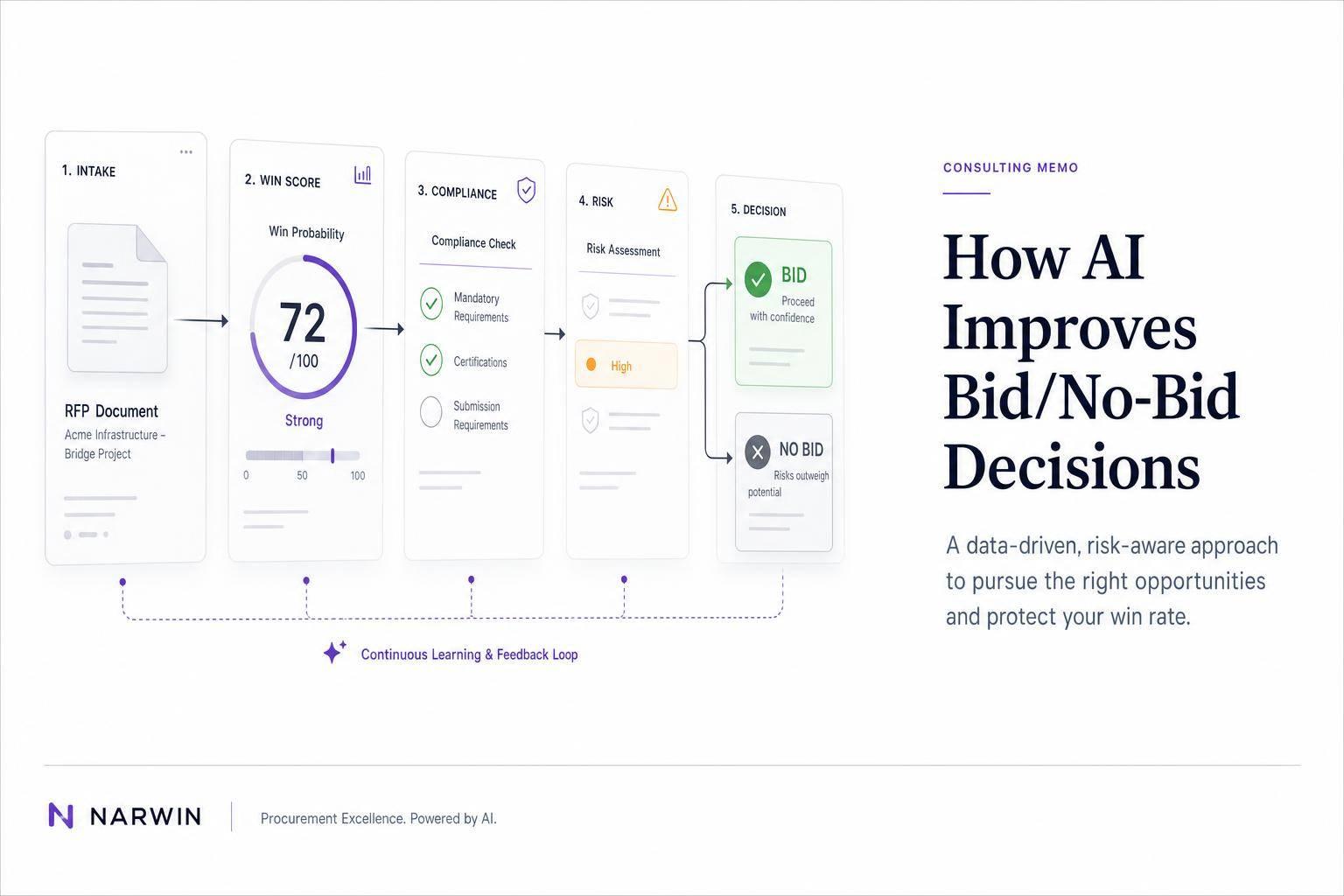
Bad bid choices waste time and money fast. If one federal proposal can cost $87,000 and low-score bids win as little as 0.8% to 4% of the time, I don’t want my team guessing.
Here’s the simple point: I can use AI to score an RFP early, filter out deals that fail hard requirements, check compliance and workload risk, and then make a clearer bid/no-bid call with a human owner still making the final decision.
What this means for me:
- I score opportunities before proposal work starts
- I filter out bids that miss hard gates like CMMC, clearances, or contract vehicle access
- I use score bands to sort Go, Conditional Go, No-Go, and Hard No
- I log overrides so the team can learn from win/loss results
- I spend more time on bids with a better shot and less time on weak-fit work
A simple AI-led process doesn’t make the decision for me. It gives me a repeatable way to make the call with more facts, less guesswork, and less wasted effort.
How AI Win Scores Help Teams Decide Whether to Bid
When gut feel starts to wobble, win scores give teams a repeatable way to rank opportunities.
A win score estimates your odds of winning a contract if you bid[1]. It’s a signal, not a promise. Teams use it to decide whether an opportunity is worth chasing before proposal work begins. The point isn’t to hand the whole call over to software. It’s to make the process more consistent.
At its core, a win score is a weighted check of fit based on data, not instinct.
What Data AI Uses to Estimate Win Probability
AI win scores pull from several inputs.
On the opportunity side, the AI reads the RFP itself: scope of work, evaluation criteria, compliance requirements, and deadlines. On the company side, it checks your profile against that RFP, including past performance, certifications, regional presence, and safety records.
Buyer history matters too. That includes past awards, buyer priorities, and incumbent bias. Customer relationships and incumbency status are 2.3x more predictive of a win than past-performance relevance alone[2].
How AI Turns RFP Inputs Into a Go/No-Go Signal
Those inputs are turned into a score and mapped to decision bands:
| Score Band | Classification | Win Rate | Recommended Action |
|---|---|---|---|
| 70–100 | Go | 38% | Full proposal investment; assign A-team |
| 55–69 | Conditional Go | 17% | Improve 2–3 factors before the kill date |
| 40–54 | No-Go | 4% | Do not bid unless a strategic override is approved |
| Below 40 | Hard No | 0.8% | No bid unless leadership approves an exception |
A "Conditional Go" means the pursuit only makes sense if certain gaps are closed before a set kill date. Maybe you’re missing a proof point. Maybe buyer engagement is weak. Maybe there’s a compliance gap. Any of those can drag a score into this band.
If those conditions aren’t met in time, the bid gets dropped. That keeps teams from drifting into wishful thinking.
The score supports human judgment. It does not replace it.
From there, the score becomes the starting point for day-to-day qualification.
Why Broader Data Coverage Leads to Better Scores
Narwin.ai monitors major public sources across the U.S. and Canada, including SAM.gov, CanadaBuys, BCBid, and city portals[3].
More coverage helps score quality because procurement patterns change by region and by agency.
sbb-itb-bb3960c
How AI Changes the Bid/No-Bid Workflow Day to Day
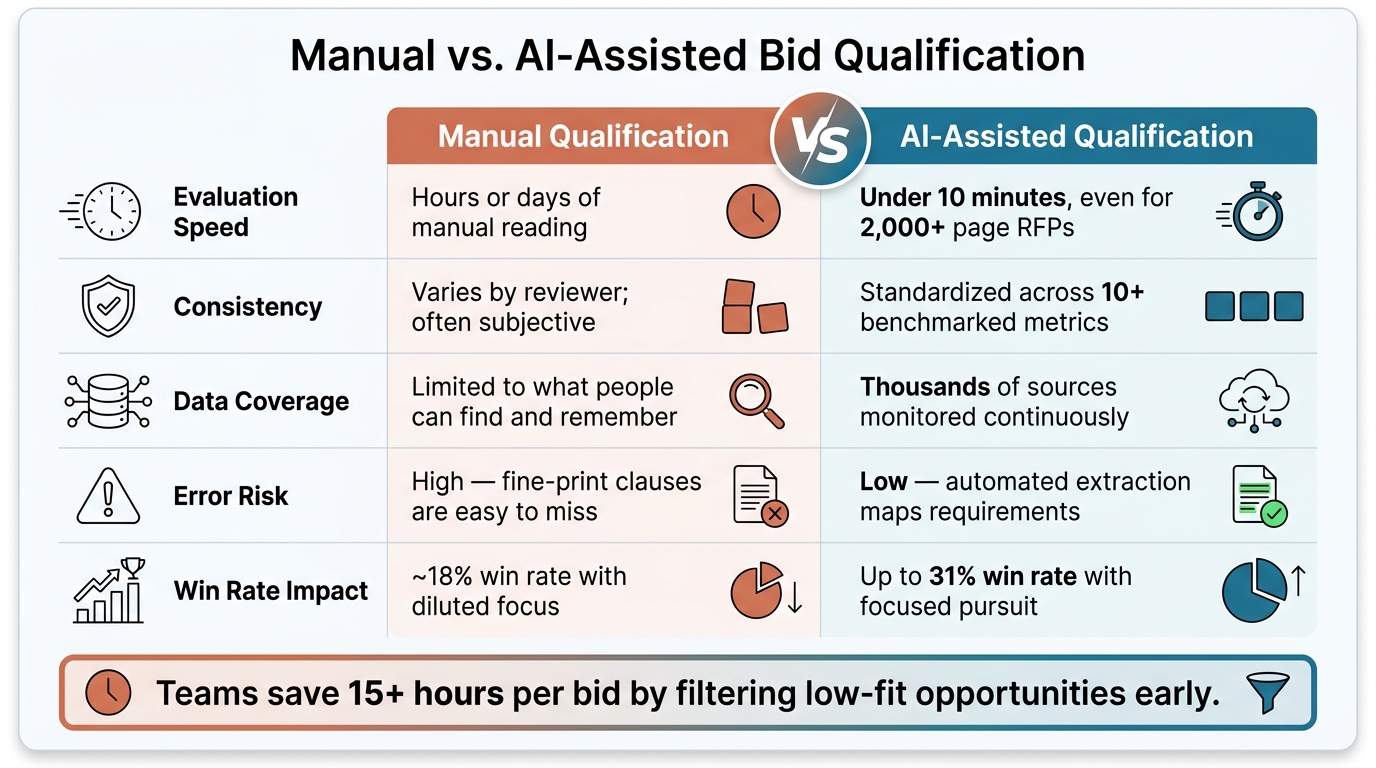
Manual vs. AI-Assisted Bid Qualification: Key Metrics Compared
A win score matters only when it changes what your team does each day. Once the score is in place, the job is no longer just ranking opportunities. It becomes deciding which ones are worth chasing.
From Long Opportunity Lists to a Focused Shortlist
AI checks each opportunity against your Company Profile before anyone has to dig through the full RFP. That profile can include certifications, safety records, past projects, and core capabilities.
Each bid gets a Preliminary Match Score with a percentage and a short explanation. That gives the team a fast read on fit. If an opportunity misses hard gates like CMMC, security clearance, or contract vehicle access, it gets filtered out before manual review starts.
That one shift can save a lot of wasted effort. Teams using this setup have reported saving more than 15 hours per bid by skipping pursuits where they had little realistic shot at winning.
Running Compliance and Risk Checks Before You Commit
Once the shortlist is ready, the next step is simple: figure out whether the bid is even workable.
Manual RFP review takes time, and it’s easy to make common mistakes in proposal writing by missing something buried deep in the document. AI is transforming the RFP process by pulling out mandatory requirements, compliance clauses, deliverables, certifications, and deadlines in minutes – even from 2,000+ page RFPs.
It also points out risk signals early, including:
- Compressed timelines
- Missing credentials
- Incumbent-biased language
- Proprietary technical requirements that could put the pursuit at a disadvantage
Narwin.ai benchmarks 10+ metrics, which helps qualification gaps show up sooner instead of later.
Manual vs. AI-Assisted Qualification: A Side-by-Side Look
The gap is easiest to see in speed, consistency, and mistakes.
| Factor | Manual | AI-Assisted |
|---|---|---|
| Evaluation Speed | Hours or days of manual reading | Under 10 minutes, even for 2,000+ page RFPs |
| Consistency | Varies by reviewer; often subjective | Standardized across 10+ benchmarked metrics |
| Data Coverage | Limited to what people can find and remember | Thousands of sources monitored continuously |
| Error Risk | High – fine-print clauses are easy to miss | Low – automated extraction maps requirements |
| Win Rate Impact | Diluted focus typically yields about 18% win rate | Focused pursuit can reach 31% win rate |
A data-driven go/no-go process can lift win rate and cut wasted bid volume.
What a Reliable AI Bid/No-Bid Framework Looks Like
A score matters only if it leads to the same decision rule every time. If one team treats a win score as a green light and another treats it as a suggestion, the score loses its point fast.
Set Clear Decision Criteria and Score Thresholds
A solid framework looks at each opportunity through a small set of core factors: strategic fit, capability match, buyer familiarity, pricing feasibility, compliance readiness, and delivery risk. These are the same questions capture managers already ask. The difference is that the answers come from data, not gut feel.
The score should then map to clear action bands:
| Score Range | Classification | Required Action |
|---|---|---|
| 70–100 | Go | Commit resources and begin capture planning |
| 55–69 | Conditional Go | Pursue only if specific gaps are closed by a defined kill date before the proposal due date |
| 40–54 | No-Go | Do not pursue; redirect capacity to stronger opportunities |
| Below 40 | Hard No | Immediate exit; no further review required |
There’s one rule that comes first: disqualifying requirements should be checked before scoring starts. If a bid needs CMMC certification, security clearances, or access to a specific contract vehicle, and your team doesn’t have it, that opportunity should be ruled out at once.
That early filter saves time and avoids false hope. Sub-55 pursuits win less than 4% of the time, and leadership overrides rarely change that result.
Once the thresholds are in place, assign one person to make the final call and document every override.
Keep Humans in the Loop and Record Every Override
AI scores should guide decisions, not make them. Capture managers, proposal leaders, and executives still own the final call. What changes is the quality of the information in front of them – and the paper trail behind each choice.
Every bid decision needs a named owner and a written reason, most of all when a team decides to chase an opportunity the AI marked as a no-go. That override record isn’t busywork. It’s what makes the process auditable and easier to improve.
Over time, those override patterns tell a clear story. Maybe the model needs recalibration. Maybe certain exceptions keep paying off. Either way, you learn something you can act on.
Narwin.ai supports this kind of structured workflow by connecting with Slack, Google Drive, and major CRMs. That keeps decision logs and score reports tied to the tools teams already use.
That split in responsibility is what separates a structured qualification process from an ad hoc review.
AI-Based vs. Human-Only Go/No-Go: Strengths and Limits
Neither side gets it all right on its own. AI brings speed, consistency, and auditability. Humans bring nuance, relationships, and room for strategic exceptions.
AI handles speed, consistency, and auditability; humans handle nuance, relationships, and strategic exceptions.
The strongest setup combines both: AI scoring, human sign-off, and documented overrides. That gives teams a steady process without boxing them into rigid choices.
Conclusion: Getting Started with AI for Bid/No-Bid Decisions
Poor qualification burns hours and pulls SMEs into deals that were never a fit. That’s why bid/no-bid decisions need data, not gut feel. More teams are shifting from instinct to data, and AI win scores give proposal and capture teams a steady baseline for those calls.
After you set thresholds, the next move is simple: qualify faster. AI win scores let teams measure opportunities against a clear cutoff and make decisions with less back-and-forth.
From there, the workflow should stay straightforward. Pair AI scoring with human review, documented overrides, and a feedback loop that recalibrates thresholds based on actual win/loss results.
For teams using Narwin.ai, that workflow includes scanning major U.S. and Canadian bid sources, scoring opportunities, flagging risk, and sending reports into Slack, Google Drive, and major CRMs.
Key Takeaways for Proposal and Capture Teams
Start with three basics:
- Score opportunities early
- Set hard gates for non-negotiables
- Review overrides on a regular basis
Then track actual win/loss data and update thresholds based on real outcomes.
FAQs
How accurate are AI win scores?
AI win scores, or probability of win (pWin) percentages, are only as good as the data behind them. If the input is thin or messy, the score will be too.
When models use both structured and unstructured data, they can predict bid outcomes with 85% accuracy and an average AUC of 0.94. That’s a strong signal that the model isn’t just guessing. It’s picking up patterns from both clean fields and messier source material like notes, documents, and deal context.
Narwin.ai improves accuracy by benchmarking more than 10 metrics tied to buyer alignment, risk, and profitability. And it gets better over time. As the system is calibrated against historical win/loss data, the scoring becomes more precise.
What should count as a hard no-bid gate?
A hard no-bid gate should kick in when there are major gaps you can’t fix before the submission deadline.
Common warning signs include:
- Failing mandatory eligibility requirements
- Missing required certifications
- Lacking past performance references the buyer asks for
Other clear deal-breakers include unresolved organizational conflicts of interest, deadlines that just don’t give you enough time, or being unable to meet core requirements without creating new content that hasn’t been approved.
How often should win score thresholds be updated?
Update win score thresholds from time to time by refreshing your company data in the platform. This matters most after you win new bids, earn new certifications, or make changes to your team’s capabilities.
As your business profile changes, re-upload your files so the system can version them and retrain on the latest details. That helps keep win probability predictions and score thresholds in line with your current situation.