
Federal proposal compliance is all about meeting strict guidelines set by agencies like the NSF and DoD. These rules ensure your bid aligns with the Federal Acquisition Regulation (FAR), agency-specific supplements (e.g., DFARS), and the RFP’s instructions. Missing even small details – like a signature or page limit – can lead to automatic disqualification. Here’s what you need to know:
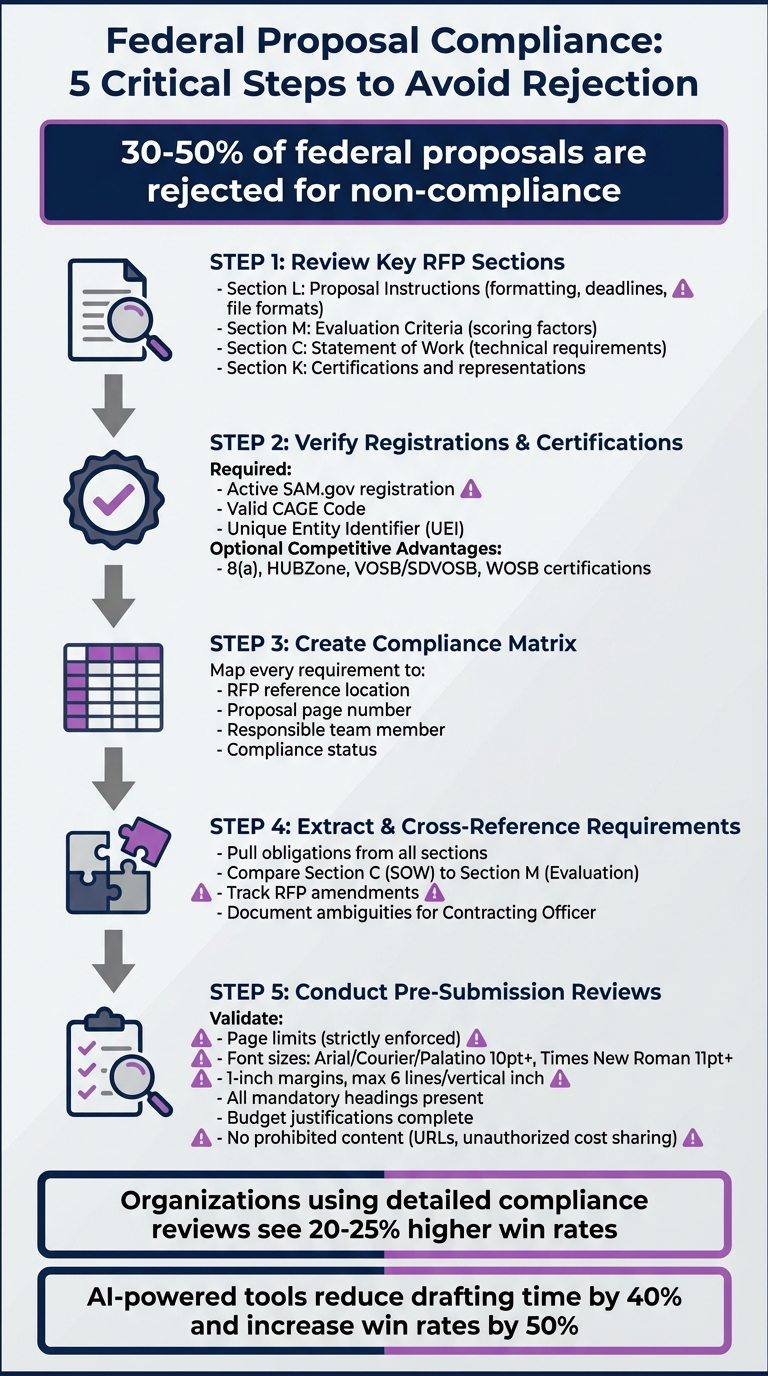
- Key Sections to Review: Focus on Section L (Proposal Instructions), Section M (Evaluation Criteria), and Section C (Statement of Work).
- Formatting Rules: Follow specific requirements for page limits, font sizes, margins, and file formats.
- Compliance Tools: Use checklists like FAR Table 15-2 or DFARS 252.215-7009 to ensure all elements are addressed.
- Registrations: Verify your SAM.gov registration, CAGE Code, and Unique Entity Identifier (UEI) are active and accurate.
- Pre-Submission Reviews: Conduct detailed compliance checks (Pink, Red, Gold reviews) to catch errors before submission.
Automated tools like Narwin.ai and AutogenAI can simplify requirement extraction and compliance tracking, saving time and reducing errors. With 30%-50% of proposals rejected for non-compliance, following a detailed checklist is critical to improving your chances of success.
Federal Proposal Compliance Checklist: 5-Step Process to Avoid Rejection
Federal Proposal Requirements Explained
Federal RFPs (Requests for Proposals) are structured documents that outline how bidders should submit their proposals and how these submissions will be evaluated. Two key sections to focus on are Section L (Proposal Instructions) and Section M (Evaluation Criteria). Section L explains the rules for formatting and submitting your proposal, while Section M details how the government will assess your response. Missing any requirement from these sections can lead to automatic disqualification. Together, these sections provide a roadmap for navigating the submission process and meeting evaluation standards.
Section L covers essential logistics, such as deadlines, submission methods, and file formats. It also includes specific formatting requirements, like page limits, font sizes (usually 12pt), margins (typically 1 inch), and file naming conventions. For cost proposals, you’ll need to include a DFARS 252.215-7009-compliant Proposal Adequacy Checklist, which breaks down costs, labor, and indirect rates.
Section M focuses on mandatory criteria that evaluators use to assess proposals. It outlines the specific elements your response must address to be considered compliant.
“Evaluators might reject an otherwise strong proposal simply because it misses a signature, exceeds a page limit, or overlooks a mandatory question.” – Dean Murphy, VisibleThread
To avoid such pitfalls, use a compliance matrix. This tool helps you map each evaluation criterion to a specific section or page in your proposal, ensuring nothing is missed.
In addition to Sections L and M, review Section C (Statement of Work) for technical requirements and submission essentials. Federal proposals also often require administrative documentation, such as disclosures for government-furnished equipment, notifications of Cost Accounting Standards (CAS) noncompliance, and specific certifications. If subcontractors handle more than 70% of the total cost, you must outline their indirect costs, profits, and the “added value” you bring as the prime contractor.
How to Review RFP Instructions and Documents
Given the complexity of RFPs, a thorough review process is non-negotiable. Go through the RFP line-by-line to ensure every requirement in Sections C, L, and M is accounted for. Appoint a compliance lead to oversee the process, starting with the creation of a compliance matrix. This document will guide your response strategy from the moment the RFP is released.
Pay close attention to critical submission details, such as deadlines, the correct submission portal or email address, and file format requirements. Confirm formatting specifics like font size, page limits, and margin settings. Identify all required documents, including cost breakdowns, subcontractor details, and regulatory forms. Incomplete or non-compliant proposals cost businesses an average of $725,000 in lost annual revenue, so investing time in this review process is essential.
Before submitting, schedule compliance review meetings to go over the checklist in detail. Use these reviews – typically referred to as Pink, Red, and Gold team reviews – to ensure every requirement is met. If you can’t provide a specific item, include a written explanation. Federal adequacy checklists require this documentation rather than leaving any section blank.
Required Registrations and Certifications
Before tailoring your proposal to meet RFP requirements, confirm that your business is eligible to bid. Start by verifying your registrations and certifications.
An active SAM.gov registration (System for Award Management) is mandatory for all federal contractors. This registration allows the government to validate your business information. Make sure your SAM profile is up-to-date, as it will be checked during the evaluation process.
You’ll also need a CAGE Code (Commercial and Government Entity Code), which is a unique five-character identifier linked to your business location. This code is tied to your DUNS number (Data Universal Numbering System), though the federal government is transitioning to the Unique Entity ID (UEI) system. These identifiers must be included in your proposal and other federal contract documents.
Depending on your business type, you may also qualify for certifications that can give you a competitive edge. These include:
- 8(a) Business Development Program for socially and economically disadvantaged small businesses.
- HUBZone certification for businesses in Historically Underutilized Business Zones.
- VOSB and SDVOSB certifications for veteran-owned and service-disabled veteran-owned small businesses.
- WOSB certification for women-owned small businesses.
Each certification requires specific documentation and periodic renewal, so ensure these are current well before the proposal deadline to avoid last-minute issues. Having these in place can enhance your eligibility and competitiveness.
sbb-itb-bb3960c
How to Create a Proposal Compliance Checklist
To ensure your proposal meets all regulatory requirements, start by building a targeted compliance checklist. Use the Uniform Contract Format (UCF), which organizes federal RFPs into Sections A–M, as your guide. Focus on the core sections – L, M, and C – as these are critical for compliance.
Instead of reading the RFP in order, take a more strategic approach. Begin with Section A to note the submission deadline and address. Then, move to Section L for formatting guidelines like page limits, font sizes, and margins. Next, review Section M to understand the scoring criteria. Finally, check Section C for technical requirements. This method helps you quickly identify key compliance points.
Don’t overlook Section K, which often contains certifications and representations, such as small business qualifications or U.S. firm eligibility. Pay close attention to Section J (Attachments), as it may include Statements of Work (SOWs) or technical exhibits that add compliance items not explicitly mentioned elsewhere.
Once you’ve reviewed these sections, create a compliance matrix to align the requirements with your proposal content.
Creating a Compliance Matrix
A compliance matrix is an essential tool for mapping every RFP requirement to specific sections and page numbers in your proposal. It should include columns for:
- The reference to the requirement in the RFP
- A brief description of the requirement
- The proposal page where it’s addressed
- Compliance status
- The team member responsible for that section
Start by analyzing Sections L and M together. Section L outlines how your proposal should be structured, while Section M explains how it will be evaluated. If there are any inconsistencies between these sections, flag them and seek clarification from the Contracting Officer. Following Section L’s outline is non-negotiable, even if its structure seems counterintuitive.
“Whether you think it makes sense or not, you absolutely must follow their [Section L] outline.” – Carl Dickson, Founder, CapturePlanning.com
Assign each requirement to a subject matter expert (SME) who specializes in that area. This ensures that every section is handled by someone with the appropriate expertise. Remember, RFP responses become legally binding contracts upon award, so your compliance matrix acts as a final check to confirm your organization can meet every obligation.
With your compliance matrix ready, move on to extracting and verifying requirements from the RFP.
Extracting Requirements with RFP Shreds and Cross-Reference Tools
Extracting requirements – sometimes called filtering or deconstructing – means pulling every specific obligation from the RFP document. This process demands an experienced proposal writer, as requirements can appear in unexpected sections or formats. Start with Section C (Statement of Work) and compare it to Section M (Evaluation Criteria). This ensures your technical response aligns with the most heavily weighted scoring factors. Every item in the SOW or Performance Work Statement (PWS) should be included in your compliance matrix to confirm your proposal is fully responsive.
Some agencies offer compliance tools to simplify this process. For example, NASA requires a “Proposal Adequacy Checklist” (NFS 1852.215-85) to cross-reference FAR requirements with specific proposal pages. Similarly, the National Science Foundation uses automated tools within Research.gov and Grants.gov to check proposals against their Proposal and Award Policies and Procedures Guide (PAPPG).
Keep a close eye on RFP amendments during this phase. Even minor updates, like a single word change, can render a previously compliant proposal non-responsive. Document any ambiguities or conflicts – such as mismatches between Section L’s formatting rules and Section M’s evaluation criteria – and submit questions to the Contracting Officer before the deadline. Use a shared workspace to upload extracted requirements, allowing your team to collaborate, provide feedback, and track progress against the compliance matrix in real time.
Pre-Submission Compliance Review
Before submitting your proposal, conduct a thorough compliance review to eliminate common mistakes in proposal writing. Studies indicate that 30% to 50% of proposals are rejected outright for failing to meet RFP guidelines, underscoring the importance of this step. As the NSF Proposal & Award Policies & Procedures Guide emphasizes:
“Conformance with all preparation and submission instructions is required and will be strictly enforced unless a deviation or accommodation has been approved in advance of proposal submission.”
Use your compliance matrix as a roadmap to confirm every requirement is met and correctly referenced. Once you’ve checked the content and formatting, review each proposal volume to ensure it aligns fully with the RFP guidelines.
Content and Formatting Requirements
This final check ensures all formatting rules are followed. Pay close attention to page limits, font sizes, and margins, as federal agencies enforce these rules rigorously. Use approved fonts – Arial, Courier New, or Palatino at 10 points or larger, and Times New Roman or Computer Modern at 11 points or larger – and maintain 1-inch margins on all sides with no more than six lines of text per vertical inch.
“Use of a small font size makes it difficult for reviewers to read the proposal; consequently, the use of small fonts not in compliance with the above guidelines may be grounds for NSF to return the proposal without review.”
Avoid prohibited content such as URLs in the Project Description or references to voluntary committed cost sharing unless explicitly required. Confirm that mandatory section headings are included exactly as specified. For NSF proposals, for instance, the Project Summary must feature headings for “Overview”, “Intellectual Merit”, and “Broader Impacts”, while the Project Description must include a separate “Broader Impacts” section.
Additionally, verify your organization’s administrative readiness. Ensure your SAM registration is active and your Unique Entity Identifier (UEI) is valid. Missing these details or submitting after the deadline – typically 5:00 p.m. local time – accounts for 10% to 15% of proposal failures.
Validating Technical, Management, and Cost Volumes
Each proposal volume – technical, management, and cost – must meet the evaluation criteria outlined in Section M of the RFP. Here’s what to focus on:
- Technical Volume: Ensure it’s self-contained and addresses every item in the Statement of Work or Performance Work Statement. Map these items to your compliance matrix for clarity.
- Management Volume: Confirm all senior personnel documents follow required templates (SciENcv or NSF-approved PDFs). Include “Results from Prior NSF Support” for principal investigators and co-principal investigators who received funding in the past five years. For proposals in 2025 and beyond, include certifications for Malign Foreign Talent Recruitment Programs (MFTRP) and proof of mandatory research security training.
- Cost Volume: Scrutinize the budget. Every line item must be justified using current negotiated rates, and subawards must include detailed justifications. Double-check that no prohibited costs, such as voluntary committed cost sharing, are included unless specifically requested in the solicitation.
Organizations that implement detailed compliance reviews see an average win rate increase of 20% to 25%. For example, in April 2025, a mid-sized IT company responding to a federal digital transformation RFP used a compliance matrix and AI tools to refine their proposal. By addressing all technical workflows and cybersecurity standards, they secured a contract that boosted their revenue by 30% in the next fiscal year.
| Review Element | Verification Action | Key Requirement |
|---|---|---|
| Page Limits | Project Summary (1 page), Project Description (15 pages), Budget Justification (5 pages) | Strictly enforced; exceeding limits results in rejection |
| Formatting | Check for required headings (Overview, Intellectual Merit, Broader Impacts) | Must appear exactly as specified |
| Budget | Ensure indirect costs use current negotiated rates and all line items are justified | Separate justifications required for each subaward |
| Personnel | Verify Biographical Sketches and Current/Pending Support use SciENcv format | Must include prior NSF support results for last 5 years |
| Supplementary | Confirm Data Management Plan (2 pages) and Postdoctoral Mentoring Plan (1 page) | Required only if applicable to your project scope |
Use automated compliance tools like Research.gov and Grants.gov for final checks on margins, fonts, and required sections. Cross-reference these tools with your compliance matrix to ensure every RFP requirement is met.
“NSF will not accept or will return without review proposals that are not consistent with these instructions.”
Using Technology for Compliance Management
Handling federal proposal compliance manually can be tedious and prone to mistakes. Technology steps in to streamline these tasks, automatically identifying gaps and ensuring every requirement is met. Early adopters of AI-driven compliance tools have reported a 40% reduction in drafting time, allowing teams to dedicate more energy to strategy rather than administrative tasks.
Automated Requirement Extraction and Gap Analysis
The cornerstone of a compliant proposal is a clear understanding of the RFP’s requirements. Traditionally, this meant painstakingly combing through lengthy documents to pinpoint every requirement, question, and evaluation criterion – a time-consuming and error-prone process. That’s where Narwin.ai shines. It rapidly scans RFP documents, extracting key requirements and evaluation criteria in just minutes. It focuses on critical sections like Section C (Scope of Work), Section L (Instructions), and Section M (Evaluation Criteria).
Building on the compliance matrix method, Narwin.ai automates the mapping of these requirements. Once extracted, the platform creates a compliance matrix that links each RFP requirement to the relevant proposal section. It also performs real-time gap analysis, flagging missing or inconsistent details so they can be resolved well before submission. Additionally, the system ensures administrative readiness by validating elements like active SAM registration and a valid Unique Entity Identifier (UEI), minimizing the risk of technical disqualification.
AI-Powered Proposal Drafting and Review
After pinpointing the requirements and identifying gaps, the next step is drafting the proposal. Narwin.ai leverages AI to create initial drafts using your organization’s existing materials – such as past proposals, certifications, and case studies. Experts can then refine these drafts, saving time and effort. The AI also analyzes the tone of the RFP to ensure the response aligns with the client’s language and expectations.
During the drafting process, automated compliance checks verify that all mandatory sections and headings are correctly formatted. The platform also tracks edits and approvals, making collaboration seamless and reducing errors. Organizations using AI-driven tools like this have seen 90% faster response times and a 50% increase in win rates, proving how effective compliance technology can be.
The table below highlights the advantages of Narwin.ai’s automated approach compared to traditional manual processes:
| Benefit Category | Manual Process | AI-Powered Process (Narwin.ai) |
|---|---|---|
| Requirement Extraction | Hours/Days of manual review | Minutes with automated shredding |
| Compliance Tracking | Error-prone spreadsheets | Automated Compliance Matrix |
| Gap Analysis | Manual cross-referencing | Real-time automated detection |
| SME Workload | Drafting from scratch | AI-generated initial drafts |
| Win Probability | High risk of rejection | Higher quality and full compliance |
Final Submission Checklist
When your proposal is ready, the final step is ensuring it meets all packaging and digital submission standards. Even small mistakes can lead to rejection, so double-check everything before submitting.
Packaging and Labeling Requirements
Your proposal should be divided into three volumes: Volume I (Business), Volume II (Technical), and Volume III (Price/Cost). Each volume must be clearly labeled with its title and number. Mark the original copy as “Original” and number additional copies as instructed in the RFP.
Every page should include the offeror’s name, offer date, and solicitation number. The Proposal Form (Standard Form 33 or 1449) must serve as the cover sheet for Volume I, with three signed original copies. Ensure the signer has the legal authority to bind your organization.
Stick to the formatting requirements outlined in the RFP. The Commerce Acquisition Regulations emphasize:
“To aid in evaluation, the proposal shall be clearly and concisely written, neatly presented, indexed (cross-indexed as appropriate), and logically assembled.”
Follow all formatting and packaging instructions carefully, especially page limits. For example, agencies like the Department of Commerce may ignore any content that exceeds the stated limit, which could hurt your evaluation score.
If submitting a physical copy, make sure it arrives at the designated government office on time. Deadlines are often set at 4:30 p.m. local time unless stated otherwise. Late submissions are rarely accepted, and exceptions are extremely limited.
Digital Submission Validation
Digital submissions come with their own set of rules, requiring strict compliance with formatting and security protocols. Start by confirming that your SAM registration is active and that your UEI (Unique Entity Identifier) is valid for at least 90 days before the submission. For Grants.gov submissions, begin at least five business days ahead of the deadline to allow time for fixing errors or resubmitting if necessary. Non-profits can streamline this process using an AI Writer to ensure all documentation is submission-ready.
Some federal systems, like Research.gov, perform automated compliance checks as you prepare your files. However, it’s still your responsibility to manually confirm file formats. For example, required documents like Biographical Sketches and Current and Pending Support must be in the specified PDF format and generated through approved platforms like SciENcv.
All electronic files should be submitted in a “locked” format, such as scanned .pdf or .jpeg, to prevent unauthorized editing. The Department of the Air Force specifies:
“Source Selection Information transmitted to offerors electronically (e.g., via email or disc) or posted to a website must be distributed in a ‘locked’ format, such as scanned .pdf file, .jpeg file, or other protected format.”
Before submission, scan all files for malware. If sensitive information is sent via email, include the phrase “Source Selection Information – See FAR 2.101 and 3.104” in the subject line. Ensure the email is encrypted and digitally signed for added security.
Deadlines for digital submissions are firm and based on the submitter’s local time. If the deadline is 5 p.m. local time, anything submitted after that will likely be rejected without review. Double-check that all electronic signatures are in place and confirm your submission passes any pre- and post-check validations required by systems like Grants.gov.
Conclusion
Federal proposal compliance is more than a formality – it’s the key to unlocking contract opportunities. A staggering 30% to 50% of federal proposals are rejected outright for failing to meet basic RFP guidelines. These submissions often don’t even make it past the initial review. For example, the National Science Foundation reviews over 46,500 proposals each year, yet only about 27.7% secure awards. In such a fiercely competitive environment, compliance isn’t just important – it’s non-negotiable. Even the strongest proposal won’t matter if it’s disqualified for administrative missteps.
The good news? A well-organized compliance checklist can help you navigate these challenges. By aligning each RFP requirement with a specific section of your proposal, confirming registrations early, and conducting thorough administrative reviews, you significantly reduce the risk of errors that could lead to automatic rejection. Companies that prioritize compliance processes often see their win rates improve by 20% to 25%.
Taking this a step further, tools like Narwin.ai are changing the game. These AI-driven platforms streamline compliance by automating the extraction of RFP requirements, flagging gaps, and even generating draft proposals that meet federal formatting standards. Early adopters report cutting drafting time by 40%, all while ensuring nothing – from font sizes to disclosure requirements – is overlooked.
Non-compliance isn’t just a missed opportunity – it can have serious consequences. Proposals that fail to meet requirements are returned without review, and violations of disclosure rules can result in penalties ranging from civil fines to debarment. Your compliance checklist is more than a tool – it’s your competitive edge in a market where accuracy and dependability are everything.
FAQs
What are the most important sections to review for federal proposal compliance?
To meet federal proposal compliance standards, it’s crucial to stick closely to the proposal preparation instructions, administrative and technical requirements, and any specific directives outlined by the funding agency. Details like formatting, submission deadlines, and required documentation are non-negotiable – overlooking them could mean disqualification.
Make sure to carefully review the agency’s compliance guide, such as the Proposal & Award Policies & Procedures Guide (PAPPG), to confirm that every requirement is addressed. Even small oversights can result in rejection, so take the time to double-check everything for accuracy and completeness before submitting.
How does Narwin.ai help ensure compliance with federal proposal requirements?
Narwin.ai streamlines the federal proposal process by automatically breaking down RFP requirements, pinpointing essential criteria, and delivering immediate go/no-go indicators to help you make informed decisions. Its AI-powered features reduce mistakes by ensuring every submission adheres to the necessary guidelines, making it simpler to craft customized, compliant proposals. The result? You save time and improve your odds of winning contracts.
What are the most common reasons federal proposals get disqualified?
Federal proposals often get disqualified because of not following submission instructions, leaving out required details, or ignoring regulations and guidelines. Common mistakes include missing mandatory forms, going over page limits, or not meeting eligibility standards.
To steer clear of these problems, thoroughly review the proposal requirements and use a compliance checklist to confirm everything is included. Tools like Narwin.ai can help analyze RFPs and spot potential risks, giving your submission a better chance of success.