
AI tools are transforming how businesses analyze past performance for RFPs, saving time, cutting costs, and improving decision-making. Instead of spending days manually reviewing data, AI processes requirements, evaluates historical performance, and predicts win probabilities in minutes. Here’s what you need to know:
- Time Savings: AI reduces RFP response times by 40–60%, freeing up over 15 hours per bid cycle.
- Increased Revenue: Companies focusing on high-probability bids report boosts in win rates (10–25%) and revenue gains, like $25,000 saved in a single month.
- Data-Driven Decisions: AI delivers objective "go/no-go" scores, eliminating guesswork and focusing efforts on viable opportunities.
- Compliance Accuracy: Automated checks ensure RFP requirements align with certifications, safety records, and past projects, reducing disqualification risks.
- Organized Data: AI standardizes and analyzes scattered documents, creating searchable databases for quick access to historical insights.
How AI Processes Past Performance Data
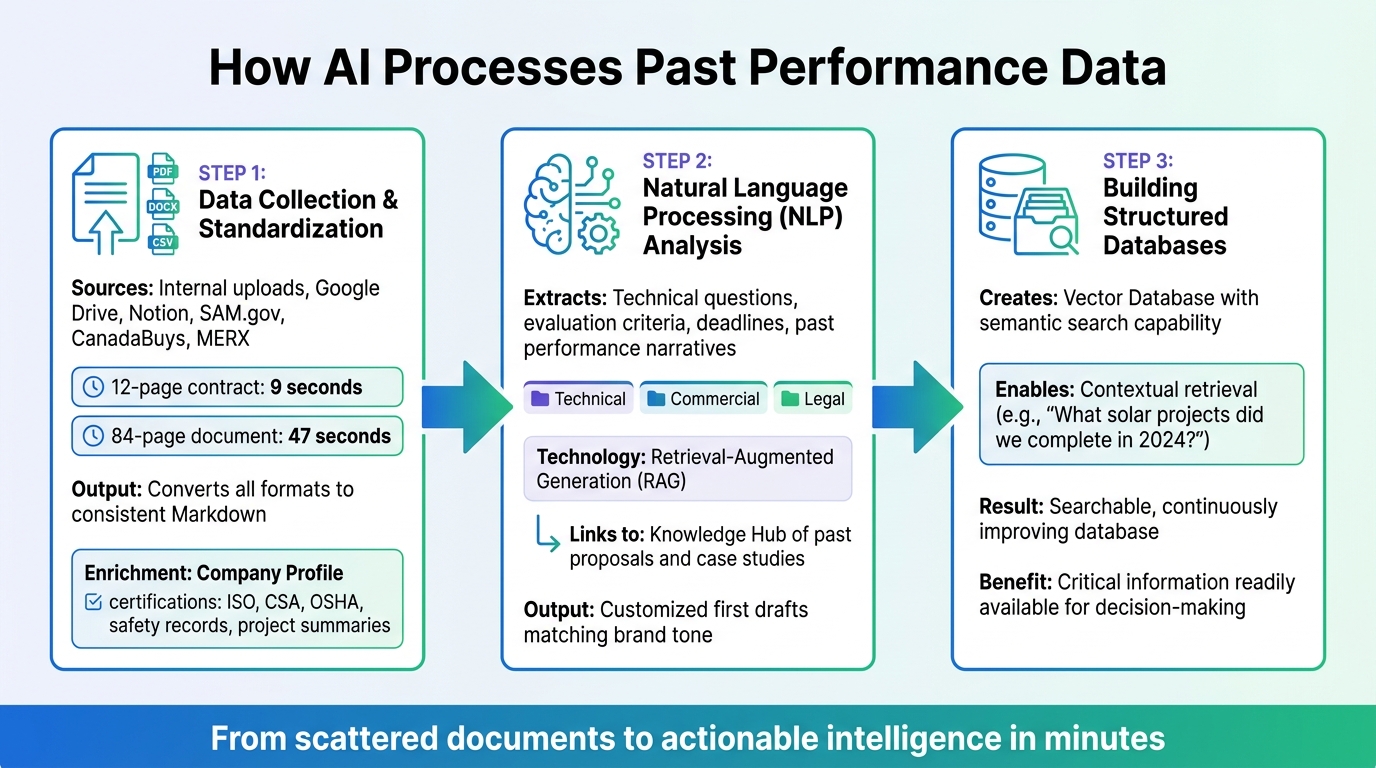
How AI Processes Past Performance Data for RFPs: 3-Step Workflow
AI is transforming the RFP process by taking scattered historical data and turning it into organized, actionable intelligence. By pulling information from multiple sources – like internal uploads in various formats, cloud storage platforms such as Google Drive and Notion, and external government portals like SAM.gov, CanadaBuys, and MERX – the system eliminates the hassle of manually sifting through countless folders, email chains, and file-sharing tools. This streamlined approach lays the groundwork for advanced data processing, which is explored further below.
Data Collection and Standardization
When documents are uploaded, AI automatically converts them into a consistent Markdown format. For example, a 12-page contract is processed in just 9 seconds, while an 84-page document takes 47 seconds. This ensures that the AI can handle everything from a scanned PDF from years ago to a recent Word document, interpreting all formats uniformly. Organizations can enrich their Company Profile with details like certifications (ISO, CSA, OSHA), safety records, and project summaries to improve processing accuracy. Specific instructions, such as "Prioritize structural steel, skip mechanical details", guide the AI in focusing on what matters most.
Once the data is standardized, it’s ready for deeper analysis using Natural Language Processing (NLP).
Natural Language Processing for Document Analysis
NLP allows the AI to extract both qualitative and quantitative insights from lengthy, unstructured documents. Instead of manually combing through extensive RFPs, AI classifiers instantly pinpoint technical questions, evaluation criteria, submission deadlines, and past performance narratives. The system organizes this extracted data into categories like Technical, Commercial, and Legal, linking it to your company’s existing assets to identify any compliance gaps. By leveraging Retrieval-Augmented Generation (RAG), the AI taps into your "Knowledge Hub" of past proposals and case studies to create customized first drafts that match your brand’s tone and style.
Building Structured Databases
After parsing and NLP analysis, the data is organized into structured formats for easy access and actionable insights. This raw information is indexed into a Vector Database, enabling semantic search and contextual retrieval. For example, you can ask, "What solar projects did we complete in 2024?" and receive precise answers based on historical records. As new data is added and analyzed, the AI continuously improves, creating a robust, searchable database. This ensures that critical information is no longer buried in filing cabinets or isolated spreadsheets but is readily available for informed decision-making.
sbb-itb-bb3960c
Using AI to Predict Win Probability
Once your data is neatly organized, AI steps in to estimate win probability, taking the guesswork out of decision-making. By analyzing standardized historical data, AI identifies strengths and compliance risks to forecast outcomes. Instead of relying on gut feelings, it dives into patterns – like your win/loss history, client profiles, pricing trends, and buyer preferences – to deliver a data-driven win probability score. This shifts go/no-go decisions from intuition to evidence-based strategy.
The results speak for themselves. Between 2024 and 2025, the average RFP win rate climbed from 43% to 45%, marking the most substantial year-over-year improvement in five years. High-performing teams leveraging AI and advanced proposal management processes achieve win rates of 60% or more, while organizations lose an average of $725,000 annually on abandoned RFPs (about 20% of RFPs are left incomplete). AI-powered scoring systems can cut the time spent evaluating and scoring RFPs by up to 70%, giving teams more time to focus on strategic decisions instead of manual tasks.
Analyzing Historical Patterns
AI evaluates a wide range of factors to gauge the likelihood of success with new opportunities. It matches RFP requirements to your firm’s unique strengths, certifications, and focus areas to determine strategic fit. Additionally, it examines buyer behavior and procurement language to pinpoint what evaluators prioritize in a winning proposal. For instance, if certain agencies prefer vendors with ISO certifications and strong safety records, the AI highlights those trends and aligns your profile to match.
Risk assessment and resource evaluation are just as important. AI flags potential legal or regulatory risks, financial stability concerns, and non-compliance issues while assessing whether you have the right expertise and capacity to deliver profitably. Tools like Narwin.ai’s Qualification Analyzer compare RFP requirements with your assets and historical success data, producing a bid/no-bid score based on factors like buyer priorities, strategic alignment, profitability, and potential risks. These insights help your team zero in on opportunities with the highest potential.
Focusing on High-Probability Opportunities
With insights from strategic fit and risk evaluations, AI-driven predictive analytics guide teams toward opportunities with the best chances of success, cutting down on wasted resources. AI delivers instant go/no-go recommendations, enabling you to decide whether to pursue an opportunity before committing 20–40 hours to proposal development. Teams using RFP automation report a 10–25% boost in win rates and can slash proposal-related labor costs by 30–60% over time.
What sets these systems apart is their transparency. Instead of a simple color-coded bar (Low, Moderate, High), AI details the factors behind its recommendations. For example, if a low score stems from pricing issues, technical gaps, or compliance concerns, you’ll know exactly why. This clarity allows you to make smart decisions – whether that’s improving your approach, finding a partner, or walking away from an unviable opportunity.
Ensuring Compliance Through Past Performance Analysis
Getting disqualified before your proposal even gets reviewed is a frustrating setback. Like other AI-driven tools improving RFP processes, compliance analysis uses both historical and real-time data to protect your bid from this outcome. AI minimizes the risk of auto-elimination by cross-referencing RFP requirements with your past performance data, certifications, and project history. Instead of relying on manual checklists, AI creates a centralized Company Profile that aligns your assets with every compliance clause in the new RFP.
Identifying Compliance Gaps
Using Natural Language Processing (NLP), AI extracts specific compliance requirements – like technical specifications, certifications, and evaluation criteria – from RFPs. It then performs compliance mapping by comparing these requirements with your historical data to pinpoint any gaps. For instance, if an RFP includes a hidden requirement for LEED certification in its technical section, the AI identifies it immediately and checks whether your Company Profile includes that credential.
Narwin evaluates over 10 metrics, organizing findings into categories like Technical, Commercial, and Legal. This helps you quickly identify both strengths and vulnerabilities. For example, if you’re missing experience in structural steel projects or lack ISO certifications required by the buyer, the AI flags these deficiencies early. This proactive gap analysis allows you to take targeted actions to reduce non-compliance risks.
Reducing Non-Compliance Risk
AI doesn’t stop at identifying gaps – it actively helps reduce non-compliance risks by flagging recurring issues and suggesting actionable recommendations. The platform creates a "Knowledge Loop", where each bid response trains the system to recognize patterns in compliance requirements across similar RFPs. For example, if your bids often miss OSHA safety records or specific NAICS codes, the system learns to prioritize those elements in future analyses.
The AI continuously monitors compliance and logs flagged issues with timestamps. This means you’re not just catching potential problems – you’re also building a documented record of your due diligence. The system can analyze large RFPs in just 5 to 20 minutes and updates opportunity relevance every 24 hours, ensuring your compliance status remains current even when buyers issue amendments or clarifications. By combining automated detection with human oversight, you can address gaps – whether by securing new certifications, forming partnerships, or seeking clarifications – well before the submission deadline.
How to Implement AI for Past Performance Analysis
Shifting from manual evaluation to AI-driven analysis can deliver significant benefits, including faster response times and a higher volume of bids submitted – all without increasing team size. Early adopters have reported cutting response times by 30–40% and boosting bid submissions by 25%. However, success in this transition hinges on clean data, team alignment, and a thoughtful balance between automation and human expertise.
Data Quality and System Integration
The foundation of any effective AI system is quality data. Start by auditing and cleaning your historical data. Remove outdated proposals, eliminate duplicates, and fix inaccuracies. Next, integrate your AI tool with existing platforms like CRM systems, SharePoint, Google Drive, Slack, and Microsoft Teams to enable real-time updates. Collect and organize critical documents – such as RFP responses, Q&A pairs, project summaries, certifications, and safety records – by product line or service category. This creates a centralized, reliable source of information, reducing errors that arise from scattered data.
Technical integration is just as important. For example, in 2025, Microsoft introduced an AI-driven content recommendation system for its global sales teams, supporting over 18,000 users and saving an estimated $17 million in time and resources. To ensure smooth operations, enable single sign-on (SSO) for easy access and set app connectors to sync daily. This keeps the AI updated with the latest company information, enhancing its effectiveness.
Training Teams on AI Tools
Even the best AI tools require skilled users to unlock their full potential. Learn how to train an AI on your past RFPs and teach your proposal team key features like automated requirement extraction, answer suggestions, and analytics dashboards. Teach them how to refine AI outputs by using specific instructions tailored to each RFP, such as focusing on particular project scopes while ignoring irrelevant sections.
Collaboration is key – align your proposal team with sales and marketing early in the process. This ensures AI-generated content incorporates insights from pre-sales discovery and aligns with buyer personas. For instance, an IT services firm used an AI platform over three months in 2025 to automate repetitive RFP tasks. By leveraging a reusable content library and AI drafting, they reduced proposal creation time by 40% and increased their bid win rate by 20%. Start small with a pilot project on one or two RFPs to measure the impact before scaling up. Once your team is comfortable with the tools, focus on blending automation with human expertise.
Combining Automation with Human Review
AI can handle a significant portion of the workload, often generating drafts that are 80% complete. However, human review is essential to refine and perfect the output. Use AI for repetitive tasks like extracting compliance requirements, filling in boilerplate sections, and identifying gaps in past performance data. Then, let subject matter experts step in to personalize the tone, ensure technical accuracy, and align the content with the buyer’s needs.
Establish feedback loops among sales teams, subject matter experts, and proposal writers to fine-tune AI outputs continually. Every submitted RFP response should be fed back into the system to help the AI learn and improve. Regularly update your AI’s knowledge base with new certifications, project wins, and other relevant data to maintain its accuracy. Remember, AI is a tool to enhance your team’s capabilities – not replace them. By automating repetitive tasks, your team can focus on strategic thinking, crafting compelling narratives, and ensuring the final product meets both organizational goals and client expectations.
Conclusion
AI is reshaping how government contractors and businesses handle past performance analysis for RFPs. What used to take days can now be completed in minutes. By automating data extraction, analyzing historical trends, and providing win probability scores, AI transforms past performance from a static record into a dynamic decision-making tool that improves with every use.
With these advancements, the future of RFP submissions is all about making smarter, faster decisions. Instead of chasing every opportunity, organizations leveraging AI can focus their efforts on bids where they have a strong chance of success. This shift from "bid on everything" to targeted, data-informed strategies gives companies a clear edge over their competition.
To get started, focus on building a solid foundation with clean data and combine automation with human expertise. Tools like Narwin.ai offer comprehensive solutions, from AI-powered bid discovery on platforms like SAM.gov and CanadaBuys to automated RFP analysis, win-score predictions, and even proposal drafting. With integrations into tools like Google Drive and Slack, these platforms help streamline processes – whether you’re managing 10 RFPs a month or 100 – allowing you to allocate resources effectively while staying fully compliant and avoiding common proposal mistakes.
FAQs
What past performance data should we feed the AI first?
To deliver precise analysis and reliable bid predictions, it’s essential to supply the AI with crucial past performance data. This includes vendor performance records, CPARS reports, certifications, safety records, details of previous projects, and the vendor’s overall performance history. These inputs allow the AI to evaluate and forecast outcomes with greater accuracy.
How does AI decide a go/no-go score for an RFP?
AI calculates a go/no-go score by examining key elements such as compliance requirements, project scope, client alignment, and profitability. Through scoring frameworks, it assesses risks, identifies gaps, and highlights opportunities, ultimately delivering an overall score. Take Narwin.ai, for instance – it conducts risk analysis, compliance evaluations, and win probability scoring. This helps teams make quicker, data-driven decisions and prioritize the most promising RFPs.
How can we trust AI compliance checks without getting disqualified?
AI compliance checks can deliver reliable results, especially when using advanced tools that thoroughly analyze RFP requirements. Tools like Narwin.ai excel at spotting compliance issues, potential risks, and red flags, while also providing actionable insights to help ensure your responses align with the necessary criteria.
However, the best approach combines AI-driven findings with manual reviews by experienced professionals. This hybrid method not only reduces errors but also enhances accuracy, giving you greater confidence in submitting RFPs that meet all requirements.