
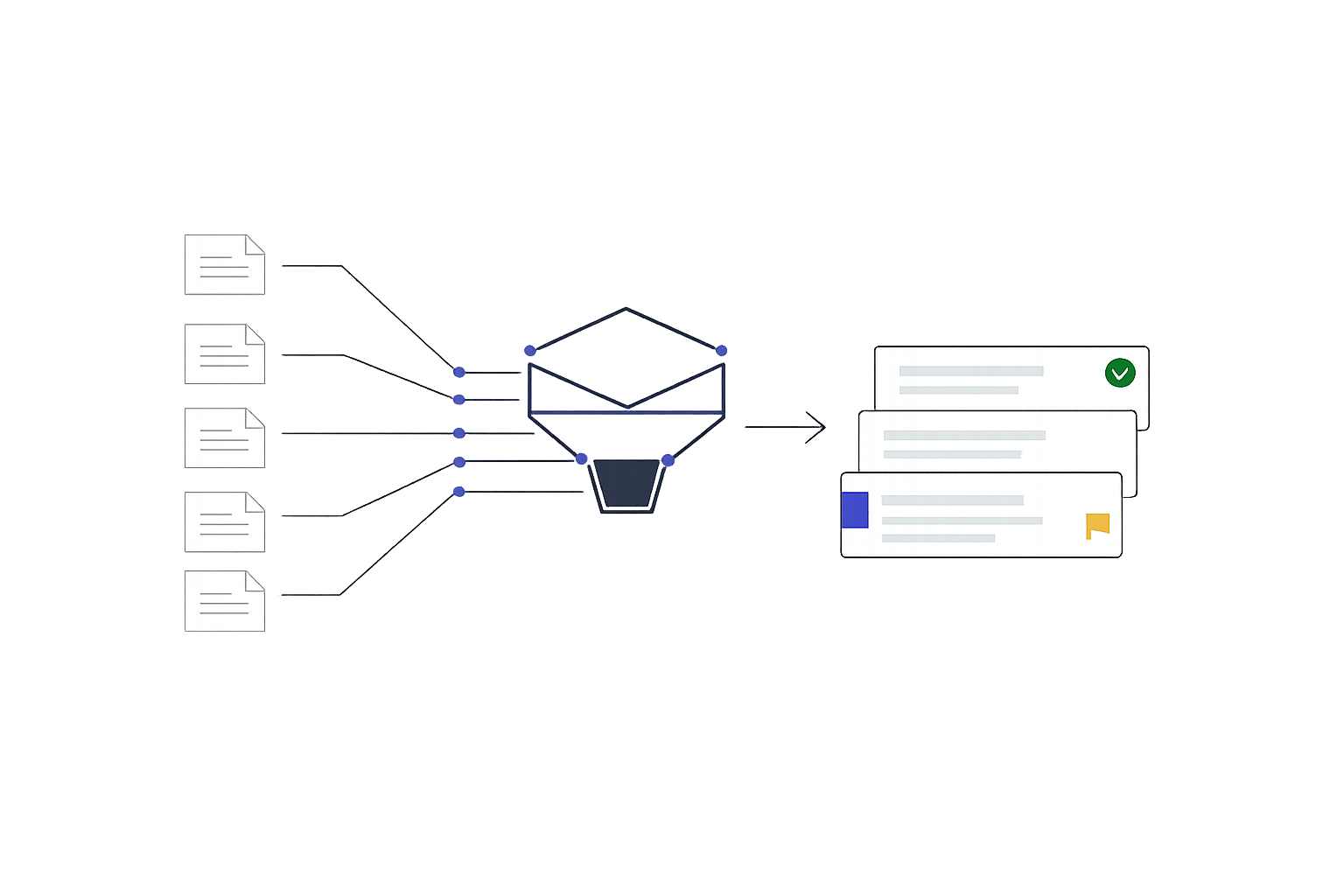
AI-powered tools like Narwin.ai are reshaping tender monitoring by saving time, cutting costs, and improving accuracy. Businesses traditionally spend 8–15 hours weekly on manual tender searches, costing $26,000–$41,600 annually and missing about 35% of relevant opportunities. AI platforms address these inefficiencies by using semantic matching to deliver precise, tailored alerts and reducing research time by 95%.
Key Takeaways:
- Manual Monitoring Challenges:
- Time-intensive (8–15 hours/week).
- Misses ~35% of opportunities due to keyword reliance.
- Costs tens of thousands annually in labor.
- AI-Powered Monitoring (Narwin.ai):
- Reduces time to 2–3 hours/week.
- Misses less than 5% of tenders after a short training phase.
- Offers features like compliance checks, risk alerts, and win probability scoring.
- Costs $1,200–$6,000 annually, saving up to 94% compared to manual methods.
For businesses relying on tenders, AI platforms like Narwin.ai streamline the process, reduce missed opportunities, and make scaling to new markets more manageable.
1. Manual Tender Monitoring
Accuracy and Relevance
Relying on exact keyword matching for manual tender searches leaves significant gaps. For example, searching for "cloud hosting" might completely overlook tenders labeled as "Infrastructure-as-a-Service" or "custom application engineering", even though these opportunities align perfectly with your expertise. This rigid approach can lead to missed chances.
The problem is compounded by fragmentation across multiple platforms. Teams often manage 5–15 different portals, from SAM.gov to local procurement sites, each with its own classification system. On top of that, contracting authorities frequently mislabel tenders with incorrect or overly broad CPV codes, making code-based searches unreliable. To make matters worse, critical mandatory criteria and eligibility details are often buried in lengthy PDF documents, making manual skimming both tedious and error-prone.
"For tender participants, not getting enough tenders is not the challenge; it’s finding the perfectly matching tenders." – Preeti Gupta, Content Manager, Nexizo
These challenges not only reduce the relevance of results but also create a labor-intensive process that eats up valuable time.
Efficiency and Time Savings
Manual monitoring is a resource drain. Teams typically spend 8–15 hours per week navigating portal logins, filtering keywords, downloading documents, and recording data. This repetitive workflow can cost businesses between $26,000 and $41,600 annually in labor.
Another issue is timing. If your team checks portals only twice a week and a tender with a 10-day deadline gets posted right after your last login, you’ve already lost nearly half your preparation time. This lack of immediacy forces senior staff to waste hours on repetitive searches instead of focusing on critical tasks like bid strategy or relationship building.
The inefficiency only grows when businesses expand their search efforts into new regions, further stretching already limited resources.
Scalability
Manual tender monitoring struggles to keep up as businesses grow. Entering new markets adds 1–2 hours of work per portal each week, with additional challenges like language barriers and unfamiliar interfaces. Expanding into other states or countries often requires hiring staff with specific language skills just to navigate local systems, making scaling across borders expensive and cumbersome.
As tender volumes increase, teams face "keyword fatigue." Broader searches flood staff with irrelevant results, forcing them to spend more time filtering through noise than acting on viable opportunities. Over time, the sheer workload reduces the frequency of portal checks, leading to even more missed chances. This approach simply doesn’t scale for businesses aiming to compete across multiple markets at once.
sbb-itb-bb3960c
2. AI-Powered Tender Monitoring (Narwin.ai)
Accuracy and Relevance
Platforms like Narwin.ai tackle the challenge of keyword mismatches with semantic matching. Instead of relying on exact matches, the system uses machine learning and vector databases to understand related concepts. For instance, a construction company specializing in solar installations would get alerts for tenders related to renewable energy infrastructure or photovoltaic systems, avoiding irrelevant results caused by strict keyword reliance.
Narwin.ai tailors its approach by learning from your company’s specific profile. When you upload documents like certifications (ISO, CSA, OSHA), safety records, or past project details into its private AI Knowledge Base, the platform builds a detailed understanding of your expertise. Using this data, it evaluates tenders and assigns a match score (e.g., 80%), showing how well the RFP aligns with your capabilities. Each alert comes with a summary explaining why it’s a good fit, helping you quickly assess opportunities.
This system significantly reduces irrelevant results. After an initial learning period of 2–4 weeks, false positive rates drop to under 5%, a vast improvement over manual searches. Plus, the platform gets smarter over time – when you mark an opportunity as relevant or irrelevant, the algorithms adjust to refine future matches. This improved precision translates into major efficiency gains.
Efficiency and Time Savings
The time saved is impressive. Manual tender monitoring often takes 8–15 hours per week, but Narwin.ai cuts this down to just 2–3 hours. It scans thousands of sources across North America, including SAM.gov, CanadaBuys, MERX, and BC Bid. Tailored bid alerts are refreshed daily at 3 AM EST, ensuring you stay updated without constant portal checks.
Narwin.ai also processes RFP documents in minutes, extracting key details like RFP requirements, potential risks, and buyer intent. This generates quick go/no-go signals along with win probabilities, eliminating guesswork and helping you focus on high-potential bids. When it comes to proposal drafting, the platform uses Retrieval-Augmented Generation (RAG) to produce compliant drafts up to 10x faster than traditional methods, freeing up time for more strategic planning.
Compliance and Risk Management
Beyond improving accuracy and efficiency, Narwin.ai helps with compliance and risk management. Unlike manual methods that might miss critical details in complex documents, the platform identifies risks proactively. It extracts compliance clauses, technical requirements, and legal concerns from RFPs, mapping them to your company profile to highlight areas needing partnerships or clarification. Red flags like unrealistic timelines, strict eligibility criteria, or missing information are flagged early, preventing costly mistakes.
During proposal drafting, integrated compliance checks reduce errors. By analyzing buyer history and motivations, the system provides insights into their risk tolerance and evaluation priorities. This combination of buyer intelligence and requirement mapping gives you a clear picture of whether an opportunity aligns with your strengths and risk capacity.
Scalability
Narwin.ai scales effortlessly as your business expands. Entering new markets often means spending 1–2 extra hours per portal each week, but this platform monitors over 100,000 government tenders across the U.S. and Canada without adding to your workload. For Canadian businesses, bilingual support in English and French is especially useful for navigating federal tenders on CanadaBuys, eliminating the need for specialized translation services.
As your workload increases, Narwin.ai keeps up. It integrates seamlessly with tools like Slack, Google Drive, Notion, and even offers a Chrome extension for platforms like SAM.gov. Whether you’re handling five tenders or five hundred, the system manages the volume without overwhelming your team or cluttering your inbox with irrelevant results. This scalability ensures you can maintain precision and efficiency across multiple markets as your business grows.
Advantages and Disadvantages
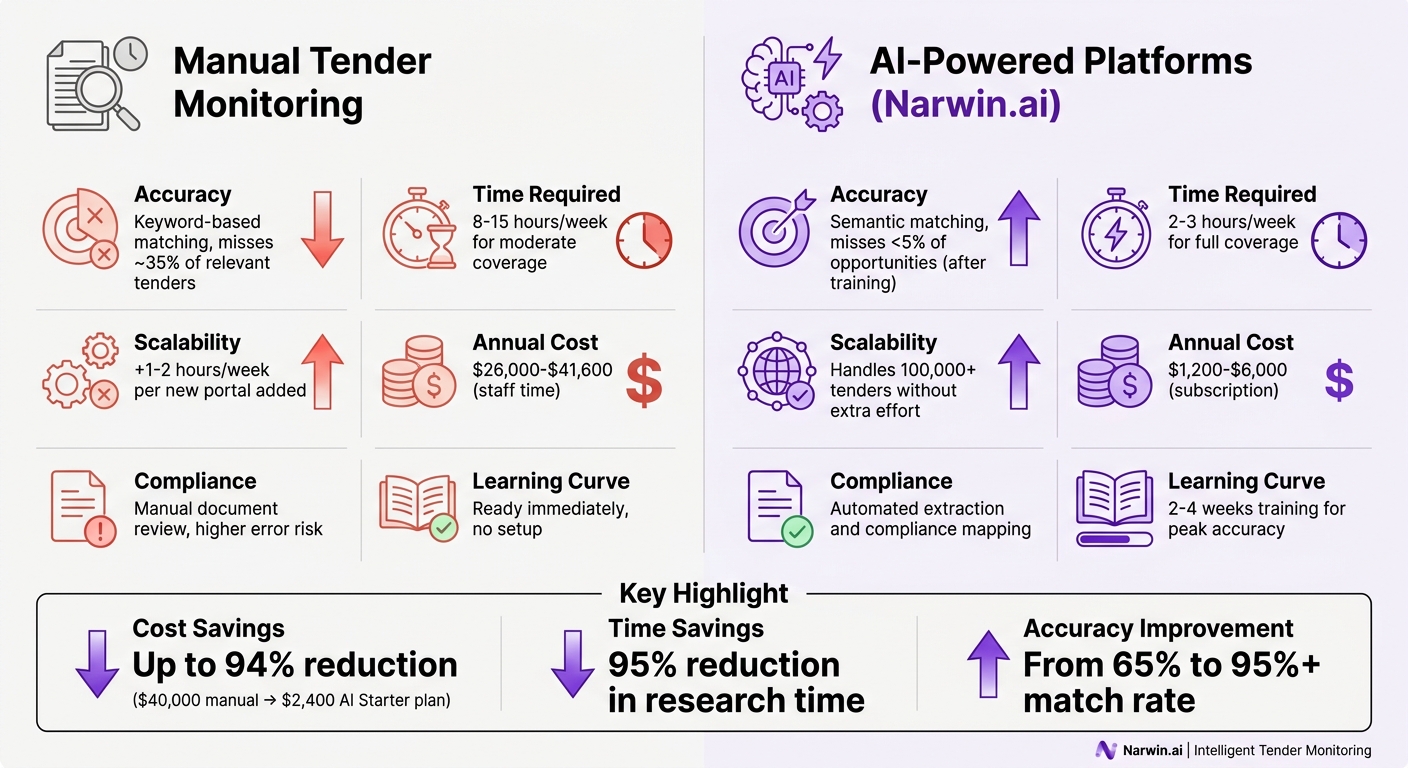
Manual vs AI-Powered Tender Monitoring: Cost, Time, and Accuracy Comparison
When it comes to monitoring tenders, manual methods and AI-powered platforms like Narwin.ai operate very differently. Manual searches rely on keyword matching, which can lead to missing about 35% of relevant opportunities due to variations in terminology. In contrast, AI platforms like Narwin.ai use semantic matching, which understands concepts rather than just exact keywords. This approach reduces missed opportunities to under 5%, especially after the initial training phase.
Time is another key factor. Manual monitoring takes about 8–15 hours per week, with an additional 1–2 hours for every new market you enter. Narwin.ai, on the other hand, provides comprehensive coverage in just 2–3 hours per week. It monitors over 100,000 government tenders across the U.S. and Canada effortlessly, even as your workload scales.
Cost is where AI monitoring truly stands out. Manual searches can cost between $26,000 and $41,600 annually in staff time. Narwin.ai’s subscription fees range from $1,200 to $6,000 per year, with the Starter plan priced at $199 per month. This plan offers 10 RFP analyses and smart opportunity matching, delivering more precise results at a fraction of the cost.
However, AI platforms do require an initial training period. During this time, you’ll need to upload your company profiles, certifications, and past project data. In the first few weeks, you might experience a 15–20% false positive rate, but this typically drops below 5% as the system adjusts based on your feedback. Manual searching, while less accurate overall, doesn’t require this setup and may still be a better fit for highly specialized niches with fewer than 20 relevant tenders annually.
Here’s a quick comparison of the two approaches:
| Feature | Manual Tender Monitoring | AI-Powered Platforms (Narwin.ai) |
|---|---|---|
| Accuracy | Relies on keywords; misses ~35% of tenders | Semantic matching; misses <5% of opportunities |
| Efficiency | 8–15 hours/week for moderate coverage | 2–3 hours/week for full coverage |
| Compliance | Requires manual review of lengthy documents; higher error risk | Automates requirement extraction and compliance mapping |
| Scalability | Adds 1–2 hours/week per new portal | Handles increased volume without extra effort |
| Annual Cost | $26,000–$41,600 (staff time) | $1,200–$6,000 (subscription) |
| Learning Curve | Ready to use immediately; no setup | 2–4 weeks of training for peak accuracy |
This breakdown shows how Narwin.ai reduces wasted resources while offering better accuracy, making it an excellent choice for government contractors looking to stay competitive.
Conclusion
Monitoring tenders manually can be a slow and expensive process, often leading to missed opportunities due to the limitations of keyword-based searches. AI-powered platforms like Narwin.ai simplify this process, cutting it down to just 2–3 hours per week while significantly reducing costs. After initial training, missed opportunities drop to under 5%, making it a game-changer for businesses.
Beyond saving time and money, AI tools like Narwin.ai offer insights that manual methods simply can’t. Features such as go/no-go scoring, win probability analysis, and automated compliance checks provide a strategic edge. With daily, curated matches tailored to your company’s certifications, past projects, and capabilities, Narwin.ai ensures comprehensive coverage across the U.S. and Canada.
To maximize these benefits, businesses should start by training the AI with detailed company profiles, certifications, and previous successful bids. This initial setup enables the system to improve accuracy within 2–4 weeks. Integrations with tools like Slack and Google Drive make it even easier to ensure tender alerts reach the right team members without delay.
For businesses spending around $40,000 annually on manual tender monitoring, Narwin.ai’s Starter plan offers the same results for just $2,400 – a massive 94% savings. For government contractors in IT consulting, construction, architecture, and procurement, adopting AI isn’t just an advantage; it’s essential to staying competitive. Leverage AI-driven tender alerts to elevate your bidding strategy and stay ahead of the curve.
FAQs
How does semantic matching find relevant tenders beyond keywords?
Semantic matching works by analyzing the meaning and context of solicitations instead of just focusing on keywords. This approach helps AI identify opportunities that are contextually aligned, delivering more precise and relevant results for businesses.
What should I upload during the 2–4 week training phase to improve alert accuracy?
To improve the accuracy of alerts during the 2–4 week training period, make sure to upload your company profile, certifications, details of past projects, and any other relevant business information. This data helps fine-tune alerts to match your specific requirements, ensuring greater precision.
How can Narwin.ai help me decide go/no-go and avoid compliance risks faster?
Narwin.ai simplifies the process of making go/no-go decisions while helping you minimize compliance risks. It provides instant risk analysis, performs compliance checks, and offers AI-driven bid/no-bid recommendations. By examining RFPs, buyer intent, and spotting potential red flags, it equips you to make confident and timely decisions without the hassle.