
Winning more government contracts doesn’t have to be a gamble. By organizing and analyzing past contract data, contractors can improve win rates, cut costs, and focus on the right opportunities. App Guardians, a small government contractor, used Narwin.ai to centralize data and make smarter bid decisions. In just one year, they increased their win rate from 18% to 32%, reduced proposal costs, and grew revenue by 20–35%.
Key Takeaways:
- Problem: Disorganized data led to high costs, low win rates, and wasted time.
- Solution: Centralized data with Narwin.ai, analyzed trends, and used AI tools for decision-making.
- Results: Higher win rates, fewer wasted bids, and improved efficiency.
This approach shows how focusing on data can transform a contractor’s bidding process, saving time and boosting revenue.
Baseline: Where the Organization Stood Before Using Past Contract Data
Before embracing a data-driven strategy, App Guardians faced challenges familiar to many small contractors. Their bidding process lacked focus, leading to a scattershot approach that drained resources, delivered few wins, and left the team struggling to identify what went wrong.
Low Win Rates and High Costs Per Proposal
The organization’s win rate lingered between 20% and 30%, a clear sign of the limitations of relying on gut instinct. Preparing each proposal came with a hefty price tag – ranging from $10,000 to $25,000. With that kind of investment, securing just one contract often meant spending over $100,000. Yet, despite these high costs, the team chased nearly every opportunity, even those that didn’t align with their strengths. This approach was fueled by disorganized data, as detailed in the next section.
Scattered Historical Data and Missed Opportunities
Historical records like past proposals, performance reviews, and debrief notes were scattered across shared drives and email chains. Without a centralized system, retrieving information became a time-consuming manual process. This disorganization led to outdated figures, inconsistent tone, and generic content in proposals – issues that evaluators could quickly spot. Research highlights that proposals using untailored, recycled content can score up to 22% lower on technical evaluations, a statistic that underscores the risks of this approach.
Intuition Over Data in Decision-Making
Without centralized data, the team relied heavily on intuition to make decisions. Much of this responsibility fell on Carter Hawthornwaite, the Operations Director, who was already juggling daily tasks. Reviewing two major RFPs often required more than 15 hours of manual effort, with decisions guided by surface-level cues like a friendly agency contact rather than objective criteria. In one case, what appeared to be a promising lead concealed significant budget authority issues – problems that only surfaced too late. It became clear that a shift to a data-driven approach was overdue.
"You don’t have to chase every RFP. Pursuing the wrong ones can waste time, energy, and trust." – Narwin
The table below outlines the key inefficiencies App Guardians faced before adopting a new approach:
| Inefficiency | Impact |
|---|---|
| Win rate | 20–30% |
| Cost per proposal | $10,000–$25,000 per response |
| Evaluation time & data access | 15+ hours for two RFPs; data fragmented across drives and email |
| Decision basis | Intuition and surface-level signals |
| Content quality | 22% lower scores due to generic reuse |
These challenges fed into one another: fragmented data slowed decision-making, poor decisions drained resources, and the lack of resources left little room for improving proposals. It was a cycle that needed breaking.
sbb-itb-bb3960c
Data Strategy: Turning Historical Contract Data Into Actionable Insights
Centralizing Historical Contract Data
App Guardians began by gathering all their historical contract-related information into one place. They moved past proposals, award notices, debrief notes, and performance reviews from scattered locations like email chains and shared drives into a single, searchable knowledge hub. At the same time, they created a detailed firm profile in Narwin.ai, which included their services, NAICS codes, and past performance metrics. This centralization wasn’t just about organization – it made the data work for them. Each new entry enriched the system, helping to automatically match relevant past performance to new opportunities. So, whenever a new RFP came in, the system could surface the most relevant experience without manual digging.
Analyzing Trends and Finding Success Patterns
Once the data was centralized, patterns that had been hidden came into focus. The team could now see which types of agencies they were most likely to win contracts with, what contract sizes matched their capacity, and where they had consistently lost in the past. One key insight? Proposals with quantified outcomes boosted their win rates by 2.7× compared to those with vague claims. On the flip side, they identified recurring red flags in their losses, such as unclear budget authority or geographic scopes that exceeded their comfort zone.
Narwin.ai’s predictive model took these patterns and turned them into actionable insights, helping the team make better decisions about which bids to pursue.
Using Narwin.ai for Win Probability Predictions
This is where the process moved from understanding data to taking action. Narwin.ai’s Predictive Win Score tapped into the centralized data, comparing each new opportunity against the firm’s historical award patterns, risks from incumbents, and alignment with their capabilities. Within minutes, the system provided a fit score for each opportunity. For example, in their January 2026 evaluation, this approach replaced more than 15 hours of manual decision-making with a structured, data-driven framework. The benefits weren’t just about speed – it ensured the team focused only on opportunities where they had a real chance of success.
"Narwin helped us save 15+ hours & generate over $25,000 by participating only where we had a real shot. Since we receive around 5 major RFPs per quarter, the annual subscription pays for itself quickly." – Carter Hawthornwaite, Operations Director, App Guardians
Process Changes: Putting Data Insights to Work in Bidding
Building a Data-Driven Go/No-Go Framework
App Guardians transformed their bidding process by setting a clear benchmark: a minimum 60% Fit Score. This shift replaced drawn-out debates with decisions rooted in data. Opportunities falling below this threshold were either pursued as subcontracting roles, referred to partners, or declined altogether.
For example, when one RFP met the 60% threshold but flagged budget concerns, the team opted for a subcontracting role, earning $15,000. Another RFP with a 50% Fit Score was referred to a partner, generating over $10,000. These two decisions alone brought in $25,000 – a result that likely wouldn’t have been achieved under the previous instinct-driven approach.
With these thresholds in place, the team turned their focus to refining proposal development using AI tools.
Improving Proposal Development with AI
Once a bid passed the go/no-go threshold, AI tools streamlined the proposal process, making it faster and more accurate. Narwin.ai, for instance, extracted all mandatory RFP requirements to create a compliance matrix before drafting even began. This mattered because proposals meeting 100% of mandatory requirements win at a 3.2× higher rate, while 34% of losing proposals fail due to missing just one requirement.
The platform also leveraged App Guardians’ centralized data to generate a tailored first draft. It automatically incorporated relevant case studies and measurable outcomes, ensuring the content aligned with the buyer’s evaluation criteria. Writers then fine-tuned these drafts, resulting in quicker turnarounds and consistently high-quality proposals. These AI-driven improvements not only sped up the process but also strengthened team collaboration.
Better Collaboration and Decision-Making Across Teams
The enhancements to proposal development also streamlined team collaboration, cutting down on delays. Previously, aligning team members on an RFP involved circulating documents, scheduling reviews, and waiting for subject matter experts to weigh in. Now, instant summaries and structured qualification reports allowed leadership to get up to speed in minutes.
Centralized data further reduced inefficiencies by eliminating the “who knows what” problem. AI-generated briefings provided a shared foundation, covering requirements, risks, winning strategies, and relevant past projects. This eliminated the need for endless file searches and reduced back-and-forth discussions. Decisions that once dragged on were made faster, with greater confidence and less second-guessing.
Results: Measurable Gains in Win Rates and Revenue
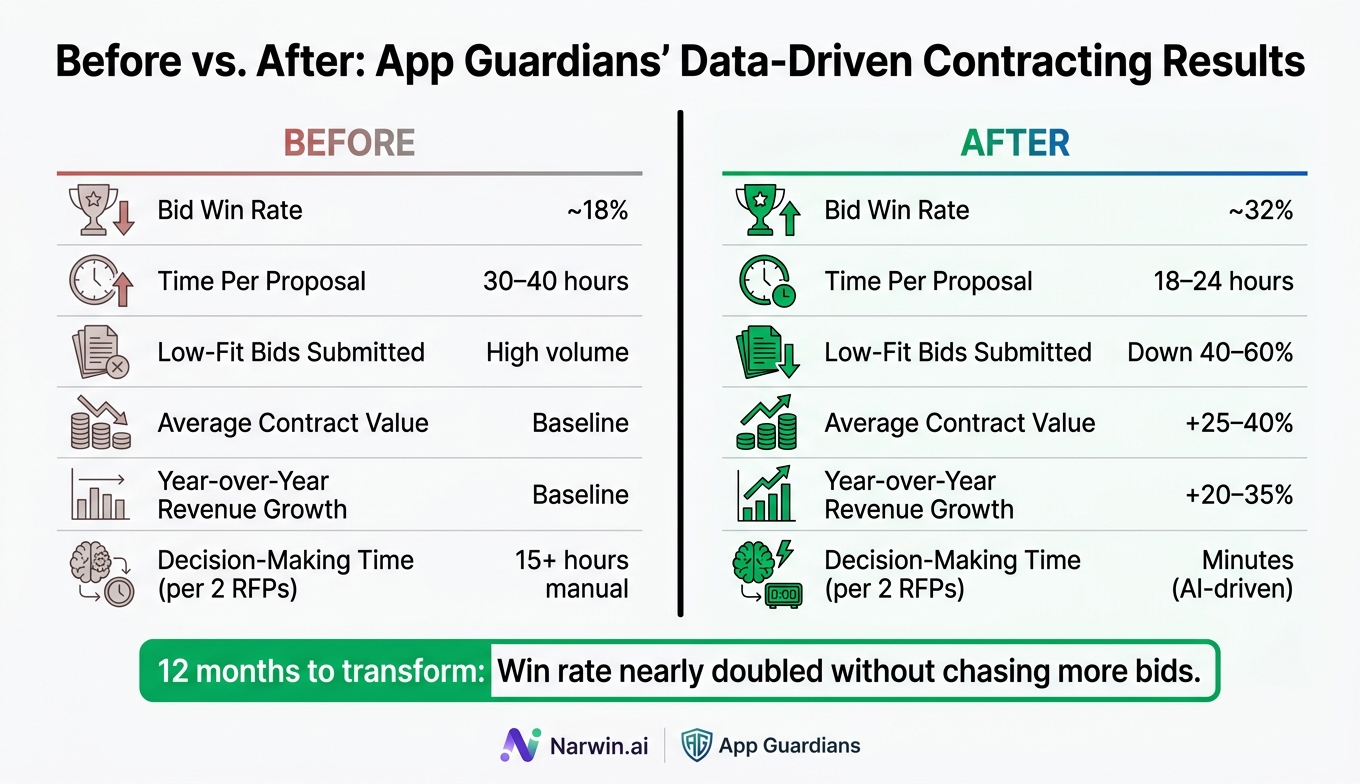
Before vs. After: App Guardians’ Data-Driven Contracting Results
The process changes led to clear, measurable improvements in win rates, proposal efficiency, and overall revenue.
Higher Win Rates and Larger Contract Values
In just 12 months, win rates jumped from 18% to 32%, almost doubling the number of contracts won per 100 bids. This wasn’t achieved by chasing more opportunities but by focusing on better ones.
Contract values also saw a boost, increasing by 25–40% depending on the segment. By targeting multi-year contracts with a proven fit, the team shifted away from smaller, one-off engagements. This strategy created a more refined portfolio of larger, strategically valuable awards.
These higher-quality bids laid the groundwork for major efficiency gains in proposal efforts.
Reduced Time and Resources Per Proposal
Streamlined decision-making drastically cut the workload for proposals. Time spent on each proposal dropped by 30–50%, going from 30–40 hours to just 18–24 hours. Meanwhile, low-fit bid submissions decreased by 40–60%, freeing up 20–30% of staff hours for high-priority pursuits and detailed capture planning.
The result? Overtime and last-minute scrambles became rare, and the cost per proposal dropped significantly as fewer resources were wasted on unwinnable bids.
Revenue Growth and Deeper Market Presence
Together, the higher win rates and larger contracts fueled 20–35% year-over-year revenue growth over 12–24 months. Despite submitting slightly fewer bids, revenue climbed because the team was winning the opportunities that truly mattered.
Beyond the numbers, App Guardians strengthened their presence in key markets. Repeat awards and task orders from existing clients grew, shortlist and interview rates improved, and the firm expanded into new agencies using Narwin.ai’s monitoring of federal, state, and city-level bid opportunities. This diversification reduced reliance on a few clients and built a more balanced portfolio, signaling a shift from being an occasional winner to becoming a trusted, go-to vendor.
| Metric | Before | After |
|---|---|---|
| Bid win rate | ~18% | ~32% |
| Average contract value increase | – | +25–40% |
| Time per proposal | 30–40 hours | 18–24 hours |
| Low-fit bids submitted | High volume | Down 40–60% |
| Year-over-year revenue growth | Baseline | +20–35% |
Conclusion: Key Lessons for Government Contractors
App Guardians’ journey highlights how tapping into historical contract data can significantly improve both efficiency and revenue. Here’s what stands out:
Why Centralized Data Management Matters
One of the biggest hurdles in government contracting is dealing with scattered historical data. When insights on past performance, pricing trends, and agency preferences are siloed, teams often end up starting bids from scratch. Centralizing this data changes the game. It allows contractors to spot expiring contracts 18–26 months before an RFP hits the public domain. This early visibility gives teams the time they need to build relationships and influence requirements – well before competitors even know an opportunity exists. Beyond that, centralized data helps uncover agency-specific trends, like whether a buyer prefers extending incumbent contracts or prioritizes small business set-asides. This kind of insight leads to far more informed and strategic investment decisions.
How AI Enhances Bid Decisions
While historical data is powerful, its value lies in how quickly and effectively it can be used – and that’s where AI steps in. Tools like Narwin.ai can analyze thousands of pages of documents and produce in-depth qualification, competition, and risk reports in under 10 minutes. Tasks that once took hours of manual effort are now streamlined.
AI also adds another layer of precision. Features like fit scores and red flag detection help teams steer clear of bids that might look promising at first but come with hidden pitfalls. These could include unclear budget authority, geographic mismatches, or an incumbent’s strong advantage. By using AI, contractors can make smarter, faster decisions about which opportunities to pursue.
Integrating Data Into Everyday Bid Processes
The real transformation at App Guardians came from embedding data into their daily workflow. Every go/no-go decision now revolves around data analysis. Incoming RFPs are assessed against fit scores before resources are allocated, ensuring teams focus only on high-potential opportunities. When an opportunity scored poorly, teams even explored referral revenue strategies, turning potential losses into gains.
Another shift was in how proposals were crafted. Instead of starting from scratch, teams tapped into structured libraries of past case studies and credentials. This streamlined approach not only saved time but also ensured consistency and quality in every submission.
This shift isn’t just about short-term wins – it’s about building a sustainable edge. By making data a central part of the bidding process, contractors can reduce wasted efforts, craft stronger proposals, and stay ahead in a competitive marketplace. The key is continuous integration, ensuring data remains at the heart of every decision.
FAQs
What past contract data should I centralize first?
If you want to increase your chances of winning bids, start by gathering your most important internal resources into a well-organized Knowledge Hub. This should include materials like past proposals, project summaries, case studies, and certifications such as ISO, CSA, or OSHA.
By uploading these resources to Narwin.ai, the platform takes care of the heavy lifting. It automatically organizes everything into a private, searchable database. The AI then uses this database to match your previous successes with the requirements of new RFPs, helping you create customized, data-backed proposals with ease.
How do I set a good go/no-go fit score threshold?
To decide on an effective go/no-go threshold, rely on Narwin.ai’s data-driven scoring system. These scores evaluate factors like your historical win patterns, certifications, and buyer preferences.
- A match score of 80% or higher indicates a strong opportunity worth pursuing.
- Scores around 60% suggest potential, but they also highlight areas needing further attention.
- Scores near 50% often signal risks, such as challenges related to geography or service compatibility.
This approach helps you focus on bids with the highest likelihood of success.
How can I reduce proposal time without lowering quality?
You can cut down on the time spent on proposals while maintaining high standards by using Narwin.ai to handle repetitive tasks. This tool swiftly scans RFPs to pull out essential details like key requirements, deadlines, and compliance criteria. It also creates customized drafts based on your previous proposals, ensuring everything stays consistent and aligned with your brand. Plus, Narwin.ai automates compliance matrices, highlights potential risks, and even offers win probability scores – freeing your team to concentrate on strategy rather than time-consuming formatting.