
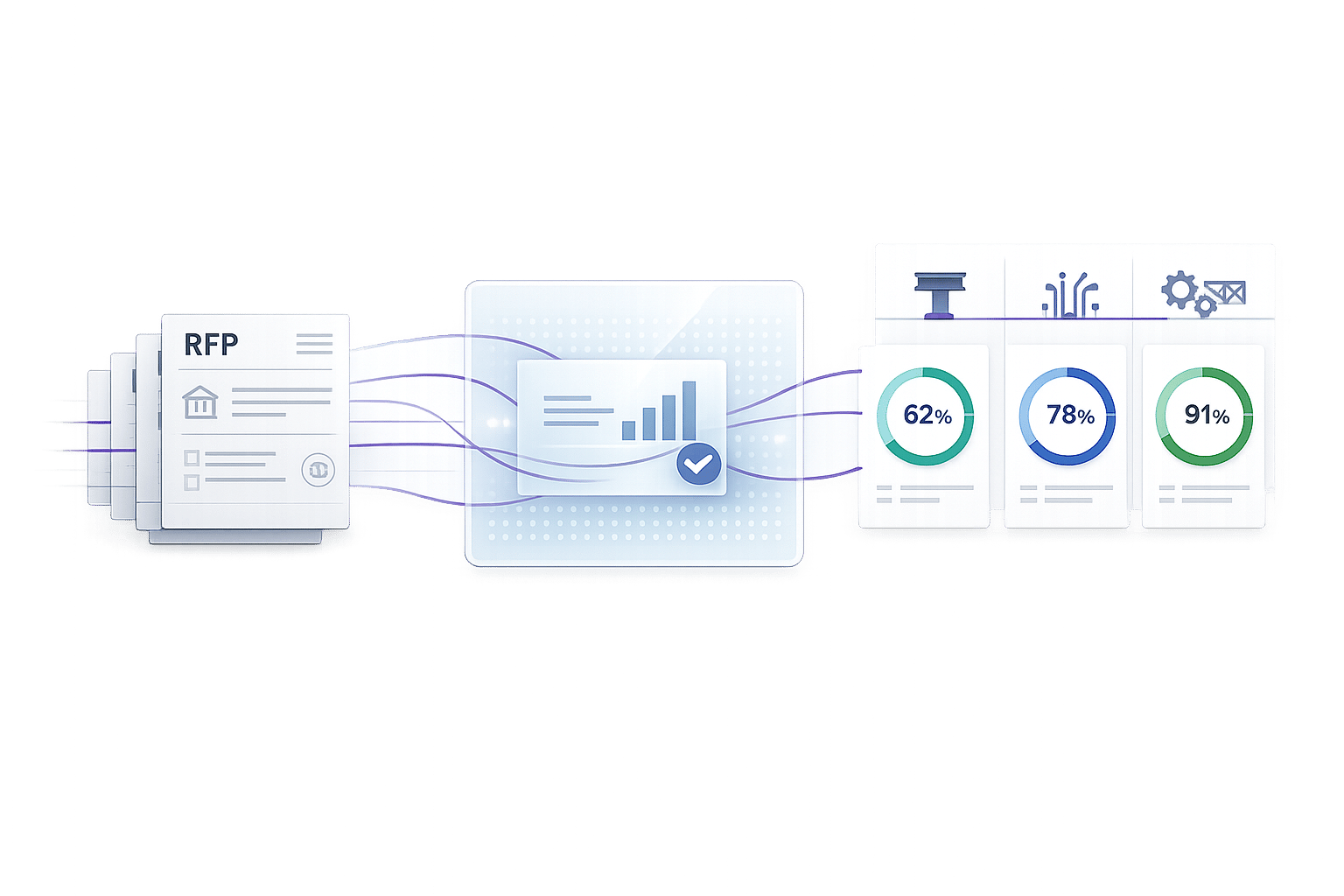
Government contractors often face a common challenge: sorting through an overwhelming number of RFPs and RFQs to find the best opportunities. AI-powered bid recommendation tools, like Narwin.ai, simplify this process by analyzing procurement data, aligning opportunities with your company’s certifications, experience, and goals, and predicting success rates. This saves time, reduces errors, and helps focus resources on high-probability bids.
Key Takeaways:
- AI-Powered Matching: Tools like Narwin.ai scan procurement platforms (SAM.gov, CanadaBuys, etc.) to match bids with your qualifications.
- Win Probability Scoring: AI predicts your chances of success based on past performance, certifications, and buyer behavior.
- Industry-Specific Insights: Tailored recommendations for sectors like construction, IT, and engineering ensure alignment with niche requirements.
- Time Savings: Automates manual tasks through RFP automation for compliance checks, risk analysis, and proposal drafting, reducing bid preparation time by up to 90%.
Why It Matters:
By focusing on opportunities that match your company’s strengths, AI tools help avoid wasted effort and increase your chances of winning contracts. Whether you’re in construction, IT, or engineering, these tools refine the bidding process, making it more efficient and effective.
Bid Recommendations for Construction
Key Factors in Construction Bids
Winning construction bids often comes down to aligning your company’s strengths with the exact needs of a project. AI tools make this easier by analyzing your past work, specialized services, and certifications like ISO, CSA, or OSHA to determine the best fit.
Compliance is another critical area AI evaluates. It ensures your bid meets requirements like bonding, prevailing wages under Davis-Bacon, and diversity goals. This is especially important as the Department of Labor has ramped up enforcement, with investigations into prevailing wage violations increasing by 35% in 2025.
Financial capacity also plays a big role. AI identifies opportunities that align with your bonding limits and project sizes where your win rate exceeds 15%. With over $400 billion awarded annually in public works construction contracts – and an additional $550 billion in federal infrastructure spending through the Infrastructure Investment and Jobs Act – targeting the right projects is more crucial than ever.
By focusing on these factors, AI provides a solid foundation for targeted bid matching, which is explored further below.
How AI Improves Construction Bid Matching
AI takes bid matching to the next level by processing real-time procurement data. Platforms like Narwin.ai scan federal, state, and local procurement portals to provide a Preliminary Match Score for each opportunity. This score ranks projects based on their relevance and your likelihood of winning, using construction-specific keywords and expertise. Contractors using AI-driven tools often uncover four times more public works opportunities than those relying on manual searches.
These matches update every 24 hours, and instant alerts notify you of new tenders. To refine the process, you can upload company-specific data – like past projects, safety records, and certifications – into the AI system. You can even give specific instructions, such as focusing on "structural steel and concrete" while ignoring unrelated opportunities.
AI doesn’t stop at matching projects; it also evaluates buyer behavior. By analyzing the issuing organization’s history, risk tolerance, and evaluation patterns, AI helps determine whether a buyer aligns well with your firm’s strengths. For instance, projects with only three or four plan holders often offer better profit margins than those with 15 or more, allowing you to prioritize bids where competition is less intense.
Table: AI Filters for Construction Bids
| AI Filter Category | Construction-Specific Application | Key Benefit |
|---|---|---|
| Geography | Filters by state, municipality, or specific portals like SAM.gov | Reduces travel costs and ensures local compliance |
| Bid Value Range | Matches bids to bonding limits and ideal project sizes | Aligns with financial and workforce capabilities |
| Compliance Needs | Identifies prevailing wage, bonding, and insurance requirements | Avoids disqualification due to missing qualifications |
| Trade/Specialty | Searches niche keywords like "Solar EPC" or "HVAC" | Finds projects tailored to your expertise |
| Diversity Goals | Highlights bids requiring DBE, MBE, or WBE participation | Identifies opportunities for certified contractors |
sbb-itb-bb3960c
Bid Recommendations for IT
Challenges in IT Bids
IT consulting firms face unique hurdles when competing for government contracts and responding to RFPs. Unlike construction bids, which often revolve around physical certifications and bonding, IT bids demand a deep dive into intricate technical specifications scattered across countless federal and state portals. This overwhelming volume of opportunities makes manual tracking nearly impossible, leading to missed chances for lucrative contracts.
Then there’s the sheer complexity of the documents themselves. IT RFPs often stretch over 50 pages, packed with detailed requirements for areas like cybersecurity, cloud migration, and compliance. Manually extracting and analyzing these technical details is not only time-consuming but also prone to errors.
Making bid/no-bid decisions without solid data adds another layer of frustration. Teams often waste precious hours on low-odds bids or proposals burdened with hidden risks. On top of that, drafting proposals becomes a repetitive grind, with teams copying and pasting content from previous documents to meet similar technical requirements. This process can lead to burnout and increases the likelihood of compliance mistakes, which could result in disqualification.
To tackle these issues, AI-driven tools are transforming how IT firms approach the bid process, offering tailored solutions for their unique challenges.
AI Capabilities for IT Bid Recommendations
AI platforms like Narwin.ai are stepping in to simplify IT bid management. Using advanced Natural Language Processing, these tools streamline the process of matching IT firms with the right opportunities. By building on AI-powered bid discovery methods, these platforms analyze procurement data in real time, aligning opportunities with your firm’s expertise.
Natural Language Processing plays a key role by instantly extracting critical technical details – such as cybersecurity protocols, cloud migration needs, and integration standards – from lengthy RFP documents. This automation ensures no essential requirements are missed, eliminating the need for manual searches.
Each opportunity is assigned a Preliminary Match Score, factoring in your company’s certifications (like ISO/IEC 27001), previous experience with similar projects, and overall technical strengths. Narwin.ai scans federal and state portals daily, delivering instant alerts when new opportunities align with your profile. Compared to manual searches, this AI-driven approach dramatically improves the ability to pinpoint relevant contracts.
Beyond just matching opportunities, AI also evaluates buyer behavior and identifies potential risks. For instance, Mike W. from Yolo County’s Innovation Office in California uses Narwin.ai to analyze RFPs for technical precision and contractual language. The tool highlights NAICS codes and flags compliance risks before significant resources are spent.
"We use Narwin to analyze and improve our RFP docs. Narwin’s detailed analysis and suggestions around things like NAICS codes, contractual wording, etc. are very on-point."
- Mike W, Innovation Office, Yolo County
When it comes to drafting proposals, AI leverages Retrieval-Augmented Generation (RAG) technology. This feature pulls relevant content from your existing case studies, past RFPs, and certifications to create tailored first drafts. With this system, drafting a 60-page government bid can go from taking over 20 hours to just about 2 hours. Plus, the AI learns from every submission, becoming more precise and effective over time.
Bid Recommendations for Engineering
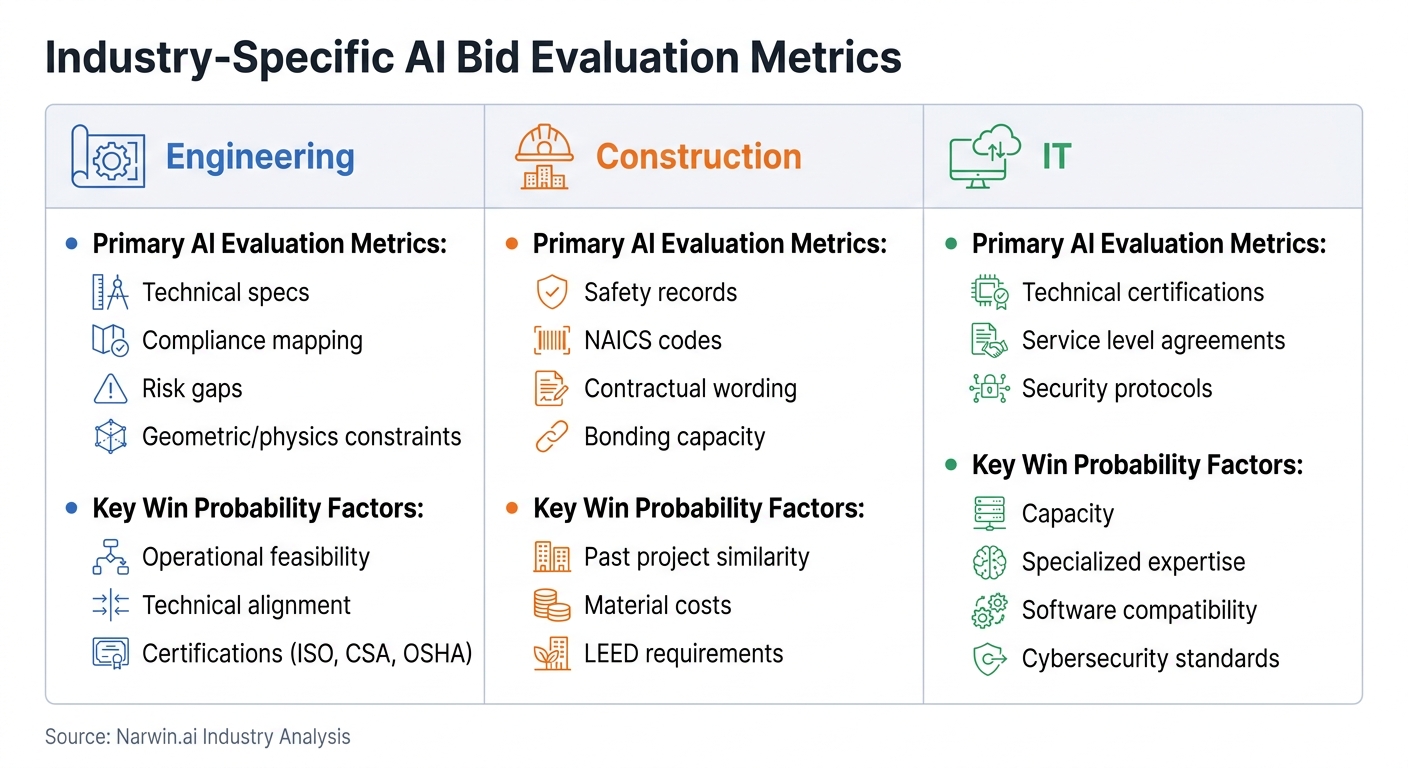
AI Bid Recommendation Metrics by Industry: Construction vs IT vs Engineering
Key Metrics for Engineering Bids
When it comes to engineering bids, the evaluation process hinges on specific technical and compliance metrics. Engineering RFPs often include detailed requirements – like tolerances, material specifications, and safety certifications (ISO, CSA, OSHA) – that must align closely with your firm’s qualifications.
At the core of this evaluation is compliance mapping. This process ensures your certifications, safety records, and project history meet the buyer’s mandatory criteria, helping you avoid disqualification early on. Beyond compliance, AI tools conduct risk gap analyses to identify potential roadblocks, such as missing certifications, restrictive eligibility rules, or financial limitations that could jeopardize your bid.
AI also calculates a color-coded win probability score (ranging from Low to High), which reflects how well your capabilities align with the buyer’s needs, your performance on similar projects, and your strategic fit. By automating these processes, AI can save engineering teams over 15 hours per bid cycle. This allows estimators to shift their focus from manual qualification tasks – often consuming 60–80% of their time – to more strategic, high-value activities. These metrics create a reliable foundation for matching the right engineering projects to your firm’s strengths.
AI’s Role in Engineering Bid Matching
AI fine-tunes its recommendations based on the specific field of engineering. For civil projects like infrastructure or paving, the system evaluates historical data and market trends to predict risks. In mechanical and technical projects, AI identifies patterns in CAE models and matches them to your firm’s technical expertise or previous project designs.
Tools like Narwin.ai further streamline the process by scanning federal and state bidding portals daily, providing instant go/no-go recommendations based on extracted engineering metrics. This feature dramatically reduces the time spent on leadership reviews, shrinking timelines from weeks to mere minutes. Its "Special Instructions" function also helps teams zero in on relevant areas – such as structural steel or concrete – while filtering out unrelated divisions.
Another advantage is automated design reviews. AI can flag missing tolerances, spot inconsistencies, and highlight manufacturability risks before submission. This proactive risk detection has delivered a stunning 2,000x ROI for firms by preventing costly mistakes in the bidding process.
Table: Comparison of Industry-Specific AI Metrics
| Sector | Primary AI Evaluation Metrics | Key Win Probability Factors |
|---|---|---|
| Engineering | Technical specs, compliance mapping, risk gaps, geometric/physics constraints | Operational feasibility, technical alignment, certifications (ISO, CSA, OSHA) |
| Construction | Safety records, NAICS codes, contractual wording, bonding capacity | Past project similarity, material costs, LEED requirements |
| IT | Technical certifications, service level agreements, security protocols | Capacity, specialized expertise, software compatibility, cybersecurity standards |
How Narwin.ai Delivers Industry-Specific Recommendations
AI-Powered Bid Discovery and Matching
Narwin.ai takes a personalized approach to bid matching by creating a Company Profile that acts as your digital fingerprint. This profile is built using your industry-specific certifications – like OSHA credentials for construction or ISO standards for IT – alongside safety records, past project details, and core capabilities. All this data is stored securely in a private vector database, forming a unique knowledge base tailored to your business.
The platform scans thousands of procurement sources across the U.S. and Canada every day, including SAM.gov, CanadaBuys, MERX, BC Bid, and BidNet. Each morning, it delivers a curated list of tenders that align with your profile. These opportunities come with a Preliminary Match Score, a percentage-based evaluation showing how well the RFP fits your qualifications, experience, and capabilities. A color-coded system highlights the likelihood of success, helping you focus on the bids that matter most.
Narwin.ai also includes a natural language search feature, allowing you to search for opportunities in plain English. For example, you could type, "structural steel projects in Texas under $500,000", and the AI will understand your intent, location, and industry needs. Plus, for contractors juggling multiple procurement portals, the Chrome extension brings Narwin’s insights directly to platforms like SAM.gov and MERX, saving you time and effort.
Automating Proposal Writing with AI
Once you’ve identified a promising bid, Narwin.ai steps in to handle the heavy lifting. It can extract key details from even the most complex RFPs – up to 2,000 pages – in less than 10 minutes. This includes compliance clauses, technical questions, evaluation criteria, and deadlines. The system then generates a detailed bid/no-bid analysis report, complete with win strategies, buyer intent insights, and potential risks flagged for your attention. Everything is broken down into actionable steps to guide your team.
When it comes to drafting proposals, Narwin.ai uses Retrieval-Augmented Generation (RAG) technology to pull relevant content from your Knowledge Hub. This includes past wins, case studies, and project descriptions, cutting drafting time from over 20 hours to just about 2 hours per bid. Each proposal is tailored to reflect your company’s experience and tone. You can even customize the AI’s focus by using the "Special Instructions" field. For instance, you might request it to "Highlight our LEED-certified projects and exclude mechanical scope" or "Focus on FedRAMP compliance for cloud services."
To make things even smoother, the platform integrates seamlessly with tools like Google Drive, Slack, and major CRMs through API connections. Daily syncs keep your AI knowledge base up to date with your latest certifications and project achievements. This ensures Narwin.ai continues to refine its recommendations, offering increasingly accurate and relevant insights for your industry.
Conclusion
Benefits of Industry-Specific AI Recommendations
Securing contracts boils down to how well your capabilities align with the specific requirements of an opportunity. Relying on broad, generic strategies often leads to wasted efforts on proposals that don’t stand a chance. That’s where industry-specific AI steps in. By analyzing your certifications, past projects, and technical strengths, it matches these to the detailed requirements of RFPs, pinpointing opportunities that truly fit your expertise.
This precise focus reshapes the bidding process. Instead of spreading resources thin, you can channel your efforts into high-probability opportunities. Contractors using AI-powered recommendations have reported saving significant time and boosting revenue by zeroing in on bids where their qualifications give them an edge. Narwin.ai takes this tailored approach to the next level, fine-tuning every recommendation to maximize its relevance.
Why Narwin.ai Works for Government Contractors
Narwin.ai simplifies the complex bidding process for government contractors, offering more than just opportunity matching – it transforms the entire process with advanced technology.
Government contractors face the daunting task of tracking countless procurement sources, from SAM.gov and CanadaBuys to state and local listings, while navigating documents that can stretch to thousands of pages. Narwin.ai tackles this challenge by scanning key procurement platforms and delivering a curated list of opportunities directly to you every day.
Using its Retrieval-Augmented Generation technology, Narwin.ai drafts proposals that seamlessly reflect your expertise, slashing the time it takes to create proposals. Plus, with integrations like Google Drive, Slack, and major CRMs, the platform keeps your knowledge base updated with your latest certifications and accomplishments. This ongoing learning process ensures that each proposal becomes sharper and more aligned with the unique demands of your industry.
FAQs
What data do I need to upload for accurate bid recommendations?
When using Narwin.ai, providing detailed company information is key to receiving precise bid recommendations. Include details like certifications, safety records, past projects, and capabilities. This information allows the platform to align your business with the most relevant opportunities and deliver insights tailored to your strengths.
You can also upload RFP documents directly. This enables Narwin.ai to assess requirements, check compliance, and even offer bid/no-go recommendations, helping you make informed decisions efficiently.
How are win probability scores calculated for my industry?
Win probability scores rely on AI models that dig into various factors, such as historical data, the details of an RFP, the competitive environment, and your company’s key strengths. Take Narwin.ai, for instance – it assesses elements like compliance, risk, and buyer intent to produce a bid/no-go score. These models also account for industry-specific details, like previous win rates and the quality of proposals. This helps businesses focus on bids with better chances of success and make decisions backed by data.
Can Narwin.ai flag compliance and risk issues before I bid?
Narwin.ai helps spot compliance and risk issues early in the process. By analyzing RFPs, it identifies red flags, evaluates compliance, and pinpoints potential risks. This allows you to make smarter go/no-go decisions with confidence.