
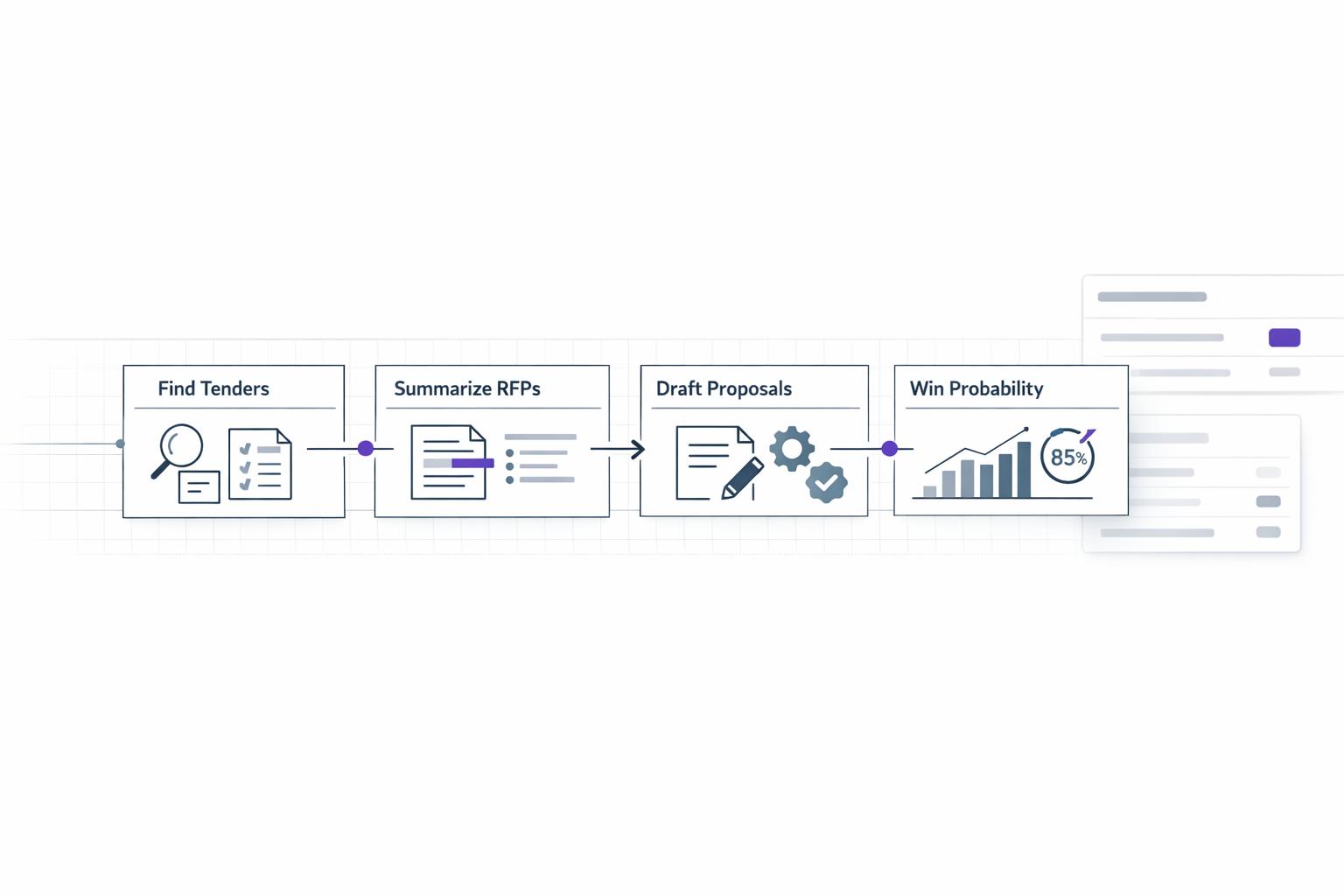
Finding government contracts can be overwhelming due to scattered portals, complex documents, and tight deadlines. AI tools simplify this by consolidating opportunities, summarizing requirements, and ranking bids based on your business strengths. These platforms save time, improve efficiency, and help businesses win more contracts without additional staff.
Key Features of AI Tools:
- Unified Search: Combines federal, state, local, and Canadian procurement data.
- Plain-English Summaries: Translates dense RFPs into easy-to-read formats.
- Semantic Matching: Aligns bids with your capabilities and past performance.
- Proposal Automation: Drafts proposals using your existing materials.
- Real-Time Alerts: Tracks opportunities 24/7 and notifies you of high-fit bids.
- Risk Analysis: Evaluates compliance and win probabilities for better decision-making.
Popular Platforms:
- Narwin.ai: Offers plain-English search, match scoring, and proposal drafting with North American coverage.
- CLEATUS: Adds pre-forecasting for expiring contracts and deep SLED data integration.
- Tenderium: Focuses on RFP summaries and automated proposal creation.
- GovDash: Enhances workflow with compliance tools and Microsoft integrations.
- Procurement Sciences: Provides conversational search and compliance matrices.
Quick Comparison
| Feature | Narwin.ai | CLEATUS | Tenderium | GovDash | Procurement Sciences |
|---|---|---|---|---|---|
| Search Method | Semantic | Natural Query | Semantic | Algorithmic | Conversational |
| Geographic Coverage | US & Canada | US & Canada | US & Canada | US | US & Canada |
| Proposal Drafting | Yes | Yes | Yes | Yes | Yes |
| Risk Analysis | Yes | Yes | No | Yes | Yes |
AI tools are transforming government procurement by reducing search time, automating proposals, and increasing contract wins. Whether you’re a small business or an established contractor, these platforms can help you navigate the complex world of tenders more efficiently and effectively.
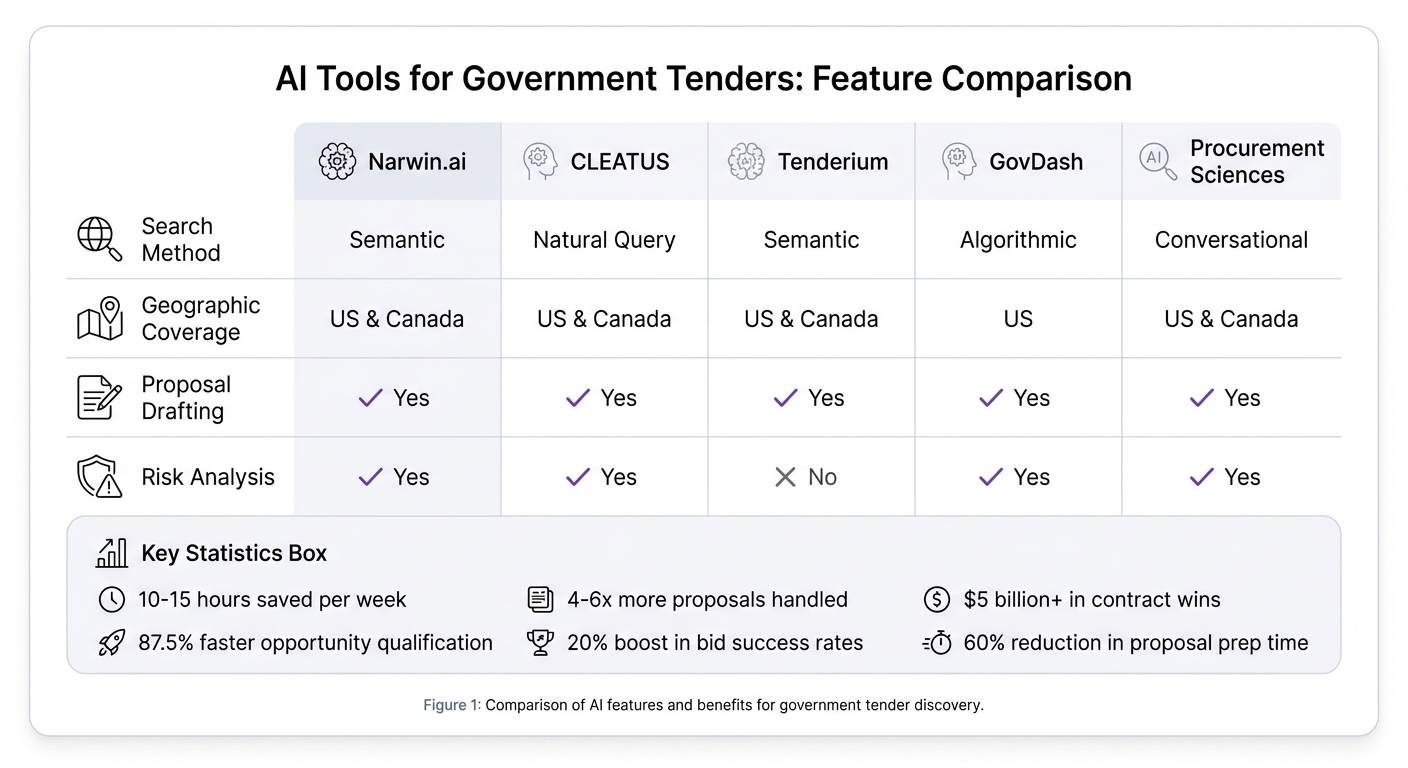
AI Government Tender Tools Feature Comparison Chart
1. Narwin.ai
AI-powered bid discovery
Narwin.ai uses advanced language models to revolutionize how AI is transforming the RFP process. Instead of relying on simple keyword searches, the platform dives deeper by analyzing your company’s strengths, certifications, and past projects to match you with the most relevant opportunities. Forget sifting through endless listings – Narwin’s AI lets you search with plain English queries like “construction contracts in Florida” or “IT consulting for federal agencies.” The system understands the context, location, and scope you’re targeting.
What’s more, Narwin assigns a preliminary match score to each opportunity, so you can instantly see which bids are worth your time. This score helps you avoid wasting energy on contracts that don’t align with your strengths. Plus, the platform extracts key details – like requirements, compliance needs, and deadlines – directly from RFP documents, transforming dense PDFs into easy-to-digest data.
Geographic coverage (US and Canada)
Narwin consolidates procurement data from across North America into one streamlined feed. For the US, it pulls opportunities from SAM.gov, state and local portals, and thousands of SLED (state, local, and education) sources. In Canada, it monitors CanadaBuys, BCBid, provincial systems, and municipal procurement sites. All of this information is presented in a unified format with AI-generated summaries, making it easier to navigate.
Proposal drafting and automation
Narwin doesn’t stop at finding bids – it helps you win them. Using retrieval-augmented generation (RAG), the platform drafts proposals by pulling content from your existing materials, like past proposals, case studies, certifications, and pricing documents. Your data stays secure and exclusive. When you’re responding to an RFP, Narwin generates draft answers tailored to your style and technical expertise. Teams can collaborate seamlessly with unlimited proposal writing seats and integrations with Google Drive, Slack, and major CRMs.
Risk analysis and win probability scoring
Narwin’s proprietary win score evaluates how well your capabilities align with RFP requirements, identifying potential compliance issues or risks before you invest time. It also examines buyer behavior, past awards, and agency trends to estimate your chances of success. With these insights, you get instant go/no-go signals and actionable recommendations, like forming partnerships, earning certifications, or refining pricing strategies. This data-driven approach helps you make quick, informed decisions and focus on bids with the highest potential for success.
sbb-itb-bb3960c
2. CLEATUS by Cleat AI
AI-powered bid discovery
CLEATUS acts as a 24/7 AI capture manager, continuously scanning federal, state, and education portals to uncover opportunities tailored to your business. With natural language queries, you can search for bids effortlessly. For instance, you might type, "Find healthcare IT contracts in Virginia under $500,000", and CLEATUS will surface relevant opportunities.
One standout feature is its pre-forecasting capability, which identifies expiring contracts 12–18 months before re-bid. This gives businesses ample time to establish relationships with agencies and prepare before formal solicitations are issued. Each opportunity includes AI-generated fit scores and compliance ratings, allowing you to focus on bids that align with your strengths. This efficient search function is just the beginning, as CLEATUS also supports proposal creation and risk analysis.
Geographic coverage (US and Canada)
CLEATUS extends its reach by offering detailed geographic data. It pulls information from SAM.gov, DLA DIBBS, GSA eBuy, SeaPort NxG, and over 40,000 SLED sources across all 50 U.S. states. With more than 800,000 active government contracts updated multiple times daily, the platform ensures you stay informed.
In Canada, CLEATUS integrates with Canada Buys, the federal procurement portal, tracking over 250,000 contracts across all 13 jurisdictions. U.S. contractors can also explore Canadian opportunities available under CUSMA trade agreements, including Indigenous set-aside programs under PSIB.
Proposal drafting and automation
CLEATUS simplifies proposal creation with its AI Proposal Writer, which transforms solicitation requirements into customized drafts. By leveraging your Document Hub, it auto-generates compliance matrices, pricing tables, and bid checklists. A real-world example comes from early 2026, when Asad Mansoor of Cloud Control Studio used CLEATUS to help a small, two-person team review and submit over 10 proposals in just 90 days. Users have reported an 80% reduction in proposal-related labor and a 4–6x increase in proposal submissions, making the platform a game-changer for efficiency.
Risk analysis
CLEATUS evaluates every opportunity with a fit and compliance score, drawing on your capabilities and historical data. The AI considers factors like past awards, compliance challenges, and competitive insights to guide bid/no-bid decisions. Companies using CLEATUS have collectively secured over $1 billion in government contracts, with users experiencing a 75% reduction in discovery time and a 75–90% reduction in capture and proposal preparation time.
3. Tenderium
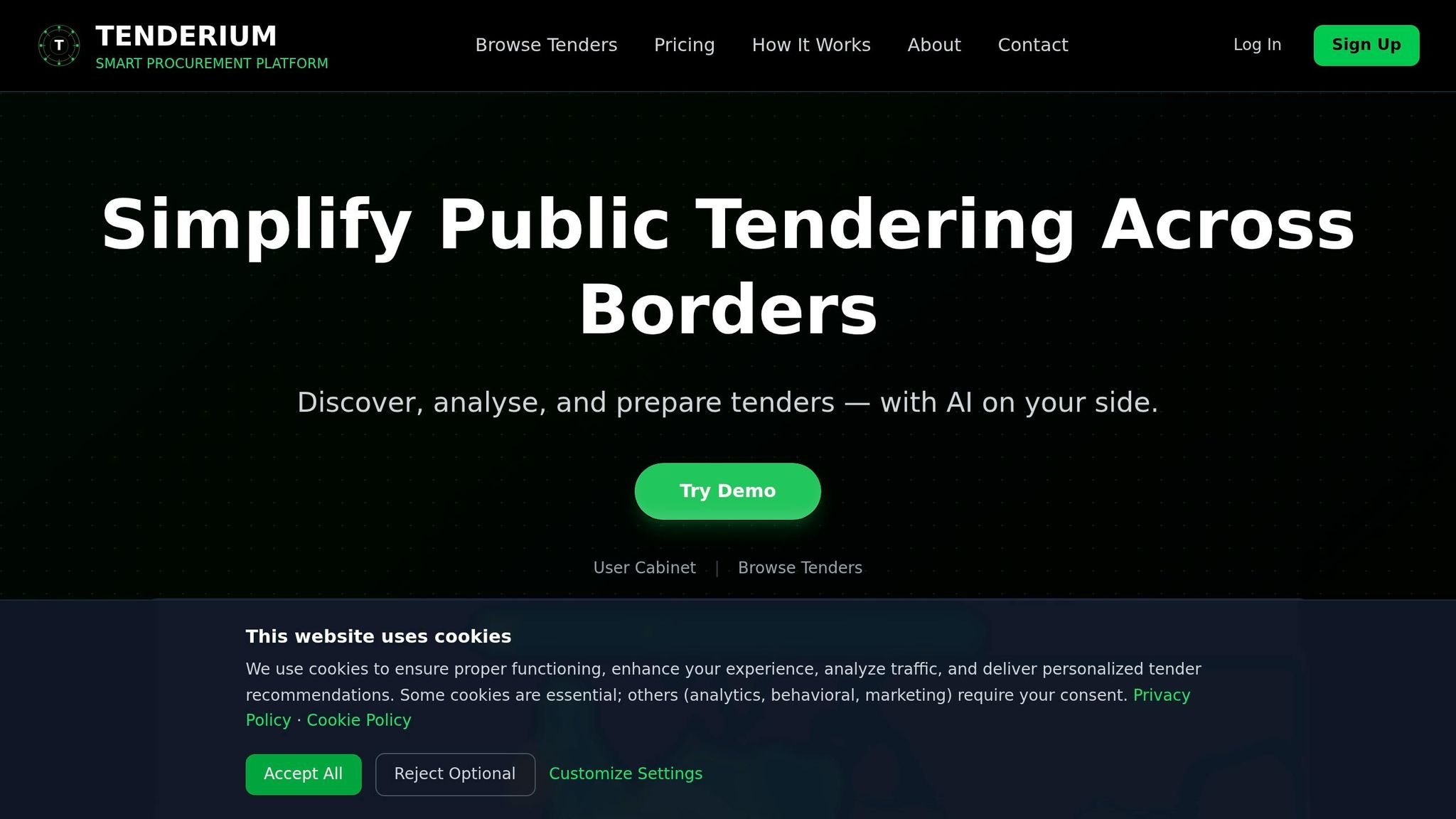
Tenderium takes efficiency to the next level by combining AI-driven tools for contract discovery and proposal automation.
AI-Powered Bid Discovery
This platform simplifies the process of finding government contracts by scanning official procurement sources across the US and Canada. Tenderium pulls opportunities directly from SAM.gov and CanadaBuys, ensuring you don’t miss out on any potential bids. To save time, it converts lengthy procurement documents into easy-to-read summaries, giving you a clear understanding of core requirements without digging through dense PDFs. By streamlining this initial step, Tenderium helps you focus on preparing competitive proposals.
Proposal Drafting and Automation
When it comes to drafting proposals, Tenderium uses AI to do the heavy lifting. Its "RFP shredding" feature analyzes historical RFPs and your company’s documents to extract key requirements. From there, it generates drafts covering areas like project management, risk planning, and accessibility commitments. This automation cuts down on repetitive tasks, freeing your team to focus on crafting a winning strategy.
4. GovDash
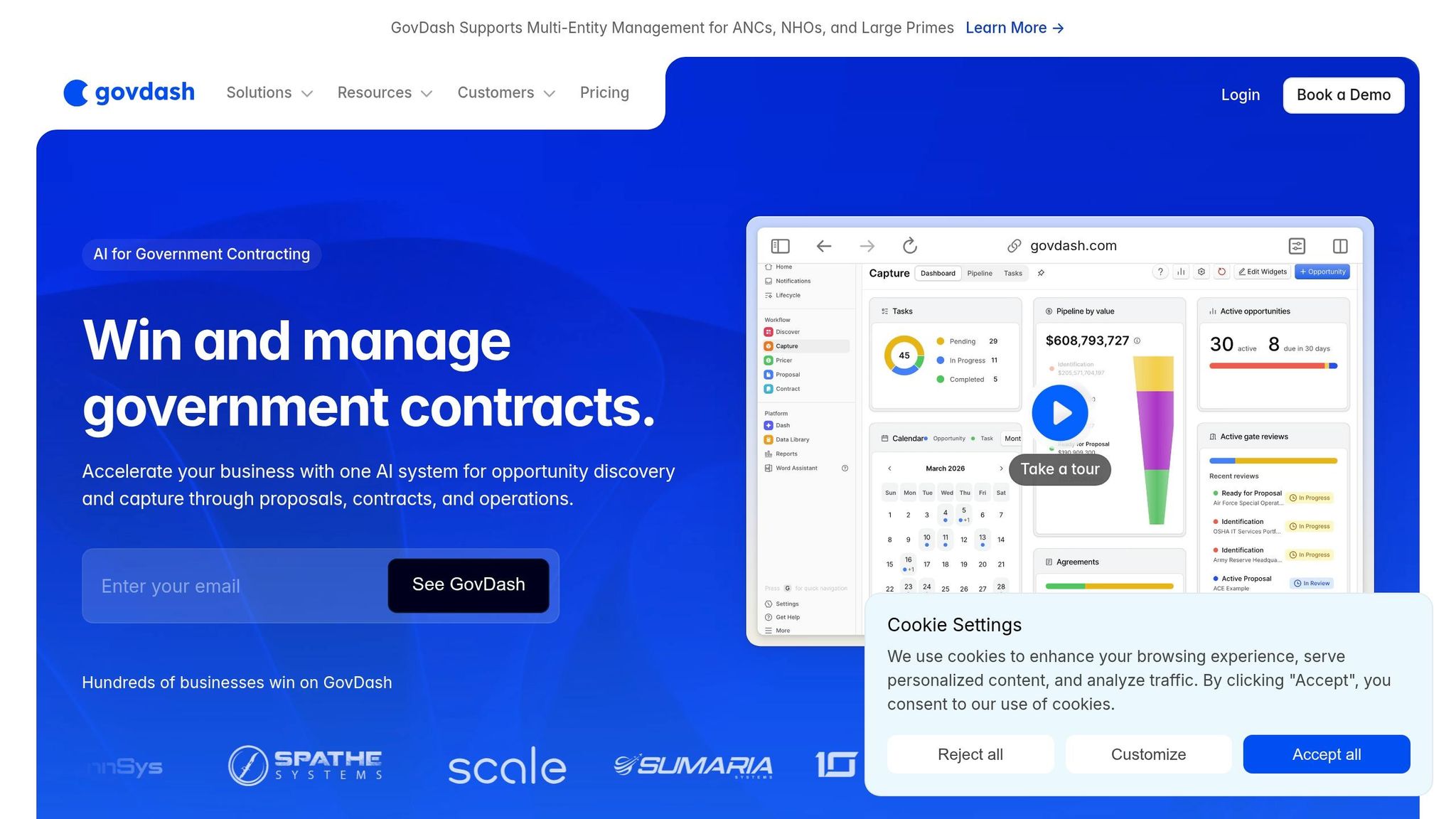
GovDash is an AI-driven platform designed specifically for government contractors, offering tools for both bid discovery and contract management. It provides a seamless experience for locating opportunities and automating the proposal process, saving time and effort for teams working on federal, state, or local projects.
AI-Powered Bid Discovery
GovDash uses advanced algorithms to scan government procurement databases and identify bids that align with your business. Its recommendation engine increases weekly qualified opportunities by 150%, eliminating the need for tedious manual searches. This efficient discovery process integrates smoothly with its automated proposal features, creating a streamlined workflow.
Proposal Drafting and Automation
GovDash significantly cuts down the time required to prepare proposals. It automatically creates annotated outlines and compliance-ready narratives tailored to specific agency requirements. The platform integrates directly with Microsoft Word and SharePoint, so teams can stick to their existing tools without learning new systems.
Here are some standout results reported by users:
- 60% reduction in overall proposal preparation time
- 50% of initial drafts generated automatically by AI
- Teams reach "pink team" draft stages 50% faster
- RFI response times decrease by 80%
Additional features include the ability to produce custom graphics in seconds and compliance tools that help prevent errors before submission. Over the past year, GovDash has helped its users win more than $5 billion in contracts.
The platform operates on FedRAMP-compliant infrastructure with strict controls for Controlled Unclassified Information (CUI). All employees are based in the United States, ensuring compliance and security. New users benefit from a structured 30-day onboarding process, during which the platform syncs with SharePoint documents and trains its AI on your company’s templates.
5. Procurement Sciences
Procurement Sciences leverages advanced AI to track thousands of federal, state, and local procurement sources in real time. It allows users to perform plain-language searches, avoiding the limitations of traditional keyword-based methods.
AI-Powered Bid Discovery
The platform’s AI engine works continuously to scan procurement databases, using conversational search to pinpoint relevant opportunities. This ensures businesses can uncover bids that may be missed with standard keyword searches.
Geographic Coverage (US and Canada)
Procurement Sciences offers extensive coverage across North America, combining data from both the United States and Canada. In the U.S., it pulls information from SAM.gov, as well as state and local portals. For Canadian users, it monitors CanadaBuys and provincial procurement systems. This integrated approach saves businesses from the hassle of navigating multiple government websites, making it easier to discover cross-border opportunities. Additionally, the platform simplifies the proposal process to help businesses act quickly.
Proposal Drafting and Automation
The platform also includes AI tools to streamline proposal creation. It can generate drafts for complex sections like project management strategies or risk mitigation plans by analyzing past RFP data and successful submissions. Beyond drafting, it breaks down solicitation documents to highlight requirements and create compliance matrices. This ensures teams meet all necessary criteria before submitting their proposals.
Conclusion
AI-powered platforms are reshaping how businesses find and pursue government contracts. These tools cut out the tedious task of sifting through scattered databases, saving users an impressive 10 to 15 hours each week. Some teams have even reported qualifying new opportunities up to 87.5% faster thanks to these advancements.
But the benefits go beyond just saving time. AI tools are driving real financial growth. One vendor team, for instance, saw their pipeline grow by 33% without hiring additional business development staff. These platforms don’t just help businesses identify more bids – they help them win more. Features like instant go/no-go decisions, compliance matrices, and AI-generated proposal drafts allow teams to handle 4 to 6 times more proposals without increasing headcount. In fact, users have reported a 20% boost in bid success rates, with some platforms contributing to over $5 billion in contract wins in a single year.
When choosing an AI platform, it’s essential to pick one that aligns with your specific needs. For example, businesses in construction or janitorial services should ensure the platform includes state, local, and education (SLED) opportunities, as 80% of these contracts never show up on federal portals like SAM.gov. Defense contractors, on the other hand, should prioritize providers with government-grade encryption and U.S.-based infrastructure to meet strict data residency requirements. Most platforms also offer free trials lasting 7 to 14 days, giving you a chance to test their accuracy and fit before making a commitment. Tools like Narwin.ai stand out by offering intelligent proposal drafting and risk analysis, making them particularly effective for tackling the challenges discussed in this article.
An effective AI tool should feel like an around-the-clock expert on your team. Whether you’re a small business stepping into government contracting or a seasoned company looking to expand, these platforms offer the intelligence and efficiency needed to compete in today’s procurement environment.
Start by identifying your biggest challenge – whether it’s finding hidden opportunities, navigating complex RFPs, or crafting compliant proposals – and choose a platform that directly addresses that need. Narwin.ai, with its tailored solutions, is a strong contender for businesses seeking comprehensive support. Investing in AI-powered procurement tools often pays off through improved efficiency, higher win rates, and the ability to seize opportunities that might otherwise go unnoticed.
FAQs
How do AI tender tools find bids that keyword search misses?
AI tender tools rely on advanced technologies such as natural language processing (NLP) and machine learning to make sense of complex documents. Unlike basic keyword searches, these tools can identify synonyms, related terms, and context-specific phrases that might otherwise go unnoticed. By using semantic analysis, they can grasp the intent and relevance behind the text, ensuring businesses don’t miss out on opportunities due to differences in wording or terminology. This approach allows companies to uncover bidding opportunities that are more precise and better suited to their needs.
What should I prepare before using Narwin.ai to draft proposals?
Before diving into drafting proposals with Narwin.ai, take a moment to update your company profile. Include key details like certifications, safety records, completed projects, and your core capabilities. Why? Because this information helps the platform create proposals that are tailored specifically to your business.
Also, gather all the essentials – such as past proposal examples, important documents, and other relevant company data. Having these on hand not only streamlines the integration process but also ensures you make the most out of Narwin.ai’s AI-driven proposal automation tools.
How can I tell if an opportunity is worth bidding on?
Narwin.ai simplifies the process of evaluating bid opportunities by analyzing key factors such as how well an RFP aligns with your capabilities, the feasibility of meeting deadlines, and any potential risks involved. With tools like bid/no-bid analysis and instant go/no-go signals, it helps you determine both the practicality and profitability of pursuing a bid. By leveraging AI-driven insights – like scoring and fit assessments – you can concentrate on bids that play to your strengths and offer a higher chance of success, making your efforts more focused and strategic.