
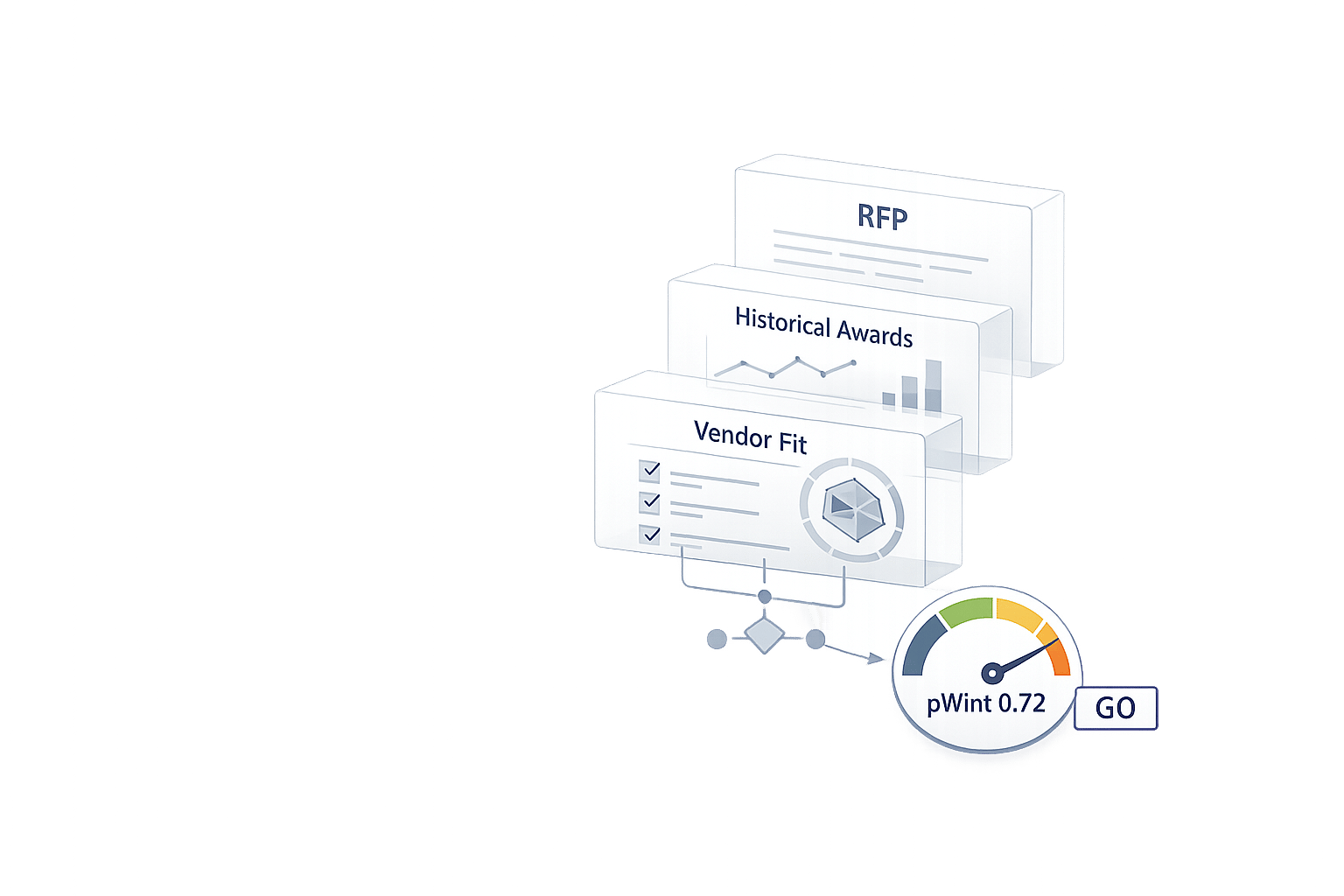
AI can now predict your chances of winning a proposal in minutes. By analyzing data from RFPs, past performance, and buyer behavior, AI calculates a "win score" and a "pWin" percentage (probability of winning). These insights help businesses decide whether to pursue or skip costly proposals, which can cost $50,000 to $500,000 to prepare.
Key Points:
- Win Score: A detailed evaluation of your proposal’s strengths across factors like technical fit, pricing, and relationships.
- pWin: A percentage (0%-100%) estimating your odds of winning.
- Data Sources: RFP details, past bid performance, buyer intelligence, and competitor analysis.
- AI Methods: Combines supervised learning and NLP to assess both structured and unstructured data.
- Decision Thresholds:
- 70%+ = Strong go.
- 50%-69% = Conditional go.
- Below 50% = Reconsider.
AI tools like Narwin.ai streamline decision-making, updating scores in real-time as new information emerges. While AI enhances speed and accuracy, human judgment remains essential for strategic decisions and resource allocation.
The Data AI Uses to Predict Win Scores
AI’s ability to predict win scores hinges on the quality and depth of the data it processes. To produce accurate probability estimates, AI systems combine structured data (like codes and numerical inputs) with unstructured data (such as documents and narratives). The reliability of these predictions is directly tied to the quality of the input data. Let’s explore how different types of data contribute to creating dependable win scores.
Proposal and Opportunity Data
The foundation of any win score prediction starts with the Request for Proposal (RFP). AI systems analyze the complete solicitation package, including key sections like the Performance Work Statement (PWS), Statement of Objectives (SOO), Section L (instructions for offerors), and Section M (evaluation criteria). Using natural language processing, AI extracts critical details such as compliance requirements, technical questions, and submission deadlines. It also tracks amendments and Q&A releases that could alter evaluation priorities.
Section M plays a pivotal role by outlining scoring criteria, helping AI align your company’s strengths with the agency’s priorities. Combined with historical data, these insights allow AI to refine its win score calculations, ensuring predictions are grounded in both the RFP specifics and past trends.
Historical Win/Loss and Performance Data
AI systems heavily rely on historical bid data to identify patterns between proposal characteristics and contract awards. Among various factors, past performance accounts for about 20% of the weight in Bayesian win probability models, making it the single most influential predictor of federal contract success – more than pricing or technical approach.
AI evaluates your CPARS (Contractor Performance Assessment Reporting System) ratings, particularly focusing on designations like "Exceptional", as well as the recency and relevance of past contracts (usually within the last 3–5 years). Additionally, AI can draw on decades of federal procurement data from platforms like FPDS-NG and USAspending.gov, uncovering long-term agency behavior patterns. The completeness of your historical performance data directly impacts the precision of the win score.
"The difference between winning and losing in GovCon often comes down to the quality of your Go/No-Go analysis. pWin gives you the quantitative framework to make that decision with confidence." – Haroon Haider, CEO, Aliff Solutions
Contextual Procurement Data
AI doesn’t stop at analyzing the RFP and your own track record – it also considers the broader procurement context. This includes buyer intelligence, such as an agency’s historical spending habits, risk tolerance, and award trends, as well as the competitive landscape, including the number of competitors and whether an incumbent contractor is involved.
Structured data like NAICS codes, set-aside status (e.g., 8(a), HUBZone, SDVOSB), and Period of Performance establish a baseline for the model. For example, a sole-source procurement starts with a higher probability baseline compared to a full-and-open competition with numerous competitors. Tools like Narwin.ai integrate buyer and competitive data into their win score analyses, leveraging procurement data from both the US and Canada to provide contractors with a comprehensive view of the opportunity.
| Data Category | Key Inputs | Source Type |
|---|---|---|
| Opportunity Data | PWS, SOO, Section L & M, NAICS codes, set-aside status | Structured & Unstructured |
| Historical Data | CPARS ratings, win/loss labels, past proposal drafts | Structured & Unstructured |
| Company Data | Certifications (ISO, CMMC), key personnel resumes, case studies | Unstructured |
| Market/Buyer Data | Incumbent identity, agency spend history, number of competitors | Contextual |
How AI Methods Calculate Win Scores
When you’ve gathered the right data, the next step is figuring out how AI transforms that data into a win probability score. This process relies on three key techniques: supervised learning, natural language processing (NLP), and hybrid models that merge both approaches.
Supervised Learning for Win Probability
Supervised learning forms the backbone of most win score systems. These models are trained on thousands of historical bids, each labeled as either a win or a loss, to identify patterns that predict success.
Many platforms use a Bayesian framework. The model starts with a prior probability based on the type of procurement. For example, a sole-source contract naturally has a higher baseline probability than a full-and-open competition with numerous competitors. From there, the model updates this baseline using opportunity-specific evidence to calculate the final win probability.
The weighting of factors in these models is far from random. Based on Bayesian models trained on federal procurement data, Past Performance and Technical Capability each account for about 20% of the total score weight, while Pricing Position, Agency Relationships, and Competitive Landscape each contribute 15%. Advanced models use a logistic transformation – for instance, 1/(1+EXP(-8*(NormalizedScore-0.5))) – to normalize raw scores, ensuring outputs stay between 2% and 95%. This approach makes the results actionable, with proposals scoring above 70% indicating strong potential for investment and guiding go/no-go decisions.
"A model trained on last year’s federal contracts can tell you what happened recently. A model trained on decades of federal data can tell you what is going to happen next." – Aliff Solutions
While supervised learning provides the numbers, NLP dives into the text for deeper insights.
Natural Language Processing for Proposal Quality
Where supervised learning focuses on quantifying competitive positioning, NLP evaluates the actual text of the Request for Proposal (RFP) and your submission. It assesses quality, alignment, and potential risks. For instance, it can flag missing certifications, unresolved organizational conflicts of interest (OCI), or tight deadlines. At the same time, it uncovers buyer priorities and risk tolerance by analyzing patterns in the solicitation language and historical agency evaluations.
Using both structured and unstructured data, multi-class classification models have achieved 85% accuracy and an average AUC score of 0.94 in predicting outcomes like "win", "no bid", or "lost to competition."
What sets NLP apart is its evidence-based scoring. Each rating is tied to specific sections of the RFP or entries in your company profile, making the scoring process transparent and auditable, rather than a mysterious black box.
Hybrid Models That Combine Text and Structured Data
Hybrid models take it a step further by merging insights from supervised learning and NLP. These models convert text features – like SOW descriptions or agency names – into vector representations using tools like CatBoost. They then combine this with structured data, such as NAICS codes, set-aside statuses, or IGCE estimates, into a single feature vector. Using algorithms like LightGBM, these models generate scores that reflect both qualitative and quantitative strengths.
Platforms like Narwin.ai leverage this multimodal approach, drawing on procurement data from both the US and Canada. The result? Speed and depth. What once took capture teams hours – or even days – of manual effort can now be completed in about 1 to 2 minutes, complete with references to the specific RFP sections or company data that influenced the score.
How AI Win Scores Work Inside Proposal Workflows
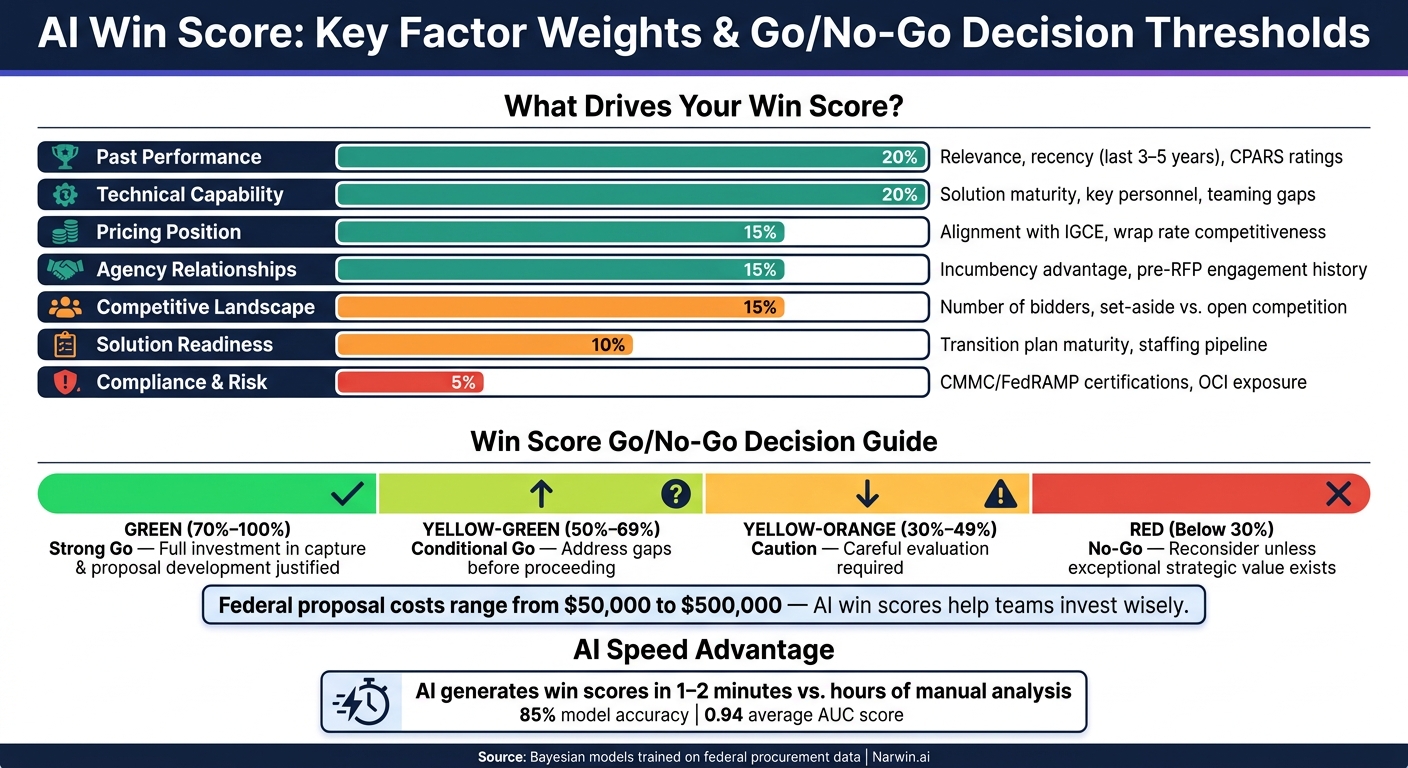
AI Win Score Decision Thresholds & Key Factor Weights in Federal Proposals
Building on AI methodologies, integrating these systems into proposal workflows transforms raw data into actionable insights, helping teams make smarter decisions.
From Raw Data to Normalized Win Scores
Once the AI model is trained, it processes each new opportunity through a structured pipeline. The system ingests raw RFP documents – whether in PDF, DOCX, or XLSX format – and extracts critical details like requirements, compliance clauses, deadlines, and evaluation criteria. It then cross-references this information with your company’s internal data, such as past projects, certifications, key personnel, and historical bid outcomes.
The AI generates factor scores, which are then normalized across different agencies and contract types. Using formulas like SUMPRODUCT(Weights, Ratings/5) / SUM(Weights), these scores are converted into a win probability percentage, typically ranging from 2% to 95%. This range ensures realistic expectations, avoiding misleading claims of near-certain wins or losses, given the inherent uncertainty in procurement processes.
Each win score is paired with a confidence rating – Low, Medium, or High – based on the quality of supporting data. For instance, a score backed by detailed CPARS ratings and recent relevant contracts will have a High confidence rating. In contrast, a score based on limited data will flag as Low, signaling the need for additional research before proceeding.
Key Factors That Drive Win Scores
Not all inputs are equally weighted in determining win scores. Below is a sample factor model commonly used in federal procurement, showing how AI systems prioritize key variables:
| Factor | Weight | Evaluation Criteria |
|---|---|---|
| Past Performance | 20% | Relevance, recency (last 3–5 years), CPARS ratings |
| Technical Capability | 20% | Solution maturity, key personnel, teaming gaps |
| Pricing Position | 15% | Alignment with IGCE, wrap rate competitiveness |
| Agency Relationships | 15% | Incumbency advantage, pre-RFP engagement history |
| Competitive Landscape | 15% | Number of bidders, set-aside vs. open competition |
| Solution Readiness | 10% | Transition plan maturity, staffing pipeline |
| Compliance & Risk | 5% | CMMC/FedRAMP certifications, OCI exposure |
In addition to these factors, AI identifies specific risk flags, such as missing key resumes, unresolved organizational conflicts of interest, or pricing outside the agency’s historical range. These insights provide proposal teams with actionable steps, not just a number to interpret, helping them refine their strategies for success.
Using Win Scores to Support Go/No-Go Decisions
Developing a federal proposal can cost anywhere from $50,000 to $500,000, making the go/no-go decision a critical one. AI win scores bring clarity and structure to this process, replacing much of the subjectivity with data-driven insights.
Most teams use a threshold system for decision-making:
- Scores of 70% or above indicate a strong go, justifying full investment in capture and proposal development.
- Scores between 50% and 69% suggest a conditional go, where gaps must be addressed before proceeding.
- Scores in the 30%–49% range call for careful evaluation.
- Scores below 30% typically lead to a no-go unless there’s exceptional strategic value.
Platforms like Narwin.ai integrate these win scores directly into bid analysis workflows, allowing teams to act quickly without switching tools or waiting for manual reviews.
Real-time re-scoring is another advantage. If an agency releases amendments or Q&A documents, the AI can update the win score within 1–2 minutes, reflecting the new information. This ensures that go/no-go decisions remain current throughout the entire pre-submission phase, giving teams the flexibility to adapt as circumstances change.
sbb-itb-bb3960c
Limitations and Governance of AI Win Score Predictions
AI win scores can provide valuable insights, but they are not without flaws. It’s essential to understand their boundaries to use them effectively.
Bias and Fairness in AI Predictions
AI win scoring often reflects the biases embedded in its training data. Since these models rely heavily on historical contract awards, they tend to favor incumbents and well-established firms. For example, a newer company with strong qualifications but limited past performance may receive a lower score – not because they lack capability, but because the model hasn’t encountered enough similar data to assess them fairly.
Human input can also introduce bias. When team members score subjective factors like "technical capability" on a scale of 1–5 without a standardized rubric, one person’s "average" could be another’s "excellent." These inconsistencies feed into the model and distort its predictions. To address this, teams should use clear, evidence-based rubrics and require specific citations for each score.
Another common issue is double counting, where a single factor – like a "Transition Plan" – gets evaluated under multiple categories, inflating its impact on the overall score. Regular calibration sessions, such as quarterly reviews comparing predicted scores to actual outcomes, can help identify and correct these distortions.
Human Judgment and AI Integration
AI win scores are tools meant to support, not replace, human decision-making. The ultimate decision to pursue a bid still requires human insight – and for good reason.
"Will AI replace human judgment? No. It accelerates and evidences your judgment – so leaders can decide quickly, with facts on the table." – CLEATUS
There are critical factors AI simply can’t evaluate. For instance, whether a bid aligns with your company’s long-term strategy, whether your team has the capacity to deliver, or whether a strong relationship with an agency contact could shift the competitive landscape. These are nuanced considerations that require human interpretation and context. AI can present the data, but it’s up to decision-makers to determine what it means for their specific situation.
Additionally, AI cannot make resource allocation decisions. Approving the $50,000 to $500,000 often required to develop a serious proposal demands human leadership. These choices involve weighing priorities and risks – something no algorithm can fully account for, especially in uncertain procurement scenarios.
Where AI Predictions Fall Short in Public Procurement
Certain aspects of public procurement are beyond the predictive capabilities of any AI model. Binary hard gates – such as security clearances, facility authorizations, or certifications like CMMC and FedRAMP – are pass/fail requirements. If your firm doesn’t meet these criteria, the win score becomes irrelevant. These compliance checks should always be completed before even considering AI scoring.
AI also struggles with external factors that are unpredictable, such as mid-cycle budget cuts, sudden policy changes, or unannounced sole-source awards. A study of 200 government IT RFPs revealed that 34% of losing proposals failed due to missing mandatory administrative or technical requirements – issues that stem from compliance gaps, not scoring errors. While AI can flag missing documents or certifications, it can’t predict shifts in an agency’s priorities after a solicitation is released.
Conclusion: Using AI Win Scores to Make Better Proposal Decisions
AI win scores serve as tools to support decision-making, not as the final word. Their main purpose is clear: they provide a numerical probability based on RFP data, past performance, and procurement history. This replaces guesswork with a structured, data-driven approach.
By focusing your resources on bids with higher win probabilities, you can make smarter use of your time and budget. Consider using PWin thresholds: bid confidently at 70% or above, proceed cautiously at 50–69%, and rethink your approach for scores below 50%. If specific sub-scores – like Key Personnel or Past Performance – are low, these can highlight areas to strengthen before pursuing similar opportunities.
The accuracy of these tools depends heavily on the quality of the data you provide. As Narwin’s documentation explains:
"The richer your company profile, the more accurate your AI recommendations, match scores, and proposal drafts become."
To enhance accuracy, regularly update your AI platform with past bids, certifications, and project references. Tools like Narwin.ai leverage this concept by comparing your company’s profile against thousands of sources, such as SAM.gov, CanadaBuys, and BCBid. This helps identify and rank opportunities before your team invests time in manual reviews.
Also, re-run AI analyses whenever there are RFP amendments or Q&A updates. Even small changes in requirements can impact your win probability. Spotting these shifts early allows you to adjust your strategy – or step back – before committing too many resources to a bid that may no longer be viable.
FAQs
How is pWin different from a win score?
While both pWin and win scores aim to predict success, they differ in focus and depth. A win score offers a broad estimate of success, often based on historical data and compliance metrics. On the other hand, pWin dives deeper, delivering a data-driven prediction tailored to a specific bid. It considers factors like risk, past performance, and competitor analysis.
This detailed insight makes pWin especially useful for guiding go/no-go decisions, helping teams prioritize bids with a stronger likelihood of success.
What data do I need to get accurate win predictions?
To make precise win predictions, it’s essential to gather a wide range of data. Start with details about your company’s capabilities, certifications, past projects, compliance records, and relevant experience. Then, collect information on the specific RFP requirements, buyer profiles, competitive landscape, and any potential risks. With this complete dataset, AI algorithms can assess your proposal’s chances of success with greater accuracy.
How often should I re-run the win score during an RFP?
Recalculate the win score every time you update your proposal data or make adjustments, like adding new details or revising existing ones. This helps ensure your evaluation stays accurate and incorporates the latest information.