
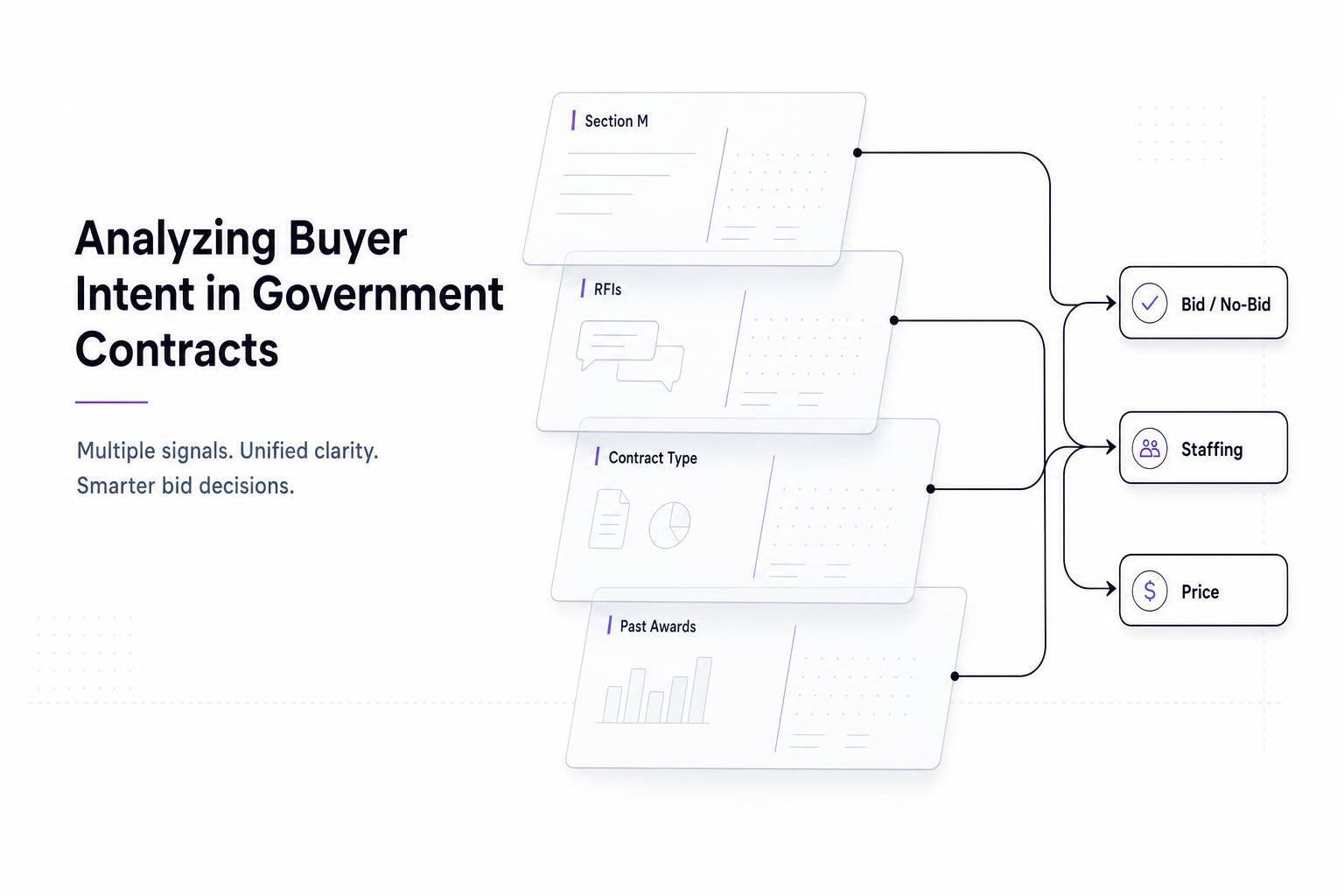
If I wait for the RFP to drop, I’m already late. In federal buying, many award signals show up months earlier through RFIs, sources sought, past awards, contract type, and Section M. Since buying cycles often run 9 to 18 months, the teams that read those signals early make better bid/no-bid calls and write to the factors that will decide the award.
Here’s the short version:
- I look at Section M first to see what gets scored.
- I separate pass/fail gates from score-moving factors.
- I check contract type and evaluation method to read price and risk.
- I review RFIs, sources sought, Q&A, and past awards to see where the agency is headed.
- I treat hard gates like CMMC, facility clearance, and TS/SCI as early filters.
- I use tools and past spend data to check whether pricing is in line with prior awards.
A few signals can change the whole decision. For example, a response window of under 14 days on a mid-size RFP can point to an incumbent edge. A thin scope tied to a contract worth $500,000+ can mean the buyer expects the winner to already know the work. And if a clearance can take 12 to 18 months to obtain, missing it usually means no-bid.
This article boils buyer intent down to one simple idea: I should respond to what the evaluator will score, not to every page with equal effort. From there, the work is to read the documents in the right order, spot early buying patterns, and turn those signals into proposal choices on staffing, proof points, transition, and price.
The Core Problem: Buyer Intent Is Hidden in Dense Solicitation Documents
Government solicitations follow FAR rules, which means compliance-heavy language often covers up what evaluators will actually score.
That creates a common problem: teams spread the same level of effort across a long, dense RFP. They write equally strong answers for pass/fail items and for the factors that will decide the award. That’s how points slip away.
Sometimes the final RFP also reflects language shaped by early market research or vendor outreach, not just the agency’s internal wording. So what you see in the solicitation may point to decisions that started well before release.
Where Teams Commonly Misread Agency Priorities
The most common mistake is treating pass/fail requirements like they set a proposal apart. They don’t. If an RFP calls for a specific certification or clearance level, meeting that bar gets your team in the game. It does not win the award. Evaluators see those items as thresholds, not scored strengths.
Teams also lean too hard on product features and technical capability when the agency’s main concern is often delivery risk and results. If an agency has lived through a failed implementation, it usually wants proof that the contractor can manage risk, hit milestones, and show performance, not just talk about tools.
Another common miss is overlooking nonnegotiable requirements. Key personnel, specific certifications, and clearances may be scattered across Sections L, M, C, and H. That’s why teams need to cross-reference those sections early, before writing starts.
Which Solicitation Documents Reveal Intent Most Clearly
Start with the sections that show scoring, not the ones that just restate scope. Experienced capture managers usually read Section M first, then Section L, then Section C.
- Section M (Evaluation Factors for Award): shows what is scored and how
- Section L (Instructions to Offerors): shows how the response should be built
- Section C (Scope of Work or PWS): adds the technical detail, once you know what evaluators are grading
Beyond Section M, one of the clearest signals in the document is contract value versus scope length. A high-value contract with a short scope and a tight response window often suggests the agency already has a direction in mind, and that the solicitation was shaped before publication.
| Document Element | What It Reveals |
|---|---|
| Section M (Evaluation Factors) | What is actually scored and how heavily |
| Contract value vs. scope length | Whether the agency expects the winner to already know the work |
| Response deadline | Whether the timeline was set for a preferred vendor |
| Brand-name specs without "or equal" | Intent to award to a specific product or vendor |
| Amendments and Q&A responses | Whether the agency is maintaining or loosening restrictive requirements |
| Pre-solicitation notices | Early intent signals before the formal solicitation is published |
Use these signals to decide what to stress, what to play down, and what to leave out before you draft.
sbb-itb-bb3960c
Buyer Intent Signals Contractors Should Analyze First
Once you know where buyer intent shows up, the next step is figuring out which signals matter most. Some details can change your score, your risk, and your odds of winning. Others barely move the needle.
Evaluation Criteria, Scoring Method, and Contract Type
The evaluation method is one of the strongest signals in any solicitation.
A Best Value Tradeoff setup gives the agency room to pay more for stronger technical work or less risk. An LPTA setup works very differently. It rewards the lowest-priced proposal that meets the minimum technical threshold. In LPTA, the play is simple: meet the bar, then win on price.
Contract type adds another layer.
With FFP, more performance risk sits with the contractor. With cost-reimbursement, the government takes on more of that risk, but there’s a catch: cost realism reviews. If your pricing looks too low to be believable, evaluators can reject it. Going in cheap won’t save you if the numbers don’t make sense.
Once the agency has spelled out the risk posture and delivery model, the next place to look is what happened before the solicitation.
Pre-Solicitation Notices, RFIs, and Historical Buying Patterns
Not all buyer intent lives inside the RFP. A lot of it shows up earlier, in how the agency buys.
Government buying cycles often run 9 to 18 months from budget approval to contract award. That means some of the best signals appear long before the formal solicitation lands. Sources sought notices and RFIs can show how early the agency is still shaping the requirement. If you respond, you get a better read on where the scope is heading and whether a small business set-aside is on the table.
Past award behavior matters too. If the same vendor keeps winning in the same agency and NAICS code, that points to incumbent advantage. Pair that with a response window of under 14 days for a medium-complexity RFP, and it may mean the deal is already leaning in a certain direction.
Compliance Depth, Oversight Requirements, and Past Performance Requests
If evaluation rules tell you how the agency will score proposals, compliance language tells you how hard it will screen them.
Requirements like CMMC Level 2 or 3, facility clearances, and Secret or TS/SCI access often point to a risk-averse buyer. In many cases, these are binary filters. You either have them or you don’t. Since clearances can take 12 to 18 months to get, treat the opportunity as a no-bid if you don’t already hold the needed clearance.
Past performance requests also deserve a close read. Agencies usually want recent, comparable work, but the details tell the bigger story. Look at the outcomes they want those references to prove. If the solicitation asks about schedule adherence, quality control processes, or data security incidents, those topics show what evaluators care about most.
That helps you decide what to lean on in your proposal:
- Proof when the agency wants evidence of results
- Process when they care about how work gets managed
- Pass/fail eligibility when compliance is the main gate
A Practical Framework for Turning Buyer Intent Into Proposal Strategy
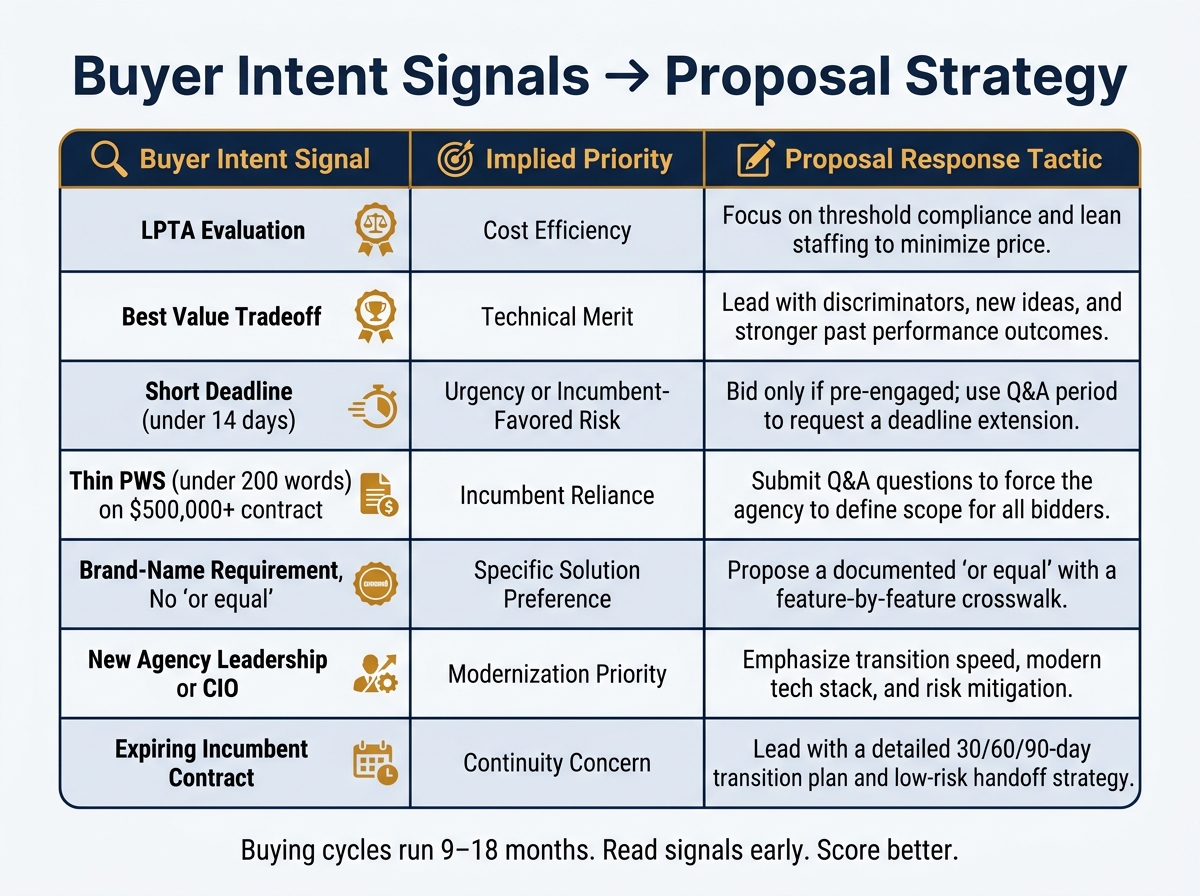
Buyer Intent Signals to Proposal Strategy: A Government Contracting Cheat Sheet
Build a Buyer Intent Analysis for Every Opportunity
Once the buyer’s signals are clear, turn them into a short intent brief before you start drafting. This brief should answer the questions that shape your win plan.
Focus on the agency’s core mission, the exact problem the solicitation is trying to fix, and the outcomes evaluators are most likely to reward. Then add the evaluation model, contract type, and any must-meet compliance rules. Split pass/fail items from scored differentiators before you write a single section.
That brief should guide every later decision in the technical approach, staffing plan, and price.
Tailor the Technical Approach, Staffing, and Pricing to Match Intent
When you know what the buyer cares about, every part of the proposal should line up with it. Best Value calls for clear discriminators, not just compliance. LPTA calls for the leanest compliant solution at the lowest supportable price.
If the solicitation puts weight on oversight, reporting, and quality control, the staffing plan should name a dedicated QC lead and show how that role ties to deliverables. If the RFP calls for 10+ years in a labor category, start sourcing that talent right away.
On pricing, use tools like GSA CALC to benchmark labor rates and USAspending.gov to check what the agency has paid on predecessor contracts. Set PTW from benchmarked labor rates and prior awards.
Map Buyer Intent Signals to Proposal Response Tactics
Use the signal-to-tactic map below to turn intent into response choices.
| Buyer Intent Signal | Implied Priority | Proposal Response Tactic |
|---|---|---|
| LPTA Evaluation | Cost efficiency | Focus on threshold compliance and lean staffing to minimize price |
| Best Value Tradeoff | Technical merit | Lead with discriminators, new ideas, and stronger past performance outcomes |
| Short deadline (<14 days) | Urgency or incumbent-favored risk | Bid only if pre-engaged; use the Q&A period to request a deadline extension |
| Thin PWS (<200 words) on a $500,000+ contract | Incumbent reliance | Submit Q&A questions to force the agency to define scope for all bidders |
| Brand-name requirement, no "or equal" | Specific solution preference | Propose a documented "or equal" with a feature-by-feature crosswalk |
| New agency leadership or CIO | Modernization priority | Emphasize transition speed, modern tech stack, and risk mitigation |
| Expiring incumbent contract | Continuity concern | Lead with a detailed 30/60/90-day transition plan and low-risk handoff strategy |
Using AI to Analyze Buyer Intent at Scale
What AI Can Extract From Government RFPs
Once you know which signals matter, the next step is handling that review across every live opportunity. When your team is juggling multiple bids at once, manual review turns into a bottleneck fast. AI can scan bid packages and pull out the signals that matter most, without forcing your team to read every line first.
It can also flag high-risk opportunities before your team sinks hours into drafting. AI does the extraction and pattern spotting. Your people decide what those signals mean for the bid. So you get a faster first pass, while the actual bid strategy still comes from human judgment.
How Narwin.ai Supports Buyer Intent Analysis and Proposal Tailoring
Narwin.ai puts that process to work at scale. It monitors major U.S. and Canadian bid sources, including SAM.gov, CanadaBuys, BCBid, and RampLA, then matches opportunities against your company’s profile, certifications, and past experience.
When you run an RFP through Narwin, it produces a structured analysis across five areas:
- Overview with win ideas
- Buyer Intel covering agency history and procurement patterns
- Requirement Analysis mapping compliance items
- Risks flagging blockers
- Profitability assessing financial feasibility
That setup gives your team a ready-made brief for go/no-go decisions and proposal strategy.
Narwin also uses your own past content, like uploaded case studies, past proposals, and certifications, to draft proposal sections in your firm’s voice and line them up with the buyer’s evaluation criteria. The platform connects with Google Drive, Slack, and CRM tools, so intent signals and draft content move straight into the systems your team already uses.
Conclusion: Respond to What the Evaluator Will Actually Score
After the analysis comes execution. The final test is simple: line up the proposal with what the evaluator will score.
Your proposal plan should match the evaluation model, contract risk, and personnel requirements.
Pre-solicitation engagement often shapes the final requirement. Teams that track Sources Sought notices, RFIs, and budget cycles are working with a fuller view of what the buyer wants before the RFP comes out.
Use AI to spot intent faster, then line up every part of the proposal with what the evaluator will score. The goal isn’t to write more. It’s to score better.
FAQs
How do I tell a no-bid from a risky bid?
A no-bid means you miss a mandatory requirement, such as required security clearances, past performance references, or eligibility. These are clear disqualifiers.
A risky bid means you meet the basic requirements but still face major concerns. That could include vague requirements, unrealistic timelines, a weak solution fit, or signs the contract leans toward an incumbent. Narwin.ai can help flag compliance gaps, risks, and profitability concerns.
What should I review before the RFP is released?
Before an RFP goes out, put your energy into early outreach and public records. That’s often where you see what an agency wants, where the money is headed, and who’s likely to be involved.
Look at procurement forecasts, board meeting agendas, budget documents, and capital improvement plans. Pay close attention to Sources Sought notices and RFIs too. They can give you a shot to shape the procurement approach before the formal bid hits the street. Narwin.ai can help you find bids and gather competitive intelligence.
How can I price competitively without underbidding?
First, identify the agency’s evaluation method. In Best Value Tradeoff procurements, the lowest bidder often loses. A winner may come in 10% to 15% higher on price if they back up that gap with stronger technical merit and past performance.
Also, avoid pricing that looks unrealistically low. Agencies may run price realism reviews, so your pricing should match a realistic staffing plan and a clear cost breakdown tied to each task area.