
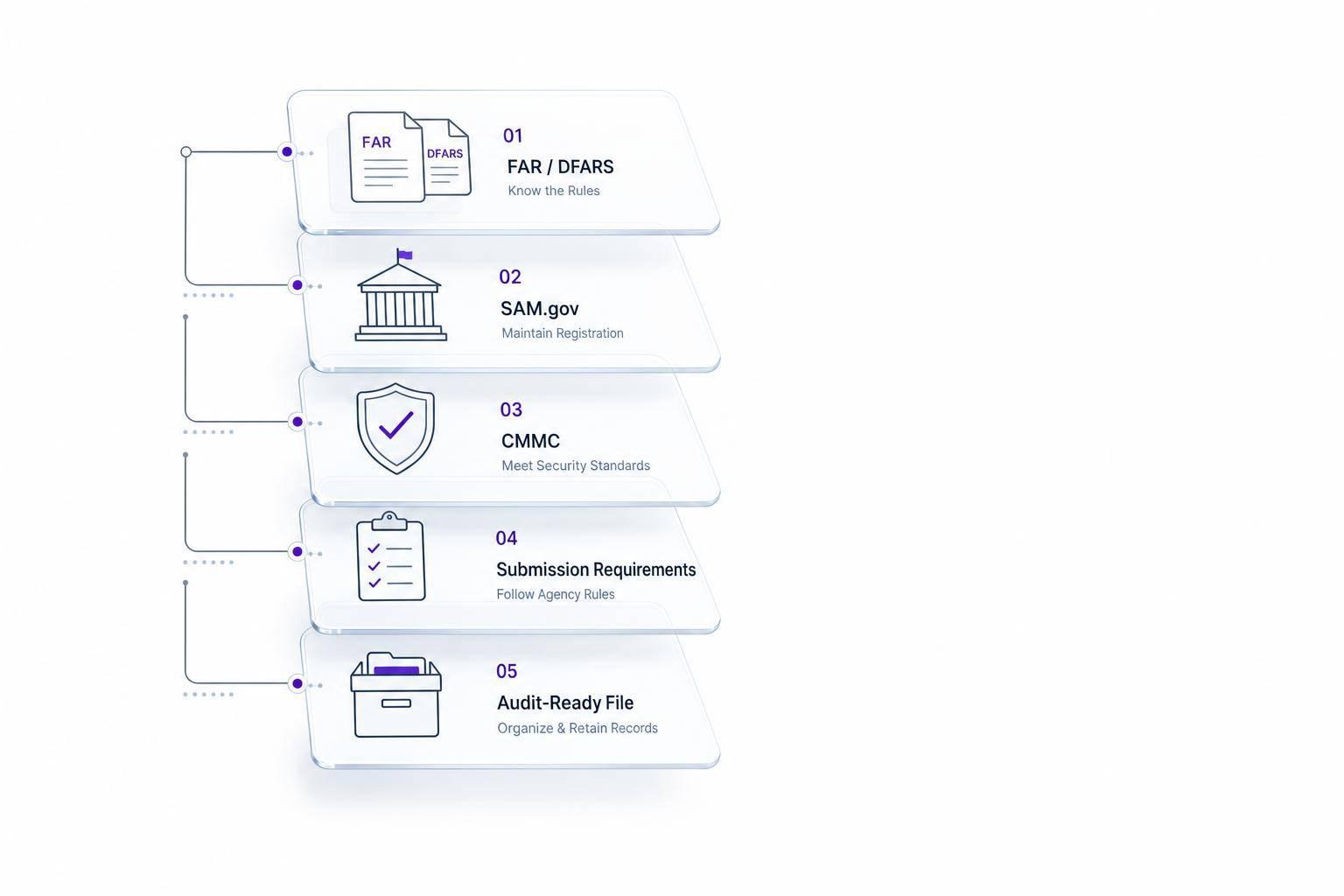
A federal bid can fail before scoring even starts. The article’s main point is simple: if I want to stay eligible, submit a compliant offer, and avoid post-award trouble, I need to check the rules before bidding, match every requirement in the solicitation, confirm vendor eligibility at award, and keep clean records after award. It also notes that 18% of federal proposal disqualifications in a 2025 GAO analysis came from missing or incomplete admin paperwork.
Here’s the article in plain terms:
- I need to confirm the rule set first: FAR, agency supplements like DFARS, labor rules, and 2 CFR Part 200 when federal grant funds are involved.
- I need to make sure SAM.gov, UEI/CAGE, and Reps and Certs are current before I bid.
- I should pull every “shall” and “must” from Sections C, L, and M into a compliance matrix so nothing gets missed.
- I need to check OCI, assign internal owners across legal, finance, HR, and IT, and decide who will sign before the deadline rush.
- I must follow submission rules exactly, including page limits, file names, file types, size limits, and time zone.
- Before award, the file should show the evaluation record, responsibility checks, pricing support, and the final signed documents.
- After award, I need tight control over invoices, mods, reporting, payroll, cybersecurity, and retention through closeout.
- The article also flags a pricing change: starting June 30, 2026, the threshold for certified cost or pricing data moves from $2.5 million to $10 million under NDAA 2026.
In short, the checklist is about one thing: making compliance a repeatable process, from the first bid review to final payment.
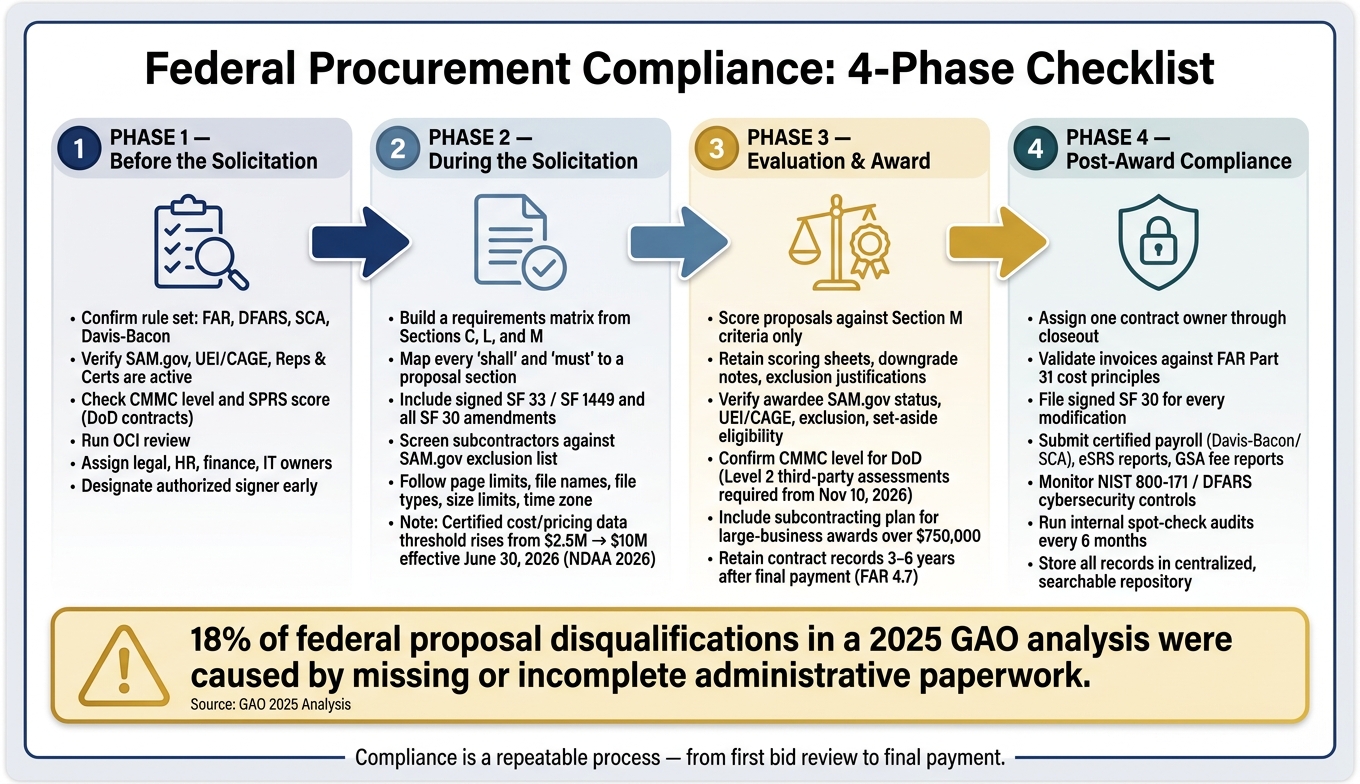
Federal Procurement Compliance: 4-Phase Checklist
1. Before the Solicitation: Confirm Rules, Need, and Internal Readiness
Before your team spends even one hour on a proposal, pause and check three things: which rules apply, whether your business can bid, and whether your internal controls can hold up under review. Then line up the solicitation with the exact rules that govern eligibility and contract performance.
Verify the Applicable Procurement Framework
Every opportunity runs under a specific set of rules, and the synopsis usually doesn’t show all of them. Start by identifying the governing framework: FAR, agency supplements like DFARS, and any labor or cybersecurity requirements tied to the work.
Most federal contracts follow FAR. If you’re going after defense work, DFARS often comes into play too. For covered service contracts, check SCA wage and fringe requirements. For covered construction work, check Davis-Bacon prevailing wage rules.
For DoD opportunities, review your CMMC level early. As of November 10, 2025, CMMC requirements are showing up directly in DoD contracts, and certification is tied to award eligibility. If the work involves CUI, confirm NIST 800-171 compliance and make sure your SPRS score is current.
You should also verify that your SAM.gov registration is active, your UEI/CAGE data is current, and your Reps and Certs are up to date. If you’re pursuing a set-aside, make sure your socioeconomic status, such as 8(a), HUBZone, WOSB, or SDVOSB, is correctly self-certified in SAM.gov for the specific NAICS code listed in the solicitation.
Once you’ve nailed down the rule set, the next step is simple: decide whether the opportunity fits what your team can actually deliver and what you can afford to pursue.
Document Need, Budget, and Procurement Method
Pull every "shall" and "must" from Sections C, L, and M into a compliance matrix. This gives you a clean way to check whether the opportunity fits your skills, staffing, and budget.
Also compare the contract value against the thresholds that apply. Confirm up front whether cost or pricing data, wage rules, or schedule fees will apply before you sink time and money into the bid. If the opportunity uses a GSA Schedule vehicle, confirm the Industrial Funding Fee (IFF) reporting duty for schedule holders.
At this stage, you’re not just reading the solicitation. You’re stress-testing it. Can your team perform the work as written? Can you price it in a way that makes sense? If the answer is shaky now, it usually gets worse later.
Check Ethics, Conflicts, and Team Roles
Run an OCI review before proposal drafting starts. Look at everyone tied to the bid and ask whether their role could create an unfair edge or even the appearance of self-dealing. That alone can trigger an investigation.
Then assign ownership across legal, HR, finance, and IT so each compliance area has one accountable owner. Keep duties separate: no single person should both initiate and approve a certification or representation. And choose the authorized signer before drafting begins, not at the last minute when everyone is scrambling.
sbb-itb-bb3960c
2. During the Solicitation: Build a Fully Compliant Response
After you’ve cleared your internal readiness checks, the next job is simple in theory and unforgiving in practice: answer every solicitation requirement. Once eligibility is confirmed, turn the solicitation into a response map and make sure nothing slips through the cracks.
Match Every Requirement to a Response Item
The safest way to track every requirement is with a requirements matrix. Think of it as a cross-reference tool that ties each RFP requirement from Sections C, L, and M to the exact page and paragraph in your proposal.
Map your technical approach, solution methodology, delivery plan, and project team governance straight to the RFP. Pull out every mandatory requirement from the solicitation. Then give each one:
- a unique ID
- a compliance status
- a pointer to where your proposal addresses it
Here’s what that usually looks like:
| Requirement Category | Key Items to Map |
|---|---|
| Technical Volume | Methodology, Deliverables, Past Performance, Staffing Plan, Project Team Governance |
| Cost Volume | Pricing Format, Labor Categories, Indirect Costs, Cost/Pricing Data |
| Certifications and Eligibility | Business Size or Socioeconomic Status (confirm it matches the solicitation set-aside), Cybersecurity (NIST 800-171; CMMC for DoD contracts), Organizational Conflicts of Interest |
| Administrative | Signed Forms, Amendment Acknowledgments, Required Forms and Representations, Labor Standards (Service Contract Act, Davis-Bacon Act) |
| Submission | Page Limits, Font Size, File Formats, File Naming, File-Size Limits, Delivery Time Zone |
For large solicitations, a requirements matrix isn’t optional in any practical sense. Manual review tends to miss buried terms, especially the ones tucked into amendments, attachments, and instructions. Use the matrix to assemble the package, then check every required form and certification against it.
Include Required Clauses, Certifications, and Registrations
Every federal proposal comes with a base set of required inclusions. Your package should include the needed forms, representations, certifications, and amendment acknowledgments, along with any labor standards that apply, such as the Service Contract Act or Davis-Bacon Act.
That usually means including a signed and dated SF 33 or SF 1449, plus signed and dated SF 30s that acknowledge every amendment issued during the solicitation period. Miss an amendment acknowledgment, and your bid can be ruled nonresponsive. That’s the kind of small miss that causes big pain.
On the certification side, double-check that the identifiers on the submitted forms match the offeror record. Make sure the socioeconomic status shown in the proposal matches the solicitation set-aside. If subcontractors are part of the bid, screen each one against the SAM.gov exclusion list and collect their required certifications before the proposal is finalized.
One more point on pricing: effective June 30, 2026, the threshold for requiring certified cost or pricing data increases from $2.5 million to $10 million under NDAA 2026. Check whether that threshold applies to your specific opportunity before you build the cost volume.
Follow Submission Instructions Exactly
Once the writing is done, treat packaging and delivery as their own compliance review. This is where solid proposals still get knocked out.
Check the submission details line by line:
- file naming convention
- required file formats, such as PDF, Word, or Excel for pricing
- file-size limits
- whether submission goes through a portal, email, or hard copy
Then confirm the due date and time in the right time zone. A proposal submitted at 4:00 PM ET when the deadline was 4:00 PM CT is late. No one cares that it was only off by an hour.
Upload early so you have time to deal with portal lag, upload failures, or access issues. And for the last compliance check, use a fresh reviewer. A new set of eyes often catches the one missing form, wrong filename, or skipped acknowledgment everyone else stopped seeing.
3. Competition, Evaluation, and Award: Support a Defensible Contract File
Once proposals come in, the job changes. You’re no longer just putting together a response. Now you’re building the paper trail that backs up the award decision and holds up under audit.
The contract file is the backbone of that effort. It should show why the award was made, how the evaluation was handled, and what checks were completed before signature.
Document Competition and Evaluation Consistently
Score proposals only against Section M. That sounds simple, but it’s where a lot of file problems start. If the scoring drifts beyond the stated criteria, the award decision gets harder to defend.
Keep the full evaluation record in the contract file, including:
- Scoring sheets
- Downgrade notes
- Exclusion justifications
Then file the evaluation record so the award rationale is easy to trace from start to finish.
Confirm Vendor Responsibility and Eligibility
After evaluation, verify the apparent awardee before signature. Before award, check the apparent awardee’s SAM.gov status, UEI/CAGE, exclusion status, reps and certs, and set-aside eligibility. Also review FAR 52.204-8 reps and certs for currency and accuracy.
For DoD contracts, confirm the vendor’s CMMC level. As of November 10, 2025, Level 1 and Level 2 self-assessments are required in applicable contracts, with mandatory third-party assessments for Level 2 beginning November 10, 2026.
For large-business awards over $750,000, include the subcontracting plan in the file.
Complete the Award File and Required Terms
The award file should include the core records tied to the solicitation, evaluation, vendor checks, pricing, and staffing.
| Document Category | Key Items |
|---|---|
| Solicitation & Award | Signed SF 33, Signed SF 30 (all amendments), Final Signed Contract |
| Evaluation Support | Scoring sheets, Downgrade/Exclusion rationale, Award rationale, Negotiation notes |
| Vendor Eligibility | SAM.gov status, Debarment/Suspension check, COI statements, UEI/CAGE codes |
| Financial/Pricing | Cost/price analysis, CLIN pricing, Labor rate justifications, Subcontracting plan |
| Technical/Personnel | Key personnel resumes, Letters of commitment, Past performance narratives |
Finish by filing the record under the correct retention schedule. Under FAR 4.7, retain contract records for 3–6 years after final payment, depending on record type.
4. Post-Award Compliance and Audit Readiness
After award, the job shifts from bid compliance to performance control.
Signing the contract isn’t the finish line. Post-award compliance affects performance, payment, and recordkeeping. It also brings more risk of audit findings, payment disputes, and False Claims Act exposure.
Monitor Performance, Invoices, and Contract Changes
Assign one contract owner to track deliverables, milestones, and due dates through closeout. When no one clearly owns the contract, follow-up slips, and small misses turn into bigger problems.
Before approving any invoice, confirm that it matches the contract terms and lines up with FAR Part 31 cost principles. Use an accounting system that meets contract requirements. Also split payment duties between the person who starts a payment and the person who approves it. That separation helps cut fraud risk.
Once payment controls are set, tighten change management too.
Every contract modification – scope changes, option exercises, funding adjustments, and extensions – needs a signed SF 30 and a clear reason in the file. Put every change in the contract record.
The table below maps common post-award control areas to the rule or system that drives them:
| Control Area | Key Post-Award Action | Compliance Driver |
|---|---|---|
| Financials | Annual Incurred Cost Proposals | DCAA / FAR Part 31 |
| Labor | Certified Payroll Reports | Davis-Bacon / SCA |
| Subcontracting | eSRS Performance Reporting | SBA / FAR Subpart 4.4 |
| GSA Schedules | Recurring sales and fee reporting | GSA Portal |
| Cybersecurity | Cybersecurity monitoring and reassessment | DFARS / NIST 800-171 |
Set automated reminders for recurring deadlines, especially eSRS reports and other recurring contract filings. Miss one of these, and you can end up with compliance gaps or a contract administration mess.
Maintain Complete Records for the Full Procurement History
Treat the award file like a live control file, not a dusty archive.
Every record created from solicitation through final payment should live in a centralized, searchable repository. That includes financial records, signed contract versions, modifications, performance logs, government acceptance notices, and compliance certifications. Keep them in one place, and make ownership clear.
The table below shows which teams should own each record type:
| Record Category | Specific Examples | Primary Owner |
|---|---|---|
| Financial | Invoices, timecards, payroll, cost reports | Finance / Accounting |
| Contractual | Modifications, change orders, signed clauses | Legal / Procurement |
| Performance | Deliverable logs, milestone approvals, acceptance notices | Operations |
| Workforce | EEO-1 reports, AAP plans, hiring data | HR |
| Security | Access logs, NIST 800-171 controls, incident reports | IT / Security |
Keep records through closeout under the applicable retention schedule. If more than one schedule applies, keep them for the longest one.
Run internal spot-check audits every six months to confirm that files are complete, modifications are filed, and flow-down clauses are in place.
Conclusion: Build a Repeatable Compliance Checklist for Every Federal Opportunity
Use the same controls on every award.
Federal procurement compliance is not a one-time task. It’s a system. Identify the governing rules before the solicitation opens. Document the procurement method, approvals, and evaluation rationale as you go. Follow submission instructions exactly. Keep every record from award through closeout. Repeatable workflows and centralized document control separate contractors who scramble during audits from those who stay ready.
FAQs
What can make a federal bid noncompliant?
A federal bid can be thrown out if it misses a mandatory requirement or ignores basic submission rules.
Some of the most common problems are simple, but costly:
- Missing signed certifications or required forms
- Going over page limits or breaking font and margin rules
- Letting your SAM.gov registration lapse
- Skipping FAR/DFARS clauses
- Failing to respond to every mandatory "shall", "must", or "will" statement
That’s where Narwin.ai comes in. It reviews the RFP, pulls out the requirements, and maps them to your proposal so fewer things slip through the cracks.
Which registrations should I update before bidding?
Before you bid, check that your SAM.gov registration is active and up to date. Your legal business name, physical address, and TIN/EIN need to match your IRS records exactly. Even a small mismatch can cause problems.
You’ll also want to review your NAICS codes, PSCs, banking details, and required Representations and Certifications, including FAR 52.212-3. If your business has socioeconomic certifications like 8(a), HUBZone, WOSB, or SDVOSB, make sure those are current too.
How should I organize records after award?
Maintain one central, audit-ready record system for signed contract clauses, modifications, approved procurement documents, and all deliverables.
Keep detailed financial records too. That includes supporting expense documents, approved timekeeping records, subcontractor agreements, and change orders.
Use structured approval workflows to track contract performance, and store records in a consistent, repeatable format under FAR Subpart 4.7.