
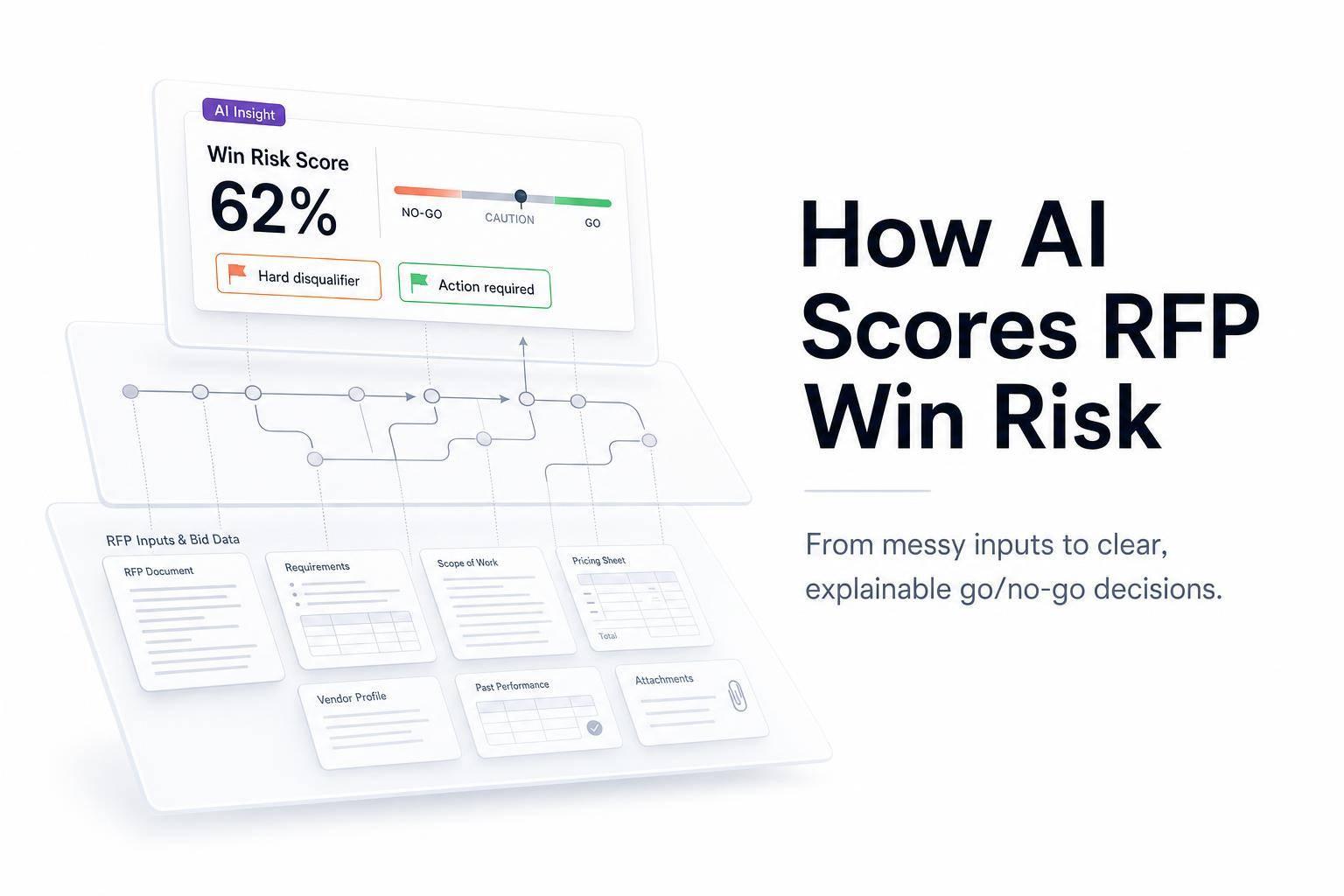
An AI win-risk score helps me decide one thing fast: should I bid or walk away? It does that by checking five core areas at once: RFP requirements, compliance risk, company fit, buyer history, and likely competition.
Here’s the short version:
- Win chance and compliance are not the same.
- A high score does not fix a missing mandatory item.
- Hard blockers like expired registrations, missing certifications, or no required clearance can stop a bid right away.
- Soft risks like thin staffing, short timelines, or weak price support can lower confidence but may still be fixed.
- The best AI scores show evidence, confidence level, score range, and next steps instead of just one percentage.
In plain English: if I only use gut feel, I can miss deal-breakers. If I only use a clean compliance check, I can still chase bids I’m not likely to win. AI helps by turning messy RFP documents, amendments, internal records, and past bid data into a clearer go/no-go view.
A useful scoring process usually checks:
- What the buyer asked for
- What changed in amendments
- Whether I can submit on time
- Whether my team, past work, and pricing fit
- Whether an incumbent or buyer pattern lowers my odds
- What must be fixed before I commit proposal hours
| Area | What AI checks | What I get |
|---|---|---|
| Requirements | Mandatory items, scored criteria, deadlines, changes | A structured checklist |
| Compliance | Forms, certifications, page limits, submission rules | Pass/fail risks |
| Company fit | Skills, staff, past performance, coverage, pricing | Match gaps and proof needs |
| Market context | Buyer history, incumbent status, award patterns | Competition risk view |
| Final decision | All evidence plus blockers and unknowns | Go, conditional go, or no-go |
One stat I keep in mind: even a 90% win estimate means there is still a 10% chance of losing. That’s why AI should guide the decision, not make it for me.
Below, I break down how this scoring works, what pushes the score up or down, and how teams can use it without treating it like autopilot.
How AI Builds an RFP Win-Risk Score
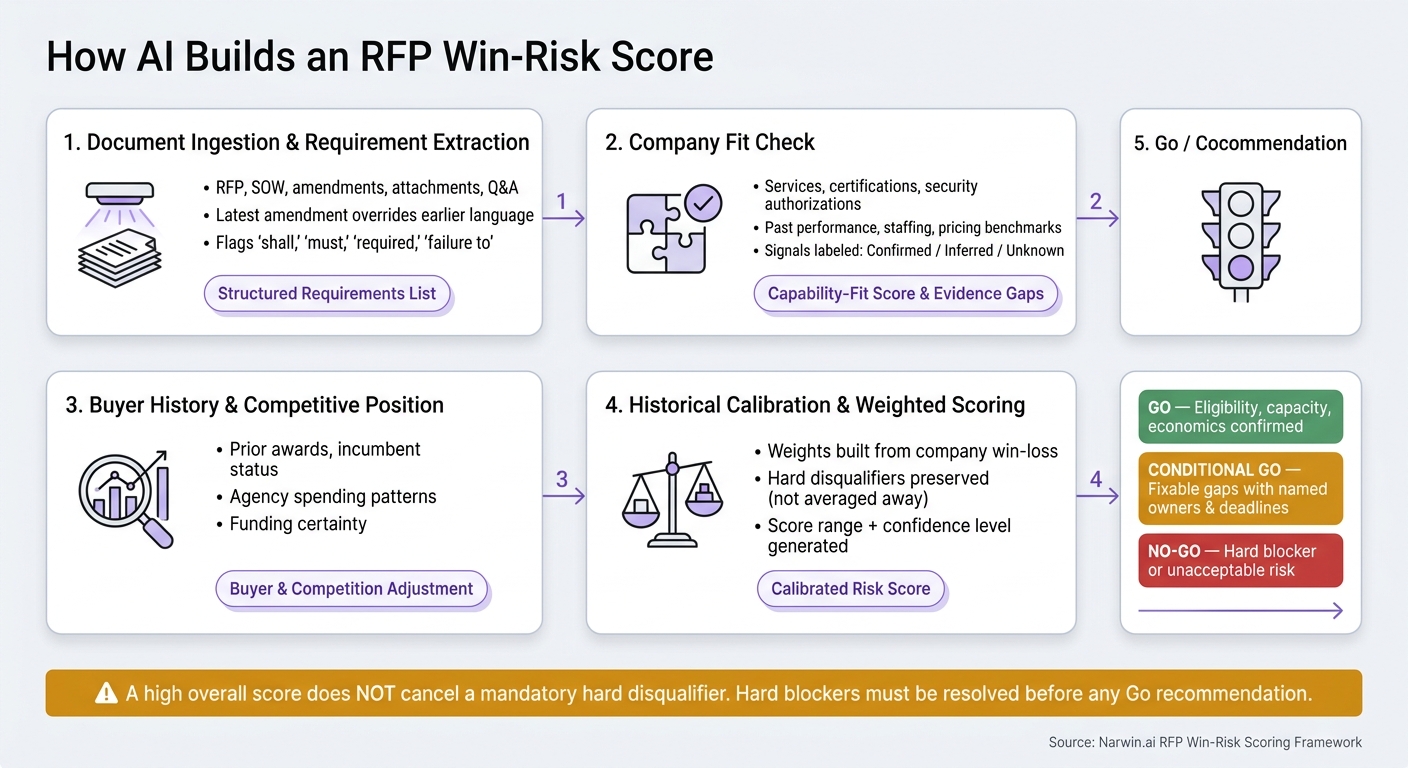
How AI Scores RFP Win Risk: The Go/No-Go Decision Process
AI win-risk scoring turns RFP text, buyer signals, and internal bid data into an explainable go/no-go recommendation. It starts by turning the RFP into structured requirements.
Document Ingestion and Requirement Extraction
The first step is simple in concept but heavy in practice: read everything. That includes the RFP cover page, statement of work, evaluation criteria, pricing instructions, contract terms, security clauses, submission rules, attachments, Q&A responses, and every amendment.
One detail matters a lot here: the latest valid amendment overrides earlier language. But the earlier versions still stay linked for auditability. That way, the team can see what changed, where it changed, and when it changed.
Once the documents are ingested, the AI sorts the text by requirement type. Phrases like “shall,” “must,” “required,” and “failure to” usually point to a mandatory requirement. Each item then becomes a structured record with the parts a bid team needs to act on right away:
- The requirement itself
- Its source location
- The responsible owner
- The evidence needed
- The deadline
- Whether it is mandatory or a scored criterion
The result is a structured requirements list the team can use immediately.
Those requirements then become the risk factors the model scores against internal evidence. Once the model knows what the buyer wants, it can compare those needs against what the company can actually deliver.
Company Fit, Buyer Signals, and Competitive Position
After the requirements are extracted, the model checks them against the company’s internal data. That includes service offerings, geographic coverage, certifications, security authorizations, past performance, available staff, delivery capacity, and pricing benchmarks.
Some signals help. For example, prior federal implementation experience plus the required certifications is a strong positive sign. Some signals hurt. An overcommitted delivery team is a clear negative.
Then the model looks beyond internal fit and checks market position. It reviews buyer history and competitive position, including prior awards, incumbent status, funding certainty, agency spending patterns, and whether the RFP requirements seem shaped around an incumbent’s solution.
Each signal is labeled as confirmed, inferred, or unknown.
A prior award to an incumbent is a confirmed competitive fact. A conclusion that the specifications were written around that incumbent is an inference. That kind of call should not shift the score on a hunch. It needs multiple supporting indicators first.
Historical Calibration and Weighted Scoring
Each input affects a different layer of pursuit risk:
| Source data | AI analysis | Decision output |
|---|---|---|
| RFP, statement of work, attachments, and amendments | Extracts obligations, scope, deadlines, and changed requirements | Compliance checklist and amendment alerts |
| Evaluation criteria and scoring method | Identifies rated factors and relative importance | Technical-priority map |
| Certifications, past performance, staffing, and service area | Matches company evidence to mandatory and rated requirements | Capability-fit score and evidence gaps |
| Prior awards, incumbent data, funding signals, and relationships | Estimates buyer familiarity and competitive barriers | Buyer and competition adjustment |
| Internal bid history, pricing, and loss reasons | Finds patterns associated with wins, losses, margin, and delivery risk | Calibrated factor weights and confidence level |
| Submission capacity, timeline, and contract obligations | Tests whether the team can deliver and submit on time | Operational-risk score |
| Combined evidence and unresolved exceptions | Applies weighted scoring while preserving hard disqualifiers | Go, conditional go, or no-go recommendation |
Generic weights are weaker than weights built from the company’s own win-loss history. If the internal data is richer, the recommendations, match scores, and draft outputs tend to be more accurate. That extra context is what makes the score useful instead of just easy to read.
The final output should never be just a percentage. It should include a score range, confidence level, key drivers, hard disqualifiers, missing evidence, and next actions. A score only helps if it shows why a pursuit is risky, not just whether it is.
sbb-itb-bb3960c
What Raises or Lowers Win Probability
AI raises or lowers win probability based on one simple thing: how closely the evidence matches the RFP. After the requirements and buyer data are structured, the model scores the factors that have the biggest effect on win odds.
Positive Drivers of a Strong Pursuit
The strongest positive signal is a direct match between what the buyer asks for and what your company can show it has done before. That usually means recent past performance on contracts with similar size, scope, and complexity. Recent and relevant work matters more than older work or examples that only partly match.
Strong pursuits also tend to have a few things in place from the start. The key personnel are named and actually available. The cost model is based on real labor rates and subcontractor quotes, not guesswork. And the team has enough proposal capacity to turn in a solid response without rushing or cutting corners. Buyer familiarity can help too, especially when it sharpens win themes and helps the team avoid reading priorities the wrong way.
Common Risk Factors That Reduce Confidence
Requirement gaps can tank a score fast. A company may have broad cloud experience and still score poorly if the RFP calls for a specific security framework or clearance level that the proposed team can’t document. In that case, the model should point to the exact unmet requirement, not just label it a general capability gap.
Other issues also pull the score down: a strong incumbent with established access, frequent or major amendments that suggest the buyer is still sorting things out, a response window that’s too short for sound pricing and reviews, and staffing plans built around people who are already tied up elsewhere. Thin margins hurt too. A low price that doesn’t support the technical approach adds risk during evaluation and later during delivery.
The most useful scores connect each risk to a source document or internal record. That way, the score isn’t just a hunch. It’s tied to proof.
| Factor | Evidence source | Score impact | Possible mitigation |
|---|---|---|---|
| Technical fit | Requirements matrix, solution library | Unmet technology, clearance, or delivery requirement | Add qualified subcontractor |
| Past performance | Contract database, CPARS records, references | No recent or comparable examples | Use key-personnel or predecessor experience where permitted |
| Buyer understanding | CRM, prior engagements, public procurement records | Little knowledge of mission or procurement pattern | Conduct compliant market research |
| Incumbent position | Award history, contract extensions | Incumbent has strong performance and established access | Identify clear differentiator; address transition risk |
| Staffing capacity | Resource plan, HR availability | Key personnel unavailable or overcommitted | Reserve staff or propose teaming |
| Pricing and margin | Cost model, historical awards, vendor quotes | Price uncompetitive, unsupported, or below sustainable cost | Recheck assumptions or adjust scope |
| Amendment activity | Amendment log, procurement communications | Frequent changes increase rework and uncertainty | Re-score after each amendment |
| Response timeline | Solicitation schedule, internal workback plan | Short timelines reduce review quality and raise submission risk | Request extension or decline |
Hard Disqualifiers vs. Soft Warning Signals
Once the risks are ranked, the next move is to separate deal-breakers from issues that simply lower confidence.
Hard disqualifiers stop the pursuit cold. These include missing mandatory certifications, ineligible geography, unavailable security clearances, failure to meet a stated experience threshold, and missing required submission elements. A high overall score does not cancel out a mandatory failure. The AI should flag the exact requirement, cite the source document and section, and block a "go" recommendation until the problem is fixed or a qualified teammate can cover it.
Soft warning signals are different. Limited buyer history, an incomplete teaming arrangement, a moderate staffing gap, or uncertain subcontractor pricing can all lower the score without ending the pursuit. Each soft signal should have:
- an assigned owner
- a mitigation deadline
- a residual-risk rating
For example, an uncertain teaming arrangement becomes easier to manage once there’s a signed agreement, confirmed workshare, and documented subcontractor qualifications. The key is to keep soft warnings visible in the score even after mitigation. That helps decision-makers see the difference between issues backed by resolved evidence and issues resting on plain optimism.
These signals drive the go, conditional go, or no-go decision.
How Teams Use the Score for Go or No-Go Decisions
Once the model scores an opportunity, teams use that output to run a go/no-go review. The score helps guide the call. But the call itself still sits with the people who see the whole picture: proposal workload, delivery capacity, contract risk, and business priorities that no model can fully sort out on its own.
Go, Conditional Go, and No-Go: How Each Outcome Works
Each outcome ties to a clear set of conditions, not just a number on a scale.
A Go means the opportunity clears the bar on eligibility, capacity, economics, and competitive fit. The financial case has to meet internal thresholds, and the team’s position has to justify the cost of putting together the proposal. Eligibility and competitive fit both need to be confirmed. That keeps the decision tied to the article’s core split between compliance readiness and win probability.
Use Conditional Go when the opportunity looks strong, but a few fixable gaps still need work. Every condition needs a named owner, a deadline, and a plain evidence requirement. For example, “confirm subcontractor cloud-security compliance” should have an owner, a written control mapping, and a date set before the final bid review. If those conditions stay unresolved, they should be treated as tracked blockers, not wishful thinking. Miss the deadline, and the decision shifts to No-Go.
Use No-Go when eligibility, timing, margin, staffing, or competitive barriers make a believable win unlikely. The reason should be specific, such as a missing mandatory certification, an unacceptable liability term, or not enough capacity. That level of detail helps teams tune future scoring.
What Decision-Makers Should Review Alongside the Score
Each reviewer looks at a type of risk the score can’t fully settle on its own.
Start with the score, then check the key functions before anyone signs off. The review should include the proposal lead, sales or account owner, delivery and technical leads, finance, legal or contracts, and the right executive.
The proposal lead checks whether the team can produce a compliant response in the time available. Sales or the account owner brings buyer access, incumbent knowledge, and account context. Delivery and technical leads confirm staffing availability, schedule realism, and whether the technical approach stands up against the RFP’s actual requirements, not just the summary. Finance pressure-tests the numbers: bid cost, expected margin, payment terms, cash-flow exposure, and the downside if the contract underperforms. Legal reviews indemnity, liability caps, intellectual property, termination clauses, and audit rights before a high score turns into a signed commitment. Executive leadership looks at portfolio fit and decides whether a strategic exception makes sense.
If an executive overrides the AI recommendation, that choice should be documented. Include the rationale, the assumptions that differ from the model, any extra resources approved, and the residual risk the team accepts. That record also makes it possible to compare the AI recommendation, the override logic, and the final outcome later.
The review package should include:
- Confidence level
- Data completeness
- Top drivers
- The compliance matrix
- Financial assumptions
- Open mitigations with owners and due dates
| Reviewer | Primary focus |
|---|---|
| Proposal lead | Response plan, compliance matrix, submission timeline |
| Delivery / technical leads | Staffing availability, schedule realism, technical feasibility |
| Finance | Bid cost, margin, payment terms, worst-case scenarios |
| Legal / contracts | Indemnity, liability caps, IP, termination, audit rights |
| Executive | Strategic fit, portfolio priorities, override documentation |
Putting the Workflow Into Practice with Narwin.ai
Finding and Qualifying Opportunities Earlier
Go/no-go scoring only helps when your team finds the right opportunities early enough to act on them. Narwin.ai puts that workflow to work in two steps: early opportunity matching and RFP risk analysis.
It tracks public procurement sources across the U.S. and Canada at the federal, provincial, and city levels, including SAM.gov, CanadaBuys, BCBid, and RampLA. From there, it matches opportunities to a company’s profile early in the buying cycle.
That company profile does a lot of the heavy lifting. It should clearly spell out your core services, target industries, locations, contract preferences, certifications, past performance, staffing capacity, and hard limits such as licenses, clearances, bonding, language, and travel caps. The more complete the profile, the better the match scores, recommendations, and draft output.
Each matched opportunity gets a Preliminary Match Score. Think of it as a first-pass triage signal, not the final call. It helps screen opportunities before the team spends time on a full win-risk review. If a match clears that first screen, the team can move into full RFP analysis.
Analyzing Risk and Extracting Requirements from RFP Documents
After qualification, Narwin.ai takes in the solicitation and pulls out the details that shape the go/no-go call. The platform processes RFPs, amendments, scope of work, addenda, and attachments, then organizes requirements, compliance items, deadlines, and deliverables into a structured report.
It also produces a Win Probability Score and a Bid/No-Bid Recommendation. More importantly, the reasoning is visible. Reviewers can inspect the logic instead of taking the output at face value.
The risk review draws a clear line between hard blockers and softer warnings. Hard blockers might include missing certifications or eligibility limits. Softer warnings can include staffing pressure or financial constraints. Narwin.ai also adds buyer intelligence based on buyer history, priorities, and evaluation focus, which gives teams context beyond the document set itself.
That matters because a score alone doesn’t move work forward. Teams still need to act on what the review finds. A missing certification needs a date for confirmation. An unclear technical requirement needs a question submitted during the clarification window. When every flagged risk has an owner and deadline, the score becomes part of a working process instead of a number that gets logged and ignored.
Conclusion: Use AI Scores as Evidence, Not as Autopilot
AI win-risk scoring pulls together solicitation data, buyer history, competitive signals, and internal bid data into one picture that teams can review. It separates compliance issues from competitive concerns, spots hard disqualifiers before teams sink major hours into a bid, and gives decision-makers a documented place to start the go/no-go discussion.
Narwin.ai supports each step of that process, from bid discovery and early qualification to risk analysis and requirement extraction. The score is evidence, not the final word. Your team still makes the call.
FAQs
How accurate is an AI win-risk score?
An AI win-risk score is only as good as the data behind it. When models use both structured and unstructured data, they can hit 85% accuracy with an average AUC of 0.94 when predicting bid outcomes.
That means the score isn’t something you set once and trust forever. To keep it dependable, update certifications, past bids, and project references on a regular basis. Then run the analysis again when RFP amendments, Q&A updates, or new competitive intel show up.
What data improves the score most?
Past performance has the biggest impact on win probability. In Bayesian models, it makes up about 20% of the total weight.
AI pays close attention to CPARS ratings – especially Exceptional ratings. It also looks at how recent and relevant your contracts are, with the strongest focus on work from the last 3 to 5 years.
Customer relationships and incumbency status matter a lot too. In fact, they are 2.3 times more predictive of a win than past-performance relevance by itself.
When should a team ignore the score?
Ignore the AI win score and treat the opportunity as a hard no-bid if you don’t meet mandatory eligibility requirements. That includes pass/fail items like required security clearances, facility authorizations, or certifications such as CMMC, FedRAMP, or SOC 2. Check those items before you score the opportunity.
Teams should also override the score when there are major gaps that can’t be fixed in time, such as limits in capacity, weak past performance, or poor strategic fit. The same goes for bad data. If the input data is weak or incomplete, the score can’t be trusted.