
If you start writing before you know what the buyer wants, you risk wasting days on the wrong bid.
I see the main point like this: AI helps proposal teams sort large RFPs, spot hidden buyer signals, flag compliance gaps, and decide early if a bid is worth the work. That matters when RFPs can run past 2,000 pages and deadlines can shrink to 5 days or less.
Here’s the short version:
- AI pulls bids into one place from sources like SAM.gov, CanadaBuys, BCBid, and city portals
- AI reads RFPs fast and points out mandatory items, scored criteria, deadlines, and risk issues
- AI checks fit against your firm’s certifications, past work, and coverage
- AI helps writing teams use those findings in win themes, compliance content, and first drafts
In plain terms, I’d say AI moves buyer research from scattered notes and guesswork to a tighter process built on facts. That means fewer weak pursuits, fewer missed clauses, and stronger proposal drafts from the start.
Bottom line: AI does not just help teams find bids. It helps them decide, plan, and write with a clearer view of what the buyer is likely to score.
That’s the core idea behind this article.
2. The Core Problems With Using Buyer Intelligence in Proposals
Even when a team sees the value of buyer intelligence, using it the same way every time is another story. In practice, three problems tend to get in the way.
Problem 1: Too much data across too many procurement sources
Government procurement lives across a patchwork of disconnected portals. A team might track federal opportunities on SAM.gov, city bids on platforms like RampLA, and cross-border notices on CanadaBuys and BCBid. The catch? Each portal uses its own format, filters, and search rules.
That leads to fragmented intelligence. One person watches SAM.gov while someone else checks provincial sources, and amendments can slip through the cracks. There’s no single view of what’s live, what changed, or what’s about to close. Once volume picks up, that inconsistency snowballs.
And even if you pull all of that data into one place, the tougher part still remains: figuring out what the buyer actually cares about.
Problem 2: RFP language hides buyer priorities
RFPs almost never come out and say what matters most to the buyer. Instead, those signals are tucked inside mandatory requirements, evaluation criteria, and addenda.
A detail like "LEED Certified" may show up just once, but it can carry serious weight. Amendments and addenda can also add regional requirements or exclusions that change the whole bid picture. Manual reviewers miss these details all the time, and one missed compliance clause can lead to automatic disqualification before scoring even starts.
Problem 3: Insights do not make it into the final proposal
The last problem is the handoff.
Buyer data gets stuck in spreadsheets, shared drives, and long email threads. Sales, legal, security, and proposal teams end up working from different versions. By the time the proposal is written, the win themes sound generic, the executive summary doesn’t reflect the buyer’s stated priorities, and the compliance matrix has holes.
The insight is there. It just never makes it into the parts evaluators score.
That’s the gap AI closes: turning buyer intelligence into proposal content.
sbb-itb-bb3960c
3. How AI Addresses These Buyer Intelligence Problems
AI turns scattered buyer intelligence into a workflow teams can actually use.
Solution 1: AI aggregates bids, buyer data, and amendments in one place
The fragmentation problem is, at its core, a visibility problem. AI helps by tracking opportunities on a continuous basis.
A platform like Narwin.ai pulls opportunities from federal, state, provincial, and city sources across the U.S. and Canada – including SAM.gov, CanadaBuys, BCBid, and RampLA – into a single dashboard refreshed daily. Each opportunity includes buyer names, deadlines, solicitation numbers, and RFP summaries.
It also pulls in amendments and attachments next to the original RFP. So instead of jumping back into every portal to see what changed, teams get one up-to-date view of the opportunity in front of them.
From there, AI can dig into what those documents are actually saying.
Solution 2: AI analyzes requirements, buyer behavior, and risk signals
Once an RFP is in the system, AI reads the full document, not just the headline sections.
Using natural language processing, it extracts and sorts requirements across technical, commercial, legal, and administrative categories. It also flags what is mandatory versus what is scored. That matters because small details often get buried – a certification tucked inside a long tender, for example, or a tight timeline that points to delivery risk.
AI can generate fit, competition, and risk reports in under 10 minutes.
It can also review the issuing organization’s history, past awards, evaluation patterns, and changes in buyer language. That helps teams spot intent that isn’t stated outright in the RFP. In plain English: hidden signals become usable proposal input.
That leads straight into the next step – figuring out if the bid is worth the effort.
Solution 3: AI scores fit and supports go or no-go decisions
Knowing what an RFP asks for only gets you so far. You also need a fast way to judge whether your firm is a strong match.
AI match scoring compares RFP requirements against a firm’s profile – certifications, past projects, geographic coverage, and capabilities – and then generates a win probability score. A high match score points to strong alignment and may justify deeper work. A low score shows up early, before the team burns days on a bid with slim odds.
Narwin.ai provides instant go/no-go signals inside this scoring layer. That helps teams focus their time where buyer fit is strongest.
These capabilities work together as one workflow:
| AI Capability | What It Does | Proposal Team Benefit |
|---|---|---|
| Aggregation | Monitors SAM.gov, CanadaBuys, BCBid, and similar sources | No missed bids; one unified view |
| Requirement Extraction | Pulls mandatory items, deadlines, and compliance clauses | Faster, more complete compliance mapping |
| Risk Flagging | Identifies missing certifications and high-risk clauses | Prevents auto-elimination before scoring |
| Win Probability Scoring | Compares fit with buyer requirements and history | Data-driven go/no-go decisions |
4. Turning AI Insights Into Better Proposal Content
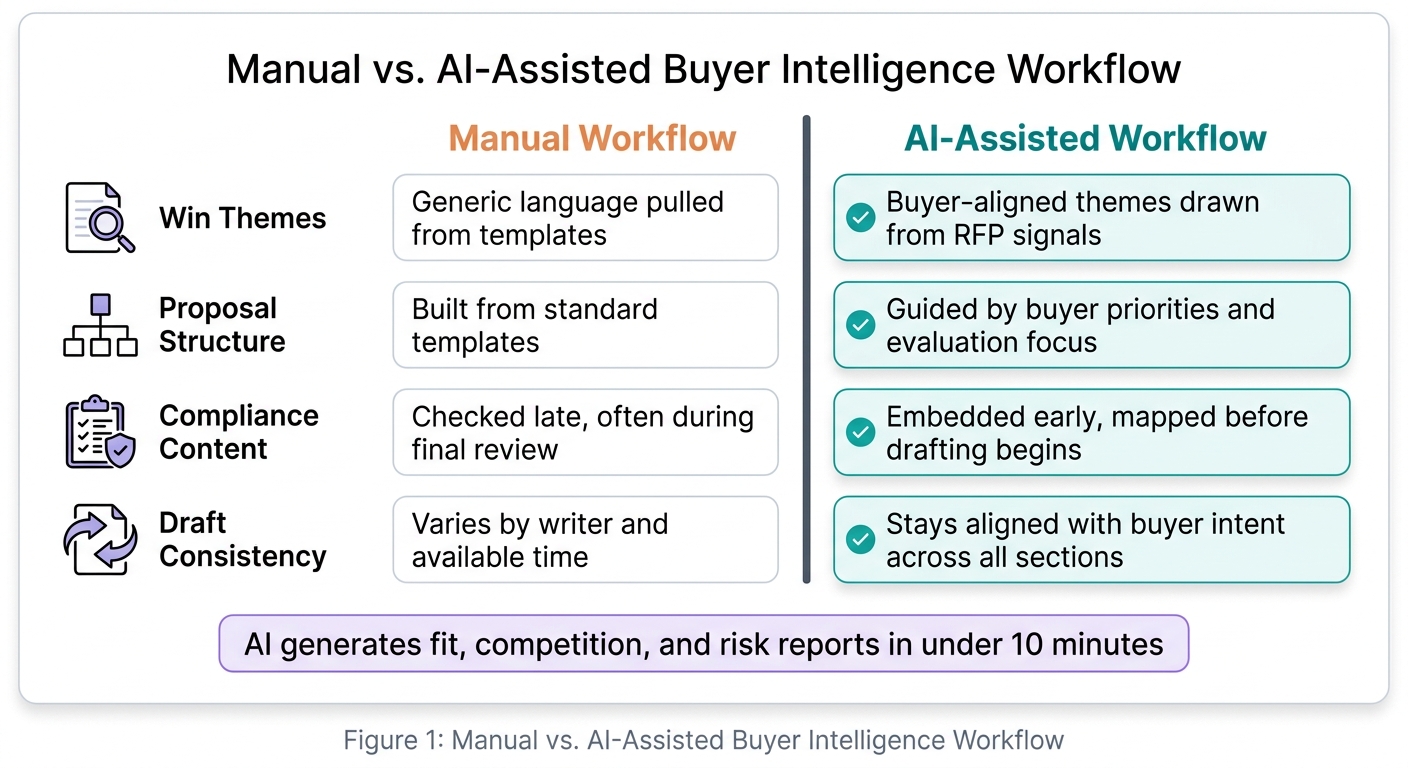
Manual vs. AI-Assisted Buyer Intelligence: Proposal Workflow Comparison
Buyer intelligence only matters if it changes the draft. Once AI scores the opportunity, those insights should flow straight into the proposal.
Use buyer intelligence to shape win themes and proposal structure
AI platforms like Narwin.ai turn buyer signals into win themes, structure, and section-level guidance. That means you can use those signals to shape the executive summary, technical approach, and past performance sections from the start.
It also helps teams pull buried certification requirements into the draft as clear compliance proof points. Instead of leaving that work for the end, you bring it into the sections evaluators usually read first.
Use AI to improve compliance, consistency, and drafting speed
Drafting is where many manual workflows bog down. Writers cross-check requirements by hand, dig through old shared drives for source material, and lose hours reworking boilerplate that doesn’t fit the current buyer.
AI-assisted drafting changes that. Narwin.ai uses a company’s private Knowledge Base – past wins, certifications, and project summaries – to produce strong first drafts that match the company’s style and prior work. At the same time, risk gaps show up early, so writers can fix them in the right sections before final review.
Manual vs. AI-assisted buyer intelligence workflow: a comparison
The table below shows where the two workflows split most at the drafting stage:
| Workflow Stage | Manual | AI-Assisted |
|---|---|---|
| Win Themes | Generic language pulled from templates | Buyer-aligned themes drawn from RFP signals |
| Proposal Structure | Built from standard templates | Guided by buyer priorities and evaluation focus |
| Compliance Content | Checked late, often during final review | Embedded early, mapped before drafting begins |
| Draft Consistency | Varies by writer and available time | Stays aligned with buyer intent across all sections |
The result is a draft that reflects the buyer from page one.
5. Conclusion: What AI Changes in Buyer Intelligence in Proposals
The problem was never access to information. It was having too much of it, with no clear way to turn that flood of data into a solid bid decision or a focused proposal draft.
AI changes that. It turns scattered inputs into one decision layer. That means pulling opportunities from places like SAM.gov and CanadaBuys, pulling out what matters from even very long RFPs, and scoring each opportunity against a firm’s actual capabilities. The result is simple: qualification becomes a data-backed decision, not a rushed guess.
Narwin.ai brings bid discovery, RFP analysis, win scoring, and proposal drafting into one flow, so buyer intelligence stops being a research task and becomes part of how strong proposals get written.
FAQs
How does AI find hidden buyer priorities in an RFP?
AI can spot buyer priorities that don’t show up in plain reading. It uses natural language processing and semantic analysis to look past surface-level prompts, which helps reveal intent, risk tolerance, and evaluation patterns that manual reviews can miss.
Narwin.ai reviews parts like Section M and historical agency data, then lines those patterns up with your company profile. From there, it surfaces action-focused win ideas and maps requirements to your capabilities.
Can AI help decide whether a bid is worth pursuing?
Yes. AI can help you decide if a bid is worth chasing by scanning RFP documents fast and pulling out the parts that matter most: requirements, compliance clauses, and possible risks.
Tools like Narwin.ai can then match that information against your company profile, past projects, certifications, and current capacity to offer go/no-go guidance and a win probability score.
That means your team can spend less time sorting through weak-fit bids and more time on opportunities with a better shot at winning.
How do AI insights improve the final proposal draft?
AI insights improve the final proposal draft by moving the work away from manual content collection and toward sharper, more focused writing. Narwin.ai uses past winning proposals and company data to build a strong first draft that is accurate, relevant, and aligned with the RFP.
It also maps your capabilities to the RFP’s requirements and buyer priorities. That helps make sure the response is compliant, tailored, and easier to refine.