
AI is transforming government procurement by automating bid evaluations and identifying disqualifications faster and more accurately than manual processes. With federal contracting actions increasing by over 22% annually, procurement teams face mounting workloads, often handling thousands of bids each year. AI tools reduce this burden by:
- Analyzing RFPs in minutes: Automating requirement extraction, compliance checks, and scoring.
- Reducing errors: Identifying missing documents, pricing discrepancies, and compliance risks with 95%+ accuracy.
- Speeding up decisions: Cutting response times by up to 90%, enabling teams to focus on strategic opportunities.
- Improving proposal quality: Ensuring compliance and aligning submissions with agency preferences.
For example, AI can process 97% of requirements in hours instead of days, flag hidden risks, and generate data-driven “Go/No-Go” scores. This allows contractors to submit three times more bids per quarter while avoiding costly errors. By integrating AI into workflows, teams save time, reduce costs, and improve their chances of winning contracts.
How AI Handles Bid Comparisons
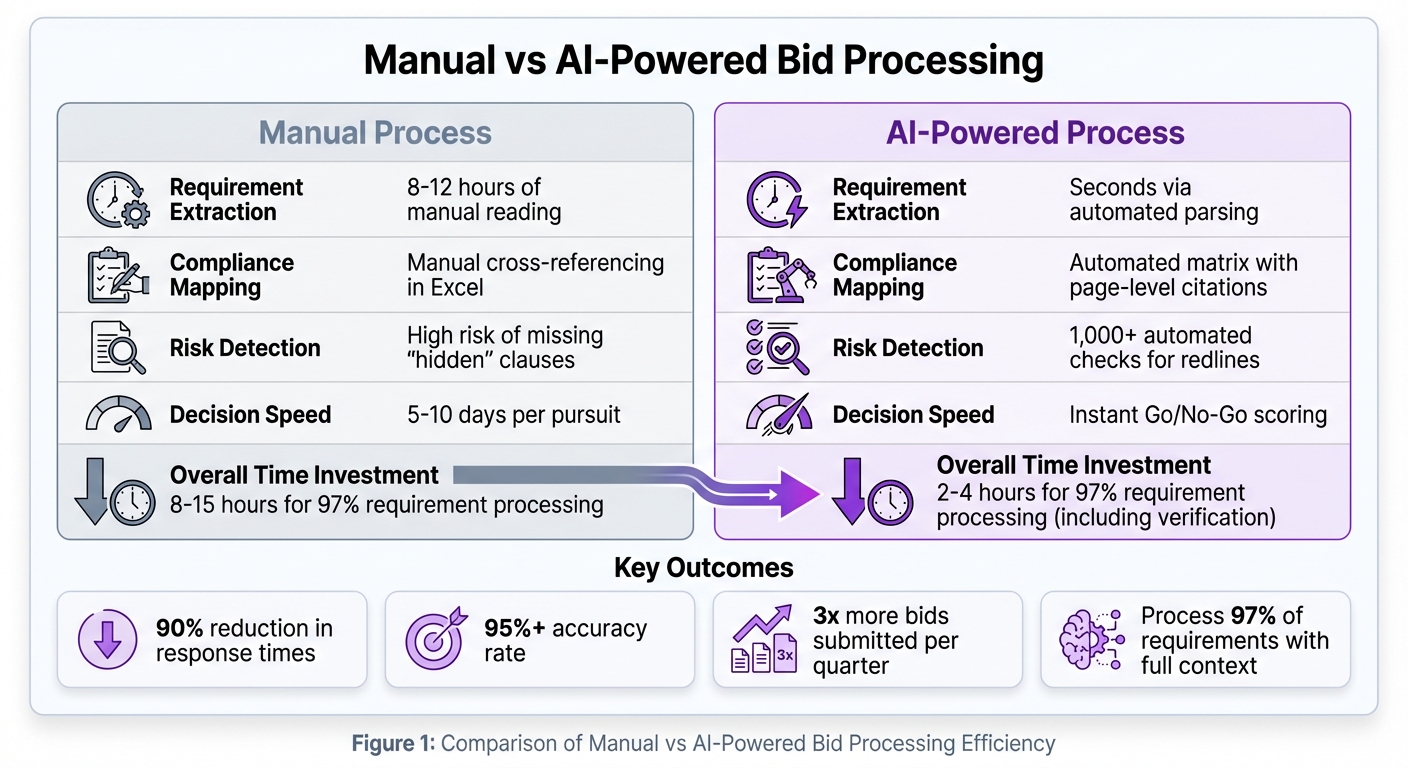
AI vs Manual Bid Processing: Speed and Efficiency Comparison
AI has changed the way government RFPs are analyzed, transforming what used to take days of manual effort into a streamlined process. By automating tasks like requirement extraction, comparison, and scoring, AI helps contractors quickly navigate complex solicitations and make more informed decisions.
Automated Requirement Extraction
AI begins by scanning RFP documents to identify and extract critical obligations. It looks for specific language patterns – such as “shall”, “must”, and “will” – to pinpoint mandatory requirements. This technology works across various file types, including PDFs, Word documents, and even scanned images, thanks to integrated Optical Character Recognition (OCR).
What sets AI apart is its ability to map extracted requirements to specific performance criteria. For example, it can analyze and link Section C (Performance Requirements), Section L (Instructions), and Section M (Evaluation Criteria) to create a clear understanding of what the agency expects. This isn’t just about pulling random details – it’s about understanding the purpose behind each section.
The efficiency gains are impressive. AI systems can process 97% of requirements with full context, a task that typically takes 8–15 hours manually. In comparison, AI completes this in just 2–4 hours, including time for verification. A real-world example? During a bridge construction project in Kanpur, India, AI identified hidden risk clauses in tenders, saving the company approximately 2,000 times the cost of the software by avoiding risky commitments.
AI also standardizes diverse RFP formats into a unified structure, such as the Uniform Contract Format (UCF). This makes it easier to compare opportunities side-by-side, revealing compliance gaps or pricing opportunities across jurisdictions. When changes are introduced through addenda, AI can automatically highlight the differences and re-check compliance for only the updated sections. With requirements clearly outlined, the next step involves real-time scoring to refine bid evaluations further.
Real-Time Comparison and Scoring
After extracting requirements, AI evaluates bids using structured scoring methods and compliance matrices. These matrices link each solicitation requirement to specific sections of the proposal, ensuring no detail is overlooked. For large government contracts, these matrices can include 200 to over 1,000 lines, making manual tracking nearly impossible without errors. AI ensures a rapid, objective evaluation, setting the stage for competitive analysis.
AI systems use weighted scoring across categories like Fit, Risk, Profitability, and Capacity. This generates a “Go/No-Go” confidence score, helping teams decide which opportunities to pursue. For instance, in 2024, App Growth Network in Vancouver saved over 15 hours per pursuit by using AI to analyze RFPs. According to their Director of Operations, Carter Hawthorniwaite, this approach generated $25,000 in additional revenue by focusing on high-probability opportunities.
AI doesn’t stop at compliance checks. It evaluates multiple dimensions at once, such as adherence to federal standards like Davis-Bacon wage requirements, DBE/MBE/WBE goals, and Buy America/Build America (BAA/BABA) provisions. It also flags risks like liquidated damages, retainage terms, and bonding capacity issues buried in hundreds of pages. With AI, teams report being able to submit three times as many RFPs per quarter, as they can quickly identify bids that align with their strengths and avoid high-risk ones.
| Feature | Manual Process | AI-Powered Process |
|---|---|---|
| Requirement Extraction | 8–12 hours of manual reading | Seconds via automated parsing |
| Compliance Mapping | Manual cross-referencing in Excel | Automated matrix with page-level citations |
| Risk Detection | High risk of missing “hidden” clauses | 1,000+ automated checks for redlines |
| Decision Speed | 5–10 days per pursuit | Instant Go/No-Go scoring |
Competitive Intelligence in Bid Comparisons
AI goes beyond immediate scoring by leveraging historical data to guide strategic decisions. It doesn’t just analyze the current RFP – it reviews past award data and vendor submissions to uncover patterns in agency preferences. This helps contractors understand what factors have led to successful bids in the past and who their key competitors might be.
By analyzing trends, AI can highlight which evaluation criteria agencies prioritize most, even when the official scoring weights suggest otherwise. This allows contractors to fine-tune their proposals, focusing on elements that resonate most with the buyer. AI can also match past performance examples from a company’s project history to the specific criteria of a new RFP, saving time and showcasing relevant experience.
Modern AI platforms act like virtual team members, continuously monitoring public sites like SAM.gov and matching opportunities to a company’s profile. These tools generate “McKinsey-style” reports, offering insights into buyer intent and win potential based on a contractor’s historical data. Unlike generic AI tools that might misinterpret requirements or overlook nuances in regulations like FAR/DFARS, these advanced systems provide tailored, reliable analysis.
sbb-itb-bb3960c
How Auto-Elimination Detection Works
AI streamlines the bid evaluation process by identifying disqualifying factors in submissions before they even reach human reviewers. This approach not only saves time but also reduces the risk of costly errors, ensuring non-compliant bids are filtered out early while enhancing overall bid comparison accuracy.
Mandatory Requirement Validation
The first step AI takes is to ensure every mandatory element in an RFP has been addressed. Using advanced tools like Natural Language Processing (NLP) and Named Entity Recognition (NER), it scans solicitation documents to extract key requirements. These include critical mandates such as FAR/DFARS compliance, security clearances, and certifications like CMMC or FedRAMP. It also analyzes specific instructions outlined in Section L (Instructions) and Section M (Evaluation Criteria). This ensures that non-compliant bids are flagged with the same level of precision applied during scoring.
AI matches each requirement to specific sections in the proposal, providing page-level citations for quick verification. It flags missing certifications, formatting issues, or even deadlines that have been overlooked. When RFP addenda are issued, the system automatically compares the updates to the original document and re-checks only the affected sections for compliance. This ensures no critical detail is missed due to changes or hidden attachments.
Detection of Pricing and Technical Risks
AI goes beyond compliance by identifying pricing and technical risks that evaluators might use to disqualify bids. It scans for potential commercial risks, such as liquidated damages clauses, price-escalation terms, retainage provisions, pay-when-paid conditions, and bonding capacity issues. Additionally, it flags pricing discrepancies and technical gaps that could jeopardize a proposal.
For example, the system compares bid line items against the complete specification set to detect missing technical elements. These gaps are a common issue, affecting nearly half of construction projects worldwide, and often lead to disputes and unexpected costs. For financial data, AI enforces a 99.9% accuracy rate, flagging any inconsistencies for manual review. Tools like heatmaps and color-coded dashboards make it easy to spot pricing outliers – such as bids that exceed the average by 20% – or missing technical components. The system can even detect “low-ball” bids, identifying patterns that suggest a misunderstanding of the scope or intentional underpricing to secure the contract.
By automating these checks, AI reduces the inconsistencies that often arise during manual screening processes.
Reducing Human Errors in Initial Screening
After identifying risks, AI further minimizes human error by applying a consistent checklist to every bid. Manual reviews, which can take 8–12 hours per package, are prone to oversights – especially when teams are under tight deadlines. In contrast, AI completes the same evaluations in seconds, running over 1,000 checks to identify red flags.
By automating financial data extraction and comparison, the system eliminates common typographical errors, such as data entry mistakes. For instance, one contractor reported that after adopting AI-driven bid analysis, they doubled their bid volume and significantly increased revenue within a few months by reallocating resources from manual tasks to more strategic analysis.
AI platforms also provide a confidence score for go/no-go decisions, aggregating factors like risk, fit, and capacity into a weighted metric. This helps teams make objective, data-backed decisions instead of relying solely on intuition. However, experts still recommend keeping a “human-in-the-loop” for final validation to account for strategic nuances that automated systems might overlook.
How AI Works in Procurement Workflows
AI has become more than just a tool for analyzing bids – it’s now embedded in the everyday processes of government contractors. It takes over repetitive, time-intensive tasks, allowing teams to focus on strategy and standing out from the competition. From analyzing bids to managing entire procurement workflows, AI simplifies everything from draft reviews to final submissions.
Comparing Proposal Drafts
Before a proposal is ready for submission, it goes through multiple review cycles – often referred to as Pink, Red, and Gold reviews. AI simplifies this process by comparing draft versions to the original RFP requirements in real time. Using advanced natural language processing (NLP), AI scans for inconsistencies, missing details, or key regulatory terms, ensuring that each draft stays aligned with the solicitation’s mandatory language, like “shall”, “must”, and “will.”
Modern platforms even offer visual tools, like scorecards and color-coded flags, to highlight differences between drafts. They also pull insights from past successful proposals and corporate resources, ensuring new drafts reflect the company’s established voice and methods.
Research shows that AI-powered RFP automation can cut proposal creation time drastically – from an average of 25 hours to less than 5 hours, an 83% reduction. Companies using these tools also report a 40% increase in win rates, thanks to higher-quality submissions and the ability to handle more opportunities.
Faster Bid/No-Bid Decisions
AI doesn’t just help refine proposals – it also speeds up the critical decision of whether to bid on a contract. Choosing the right opportunities to pursue is a cornerstone of success in government contracting. AI makes this process faster by monitoring thousands of procurement sources, such as SAM.gov and CanadaBuys, to identify contracts that match a company’s profile, certifications, and past performance. This goes beyond simple keyword searches; AI understands context, location, and scope.
Once a relevant opportunity is identified, AI processes solicitation documents – often hundreds of pages – within minutes. It extracts key details like requirements, evaluation criteria (Section M), and submission instructions (Section L). The system flags potential issues, such as missing certifications or risky terms like liquidated damages. Contractors can also set specific parameters, like profit margins or geographic preferences, so the AI evaluates opportunities based on the company’s policies.
The result? A weighted confidence score that factors in Fit, Risk, Profitability, and Capacity, simplifying the Go/No-Go decision. When amendments are issued, AI can quickly identify changes, saving teams from re-reading entire documents. While federal proposals typically take 8 to 10 hours of work and IDIQ task orders may have response windows as short as 2 to 5 days, AI can reduce RFP analysis and preparation time by up to 90%, allowing teams to make informed decisions in minutes.
“The bid/no-bid decision represents one of the most critical choices in government contracting. Get it right, and you focus resources on winnable opportunities. Get it wrong, and you waste time and money.”
Better Submission Quality and Speed
Speed alone isn’t enough – compliance is non-negotiable. A non-compliant bid is automatically disqualified. AI ensures both quick turnarounds and strict compliance, while also maintaining consistency across drafts. Acting as a “corporate memory bank”, AI pulls from past winning proposals and performance data to suggest relevant themes and evidence for new bids.
Teams using AI report a 78% faster turnaround on average. Proposal automation has cut draft completion time by 50% to 60%, and in 2024, the average proposal response time dropped to just 25 hours. Additionally, 64% of proposal teams now submit responses in under 10 days.
AI also enhances quality assurance by scanning drafts for gaps, inconsistencies, and missing elements before human reviewers step in. This “human-in-the-loop” approach ensures that while AI handles the heavy lifting, experts validate the final product for strategic alignment and compliance. Small businesses, in particular, benefit from AI, enabling them to respond to 30% more RFPs without increasing overhead. For a typical three-person team, AI can boost capacity from managing 6 bids per quarter to handling 18–24 bids. These streamlined workflows integrate seamlessly with AI-driven bid comparisons, offering a complete solution for government procurement challenges.
Benefits for Government Contractors
AI is reshaping how government contractors operate, making procurement processes more efficient, helping them do more with less, and improving outcomes like decision-making, resource management, and success rates.
Faster and Smarter Decisions
Responding to IDIQ task orders often means working within tight deadlines – sometimes just 2 to 5 days. Even standard federal proposals can take 8 to 10 hours of analysis just to grasp the requirements. AI slashes these timelines, giving contractors immediate insights into potential deal-breakers like missing certifications or compliance issues. This way, teams can decide early whether to pursue a bid, saving time and effort.
Contractors using AI tools have reported a 150% increase in qualified opportunities each week. By relying on data-driven win probability scores – calculated based on past performance and technical capabilities – they can make strategic, informed decisions instead of relying on intuition.
Better Use of Resources and Lower Costs
For small teams, finding the capacity to take on new opportunities can be a major challenge. AI steps in by automating tedious tasks like RFP shredding, creating compliance matrices, and drafting initial proposals – tasks that would normally take 8 to 12 hours per bid. This allows small businesses to respond to 30% more RFPs and manage three to five times more opportunities without hiring additional staff.
For example, a three-person team can now handle 18–24 bids per quarter, compared to just 6 before. Saving 20 hours on a single proposal can make the software pay for itself. A small contractor generating $15 million in revenue could use AI to pursue 20 extra bids a year, achieving an ROI of over 125x. And with tools like Narwin.ai starting at $199 per month, cost savings kick in almost immediately.
Better Proposals, Higher Win Rates
Sometimes, a single missing certification or formatting mistake can disqualify an otherwise strong proposal. AI helps eliminate such risks by performing real-time compliance checks, ensuring every submission meets requirements and stands out. This automated quality control means contractors can submit polished, competitive proposals every time.
AI also draws on past winning proposals to incorporate effective themes and messaging into new bids. This ensures each submission highlights a company’s strengths. In FY24, federal contract awards hit $773 billion, with $183 billion awarded to small businesses. By enabling faster, higher-quality, and more compliant bids, AI positions contractors to capture a bigger piece of this market while improving their internal processes and competitive edge.
How AI Transforms Government Contracting
AI is revolutionizing the way government contractors handle bid comparisons and detect auto-elimination risks. Tasks that once required weeks of manual effort can now be completed in minutes. Tools like Narwin.ai sift through extensive RFPs, identifying potential disqualification risks with remarkable speed and accuracy.
The benefits go beyond just saving time. By automating processes like data extraction, compliance checks, and risk analysis, AI significantly reduces human error. This means fewer costly mistakes, like missing certifications or overlooking mandatory clauses buried deep in solicitation documents. For federal compliance matrices – sometimes spanning 200 to over 1,000 lines – AI ensures every requirement is accounted for, leaving no room for oversights.
Contractors are also seeing tangible time and cost savings. With AI, they can cut over 15 hours from each bid cycle and draft proposals up to 60% faster. This increased efficiency allows firms to take on more opportunities without needing additional staff. The return on investment speaks for itself: some companies have avoided errors costing up to 2,000 times the price of the software, while others have unlocked over $25,000 in extra revenue by focusing only on bids they’re likely to win.
The federal market, valued at $773 billion, is highly competitive. AI tools, starting at just $199 per month and often offering a 14-day free trial, provide contractors with a cost-effective way to gain an edge. By enabling faster, data-driven decisions and higher-quality proposals, these tools help contractors navigate the government procurement lifecycle with confidence and success.
As the landscape of government contracting evolves, those who embrace AI-driven workflows will be better equipped to secure more contracts, streamline their operations, and thrive in this challenging yet lucrative sector.
FAQs
What can AI catch that humans often miss in an RFP?
AI tools excel at spotting critical compliance issues, evaluating risks, and ensuring all necessary requirements are satisfied. These tasks, when handled manually, can be both time-intensive and prone to errors.
Some standout capabilities of AI include identifying subtle inconsistencies, conducting in-depth risk assessments, and simplifying complex proposals into more digestible parts. By automating these processes, AI not only makes bid reviews more efficient but also reduces mistakes. This can help organizations steer clear of disqualifications caused by missed or misinterpreted requirements.
How does AI decide a bid is auto-eliminated?
AI plays a key role in filtering out bids through an auto-elimination process. It evaluates submissions based on factors like compliance with technical specifications, adherence to regulatory standards, and the inclusion of required documentation. When a bid fails to meet these criteria – whether due to non-compliance, scope discrepancies, or missing details – it is flagged for automatic disqualification. This approach not only saves time by reducing the need for extensive manual reviews but also ensures that only qualified bids move forward, minimizing errors and inconsistencies early in the evaluation process.
How do teams keep a human-in-the-loop with AI screening?
Teams keep a human-in-the-loop during AI screening by integrating human oversight into critical decision-making processes. This ensures that complex judgments benefit from human context and expertise. Additionally, experts provide feedback to fine-tune AI systems, helping to improve their performance over time. By combining human judgment with AI efficiency, organizations can maintain accuracy, dependability, and alignment with their goals.