
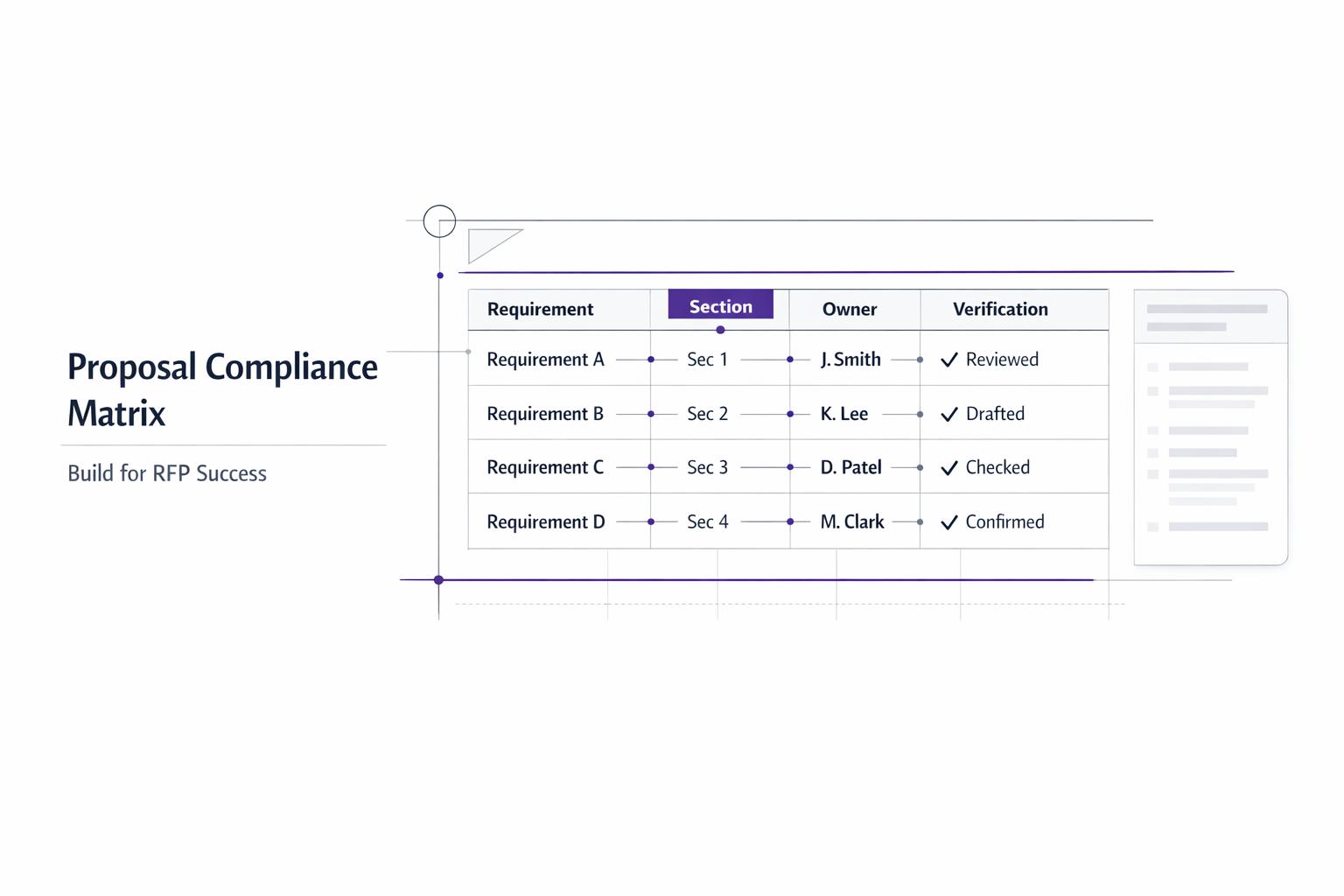
A proposal compliance matrix is a crucial tool for ensuring your response to a Request for Proposal (RFP) meets all mandatory requirements. It maps every RFP requirement to specific sections in your proposal, tracks progress, and assigns ownership, preventing costly compliance errors.
Why it matters:
- 30%-50% of government proposals are rejected for non-compliance before evaluation.
- Federal Acquisition Regulations (FAR) mandate zero credit for unaddressed requirements.
- A compliance matrix ensures no requirement is overlooked, giving your proposal a chance to compete.
Key steps to build one:
- Extract requirements: Identify mandatory language like "shall", "must", and "will."
- Organize documents: Include all RFP sections, amendments, and attachments.
- Structure the matrix: Use columns for Requirement ID, Source, Verbatim Text, Proposal Location, and Compliance Status.
- Assign ownership: Ensure one person is accountable for each requirement.
- Track progress: Use a status system (e.g., Not Started, In Progress, Verified).
Use AI tools like Narwin.ai to automate requirement extraction, save time, and reduce errors. These tools can process complex RFPs in under an hour, flagging gaps and amendments in real-time.
Pro tip: Update the matrix with every amendment and verify compliance during all review stages (Pink, Red, Gold Teams). Properly aligning your matrix with RFP instructions and evaluation criteria boosts your chances of success.
Preparing to Build Your Compliance Matrix
Gathering and Organizing RFP Documents
Before diving into your compliance matrix, make sure you’ve gathered all the solicitation documents. This includes the base RFP, amendments, Q&A releases, and any referenced attachments. Skipping even one document could leave you with critical gaps.
Federal RFPs are typically divided into sections, each packed with details you’ll need to track. Here’s a quick guide on where to find key information:
| RFP Section | What It Contains | Extract |
|---|---|---|
| Section C | SOW / PWS / SOO | Tasks, deliverables, and technical capabilities |
| Section L | Instructions to Offerors | Format rules, page limits, font specs, deadlines |
| Section M | Evaluation Criteria | Scoring factors, sub-factors, and relative weights |
| Section H | Special Contract Requirements | Security clearances, key personnel, subcontracting plans |
| Section J | Attachments | Required forms, certifications, pricing workbooks |
| Amendments | Modifications | Any changes to requirements or deadlines |
Sign up on SAM.gov to get automatic notifications about amendments. Every time an amendment is issued, revisit your matrix. Amendments can tweak deadlines, shift page limits, or even introduce new requirements – so don’t skip this step.
Breaking Down the RFP
Once you’ve collected all the documents, your next step is to read the entire solicitation – before you start extracting requirements. For complex RFPs, set aside 3–4 hours for this process. This initial read-through helps you understand the anatomy of a successful government bid and how different sections interconnect. Why does that matter? Because requirements in one section often reference or depend on details from another.
When you start pulling requirements, pay close attention to mandatory language like "shall", "must," and "will." These terms signal non-negotiable requirements. On the other hand, words like "should" or "may" usually indicate preferences or areas where you can earn extra points. Always copy requirements word-for-word – don’t paraphrase.
"The verbatim text is the legal standard. Summaries introduce interpretation errors." – CapturePilot Team
Don’t overlook footnotes, tables, appendices, or cross-references (e.g., NIST standards or MIL-STD specs). Statements like “see Attachment X” or “per FAR Y” often point to mandatory details that are easy to miss. For instance, a typical DoD RFP can have 200–400+ individual requirements, so being thorough here is crucial for scoring well.
Once you’ve identified all the requirements, you’re ready to build a compliance matrix that will streamline your proposal drafting process.
Setting Up the Compliance Matrix Structure
Now that you’ve gathered the requirements, it’s time to organize them into a compliance matrix. The key is to structure it in a way that matches the evaluator’s scorecard – not your internal hierarchy.
Here’s how to set up your matrix:
| Column | Purpose |
|---|---|
| Requirement ID | A unique label (e.g., L-01, M-03) for quick reference |
| Source Reference | The exact RFP location: section, paragraph, and page number |
| Verbatim Text | The exact "shall/must" language from the RFP |
| Requirement Summary | A simplified version for the writing team |
| Proposal Location | Where the requirement is addressed in your proposal |
| Compliance Status | Progress: Not Started, In Progress, or Verified |
| Owner | The person responsible for drafting the response |
| Reviewer Notes | Space for reviewers to flag issues or missing details |
To keep things clear, assign one owner per requirement. This avoids confusion over accountability. A color-coded status system – Red for Not Started, Yellow for In Progress, and Green for Verified – makes it easy for managers to spot risks at a glance without digging through every detail.
This structured approach ensures your proposal stays aligned with the RFP’s requirements, giving you a better shot at a high score.
sbb-itb-bb3960c
Step-by-Step Guide to Building a Compliance Matrix
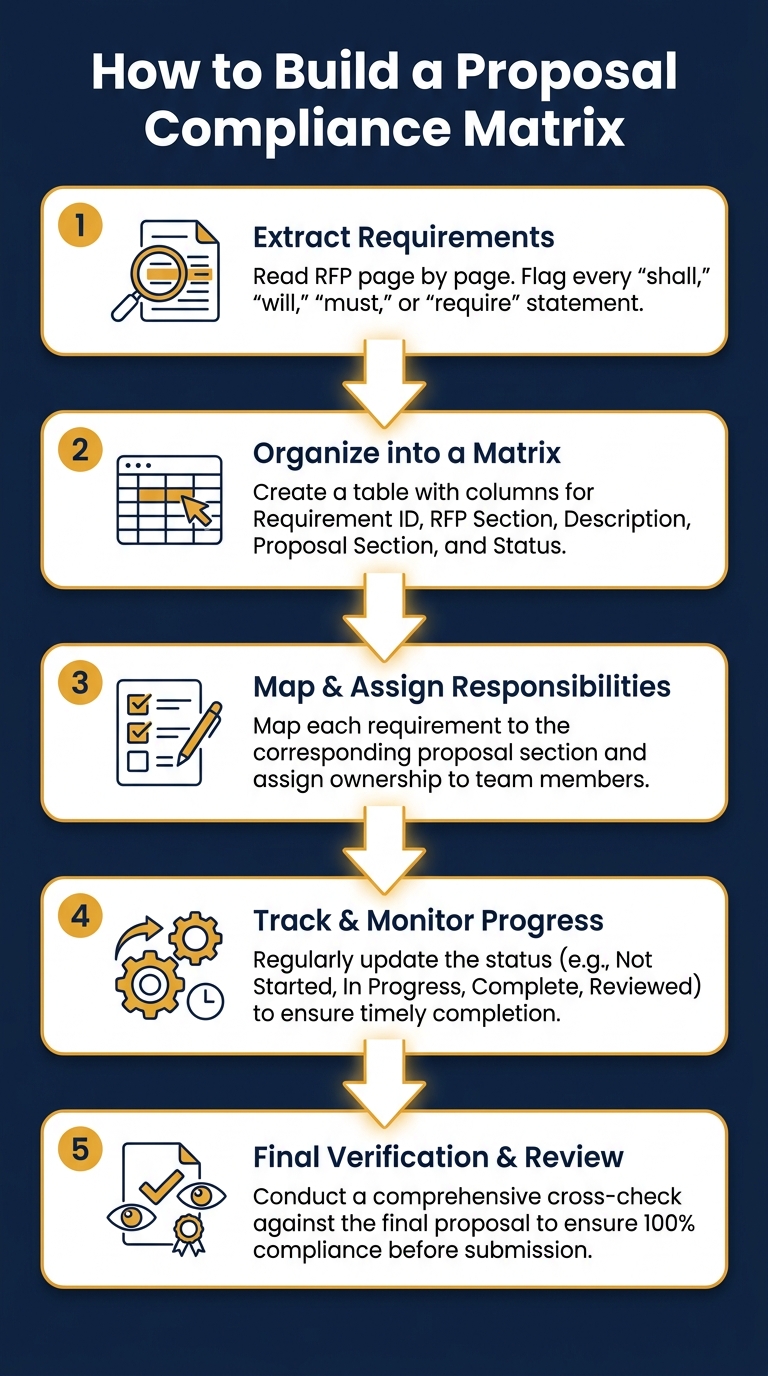
How to Build a Proposal Compliance Matrix: 5-Step Process
Extract and Organize Requirements
Once your matrix structure is ready, the next step is filling it in. Go through the RFP page by page – yes, page by page, not section by section. Why? Because requirements often pop up in unexpected spots. For example, don’t overlook obligations hidden in Section C (SOW/PWS), Section H (Special Contract Requirements), Section I (FAR/DFARS clauses), or Section J (Attachments/CDRLs). Evaluators expect all of these to be addressed.
Copy each requirement exactly as written into the matrix. Then, in the next column, add a brief plain-English summary to make it easier for your writing team to scan. Assign each requirement a unique ID and note its source – section, paragraph, and page number. This level of traceability can save you hours if any disputes come up during reviews.
Here’s a common pitfall to avoid: Contract Data Requirements Lists (CDRLs) in Section J. These are binding deliverables. If you miss them in your matrix, there’s a good chance they won’t make it into your proposal, which could cost you the contract.
Once you’ve captured all the requirements, the next step is to classify and prioritize them, ensuring the most critical items get immediate attention.
Classify and Prioritize Requirements
With all requirements in hand, it’s time to classify them. Start by identifying mandatory requirements – look for words like "shall", "must", or "will." These are non-negotiable. Next, separate out desirable requirements, which use terms like "should" or "may." These aren’t deal-breakers but can boost your score.
Don’t stop there. Create a separate category for mechanical constraints: page limits, font sizes, margin settings, required forms, and submission deadlines. These details might seem small, but they can sink your proposal before evaluators even start reading. In fact, industry data shows that over half of first-time bids fail because of these avoidable compliance errors.
Map Requirements to Proposal Content
After classifying everything, the next step is mapping each requirement to your proposal. This ensures nothing gets missed. Be precise – link each requirement to a specific location in your proposal: Volume, Section, and Paragraph. Simply mapping to a volume is too vague and won’t help during drafting or reviews.
If Section L of the RFP outlines a specific proposal structure, follow it to the letter. Then, overlay the evaluation criteria from Section M onto the corresponding instructions in Section L. Many teams skip this, and it’s a costly mistake.
"The Section L/M Alignment Trap: If your matrix only tracks Section L, you address QA in general terms but miss four evaluation sub-criteria." – Projectory AI
By mapping each requirement to a precise spot in your proposal, you avoid scoring gaps. Remember, evaluators score what they see – not what they think you meant to include.
Assign Ownership and Track Progress
Every row in your matrix needs a single, named owner – not a team, not a role, but one person who’s accountable for drafting the response.
"Shared ownership often means no ownership, so be specific." – Kyla Wallace, Loopio
Use a status system to track progress, building on the Red/Yellow/Green system with an added Blue stage:
| Status | Meaning | Action Required |
|---|---|---|
| Blue | Draft Complete | Pending compliance verification by a second reviewer |
| Green | Verified Compliant | Confirmed against verbatim RFP text by someone other than the writer |
The Blue status is crucial. A requirement isn’t "done" until a reviewer – someone other than the original writer – has verified it against the source text. Never submit a proposal with blue rows still unresolved.
Tie your status tracking to review milestones. For example:
- Aim for 30–50% of requirements addressed by the Pink Team review.
- Reach 90%+ by the Red Team review.
- Achieve 100% verified compliance by the Gold Team review.
In the final two weeks before submission, track progress daily. Count how many rows are red, yellow, or blue to gauge the remaining workload and decide if additional resources are needed.
Using Narwin.ai to Automate the Process
Manually building a compliance matrix for a complex government solicitation can take 8 to 16 hours – time that could be better spent refining your technical approach or past performance narratives. Enter Narwin.ai, a tool designed to streamline this entire process.
Narwin.ai automates key tasks, such as extracting "shall/must" statements directly from uploaded solicitation documents. It even finds requirements buried in tables, footnotes, and cross-references to FAR/DFARS clauses. When an amendment is issued, Narwin generates a diff report highlighting the changes, saving you from re-reading the entire solicitation. Its compliance gap identification feature flags missing certifications and weak points, giving your team a clear roadmap for what needs attention before the deadline.
Using the Compliance Matrix Throughout the Proposal Process
Once your compliance matrix is in place, it becomes a central tool throughout every stage of your proposal process. With all requirements mapped out, this matrix isn’t just a reference – it actively shapes how your proposal takes form.
Planning and Drafting Your Proposal
Think of your compliance matrix as the backbone of your proposal. By creating it on day one, you naturally structure your outline around what evaluators are looking for, rather than what’s easiest for your team to write. This approach avoids last-minute scrambling to fit the requirements into your content.
The matrix also allows different teams – legal, technical, and pricing – to work simultaneously, speeding up the overall process. For writers, it saves time by eliminating the need to repeatedly comb through the RFP. With the exact requirement text and its source already listed in the matrix, everything they need is readily accessible.
Here’s a step many teams miss: incorporate Section M evaluation criteria directly into your matrix alongside the Section L instructions. Each Section M sub-factor should have its own row. Without this, your content might look compliant but fail to address the specific criteria evaluators use to score proposals.
Finally, ensure your responses meet both the substantive requirements (what the content says) and the mechanical ones (how it’s formatted and presented).
Running Quality and Compliance Checks
Just because a draft is complete doesn’t mean it’s compliant. This is where your matrix becomes indispensable, helping you run two critical types of checks before submission.
- Substantive Check: Review whether each requirement is addressed with specific, actionable content. Avoid vague promises like "we will comply." For example, if the RFP requires a staffing plan with named key personnel, your proposal must include those names – not just a promise to provide them later.
- Mechanical Check: Conduct this check 24–48 hours before submission. Verify that formatting details – like font size, margins, page limits, and mandatory forms – meet the RFP’s specifications. Overlooking these details can lead to disqualification before anyone even reads your proposal.
For a thorough final review, use the two-person rule: one person reads each requirement from the matrix aloud while another confirms its presence and adequacy in the proposal. This method helps catch blind spots and assumptions that the original writers might miss.
Once these checks are complete, the matrix becomes a key tool for guiding your review cycles.
Using the Matrix in Review Cycles
During review cycles, your compliance matrix should be the first document you open – not something you consult only when issues arise. As reviews progress, the matrix’s role shifts to ensure compliance at every stage. Here’s how its focus evolves:
| Review Stage | Matrix Focus | Target |
|---|---|---|
| Pink Team | Structure & mapping | 100% of requirements captured and mapped to the outline |
| Red Team | Substantive coverage | 90%+ requirements addressed with written evidence; 80%+ marked "Full Comply" |
| Gold Team | Final validation | 100% "Full Comply"; page references verified post-pagination; all amendments reconciled |
Note: A "Blue" row indicates draft completion, but only "Green" rows confirm verified compliance. A row turns Green only after a reviewer (not the original writer) confirms it against the RFP’s exact wording. Submitting a proposal with unresolved Blue rows introduces risks that disciplined teams work actively to avoid.
For large proposals with multiple volumes – such as Technical, Management, and Pricing – the matrix also solves a common issue: disconnected teams accidentally duplicating content or leaving gaps because they assume another team is covering a requirement. A shared matrix with cross-volume visibility ensures these problems are addressed before they impact your score.
Best Practices for Building High-Scoring Compliance Matrices
Start Early and Follow the RFP Structure
The best way to ensure a strong compliance matrix is to begin working on it as soon as the RFP lands in your inbox. Delaying this process until you start drafting can lead to gaps and rushed retrofitting. Starting early gives you the opportunity to use the Q&A period to clarify uncertainties and refine your approach well before writing begins.
Stick closely to the RFP’s structure. Use its section headings in both your compliance matrix and proposal. Why? Evaluators often rely on internal scorecards that mirror the RFP’s layout. Aligning your proposal with this format makes it easier for them to locate and score the relevant content.
"Evaluators score what they can find, not what they can infer. If your response to a Section M sub-factor requires the evaluator to connect dots across different sections, many won’t – and you won’t get credit." – CapturePilot Team
Don’t overlook Section J attachments. Missing even one required form or certification can result in an automatic disqualification before your proposal is even reviewed for technical merit.
By starting early and following these steps, you’ll establish a solid foundation for compliance and tracking throughout the proposal process.
Keep the Matrix Accurate and Up to Date
Always copy the RFP’s requirement language word for word into your matrix. Even minor paraphrasing can lead to misinterpretations that might leave your proposal non-compliant. For instance, if the RFP states, "shall provide a staffing plan with named key personnel", your matrix must reflect that exact language.
Pay close attention to amendments. Every amendment should trigger an immediate review by a designated team member. This person should compare the changes against the original RFP, noting any additions, removals, or modifications. This isn’t just a suggestion – it’s a critical step to ensure compliance.
"A matrix that doesn’t reflect the latest amendment is more dangerous than no matrix at all." – CapturePilot Team
Keep all requirements in your matrix, even those you can’t meet, and flag them instead of removing them. This ensures no requirement is overlooked or forgotten.
By keeping your matrix accurate and updated in real time, you’ll safeguard your proposal against compliance issues as changes arise.
Use AI to Work More Efficiently
Given the demands of accuracy and timeliness, AI tools can significantly ease the burden of creating compliance matrices. Building a matrix manually for a complex RFP that spans 200–300 pages can take 8 to 16 hours. Even then, human error is common, with reviewers often missing 15% to 20% of requirements buried in appendices, footnotes, or tables. Keep in mind that 30%–50% of government proposals are rejected for non-compliance before they even reach technical evaluation.
Tools like Narwin.ai are designed to tackle these challenges. This AI-powered software scans RFP documents to extract requirements, highlight mandatory "shall/must" language, and align them with your proposal structure. What usually takes hours can now be done in under an hour. It also handles amendment reconciliation by automatically flagging changes, keeping your matrix up to date throughout the proposal process.
Using AI not only ensures your matrix is complete and current but also frees up your team to focus on crafting a more competitive proposal instead of chasing missed requirements at the last minute.
Conclusion
A compliance matrix is far more than just a simple checklist – it’s the backbone of a successful proposal. Non-compliance is one of the most common reasons proposals are rejected, often disqualifying bids before evaluators even review the technical content. A well-constructed matrix ensures your proposal stays in contention.
To get it right, start as soon as the RFP is released. Use the exact language from the document, assign clear responsibility for each requirement, and treat the matrix as a dynamic tool that adapts with every amendment. These steps not only help you meet compliance standards but also enhance the overall quality of your proposal. Compliance forms the base; everything else – your technical strategy, pricing, and win themes – builds on top of it. But none of that will matter if your proposal doesn’t make it past the initial compliance checks.
Using technology can make this process more efficient. Tools like Narwin.ai help you extract requirements, identify gaps, and keep your matrix up to date, freeing your team to focus on crafting a proposal that stands out and wins.
FAQs
What should I do if I can’t meet a mandatory RFP requirement?
If there’s a mandatory requirement you can’t meet, it’s best to be upfront about it in your proposal. Clearly highlight the exception and address it directly. This approach is far better than having it identified during the evaluation process.
Make the most of the Q&A period to seek clarification on unclear terms or to request changes to requirements you’re unable to fulfill. When submitting such requests, be specific: reference the exact section, explain your reasoning, and detail how your proposed change benefits the agency. Also, stay alert for amendments, as these may update or adjust the requirements.
How do I align Section L instructions with Section M evaluation criteria?
To ensure your proposal aligns with Section L instructions and meets Section M evaluation criteria, a compliance matrix serves as a crucial traceability tool. Here’s how you can create one:
- Understand Section M Scoring
Begin by thoroughly reviewing Section M. This section outlines the evaluation factors and scoring criteria that will determine how your proposal is assessed. Take note of any specific priorities or weightings. - Structure Your Response Using Section L
Section L provides the instructions for how your proposal should be organized. Use it as a guide to structure your response, ensuring all required elements are included and properly formatted. - Map Requirements to Proposal Sections
Create a matrix that connects every requirement in Section L and Section M to specific locations in your proposal. This ensures that:- Section L’s instructions are fully addressed.
- Section M’s evaluation factors are clearly demonstrated.
- Use Narwin.ai for Efficiency
Tools like Narwin.ai can streamline this process by extracting requirements from Sections L and M and generating a structured matrix. Each requirement is assigned a unique ID, making it easier to track and verify compliance.
By following this approach, you’ll create a clear roadmap that ensures your proposal aligns with the necessary guidelines and evaluation criteria.
When should I update the compliance matrix for RFP amendments?
Every time a solicitation amendment is issued, make it a priority to update your compliance matrix. Amendments often modify critical details such as deadlines, evaluation criteria, or technical requirements, effectively replacing the original solicitation. If you continue working from outdated documents, you risk falling into non-compliance – a mistake that could cost you the opportunity.
Think of the compliance matrix as a living document that evolves with every change. Assigning a compliance lead can help ensure all updates are captured quickly and accurately, keeping your team aligned and on track.