
You do not need to guess before you bid. I can use AI to read RFPs, addenda, Q&A logs, and past awards to spot four things early: delay risk, buyer priority changes, compliance pressure, and bid fit.
That matters because a single public-sector bid can burn dozens to hundreds of staff hours before submission. If I can see signs of a likely deadline slip, a tighter certification requirement, or a poor fit with the buyer’s past awards, I can make a better go/no-go call before my team spends more time and money.
Here’s the short version:
- AI reads published procurement data across the full tender record, not just the base RFP.
- It looks for repeat patterns in wording, amendment timing, bidder questions, and award history.
- It turns those patterns into four working signals:
- Delay risk
- Preference shift
- Compliance intensity
- Bid fit
- Each signal should lead to an action, like holding extra review time, checking certifications, changing proposal emphasis, or walking away.
A few clear examples:
- If an agency posts multiple addenda in a short span, I should plan for schedule movement.
- If Q&A keeps circling around FedRAMP, SOC 2, insurance, or security terms, I should expect tighter proof requirements.
- If past awards keep going to the same vendor type, I should review whether the deal leans toward an incumbent or a narrow buyer pattern.
- If the contract size falls far outside my past win range, that is a warning sign on fit.
AI helps most when I use a simple workflow:
- Collect current and past tender data
- Normalize fields like due dates, addendum count, clause changes, and award timing
- Compare language and buyer behavior across records
- Score the four signals
- Check high-impact outputs against the official portal before acting
One point matters most: the portal is the source of truth. AI is useful for early warning, pattern spotting, and sorting bid effort. But I still need human review for dates, mandatory criteria, technical merit, and insurance limits, and other high-risk items.
If I want better bid decisions, the play is simple: use AI to scan faster, then use people to confirm what matters.
The Buyer Signals AI Reads
AI compares the current solicitation with addenda, Q&A, past awards, and timelines to spot delay risk, buyer preference shifts, compliance pressure, and overall bid fit. That cuts review time and helps surface patterns across tenders that a manual pass can miss. The best place to start is the current solicitation. Then compare it with edits, bidder questions, and prior awards.
Tender Documents: Scope, Evaluation Criteria, and Mandatory Requirements
AI starts with the base solicitation. It pulls out due dates, pricing structure, submission instructions, certification requirements, insurance thresholds, security clauses, and deliverable milestones.
Then it reads the wording itself. It flags how often certain themes show up and whether the requirements lean on mandatory terms like "shall" and "must" or softer terms like "should" and "may." If cybersecurity comes up again and again, and the document uses "shall" all over those sections, that usually points to more evaluation weight in that area.
After that, the next move is simple: check whether later amendments back up those priorities or water them down.
Addenda and Q&A Logs: Where Shifting Priorities Show Up First
Addenda and Q&A logs show what the buyer changed after the release. AI tracks multiple amendments in a short period, deadline extensions, scope revisions, pricing format changes, and repeated questions from different bidders about the same clause.
That’s often where the story starts to change. If several vendors ask whether a certification is actually mandatory, and the buyer gives mixed answers or follows up with another amendment, that points to internal disagreement or a policy shift. If a tender keeps getting amended around staffing, insurance, or security duties, that’s a delay-risk signal.
The next step is to compare those edits with the buyer’s award history and timing patterns.
Past Awards and Procurement Timelines: Patterns Behind Current Behavior
Past awards and procurement timelines show how the buyer tends to act over time. If a buyer keeps awarding to the same type of vendor, that points to a preference pattern, even when the solicitation language looks neutral on the surface. Repeated deadline extensions also push delay-risk scores higher.
Narwin.ai’s Buyer Intel feature uses this kind of historical context from sources like SAM.gov and CanadaBuys to surface past priorities, risk tolerance, and evaluation patterns. Repeated protests can also change buyer behavior. Agencies often respond by tightening language, adding more compliance detail, or extending timelines.
That history feeds the delay, preference, and compliance scores used in the next step.
sbb-itb-bb3960c
How to Build an AI Tender Prediction Workflow
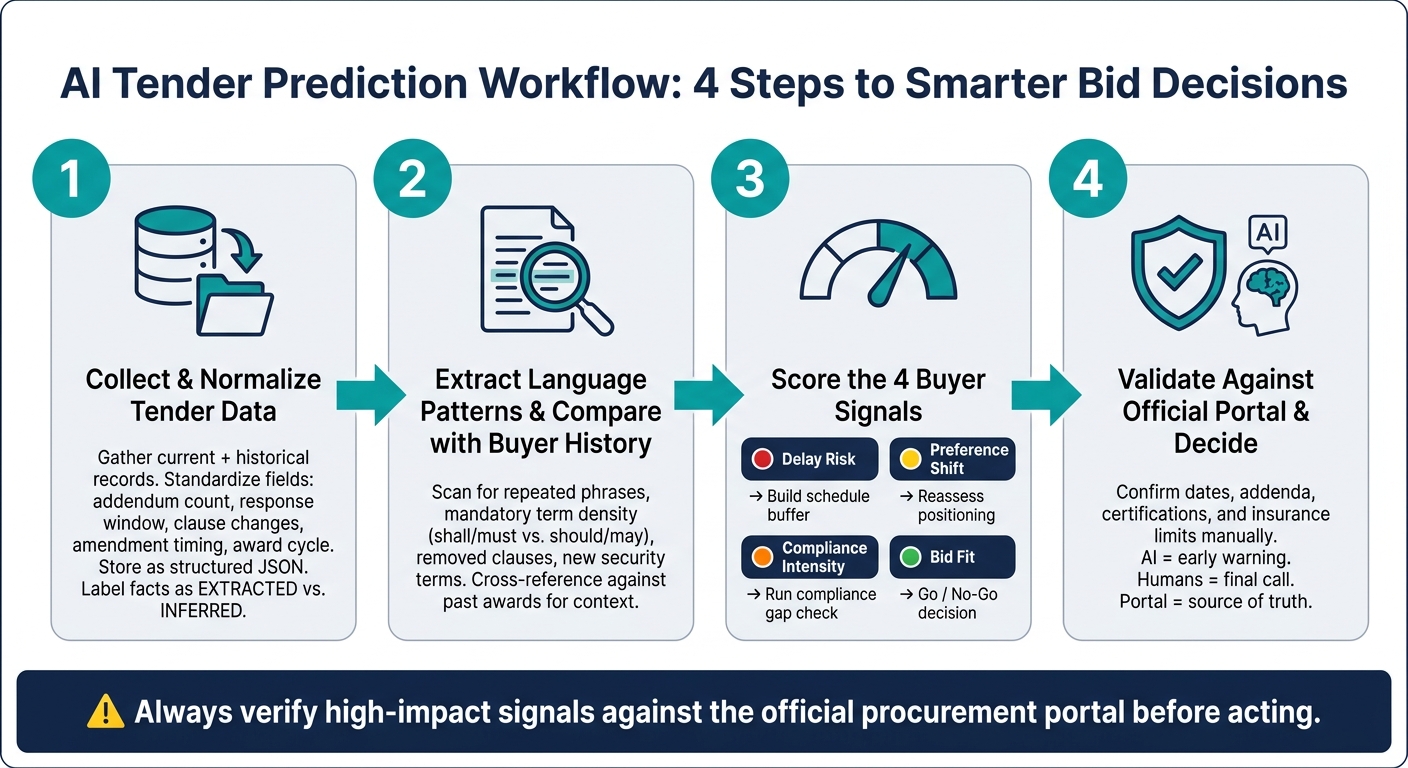
AI Tender Prediction Workflow: 4 Steps to Smarter Bid Decisions
Turn those signals into a repeatable review process. The goal is simple: move from raw tender data to a clear bid decision without digging through the same files again and again.
Step 1: Collect and Normalize Current and Historical Tender Data
Bring current and past tender records into one structured record. Then standardize the fields that matter most, including addendum count, response-window length, clause changes, amendment timing, question volume, and award cycle length.
Store that normalized data in JSON or another structured format so the AI can query it directly instead of re-reading raw files every time.
If you’re dealing with sensitive procurement documents, parse those files locally before sending outputs to a cloud model. That gives you more control over what leaves your system.
Also, label source facts as EXTRACTED and model outputs as INFERRED. That simple split matters. It keeps hard facts separate from model judgment.
Step 2: Extract Language Patterns and Compare Them with Buyer History
Once the data is clean and structured, AI uses natural language processing to scan for patterns that are easy to miss in a manual review.
That includes repeated phrases, the density of mandatory terms, evaluation emphasis, removed clauses, tightened security terms, and new requirements.
When your dataset is linked, you can compare current clauses against past awards and spot the requirements the buyer seems to care about most. That’s where the review starts to get sharper. You’re not just reading the tender. You’re reading it in context.
Step 3: Score the Signals and Turn Them into Actions
Next, turn those signals into four action-ready scores: delay risk, preference shift, compliance intensity, and bid fit.
Each score should lead to a clear next step, not just sit on a dashboard.
| Signal Score | What It Suggests | Action |
|---|---|---|
| High delay risk | Multiple amendments or deadline extensions | Build buffer time into your schedule; flag for leadership |
| Preference shift | Buyer behavior changes across recent tenders or awards | Reassess your positioning |
| High compliance intensity | Dense mandatory language or new certifications | Run a compliance gap check before writing the proposal |
| Low bid fit | Scope or geography mismatch | Consider a no-bid and redirect resources |
Add policy guardrails before anyone acts on those scores. For example, high compliance intensity should trigger a certification check, and low bid fit should trigger a no-bid review.
That way, the workflow doesn’t just score tenders. It nudges the team toward the right call.
Step 4: Use AI Tools to Speed Up Review and Qualification
Once the data is structured, AI can speed up review and qualification in a practical way.
Narwin.ai automates requirement extraction, buyer-intel review, and go/no-go scoring across U.S. and Canada tenders. That makes it easier to sort opportunities and focus deeper analysis on the ones that deserve your team’s time.
How to Read AI Predictions and Adjust Your Bid Strategy
The next step is simple: turn each score into a bid move.
Once the workflow scores delay risk, preference shift, compliance intensity, and bid fit, map each one to an action:
- Delay risk → timeline
- Preference shift → win themes
- Compliance intensity → evidence
- Bid fit → go/no-go
That way, the scores don’t just sit in a dashboard. They shape what your team does next.
Reading Delay Risk and Planning Around Timeline Changes
A high delay risk score is a planning signal. When those signals pile up, treat an extension or reissue as likely, not just possible.
That changes how you plan. Keep key reviewers reserved past the current deadline. Have a compliant baseline ready by the original due date. Hold a contingency review slot in case the buyer moves the schedule. If delay risk is high, build pricing and staffing scenarios early instead of scrambling later.
For U.S. and Canadian government bids, Narwin.ai can monitor sources such as SAM.gov and provincial portals in real time. As new addenda post, it updates delay risk scores so your team doesn’t have to keep checking every listing by hand.
Spotting Preference Shifts and Rising Compliance Pressure
Preference shifts often show up in small but telling ways: new terms in amendments, reordered criteria, or repeated Q&A around one issue like data residency or accessibility.
When AI flags those patterns, don’t stop at the executive summary. If security language spikes, move cybersecurity assurances into a dedicated proposal section and lead with prior government implementations. If the buyer’s Q&A shows a tight focus on certifications like FedRAMP or SOC 2, map each clause to dated evidence – audit letters, test results, credentials – not generic claims.
When compliance intensity rises, shift from review to proof.
That pressure can also change solution design and teaming. If amendments put more weight on local participation or small business engagement, check whether your current teaming setup matches that push. If AI picks up a stronger focus on total lifecycle cost or modern architecture, adjust pricing structure, solution design, or subcontractor mix – not just the words on the page.
Using a Buyer-Signal Matrix and Fit-and-Risk Table
Use the signals to make the decision more consistent. Two tools help here: a buyer-signal matrix and a fit-and-risk table.
Buyer-Signal Matrix
| Signal Type | What It Means | Strategy Adjustment |
|---|---|---|
| Multiple addenda in a short period | Buyer is still refining scope; internal alignment may be weak | Increase contingency budget; prepare for a potential reissue |
| New or intensified technical language in amendments | Evaluation priorities are shifting | Update win themes; add sections that directly address the new language |
| Repeated certification questions in Q&A | Compliance scrutiny is rising; buyer is risk-averse | Front-load certifications; expand the compliance matrix with dated evidence |
| Clustered Q&A replies | Internal bottlenecks; timeline extension is likely | Delay final resource commitment; schedule a contingency review slot |
| Compressed response window vs. historical average | High urgency or possible incumbent advantage | Accelerate the go/no-go decision; prioritize must-win sections first |
Fit-and-Risk Table
| Strong-Fit Indicators | Warning Signs |
|---|---|
| High solution match to the RFP’s technical requirements | Ambiguous scope with conflicting descriptions across sections |
| Buyer’s past awards align with your approach | Frequent requirement changes via multiple scope-related addenda |
| Contract size within 1–3× your comparable past wins | Contract size too large or too small |
| Sufficient response window for your team’s typical timeline | Response window shorter than your proven development time |
| Clear, measurable evaluation criteria | Unusual liability or insurance terms outside your standard risk appetite |
Proceed only when strong-fit indicators clearly outweigh high-severity warnings.
Common Limits and Validation Checks
AI is only as reliable as the tender data behind it. Validate signals before you act. These scores matter only when the source data is complete and clean. The four signals – delay risk, preference shift, compliance intensity, and bid fit – stand or fall on data quality.
When Sparse History or Noisy Documents Reduce Prediction Quality
The most common cause of weak predictions is limited buyer history. If an agency has issued only one or two prior solicitations, delay-risk scoring has to lean on broad patterns instead of buyer-specific behavior. In that case, win-score estimates can depend more on assumptions than on hard evidence. To close the gap, use agency budgets, press releases, and public records.
Poor-quality documents cause a different kind of trouble. Scanned PDFs with weak text recognition, evaluation criteria buried inside formatted tables, or addenda that refer to changes indirectly can all lead to extraction mistakes. A misread closing date – say, reading "01/08/2026" as January 8 instead of August 1 – can throw off delay risk. A missed mandatory certification in a late addendum can skew bid fit and compliance intensity.
Missing award records make things worse. If there’s no data linking stated evaluation criteria to actual award outcomes, the AI can’t learn with much confidence whether a buyer puts more weight on technical quality than price, or whether they tend to keep incumbents. Without original bid documents, AI cannot classify, quantify, or price accurately. That’s why every high-stakes signal needs a validation step.
How to Verify Outputs Before Acting on Them
Once you’ve checked data quality, verify every high-impact signal against the official record. The portal is the authority. The AI is an early warning system. Confirm dates in the official portal, download every addendum, and manually review high-impact compliance items before you shift strategy.
For requirements, run a document cross-check. Compare the AI’s extracted requirement list against the latest official RFP and all addenda, then sort items into mandatory, rated, and informational buckets the right way. Certifications, insurance limits, security clearances, and socioeconomic status requirements should always get a manual review from a contracts or compliance lead before you commit to a bid.
If the AI flags a requirement as low-confidence or leaves a quantity blank, go back to the original document instead of accepting the inference. Use a time-boxed checklist by role.
Conclusion: Use AI Signals to Make Better Bid Decisions
Once you score the four signals, you can turn that input into action. The path is simple: collect, normalize, compare, score, and decide. Each step builds on the last, so the process works best when the data is clean from the start.
The models make the scan faster. People still make the call. AI reads the signals, and humans check intent, context, and bid strategy.
Move early on delay risk, compliance pressure, and bid fit. That helps protect your team’s time and improve win quality.
If you want to run this in one workflow, Narwin.ai uses the same process across live tenders. It monitors public tenders across the United States and Canada and surfaces go/no-go signals, risk analysis, and buyer intelligence.
Start small. Pick one agency or one region, run the workflow on upcoming bids, and compare the predictions with actual award outcomes.
FAQs
How accurate are AI tender predictions?
AI tender predictions draw on both structured and unstructured data. That usually includes RFPs, past performance records, and procurement history.
How well they perform depends on the job. For example, extracting RFP requirements often lands in the 75% to 92%+ range. Some compliance tasks go even higher, reaching 97%.
Bid outcome prediction shows strong results too. Models that combine NLP with historical bid data have reached 85% accuracy and an AUC of 0.94.
That said, these systems tend to work best when people stay in the loop. Human experts can review the output, fix edge cases, and sharpen the final result.
What data matters most for spotting buyer shifts?
Prioritize the sources that tell you the most, fastest.
- Evaluation factors: These show what will be scored and whether the buyer leans toward Best Value or LPTA.
- Pre-solicitation signals: Sources Sought, RFIs, forecasts, and agendas can show when requirements or funding are still shifting.
- Past awards, amendments, and Q&A logs: These often point to incumbent patterns, mid-cycle changes, compliance focus, and likely bid fit.
When should I trust AI versus manual review?
Trust AI for data extraction, pattern spotting, and compliance mapping. Narwin.ai is good at scanning long bid packages, flagging red flags, and pulling out key requirements fast.
Use human judgment for the calls that need context, experience, and a longer view, like long-term strategy, internal capacity, and agency relationships. AI can surface data and win probability scores, but your team should make the final bid strategy.