
Handling RFP compliance manually is time-consuming and error-prone. Missing a single requirement in a government proposal can lead to disqualification, regardless of your pricing or technical expertise. AI tools are changing this by automating repetitive tasks, reducing errors, and saving significant time.
Here’s how AI improves the process:
- Automated Requirement Extraction: AI scans dense RFP documents in minutes, identifying key requirements and cross-referencing external standards like FAR/DFARS.
- Real-Time Compliance Matrices: AI builds compliance matrices instantly, mapping requirements to proposal sections and flagging updates or amendments.
- Risk Detection: AI checks for missing certifications, outdated clauses, and formatting issues, ensuring submissions meet all criteria.
- Team Collaboration: Modern platforms integrate with tools like Google Drive and Slack, enabling teams to work together efficiently.
Organizations using AI for RFP compliance report saving 40–60 hours per proposal, increasing win rates by 10–25%, and avoiding costly errors. With features like live compliance scoring and automated updates, AI ensures you stay competitive in government contracting.
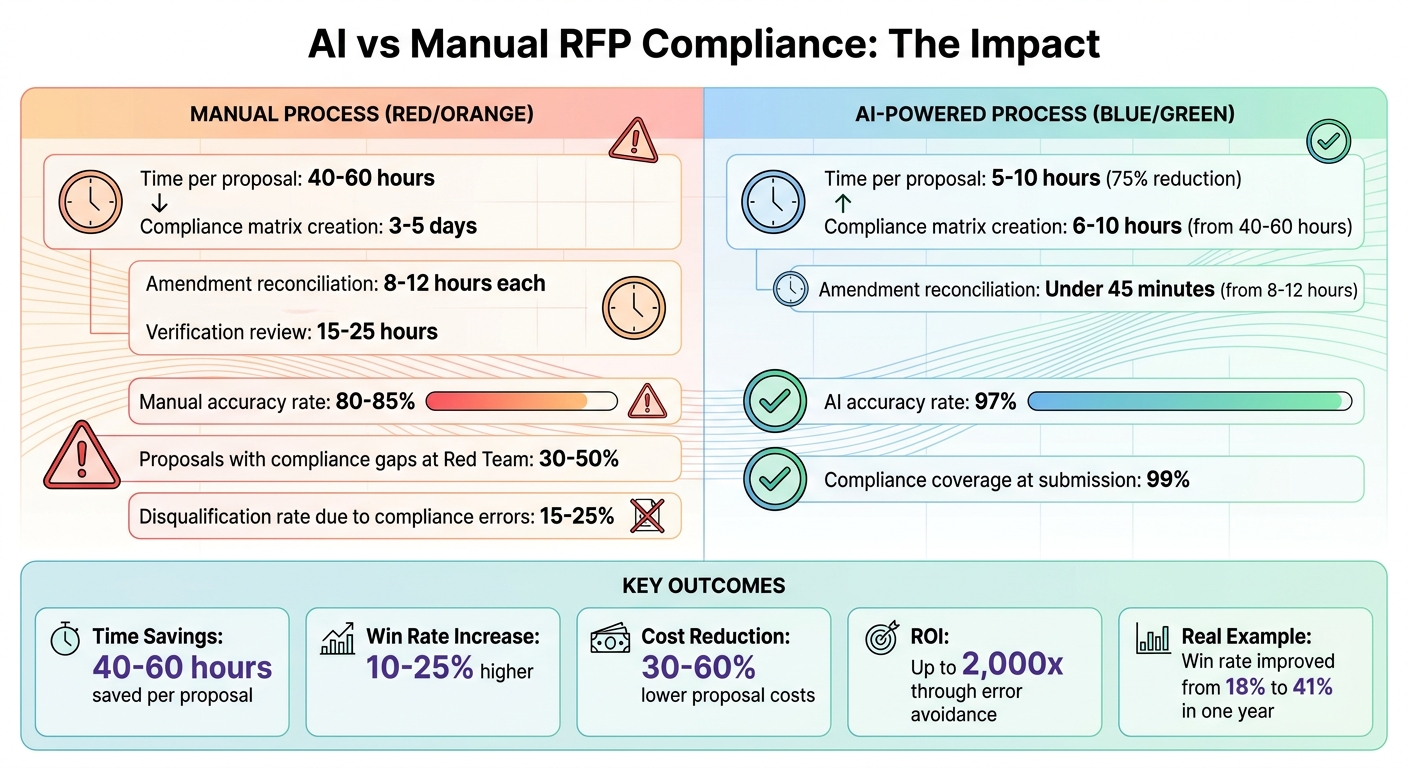
AI vs Manual RFP Compliance: Time Savings and Win Rate Improvements
Common Challenges in RFP Compliance
Manual Processes Take Too Much Time
Federal RFPs often include anywhere from 200 to 400 requirements, leaving teams to sift through dense documents to extract every "shall", "must", and "required" statement. Building a compliance matrix – essentially a roadmap that connects each requirement to a specific section of the proposal – can take 3 to 5 days of painstaking manual effort. Adding to the complexity, references to FAR/DFARS clauses, NIST publications, or MIL-STDs can tack on an additional 50 to 100 requirements that need individual tracking. When amendments roll in, reconciling them manually can take another 8 to 12 hours per amendment.
The verification stage adds yet another layer of labor, requiring 15 to 25 hours of review time spread across team members. Shared spreadsheets often cause version control issues, creating bottlenecks and fatigue as team members repeatedly verify the same details. All told, organizations spend 40 to 60 hours on compliance matrix creation for a single proposal – valuable time that could be better spent refining strategy or crafting a winning narrative.
These time-draining manual processes not only slow teams down but also increase the likelihood of costly mistakes.
Human Error Creates Compliance Risks
Mistakes happen, and in the world of federal proposals, even minor errors can have major consequences. A missed signature page, an unchecked box in Section 4.2.7, or an improperly formatted certification can undo months of hard work. Shockingly, 15 to 25% of competitive proposals are disqualified not because of weak technical solutions or pricing, but due to compliance oversights.
"One missed signature page, incorrect format, or unaddressed compliance item can eliminate proposals that took hundreds of hours to prepare." – Arphie
The situation worsens when teams rely on multiple versions of tracking spreadsheets. Miscommunication or assumptions about who is handling a specific requirement can lead to gaps. Reviewers often find themselves toggling between spreadsheets and proposal drafts, struggling to confirm that every response aligns with the details required. By the time proposals reach the "Red Team" review stage, 30 to 50% already have compliance gaps. For example, one defense contractor lost a $48 million contract because a single requirement was overlooked, leading evaluators to deem the proposal "not fully compliant."
Managing Multiple RFPs Gets Complicated
When juggling multiple RFPs, these challenges multiply. Each Department of Defense (DoD) RFP can contain hundreds of requirements, and frequent amendments only add to the workload. Managing three or four proposals at once means tracking 1,200 to 1,600 requirements and spending 24 to 48 hours reconciling amendments each time changes occur.
Accountability often falls through the cracks. With "shared ownership" of requirements, it’s easy for everyone to assume someone else is handling a specific compliance point. Subject matter experts are frequently interrupted to answer the same technical questions across multiple proposals, leaving them stretched thin. Teams also struggle to align Section M scoring criteria with Section L instructions, a common pitfall that results in responses that are technically "compliant" but score poorly. Meanwhile, requirements buried in Section H or Attachment J can be completely overlooked when staff are spread too thin to catch every detail.
These overlapping challenges underscore why leveraging AI tools is becoming increasingly important for streamlining RFP compliance.
sbb-itb-bb3960c
How AI Simplifies RFP Compliance
AI is transforming the way teams handle RFP compliance, replacing tedious manual processes with RFP automation that saves time and reduces errors. Tasks that once consumed 40 to 60 hours per proposal can now be completed in a fraction of that time. Using Natural Language Processing (NLP), AI-powered platforms can scan entire RFP documents – including attachments like Statements of Work, Contract Data Requirements Lists (CDRLs), and Section H clauses – and extract key requirements in just minutes. With an accuracy rate of 97%, compared to the 80–85% typical of manual reviews, AI significantly lowers the chances of missing critical details that could lead to disqualification.
Here’s a closer look at how AI handles these tasks.
AI Extracts Requirements Automatically
AI uses NLP and vector search to comb through RFP documents and pinpoint technical questions, compliance requirements, evaluation criteria, and submission deadlines, even across hundreds of pages. It doesn’t just look for keywords – it interprets context, distinguishing between mandatory terms like "must", "shall", and "required" and optional ones like "desired" or "preferred." This prioritization ensures your team focuses on what matters most.
When RFPs reference external standards, such as FAR/DFARS clauses, NIST publications, or MIL-STDs, the AI follows these cross-references to uncover requirements hidden in attachments – details that manual reviews often miss. Tools like Narwin.ai take this a step further by using Retrieval-Augmented Generation (RAG). They index your company’s private knowledge base, including certifications, past projects, and safety records, and align your capabilities with the extracted requirements. You can even guide the AI by providing "Special Instructions", like specifying a focus on certain materials or scopes, to tailor the results to your needs.
AI Generates Compliance Matrices in Real Time
Once requirements are extracted, AI can build compliance matrices in minutes, a task that traditionally takes 8 to 40+ hours. These matrices organize requirements by type and clearly separate Section L instructions from Section M evaluation criteria, ensuring your responses align with evaluator scoring methods. Each requirement is assigned a unique ID for easy traceability, and the AI maps them to specific sections of your proposal, creating a structured and accountable framework.
When updates or amendments are issued, AI compares the new version to the original, instantly flagging any changes or additions. This eliminates the painstaking manual reconciliation process, which can take 8 to 12 hours, reducing it to under 45 minutes. For example, a mid-tier defense firm reduced its matrix build time from 40–60 hours to just 6–10 hours. Their compliance coverage at submission jumped from 78% to 99%, boosting their win rate from 18% to 41% in just a year.
AI Detects Risks and Sends Alerts
AI continuously monitors compliance as your team drafts responses, using "Live Compliance Scoring" to check your content against extracted requirements in real time. It flags missing certifications, outdated clauses, or inconsistencies in your response library before they become submission blockers. If requirements are unclear or contradictory, the system highlights them early, giving you time to request clarifications.
AI also keeps an eye on submission logistics, ensuring you don’t miss signature pages, exceed page limits, or use incorrect formatting – common issues that lead to 15% to 25% of proposals being disqualified.
"The compliance matrix generator found 23 requirements our team missed in manual review. It literally saved our proposal from rejection." – Michelle R., Proposal Manager, IT Services Provider
Improving Team Collaboration and Workflow Integration
AI is changing the game for team collaboration and workflow integration, especially when it comes to handling RFP compliance. The process often requires input from various roles – estimators, CFOs, proposal writers, and subject matter experts. AI platforms simplify this by creating a shared workspace where everyone can access the same up-to-date information. No more digging through outdated folders or waiting on email chains – teams can now review compliance matrices, provide feedback, and track progress all in one place.
Teams Can Work on Compliance Together
Modern AI tools make real-time collaboration effortless. Stakeholders can edit, comment on, and update compliance documents simultaneously. For example, platforms like Narwin.ai allow instant sharing of compliance reports. Teams using AI for RFP management have reported saving over 15 hours per bid cycle. This streamlined approach not only boosts efficiency but also improves accuracy and speeds up decision-making.
AI Integrates with Your Existing Tools
One of AI’s strengths is its ability to work with the tools your team already uses. It connects to platforms like Google Drive and Notion, indexing documents daily to keep your knowledge base current. Communication tools like Slack send instant notifications for new RFP matches or tasks requiring attention, reducing the need for constant check-ins. If your team uses procurement portals like SAM.gov or Merx, Chrome extensions can bring AI insights directly into your browser, making integration seamless.
AI Generates Audit-Ready Documentation
AI doesn’t just help during the compliance process – it also ensures your documentation is audit-ready. It generates detailed reports that map requirements to your company’s capabilities, complete with win probability scores and supporting reasoning. These reports can be exported as Word or PDF files, offering transparency for internal audits or stakeholder reviews. With built-in version control and a system that tracks every change, AI creates an evolving knowledge hub. Past proposals become valuable training data, enhancing future accuracy and complementing real-time compliance scoring. This shift from static file storage to dynamic, indexed intelligence ensures consistency and simplifies compliance reviews when auditors come knocking.
How to Implement AI for RFP Compliance
To successfully integrate AI for RFP compliance, start by choosing the right platform, onboarding your team effectively with modern proposal management strategies, and tracking key metrics to measure impact. These steps directly address inefficiencies and risks, setting you up for success.
Select the Right AI Platform
The platform you choose should streamline your workflow by extracting requirements, scoring opportunities, and integrating seamlessly with your processes. Features like automated requirement extraction and bid/no-bid scoring are crucial. These tools simplify the process by pulling compliance requirements and evaluation criteria from complex RFPs, while also helping your team prioritize winnable opportunities.
For example, Narwin.ai offers a comprehensive solution for RFP compliance. It automates bid discovery across platforms like SAM.gov and CanadaBuys, drafts proposals using AI, and improves over time through a "knowledge loop" where each submission enhances the AI’s performance. Pricing starts at $199/month for 10 full RFP analyses, making it a scalable option for teams of various sizes.
Train Your Team and Scale Usage
After selecting your platform, focus on onboarding your team to maximize its potential. Begin by uploading past bids, case studies, certifications, and other relevant documents to build a robust knowledge base. Regular updates to this database will improve the AI’s output over time. Involve key stakeholders, such as estimators, CFOs, and proposal writers, to ensure a smooth and collaborative onboarding process.
AI platforms can generate first drafts that are about 80% complete, saving significant time. Use system and custom prompt templates to maintain a consistent tone that aligns with your brand. For more targeted results, include specific instructions like "Focus on solar or BIPV sections" during analysis. Additionally, connect the platform with tools like Slack for instant updates and sync with Google Drive or Notion for daily document indexing.
Track Results and Calculate ROI
Before implementing AI, establish a baseline by tracking metrics like your average time per RFP cycle, error rates, and labor costs. Once the platform is in use, monitor improvements in efficiency, such as time saved per RFP and the speed of data extraction. Teams using AI platforms have reported a 16% higher win rate compared to manual processes, along with 63% time savings in contract and RFP reviews.
To calculate ROI, multiply the hours saved by your team’s average hourly rate. For mid-sized teams, where salespeople often spend 23% of their time on proposals, this can translate into significant savings – potentially hundreds of thousands of dollars annually. Some organizations have even achieved a 2,000x ROI by using AI for risk detection, avoiding costly bidding errors. Keep an eye on bid/no-bid accuracy to ensure your efforts focus on high-probability opportunities, and track how much time shifts from routine tasks to strategic, high-value work.
Conclusion
AI is transforming the RFP process and how teams handle compliance by taking over time-consuming tasks like requirement extraction, real-time matrix generation, and risk flagging. What used to take 20–40 hours can now be done in just 5–10 hours, allowing teams to focus on strategy rather than tedious administrative work.
The accuracy boost is just as transformative. AI tools cross-check every requirement against your proposal, identifying gaps and inconsistencies that human reviewers might overlook. Teams using these tools have reported 10–25% higher win rates and 30–60% lower proposal costs over time.
Speed is another game-changer. In government contracting, where deadlines are tight and multiple RFPs often overlap, AI platforms like Narwin.ai significantly shorten bid preparation timelines – from weeks to just days. These tools automatically extract compliance requirements from dense documents and draft responses tailored to your past successes and certifications. This involves training AI on past RFPs to maintain your unique brand voice. Features like instant go/no-bid scoring, risk analysis, and integrations with tools like Slack and Google Drive mean you can tackle more opportunities without compromising quality.
The return on investment (ROI) speaks volumes. Organizations leveraging AI for RFP compliance have seen 75% reductions in time spent per proposal and, in some cases, achieved 2,000x ROI by avoiding costly bidding errors that could have led to disqualification. For mid-sized teams, where salespeople often dedicate nearly a quarter of their time to proposals, this can translate into savings worth hundreds of thousands of dollars annually.
Relying on manual processes for RFP compliance puts you at a disadvantage. AI-driven platforms allow you to handle a higher volume of bids, improve compliance precision, and secure more contracts without needing to expand your team. The time savings and increased win rates alone make the investment worthwhile. In today’s fast-paced government contracting world, adopting AI-driven compliance tools is no longer optional – it’s essential to staying competitive.
FAQs
How accurate is AI at extracting RFP requirements?
AI can pull out RFP requirements with an accuracy rate between 75% and over 92%, depending on how the solicitation is laid out and formatted. The better organized the RFP, the higher the accuracy tends to be.
How does AI handle RFP amendments and version changes?
AI handles RFP amendments and version updates by automating the process of monitoring and extracting changes. It identifies updates, pinpoints revised sections, and updates compliance matrices to reflect those changes, ensuring every detail is accounted for. Platforms like Narwin.ai offer real-time alerts on amendments, allowing teams to adjust their responses promptly. This automation not only cuts down on manual work but also ensures responses remain compliant and aligned with the most current RFP requirements throughout the bidding process.
What do I need to set up AI for RFP compliance?
Here’s how you can get started with Narwin.ai to streamline your RFP compliance process:
- Create a Company Profile: Start by uploading essential details like certifications, past projects, and your company’s capabilities. This helps Narwin.ai provide analysis tailored to your business.
- Upload RFPs: Once your profile is set, upload your RFP documents. Narwin.ai will scan them to identify compliance issues, potential risks, and specific requirements.
- Integrate Tools: Enhance your workflow by connecting Narwin.ai to platforms you already use, such as Google Drive or Slack.
By following these steps, you’ll enable precise compliance checks, gain actionable risk insights, and improve your chances of winning bids.