
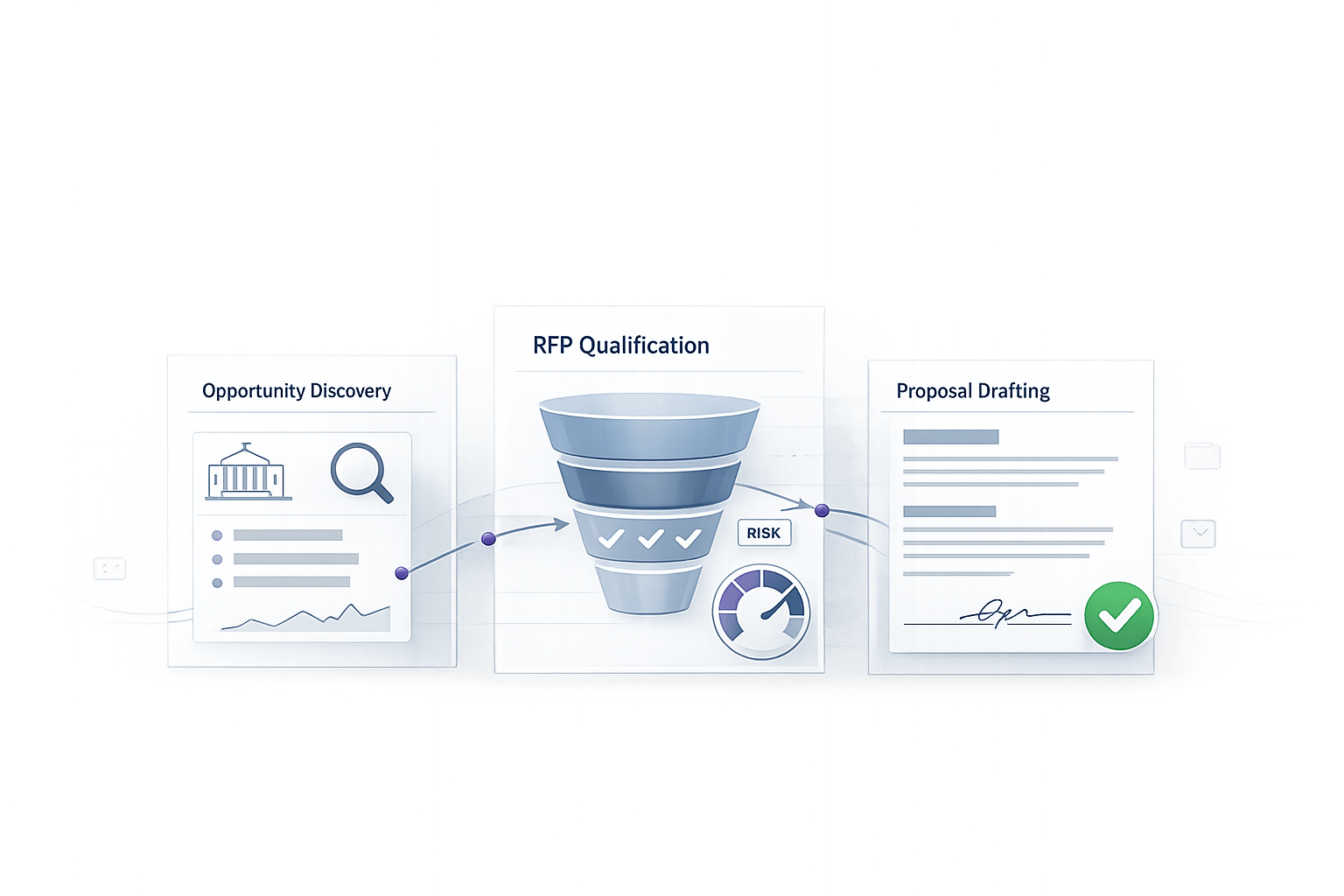
Government contractors face a tough challenge: too many opportunities, not enough time. AI tools are changing that by automating tasks like opportunity discovery, RFP qualification, and proposal development. Here’s how AI helps GovCon teams handle more bids, cut costs, and boost win rates:
- Opportunity Discovery: AI finds 150% more qualified leads by scanning federal, state, and local procurement sources 24/7.
- RFP Qualification: AI analyzes compliance, calculates win probabilities, and flags risks in minutes, saving hours of manual work.
- Proposal Development: With AI-assisted drafting, teams complete proposals 50-60% faster, increasing bid capacity from 6 to 18-24 per quarter.
- Team Collaboration: Centralized AI tools streamline workflows, track pipelines, and preserve institutional knowledge.
The result? Teams using AI report a 22% higher win rate and significant time and cost savings. Whether you’re managing a few bids or scaling to handle dozens, AI is the key to staying competitive in 2026 and beyond.
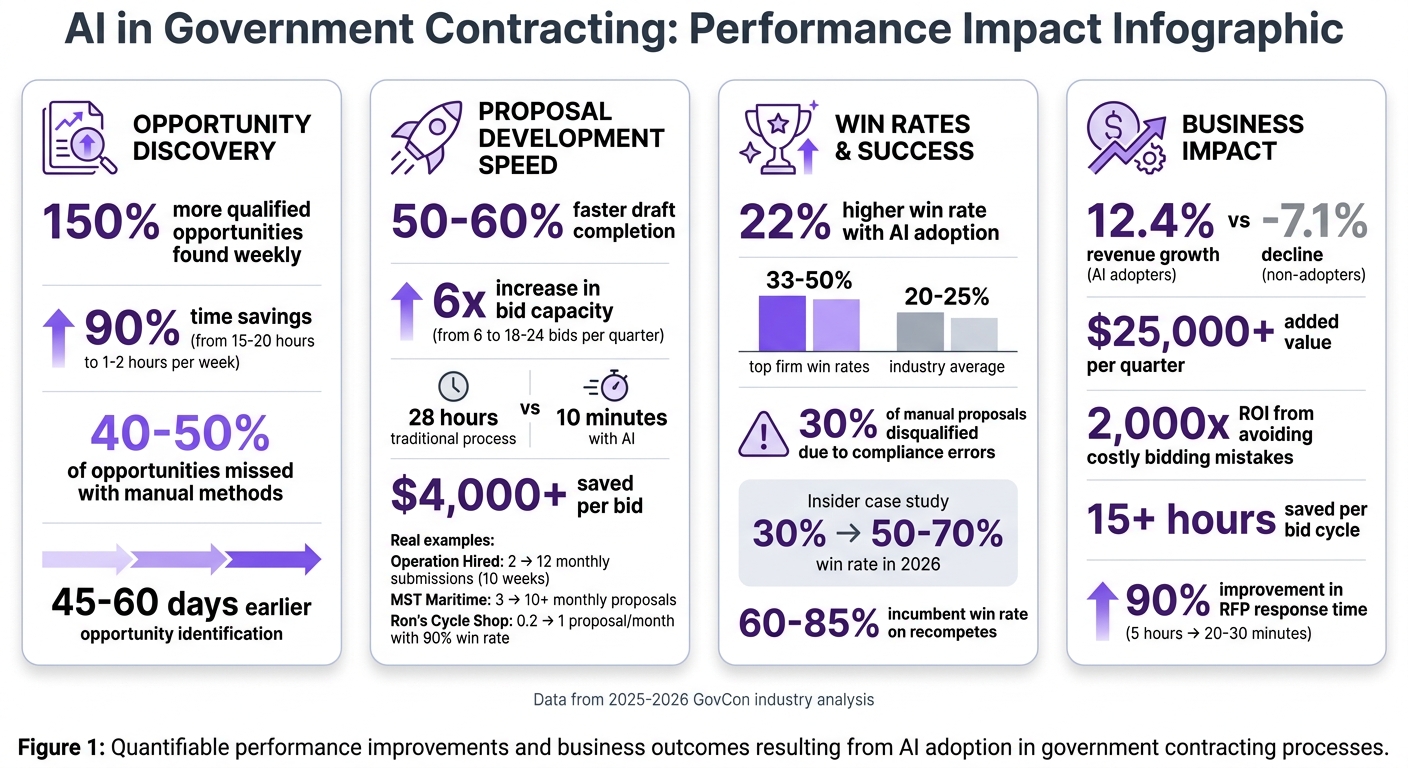
AI Impact on GovCon Sales: Key Performance Metrics and ROI Statistics
AI Strategy 1: Automating Opportunity Discovery
One of the biggest hurdles in scaling GovCon sales is identifying the right opportunities before your competitors do. Relying solely on manual searches on SAM.gov often reveals only 40–50% of the opportunities your company could pursue, leaving a critical gap that impacts potential revenue.
AI platforms tackle this issue by monitoring thousands of procurement sources around the clock. These include federal portals like SAM.gov, state databases, local municipal systems, and niche channels such as DIBBS for defense contracts. Instead of spending 15–20 hours a week combing through listings, AI can cut that time down to just 1–2 hours – a 90% time savings. Companies leveraging AI-powered discovery tools report finding 150% more qualified opportunities weekly compared to manual methods.
Monitoring Procurement Sources with AI
AI platforms like Narwin.ai continuously scan procurement sources across the U.S. and Canada, pulling in fresh opportunities from systems like SAM.gov, CanadaBuys, and various state and local portals. These platforms automatically update their databases, eliminating the need for daily manual checks. For instance, Narwin.ai refreshes matched opportunities every day at 3:00 AM EST, ensuring your team starts each day with the most up-to-date leads.
With natural language understanding, you can search using simple queries like "cybersecurity contracts in Virginia" or "HVAC services for federal buildings." The AI interprets your intent and uses semantic matching to surface relevant opportunities. It even identifies related solicitations, such as linking "peer support" to services like "recovery coaching." This real-time data seamlessly integrates into your company’s profile, streamlining the discovery process.
AI-Driven Opportunity Matching
After identifying opportunities, AI tools match them to your company’s strengths by analyzing factors like past performance, certifications, geographic focus, and technical expertise. The system generates a match score, such as "80% – Excellent Match", providing a quick snapshot of how well an RFP aligns with your capabilities.
The more you train the system, the more accurate these match scores become. By uploading certifications (e.g., ISO, OSHA, CSA), project summaries, safety records, and case studies, you can fine-tune the AI’s precision. Additionally, you can offer specific instructions for complex RFPs, such as "Focus on structural steel scope, ignore mechanical and electrical divisions", to further refine results and minimize irrelevant matches.
Go/No-Go Decision Support
The final piece of automated discovery is the ability to make instant go/no-go decisions. AI tools flag potential deal-breakers upfront by scanning for issues like missing qualifications, strict eligibility requirements, tight deadlines, or strong incumbent advantages.
"Instead of discovering a deal-breaker on page 47 of an attachment, you see it in the first summary." – Procura
Narwin.ai simplifies decision-making by providing clear recommendations such as "Go for a Bid" or "Caution: Review Further." These insights can be integrated directly into your CRM or Slack, enabling quick collaboration across teams. By using AI for bid qualification, teams save an average of 15+ hours per bid cycle. Focusing on winnable opportunities has helped some companies generate over $25,000 in added value per quarter, with clients reporting an impressive 2,000x ROI from avoiding costly bidding mistakes.
sbb-itb-bb3960c
AI Strategy 2: Improving RFP Qualification
Once opportunities are identified, the next step is figuring out which ones are worth pursuing. Traditionally, this has been a gut-driven process. AI changes that by offering data-driven precision, highlighting critical issues in minutes. In 2026, while 80% of RFP teams used generative AI, the average proposal win rate was only 39%. This shows that success often hinges on how accurately opportunities are qualified right from the start. Building on automated discovery, AI-powered qualification ensures resources are focused on high-probability wins.
AI platforms assess multiple factors at once – buyer behavior, compliance requirements, competitive positioning, and historical award data – producing a detailed qualification score. This eliminates the need for manual document reviews, which can lead to missed critical details.
Win Probability and Risk Analysis
After automated discovery, AI-driven qualification fine-tunes bid selection. By comparing RFP requirements with a company’s historical performance and core strengths, AI calculates win probabilities. Tools like Narwin.ai provide a "Smart Fit Score", which numerically evaluates how well an opportunity aligns with your capabilities. These scores also consider buyer intent, analyzing how agencies have historically procured similar services. They match NAICS codes, technical requirements, and prior successes while factoring in incumbent performance and market trends.
Beyond win probability, AI identifies risks that could affect margins or compliance. It flags unfavorable contract terms, strict cybersecurity demands, or FAR/DFAR compliance issues early in the process. This allows teams to make informed decisions before committing resources. Kevin Brandt, Principal at Baker Tilly, highlights that AI is "helping contractors make more objective, evidence-based decisions" by replacing subjective guesses with solid data.
Automated Compliance Checks
AI leverages natural language processing to quickly "shred" RFP documents, extracting key evaluation criteria and submission instructions in mere minutes. This process generates a compliance matrix on the spot, shifting compliance checks from a final review step to an integral part of the qualification phase. The result? A streamlined process that reduces errors and fatigue associated with manual reviews.
This automation is especially helpful for complex solicitations. AI can process a 100-question RFP in just 20–30 minutes – a task that typically takes 4–5 hours – cutting the time required by 90%. More critically, it helps teams avoid pursuing opportunities where they lack essential qualifications. Beyond compliance, AI also collects insights on buyer behavior and competitive landscapes.
Buyer and Competitive Intelligence
AI delivers actionable insights by analyzing historical award data and buyer behavior, helping teams determine which opportunities are genuinely competitive. It continuously monitors procurement feeds at federal, state, and local levels, gathering data on contracting officer preferences, agency structures, and competitor award histories. This intelligence helps assess whether a recompete is winnable or if the buyer is likely to stick with the current provider.
Narwin.ai takes this a step further by offering deeper insights into buyer intent and agency behavior. It uncovers not just what is being procured but also why and how. By analyzing patterns in agency requirements and evaluations and capturing feedback from past debriefs, AI turns historical losses into strategies for future bids. This creates a feedback loop that sharpens qualification accuracy over time, ensuring teams are better prepared for future opportunities.
AI Strategy 3: Speeding Up Proposal Development
Once you’ve identified the right opportunities, the next hurdle is developing proposals quickly enough to seize them. Proposal creation often becomes a bottleneck, with teams spending weeks drafting from scratch, verifying compliance, and juggling edits from multiple contributors. AI steps in to streamline these repetitive tasks, freeing up time for teams to focus on strategy and crafting standout proposals.
The results speak for themselves. Between late 2025 and early 2026, Operation Hired used AI-driven tools to scale from 2 monthly submissions to 12 in just 10 weeks – a sixfold increase. Similarly, MST Maritime saw their proposal development speed triple, boosting their monthly output from 3 to over 10 proposals by early 2026. These aren’t outliers. AI automation has been shown to cut draft completion time by 50-60%, enabling teams to handle 18-24 bids per quarter, compared to just six when relying on manual processes.
AI-Powered Proposal Drafting
Once opportunities are qualified, the next step is turning insights into compelling proposals – and fast. AI tools like Retrieval-Augmented Generation (RAG) help by creating drafts grounded in your company’s past performance, methodology templates, and boilerplate sections. Unlike generic chatbots, GovCon-trained models understand FAR/DFARS clauses and agency-specific requirements, ensuring the language and structure meet federal standards. For example, Narwin.ai pulls from your private content library to generate tailored phrasing that aligns with specific RFP requirements and buyer personas. This eliminates the need for tedious copy-pasting from old proposals, which often results in irrelevant or outdated content.
These drafts are typically 80% complete, leaving room for strategic fine-tuning.
"AI doesn’t remove the human touch. It amplifies it, by giving writers more time to think strategically, tell better stories, and fine-tune responses." – Narwin.ai
The process follows a human-in-the-loop (HITL) model: AI handles the heavy lifting of extraction and drafting, while humans focus on validating technical accuracy and refining the strategic approach. This division allows subject matter experts (SMEs) to prioritize differentiation instead of spending hours on repetitive boilerplate sections. For example, in January 2026, Ron’s Cycle Shop used AI-powered drafting to increase output from 0.2 proposals per month to 1 full proposal per month, all while maintaining a 90% win rate.
Compliance Matrices and Gap Analysis
AI can analyze 100-200 page solicitations in minutes, extracting requirements from Sections C, L, and M, as well as referenced attachments and clauses. What used to take 8-12 hours now happens almost instantly. This automated "shredding" generates compliance matrices on the fly, making compliance checks an integral part of the qualification process rather than a last-minute task.
These AI-generated matrices remain dynamic, automatically incorporating amendments and linking each requirement back to the original solicitation text. This prevents common errors – like missing clauses or formatting violations – that account for 30% of disqualified manual proposals.
Additionally, AI performs gap analyses before formal reviews, flagging missing responses, unsupported claims, and inconsistent terminology. This ensures that reviewers can focus on strategic improvements instead of catching basic compliance mistakes. The technology even adapts to evaluation methodologies, whether it’s prioritizing minimum requirements for Lowest Price Technically Acceptable (LPTA) bids or emphasizing differentiators for Best-Value trade-offs.
"Compliance matrices are where proposals live or die. Miss a single requirement buried in Section L, and your bid gets tossed before evaluators read a word of your technical approach." – GovDash
Collaborative Writing and Version Control
AI tools also enhance collaboration and version control, centralizing feedback and streamlining workflows. Platforms integrate with tools like Slack, Google Drive, and major CRMs to assign tasks, track progress, and manage feedback in real time. AI can even recommend section owners and SMEs based on their involvement in past successful bids.
Consistency across proposal sections is another advantage. AI ensures that technical narratives, staffing plans, and pricing align perfectly. For instance, it can cross-check a staffing model in Volume I against the pricing details in Volume III. With centralized, AI-powered content libraries, tools like Narwin.ai ensure all team members access the most current, approved content, avoiding outdated or conflicting information.
As of 2024, the average proposal response time has dropped to 25 hours, with 64% of teams submitting responses in under 10 days. AI-driven workflows implement mandatory review gates (Pink Team, Red Team), requiring human validation at each stage to catch errors while maintaining speed. These systems also safeguard institutional knowledge, preserving best practices and successful strategies for future use, even when senior proposal writers leave.
AI Strategy 4: Improving Team Collaboration and Intelligence Gathering
Winning government contracts is no solo act – it demands teamwork. Business development professionals, capture managers, proposal writers, and subject matter experts all need to work in sync. But here’s the catch: many teams still rely on outdated tools like spreadsheets, which create silos and disrupt collaboration. AI is changing the game by centralizing information, automating processes, and ensuring everyone operates on the same page.
AI acts as a "content brain" for your team, preserving critical knowledge like evaluator feedback, win themes, and competitor profiles. This ensures that even when staff transitions occur, institutional knowledge stays intact. By storing past proposals, pricing data, and successful strategies in AI-powered hubs, teams maintain consistency and continuity across all pursuits.
Teaming and Partner Matching
Finding the right teaming partners used to mean endless networking and manual research. AI speeds up this process by identifying gaps in your capabilities and suggesting partners with complementary strengths, relevant certifications, and proven track records. For instance, if you’re bidding on an IT modernization contract but lack cybersecurity credentials, AI can recommend partners with the necessary expertise and experience.
Platforms like Narwin.ai take this further by analyzing tender requirements and matching them to your company’s profile. They can even uncover hidden subcontracting opportunities by spotting keywords like "LEED Certified" or "8(a) Small Business" in RFPs. This allows smaller firms to join larger contracts they might have otherwise missed, turning overlooked opportunities into real possibilities.
Historical Award and Recompete Insights
Understanding past contract awards can give you a serious edge. AI scans millions of records from sources like SAM.gov and FPDS.gov to build detailed profiles of historical awards, pricing trends, and protest histories. This data reveals patterns that manual research often misses – like which agencies favor incumbents (who win recompetes at rates of 60% to 85%) or where challengers have successfully disrupted the status quo.
AI also tracks agency budgets, program milestones, and contract expiration dates, alerting you to opportunities 45 to 60 days earlier than traditional methods. This head start lets your team begin building relationships and shaping requirements before the RFP even drops. After all, 70% to 80% of competitive outcomes are decided before the solicitation is released.
With AI, you can also conduct targeted competitor analysis. For example, if data shows an incumbent consistently struggles with delivery timelines, you can focus your proposal on your company’s strong record of on-time delivery. This takes the guesswork out of your strategy, grounding it in hard facts and giving you a clear advantage.
Pipeline Tracking and Opportunity Management
Managing dozens of opportunities across various stages – qualification, capture, proposal development – can quickly become overwhelming. Spreadsheets just don’t cut it anymore. AI-powered pipeline management platforms provide centralized dashboards that track every opportunity, update statuses, assign tasks, and flag stalled pursuits automatically.
Take App Growth Network, for example. In January 2026, they used Narwin.ai to implement AI-driven pipeline tracking, saving over 15 hours per bid cycle and generating an extra $25,000 in revenue. Their Director of Operations, Carter Hawthorniwaite, noted that the platform helped them focus only on bids where they had a strong chance of winning. They even monetized unsuitable opportunities by referring them to competitors for a fee. AI-generated bid/no-bid scores ensured their resources were spent wisely, avoiding burnout and maximizing results.
AI also enhances pipeline velocity by identifying bottlenecks and suggesting actions to keep deals moving. For instance, if an opportunity stalls in the qualification stage for weeks without customer engagement, the system might recommend scheduling a briefing or dropping the pursuit to free up resources. This approach allows teams to handle 18 to 24 bids per quarter, compared to the manual limit of around six, ensuring they focus on the opportunities that truly matter.
Measuring ROI from AI-Powered GovCon Sales
When you bring AI into GovCon sales, tracking ROI becomes key. Metrics like win rates, time and cost savings, and team capacity offer a clear picture of how AI drives revenue growth and boosts efficiency. These factors tie directly into the broader AI strategy framework, showing measurable results in qualification, proposal development, and team scalability.
Win Rate Improvement
Winning more contracts starts with better bid selection, and that’s where AI shines. Tools like AI-driven probability of win (pWin) scoring help teams focus on high-potential bids and avoid wasting resources on low-probability opportunities. This smarter approach reallocates Bid & Proposal (B&P) spending to pursuits more likely to succeed.
Top GovCon firms boast bid-to-win ratios between 33% and 50%, compared to the industry average of 20% to 25%. AI helps close this gap by tailoring proposals to evaluation criteria, eliminating generic responses, and catching compliance errors that often lead to disqualification – errors that account for up to 30% of rejected manual submissions.
Take Insider, for example. This global marketing firm saw their win rate climb from 30% to an impressive 50% to 70% in 2026 after adopting AI-powered RFP tools. AI ensured every requirement was met, compliance issues were resolved, and proposals aligned with buyer priorities. This leap in success highlights the value of enhanced bid qualification powered by AI.
Time and Cost Savings
RFP processes can be a drain on time and resources. Capture managers typically spend 60% to 70% of their time on tasks like reading solicitations, building compliance matrices, and finding past performance examples. AI cuts this workload drastically, completing hours of work in just minutes.
A manual RFP process takes over 28 hours per opportunity, but AI can reduce that to under 10 minutes. At a loaded labor rate of $150 per hour, this translates to more than $4,000 saved per bid. For teams managing multiple opportunities each quarter, these savings add up fast.
AI also minimizes the need to pull Subject Matter Experts (SMEs) away from billable work to write repetitive content. With SMEs costing between $150 and $300 per hour, AI-generated first drafts free them up to focus on technical strategy instead of boilerplate writing.
Insider reported a 90% improvement in RFP response time in 2026, slashing the time for a 100-question RFP from 5 hours to just 20 to 30 minutes. Beyond saving money, this efficiency helps prevent burnout and reduces turnover. Considering the cost of replacing experienced proposal managers ranges from $50,000 to $100,000, the benefits are clear.
Scaling Team Capacity
AI removes the limits on how much your team can handle. Traditional teams typically manage about 6 bids per quarter, but AI boosts that to 18 to 24 bids – all without increasing headcount.
For example, Operation Hired scaled from 2 monthly submissions to 12 in just 10 weeks, while MST Maritime tripled their proposal output, growing from 3 monthly proposals to over 10. By breaking through the usual volume limits, AI helps teams seize opportunities they might have otherwise missed.
AI also helps expand your pipeline. Teams using AI identify qualified opportunities 45 to 60 days earlier than manual methods, leading to a 3x increase in their qualified pipeline. This early discovery gives teams a chance to shape requirements and build relationships before the RFP is even released – critical since 70% to 80% of competitive outcomes are decided before the RFP stage.
Ultimately, AI not only speeds up processes but increases your team’s capacity to pursue revenue-generating opportunities. If you’re passing on strong-fit bids because of bandwidth issues, AI can be the game-changer that removes those limits.
Narwin.ai: Your Partner in Scaling GovCon Sales
Narwin.ai is designed to streamline government contracting operations, allowing teams to scale without feeling overwhelmed. By combining advanced AI strategies with practical tools, this platform helps you tackle the complexities of government contracting efficiently.
Each night, Narwin.ai scans key US and Canadian procurement portals, delivering matched opportunities to your team by 3:00 AM EST. Beyond just identifying bids, it automates compliance checks, scores win probabilities, and drafts proposals using your company’s historical data. These features align with earlier-discussed AI strategies, such as smarter qualification, faster proposal creation, and increased team productivity. Narwin.ai ensures that your GovCon sales efforts are not just strategic but also seamlessly executed.
Core Features for GovCon Teams
Narwin.ai’s features are built to simplify and accelerate every step of the bidding process.
- AI Bid Search: Find opportunities by typing plain English queries or filtering by location, due date, and category.
- RFP Analyzer: Upload an RFP, and within 5 to 20 minutes, the platform extracts requirements, compliance clauses, and evaluation criteria – saving hours of manual work.
- Win Probability Score: Get instant Go/No-Go recommendations based on buyer intent, risk factors, and your company’s fit. This helps you focus resources on bids with the highest chances of success.
- AI Writer: Using Retrieval-Augmented Generation (RAG), the AI drafts compliant responses by pulling from your internal knowledge base, including past projects, certifications, and case studies.
Narwin.ai also integrates with tools like Slack, Google Drive, and Notion, centralizing team collaboration. Its Chrome extension allows you to analyze opportunities directly on procurement portals. Additionally, the platform’s Compliance & Risk Detection flags strict eligibility criteria and potential blockers, reducing the risk of disqualification.
By automating these processes, Narwin.ai users save over 15 hours per bid cycle. Some teams have even generated over $25,000 by focusing on high-probability bids identified by the platform.
Pricing Plans
Narwin.ai offers flexible pricing to fit the needs of teams at different stages.
- Starter Plan: Priced at $199/month, this plan includes 10 RFP analyses per month, smart opportunity matching, unlimited proposal writing for up to 5 team members, and integrations with Google Drive and Slack. Ideal for smaller teams managing fewer bids.
- Growth Plan: At $599/month, this tier supports 20 team members, provides 100 RFP analyses per month, and includes 5 expert strategy sessions annually, along with a dedicated account manager. Perfect for teams handling higher bid volumes.
- Business Pro Plan: Custom pricing is available for enterprises, offering unlimited RFP analyses, support for up to 500 team members, API access, and SOC2 compliance.
| Feature | Starter ($199/mo) | Growth ($599/mo) | Business Pro |
|---|---|---|---|
| RFP Analysis Reports | 10/month | 100/month | Unlimited |
| Team Members | 5 (Unlimited viewers) | 20 (Unlimited viewers) | Custom (up to 500) |
| Opportunity Matching | Smart matching | Priority daily | Priority daily |
| Support | Same Day + Account Manager | Dedicated CSM | |
| Strategic Consultation | Not included | 5 sessions/year | Unlimited |
All plans come with a 14-day free trial, giving you the chance to explore the platform before committing.
Getting Started with Narwin.ai
Starting with Narwin.ai is quick and straightforward. Once you sign up, update your Company Profile with certifications, past project details, and capabilities. This ensures the AI delivers highly accurate matches, scores, and proposal drafts.
"The richer your company profile, the more accurate your AI recommendations, match scores, and proposal drafts become."
After setting up your profile, upload an RFP to run your first analysis. Use Custom Instructions to refine the AI’s focus (e.g., “Focus on structural steel, ignore mechanical”) and create Proposal Templates for recurring sections like executive summaries. Integrating Slack and Google Drive early allows you to automate notifications and index your existing documents for the AI Writer.
Narwin.ai also offers a free plan to explore opportunities or the option to book a demo for a deeper dive into its features. With AES-256 encryption and SOC2 compliance, your data remains secure throughout the process.
Conclusion: The Future of GovCon Sales with AI
GovCon sales have entered an era where speed and precision are non-negotiable. With tighter timelines and faster procurement cycles, traditional manual processes just can’t keep up. Contractors who stick to outdated methods are already feeling the pressure.
To stay competitive, contractors are transforming how they work. AI is at the center of this shift, helping teams capture institutional knowledge, automate compliance, and overcome capacity challenges. The results speak for themselves – teams using AI-driven workflows now manage 18 to 24 bids per quarter, far outpacing the traditional six. Even better, their success rates are climbing: AI adopters report 22% higher win rates and 12.4% revenue growth, while their non-AI counterparts face a 7.1% decline. These numbers highlight the edge AI provides in a fiercely competitive environment.
This move from manual labor to strategic execution is already reshaping the landscape. Federal agencies are integrating AI into acquisition planning and vendor evaluations. And by February 2026, the Department of Labor’s AI Literacy Framework will make AI competency a baseline workforce requirement. Treating AI as optional at this point is like stepping into the ring with one hand tied behind your back.
"AI isn’t the future of federal contracting anymore. It’s the present. The question is whether you’re engaging with it deliberately or just hoping it doesn’t change too much too fast." – Mike Goetz, USFCR
FAQs
What GovCon tasks should I automate first with AI?
Focusing on opportunity identification, proposal support, and compliance analysis can transform operations in the GovCon space. AI excels at sifting through massive datasets to pinpoint high-probability opportunities, dramatically cutting down on time spent researching.
When it comes to proposal drafting, automation can speed up the process by an impressive 50-60%. This means even smaller teams can handle more bids without feeling overwhelmed.
Compliance tools are another game-changer. They help ensure proposals align with regulatory requirements by catching potential errors, boosting both accuracy and competitiveness in the demanding GovCon landscape.
How do I trust AI win scores and go/no-go recommendations?
AI win scores and go/no-go recommendations, like those offered by Narwin.ai, rely on advanced models specifically designed for government contracting. These tools evaluate elements such as compliance, competition, and risk to deliver clear, data-backed insights. While these systems are dependable, combining their analysis with your own research is always a smart move. Narwin.ai builds confidence by transparently explaining how scores are calculated and pointing out critical decision factors, empowering you to make well-informed decisions.
How can AI speed proposals without risking compliance or errors?
AI can speed up the process of creating proposals by automating tasks like pulling relevant information and drafting content, all while ensuring compliance. To minimize risks, it’s important to use AI tools that are built to securely handle sensitive data. For example, private systems that keep Controlled Unclassified Information (CUI) off external servers are a smart choice. Additionally, automated compliance checks can help ensure proposals meet regulations like FAR and NIST, reducing mistakes and maintaining regulatory precision.