
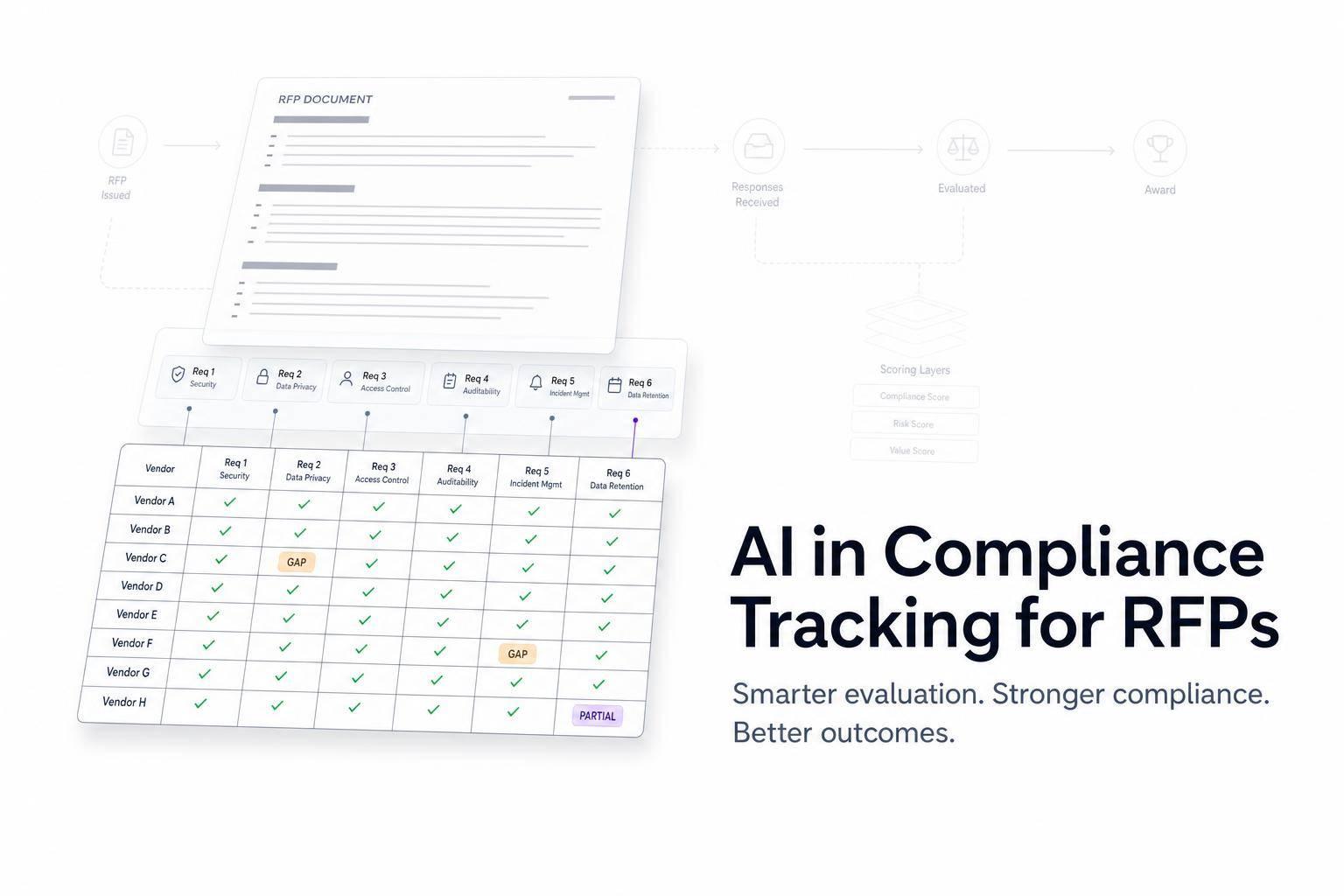
Miss one mandatory RFP item, and your bid can be rejected before scoring starts. I’d sum up the fix like this: AI helps me pull requirements from the RFP, map them into a compliance matrix, flag missing items early, and check bid risk before too much time is spent.
Here’s the short version:
- I use AI to extract shall, must, deadlines, forms, page limits, and evaluation factors from the RFP
- I turn those items into a live compliance matrix with owners, due dates, and status
- I track gaps during drafting instead of waiting until final review
- I check pass/fail items like certifications, amendments, formatting, and pricing tables before submission
- I use early risk checks to support bid/no-bid decisions
- I cut manual intake time from 10–12 hours to about 2–3 hours per opportunity
- I can also reduce late-stage compliance issues by 30–50%
- In one example, non-compliance disqualifications drop from 8% to 2%, while win rate moves from 18% to 23%
A big point in the article is simple: manual spreadsheets and email chains can work for small bids, but they break down fast when an RFP has hundreds of requirements, amendments, and contributors.
| Area | Manual approach | AI-assisted approach |
|---|---|---|
| Requirement review | Slow, line-by-line checks | Fast extraction from source files |
| Compliance matrix | Built by hand | Auto-generated and updated |
| Gap finding | Often late | Flagged during drafting |
| Risk review | Manual judgment first | Risk scoring helps sort issues |
| Team visibility | Spread across files and email | One live view of status |
I’d say the core message is this: AI does not replace proposal review. It gives me a faster way to track requirements, spot bid-ending issues early, and keep people in charge of final decisions.
How AI Improves Compliance Tracking From Intake to Review
Automated requirement extraction and RFP shredding
When an RFP comes in, AI pulls requirements from PDFs, Word files, and portal downloads, then turns them into trackable items. That includes mandatory technical requirements, staffing requirements, pricing instructions, submission deadlines, past performance questions, and compliance certifications. The point is straightforward: find every requirement before writing begins.
It can spot standard sections like Instructions to Offerors, Evaluation Criteria, the Statement of Work, and attachments. It also picks up obligation language such as shall, must, and is required to, then separates those items from optional requests.
So if the RFP says, "Offeror must be registered in SAM.gov prior to award," AI flags that as a mandatory pass/fail item. If it asks for a description of an innovation approach, that gets tagged as non-mandatory. That split helps teams focus on the items that can knock a bid out first.
After extraction, AI turns the full set of requirements into a live compliance matrix.
AI-generated compliance matrices and owner tracking
Once the RFP is parsed, the AI builds a structured compliance matrix on its own. Each row includes the requirement, source, owner, due date, status, and priority.
For busy proposal teams, one of the most useful parts is owner suggestion. Based on the type of requirement, AI can recommend who should take it:
- Technical lead for solution requirements
- Contracts manager for terms and conditions
- Pricing lead for cost inputs
Those assignments can also sync with task systems, so owners get notified automatically instead of waiting for someone to track them down by hand.
AI doesn’t replace review. It gives the team a cleaner and faster way to review. Each solicitation gets its own matrix, each requirement has a named owner, and fewer items get lost between bids.
That setup gives proposal teams a live view of what’s covered, what’s missing, and what’s still assigned.
Real-time coverage dashboards for proposal teams
From intake to final review, the same requirement list stays up to date. A live dashboard shows current compliance status across the draft and tracks each requirement as complete, in progress, missing, or high risk. It updates as owners submit their sections. High-risk flags call out mandatory items, near-term deadlines, and incomplete responses.
Proposal managers can go straight to unresolved and high-risk items. Handoffs between capture, proposal writing, and delivery teams get cleaner too. Each group can see what has already been addressed, what still needs work, and whether any amendments came in after the original release.
With that level of visibility, AI can spot gaps before they turn into bid-elimination risks.
sbb-itb-bb3960c
How AI Reduces Compliance Errors and Bid Elimination Risk
Gap detection for mandatory requirements
Once the dashboard shows gaps, AI can check whether those gaps are serious enough to knock a bid out.
With the matrix in place, AI reviews the draft against each requirement. It flags missing certifications, unanswered mandatory questions, missing attachments, incorrect font size, page-limit overruns, and unacknowledged amendments.
Because this runs during drafting, teams catch problems before the final review. That matters. A miss found late can turn into a scramble. A miss found early is usually just a fix.
AI can also spot cases where a requirement looks covered at first glance but still fails the stated condition. So it’s not just looking for blank spots. It’s checking whether the response actually meets the rule.
Risk scoring and elimination checks
AI risk scoring helps teams separate fixable issues from bid-ending risks. Then it sorts those risks by elimination impact, so the biggest threats rise to the top first.
Common elimination risks include:
| Risk Category | Example Issues | AI Checks Used |
|---|---|---|
| Mandatory certifications | Missing or expired ISO, SOC, DBE, or security clearances | Compare RFP-required certifications against company profile |
| Minimum qualifications | Insufficient past performance, revenue, or capacity | Extract minimums; compare to internal data |
| Pass/fail technical requirements | Unanswered mandatory questions or sections | Coverage analysis showing unassigned requirements |
| Page limits and formatting | Exceeding page limits; incorrect font or structure | Word and page counts; template and format validation |
| Submission instructions | Wrong portal, late uploads, missing labels | Deadline tracking; packaging checklist |
| Pricing and cost structure | Incomplete price tables; mismatched totals | Parse pricing forms; consistency checks across line items |
| Legal and regulatory clauses | Unacknowledged amendments; non-acceptance of key terms | Clause extraction; addenda acknowledgment tracking |
This kind of sorting saves time. Instead of treating every issue the same, the team can focus first on the ones most likely to cause elimination.
Bid/no-bid support before proposal resources are committed
The sooner a team sees a compliance problem, the sooner it can fix it – or stop work before too much time is spent.
AI can run a preliminary fit and risk analysis as soon as an RFP is uploaded, before any writing starts. It compares the RFP’s requirements against the company’s profile, including certifications on file, past performance history, available capacity, and relevant experience.
If the gap between what the RFP asks for and what the company can document is too wide, that shows up right away. No guesswork. No waiting until the middle of the proposal process to find out the bid was weak from day one.
Narwin.ai can add an instant go/no-go signal, win score, and risk breakdown as soon as an RFP is uploaded – covering eligibility gaps, capacity, and bid fit for U.S. and Canadian bids. That helps teams decide fast whether to bid and where to spend effort.
What AI-Driven Compliance Tracking Delivers in Practice
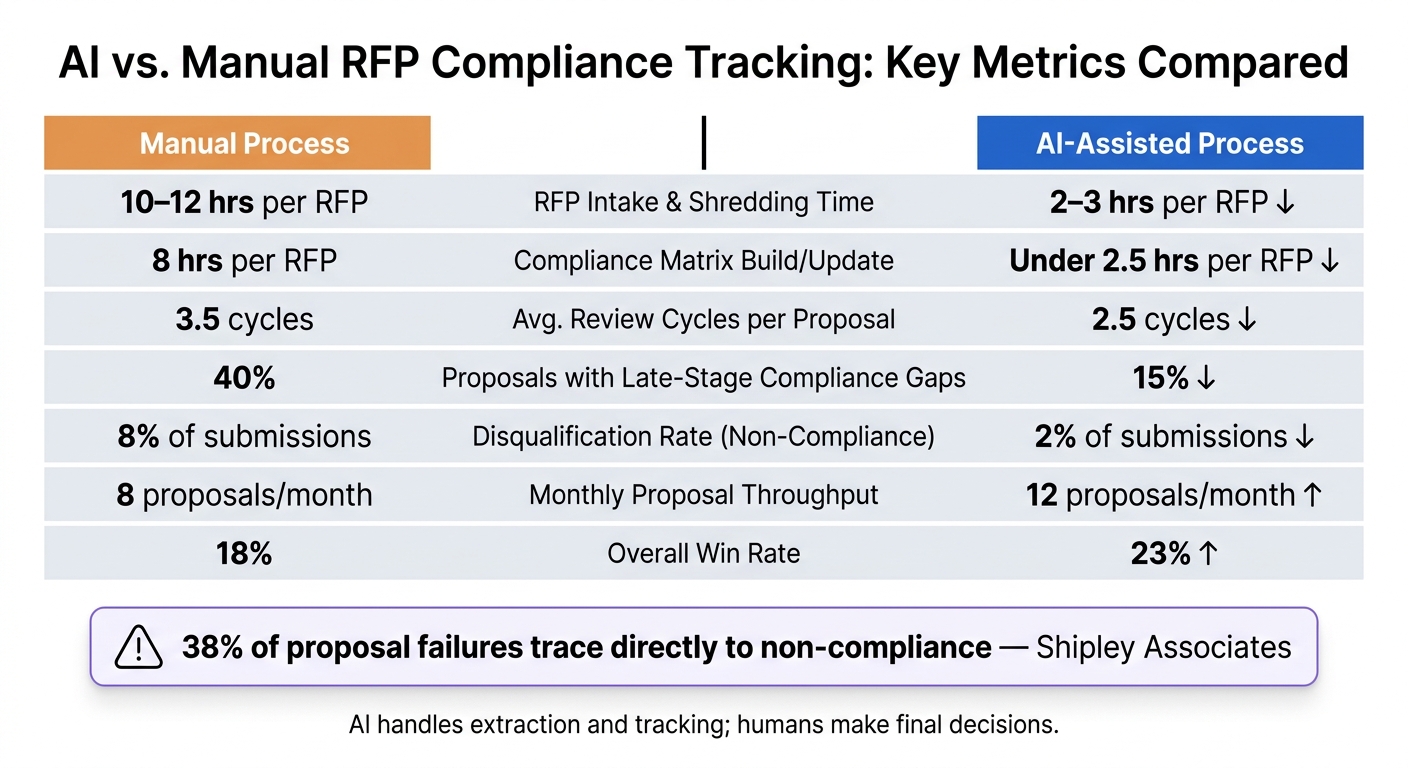
AI vs. Manual RFP Compliance Tracking: Key Metrics Compared
Metrics that matter in proposal operations
When AI spots gaps early, the payoff shows up in the numbers proposal teams watch every day.
With AI handling extraction and tracking, teams spend less time on compliance admin and more time improving the proposal itself. You can see the shift in day-to-day metrics like intake time, matrix upkeep, review cycles, and disqualification rates.
Manual RFP intake and shredding usually takes 10 to 12 hours per opportunity. With AI-assisted extraction, that drops to about 2 to 3 hours. That’s a 70–80% reduction before drafting even begins.
The compliance matrix sees the same kind of time cut. Building and updating it goes from about 8 hours per RFP to under 2.5 hours, even for complex bids with multiple amendments. Review cycles drop too, from 3.5 major compliance reviews per proposal to 2.5, which gives subject-matter experts more time for higher-value work.
Late-stage compliance issues can fall by 30–50% because the matrix stays current and missing items get flagged sooner. Disqualification rates also move in the right direction, like a drop from 8% to 2% of submissions.
Those gains stack up fast. A team handling 8 complex proposals per month can realistically get to 11 to 12 without adding headcount. Across 50 proposals per year, even a modest 10-hour savings per bid turns into 500 hours annually. That’s close to a quarter of a full-time employee shifted toward more strategic pursuits.
Why better compliance can improve award probability
Benchmark data from Shipley Associates indicates that 38% of proposal failures trace directly to non-compliance – missed sections, format errors, or forgotten certifications.
That number hits hard. More than a third of lost bids never even reached a fair test of solution quality or price.
Better compliance doesn’t just help a team avoid getting knocked out. It also makes the evaluator’s job easier. When answers are easier to find, proposals are easier to score. And when AI maps requirements straight to scoring criteria, evaluators have a cleaner path to justify higher ratings.
For a mid-sized contractor, the shift can look like this:
| Metric | Before AI Compliance Tracking | After AI Compliance Tracking |
|---|---|---|
| Avg. hours for RFP intake + shredding | 10.0 hrs per RFP | 3.0 hrs per RFP |
| Avg. hours to build/update matrix | 8.0 hrs per RFP | 2.5 hrs per RFP |
| Avg. review cycles per proposal | 3.5 cycles | 2.5 cycles |
| Proposals with late-stage compliance gaps | 40.0% | 15.0% |
| Proposals disqualified for non-compliance | 8.0% of submissions | 2.0% of submissions |
| Monthly proposal throughput | 8 proposals/month | 12 proposals/month |
| Overall win rate | 18.0% | 23.0% |
One system keeps opportunity data, compliance status, risk scores, and proposal history in one place, so before-and-after measurement is simple.
How to Add AI Compliance Tracking to Your Proposal Process
Where AI fits into existing proposal workflows
Once AI flags requirements and risk, the next move is to build those checks into the workflow itself. The best places to add it are intake, review, and QC.
At intake, AI can take in a new RFP as soon as it hits your document repository and build the first compliance matrix. During Pink Team review, that matrix makes coverage gaps easy to spot. Before Red Team, AI brings the highest-risk gaps to the surface. At final QC, it runs one more pass against the RFP to confirm every required item is in place before submission.
Narwin.ai supports this process from intake through final QC. Its native integrations with Google Drive, Slack, CRMs, and ERPs let AI ingest new solicitations, send alerts on its own, and pull past performance data from the CRM.
Data governance, ownership, and rollout priorities
Automation falls apart fast if ownership and controls are fuzzy. Give each requirement to one named owner. That person drafts the response or coordinates it, checks that supporting evidence is included, and signs off that the requirement has been met. Proposal managers watch coverage across volumes. Compliance leads interpret unclear language and decide when a risk should be escalated. AI points out the gaps; people make the judgment calls.
On the security side, look for tools with role-based access, AES-256 encryption, and SOC 2 Type II certification for federal, state, and local bids. Check that your AI vendor’s policy says your internal proposal content is never used to train public models. You should also keep audit logs that show who accessed each solicitation and when. Those records matter during debriefs and internal reviews.
For rollout, start with 2–5 lower-risk RFPs. Compare the AI output with manual review, then expand from there.
Conclusion: The case for AI in RFP compliance tracking
The point isn’t automation for the sake of automation. The point is to cut compliance risk early while keeping human reviewers in charge of interpretation and final sign-off.
FAQs
How accurate is AI at finding mandatory RFP requirements?
AI is often good at finding mandatory RFP requirements, but the results depend a lot on how the solicitation is put together.
Reported accuracy usually falls between 75% and 92%+. One Narwin.ai article puts AI at about 97%, compared with 80%–85% for manual review. In plain English: when an RFP is clean, well laid out, and easy to parse, AI tends to do a better job. Messy formatting, scattered requirements, or inconsistent structure can drag those results down.
Can AI track amendments and last-minute compliance changes?
Yes. Narwin.ai keeps watch for updates and checks the original solicitation against each new amendment.
When a change shows up, it flags the revised sections, points out additions and deletions, and updates your compliance matrix in real time. That helps your team stay in sync with the latest requirements and cuts down on manual reconciliation.
What should teams review manually before submission?
In the final 72 hours, teams should run a final mechanical compliance audit.
Check that every item in the compliance matrix is marked fully compliant, all internal references are correct, and page and paragraph numbers line up with the final paginated proposal.
The submission version also needs to be clean. Remove internal notes, reviewer comments, risk flags, and SME names.
Then verify the basics that can trip people up at the last minute:
- File names
- Required formats
- File size limits
- The exact submission deadline and time zone
This is the kind of last-pass review that feels small until it isn’t. One wrong file name or a mismatched page reference can turn into a headache fast.
Related Blog Posts
- How AI Analyzes Past Performance for RFPs
- How AI Simplifies RFP Compliance
- Competitive Analysis For Government RFPs
- How startups are redefining the RFP and Goverment Bid space