
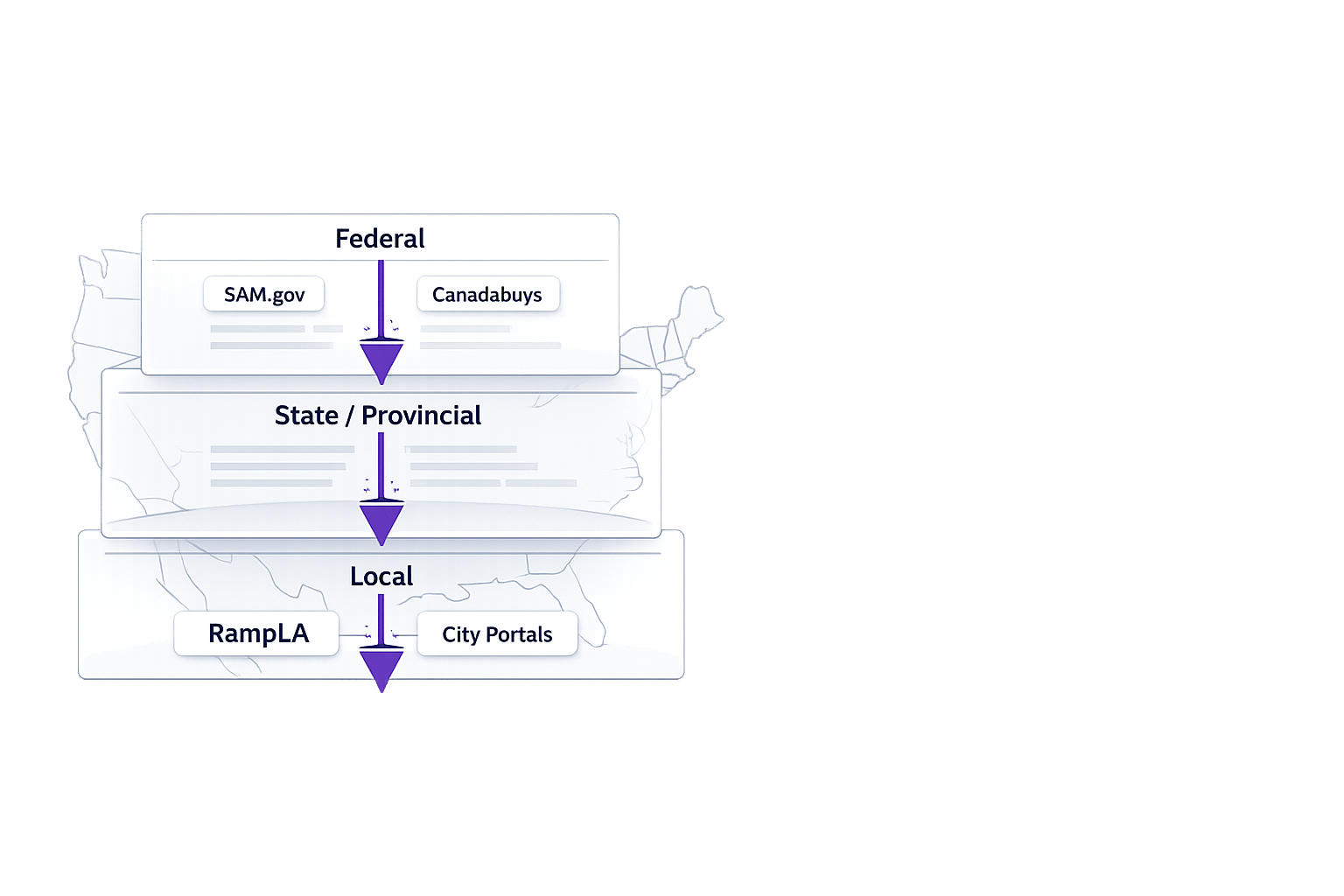
If you’re a business aiming to secure public sector contracts in the U.S. or Canada, knowing where to search is critical. Here’s a quick breakdown of the main platforms:
- SAM.gov: The central hub for U.S. federal contracts over $25,000. Offers access to $600 billion in annual awards but requires a steep learning curve.
- CanadaBuys: Canada’s official procurement platform for federal and some provincial/municipal opportunities. Integrated with SAP Ariba for streamlined bidding.
- RampLA: Focuses on procurement opportunities in Los Angeles, simplifying access to city and county contracts.
- Local City Portals: Decentralized systems for municipal bids. Each city has unique registration requirements and processes.
Why It Matters:
- U.S. federal spending exceeds $600 billion annually, while Canada’s public procurement market is worth $37 billion.
- Over 26,000 government tenders are currently open across the U.S. and Canada.
- Small businesses win 25–30% of U.S. contracts they pursue, while the median Canadian contract value is $136,000.
Quick Tip: Combining platform registrations with AI-driven tools like Narwin.ai can help you manage bids across multiple systems efficiently.
Quick Comparison
| Platform | Scope | Access Requirements | Key Features |
|---|---|---|---|
| SAM.gov | U.S. federal contracts | Free registration, UEI required | Advanced search, Sources Sought |
| CanadaBuys | Federal + MASH (Canada) | CRA business number, SAP Ariba | Bilingual, trade agreement filters |
| RampLA | Los Angeles region | Free registration | Local focus, NAICS-based alerts |
| City Portals | Specific municipalities | Varies by city | Tailored alerts, local policies |
Read on for a detailed guide to navigating these platforms and strategies to streamline your search for government contracts.
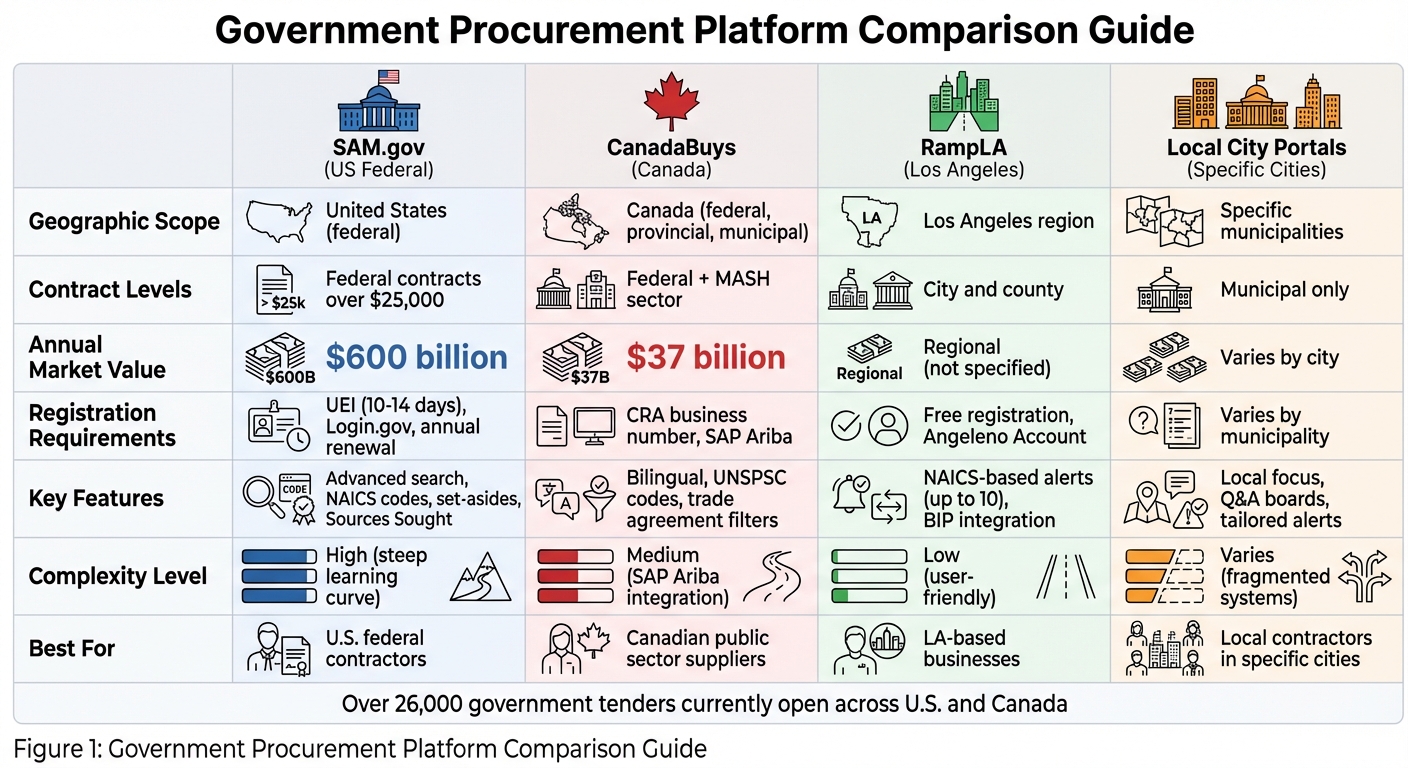
Comparison of Government Procurement Platforms: SAM.gov, CanadaBuys, RampLA, and City Portals
SAM.gov: US Federal Procurement Platform
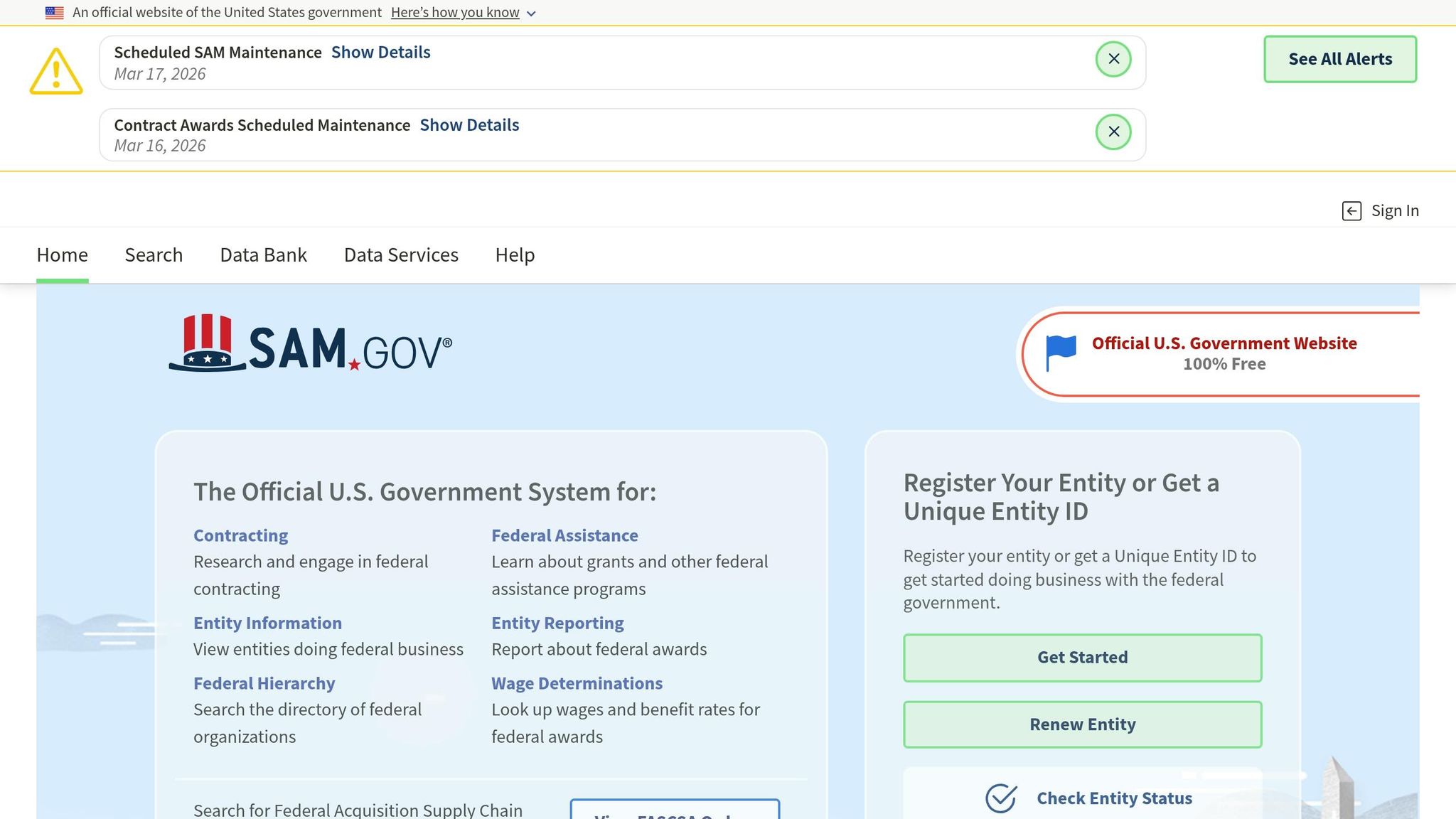
SAM.gov serves as the U.S. government’s go-to portal for federal contracts exceeding $25,000. It has replaced older systems like FBO and CCR, consolidating federal procurement under one roof. Managed by the General Services Administration (GSA), the platform grants access to a staggering $600 billion in annual contract awards distributed by agencies such as the Department of Defense, NASA, and GSA itself.
The platform hosts a variety of notices, including Sources Sought (used to gauge interest), Presolicitation (to preview upcoming RFPs), Solicitation (for full bid submissions), and Award notices (announcing winners). Engaging with Sources Sought notices can be a strategic move, helping businesses gain visibility with agencies before formal RFPs are issued.
Features and Registration Requirements
To participate in federal contracting, businesses must first register on SAM.gov and secure a Unique Entity ID (UEI) – a 12-character alphanumeric code that replaced the DUNS number in April 2022. Registration is free but takes about 10–14 business days to complete. The process requires a Login.gov account with multi-factor authentication (MFA), a Taxpayer Identification Number (TIN) that matches IRS records, banking details, and your NAICS codes.
Once registered, users can search for Contract Opportunities using advanced filters such as NAICS codes, Product Service Codes (PSCs), set-aside categories (e.g., Small Business, HUBZone, Women-Owned), and specific federal agencies. The “Save Search” feature allows users to set up automated email alerts for new opportunities that meet their criteria, reducing the need for constant manual checks. However, registrations must be renewed every 365 days. Missing the renewal deadline can result in disqualification from receiving new awards or payments.
“SAM.gov registration is completely free. Beware of third-party services that charge fees for ‘SAM registration assistance.'”
– BidFinds
Pros and Cons
SAM.gov is the definitive resource for federal contracting opportunities above $25,000, offering unparalleled access to the federal marketplace. With over 350,000 active entities registered as of 2026, the platform also enables federal agencies to directly search for contractors, potentially opening doors to inbound opportunities.
However, the platform has a notoriously steep learning curve. New users often find it overwhelming due to the sheer volume of daily postings and the need to grasp complex federal terminology like NAICS and PSC codes. Registration delays are another common pain point, often caused by mismatches between TIN and IRS records. Additionally, the platform’s search functionality lacks prioritization based on past performance or technical fit, meaning users must manually sift through postings to identify relevant RFPs. Missing updates to solicitations, such as amendments, can lead to disqualification, making it essential to monitor active opportunities at least twice a week.
Up next, we’ll dive into CanadaBuys, Canada’s federal procurement platform, to see how it stacks up in comparison to SAM.gov.
CanadaBuys: Canada’s Federal Procurement Platform
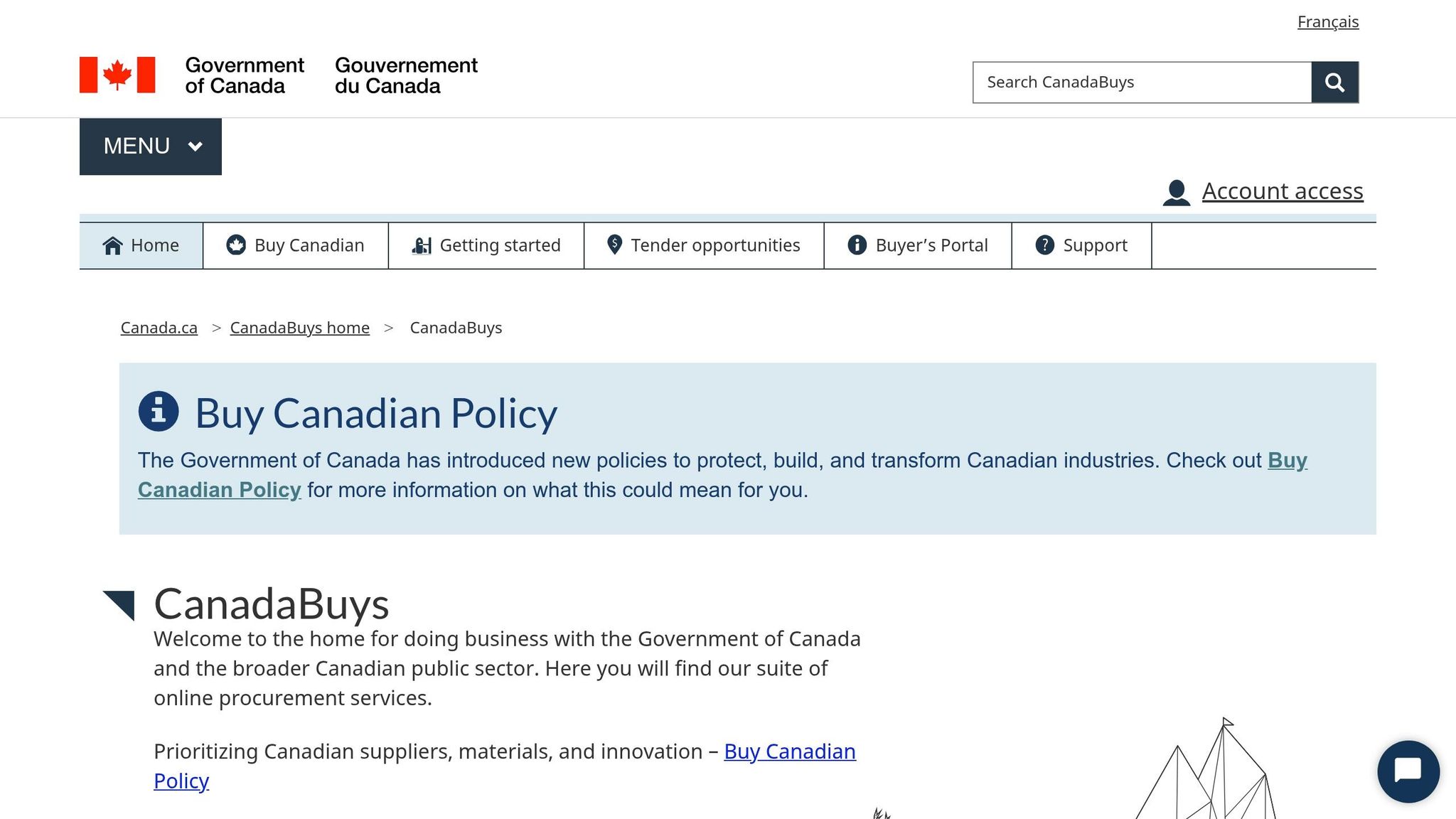
CanadaBuys, managed by Public Services and Procurement Canada (PSPC), serves as the central hub for federal procurement in Canada. It replaced the “Buyandsell.gc.ca” platform and now acts as the primary access point for federal tender opportunities across the Canadian public sector. PSPC facilitates the procurement of approximately $37 billion in goods and services annually, making CanadaBuys essential for businesses aiming to contract with the Canadian government.
With over 20,000 registered suppliers and significant daily traffic, the platform is a critical tool for suppliers. Unlike SAM.gov, which focuses solely on federal contracts, CanadaBuys aggregates opportunities from federal departments as well as provincial and territorial governments, municipalities, academic institutions, schools, and hospitals – referred to as the MASH sector. However, for non-federal tenders, businesses are often redirected to external websites to submit bids.
Features and Access
CanadaBuys complies with Canada’s Official Languages Act, offering full bilingual functionality in English and French. The platform operates using SAP Ariba (now SAP Business Network) as its main bidding tool. This system allows suppliers to create a single, reusable company profile, streamlining the process by eliminating the need to repeatedly enter the same information for each bid.
Registration on the platform is free but requires a Canada Revenue Agency (CRA) business number, regardless of where the company is based. After creating an SAP Business Network account, suppliers must complete a mandatory Government of Canada questionnaire to qualify for bid submissions. For contracts not managed through SAP Ariba, businesses need a Procurement Business Number (PBN), which can be obtained via the Supplier Registration Information (SRI) system.
The platform provides robust search filters, allowing users to find opportunities by keywords, United Nations Standard Products and Services Codes (UNSPSC), trade agreements, department names, location, and status (Open or Awarded). Additionally, the “Follow” feature enables users to set up email alerts for updates on amendments, competition extensions, or new opportunities that match their saved searches. High-value tenders – those exceeding CAD $120,000 (EUR €80,000) – are also published on CanadaBuys, though there is a 24-hour delay compared to the NSPA eProcurement portal.
Pros and Cons
CanadaBuys offers a centralized and intuitive interface, simplifying the management of Canadian procurement opportunities. The integration with SAP Ariba makes the bidding process more efficient, and the platform’s Protected-B security certification ensures a high level of data protection. Its bilingual support and accessibility standards make it inclusive and user-friendly. To further assist businesses, Procurement Assistance Canada (PAC) provides free seminars and resources, helping smaller and more diverse companies navigate the system.
However, there are limitations. While CanadaBuys lists tenders from the MASH sector, businesses often need to visit external websites to submit bids, which can complicate the process. Additionally, the platform is still being refined, with PSPC conducting ongoing usability testing and adding features, meaning users may encounter periodic changes. For smaller contracts – those under CAD $25,000 for goods or CAD $40,000 for services – businesses typically need to market themselves directly to buyers, as these opportunities often bypass the formal tendering process.
Next, we take a closer look at RampLA, a platform designed for regional procurement in Los Angeles.
RampLA: Los Angeles Regional Procurement Portal
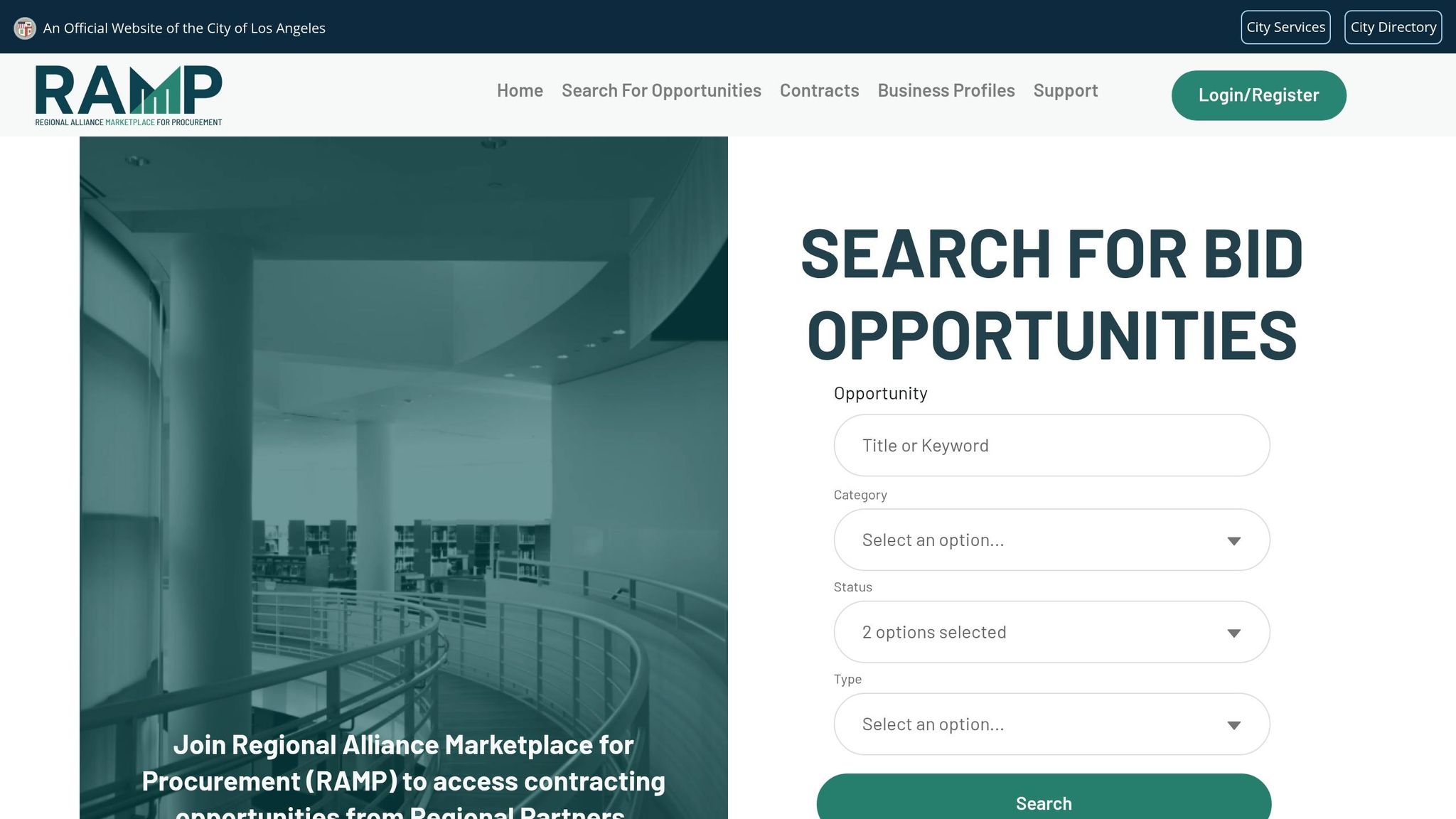
RampLA, short for the Regional Alliance Marketplace for Procurement, serves as the official hub for accessing contractual opportunities with the City of Los Angeles. This centralized platform focuses solely on city and county procurement within Los Angeles, offering a broad range of opportunities such as construction projects, commodities, and personal services. Best of all, it’s free to use and accessible through a single sign-on Angeleno Account, which connects users to all City services.
To get started, businesses can register a company profile, select up to 10 NAICS codes, and receive email notifications for bids that match their expertise. Certified businesses can further enhance their visibility by verifying their profiles. Additionally, RampLA includes a directory of certified subcontractors, making it easier for prime contractors to meet Business Inclusion Program (BIP) requirements.
Features and Applications
RampLA hosts a variety of procurement opportunities, including Requests for Bids (RFBs), Proposals (RFPs), Quotes (RFQs), and Information (RFIs). As of March 15, 2026, the platform provides up-to-date listings of open bids in these categories. Some agencies, like LAFPP, may require additional registration steps for their specific opportunities.
To support users, the City offers training programs such as webinars and the ProcureLA Accelerator. For technical issues, help is available through the Service Now ticketing system. RampLA demonstrates how a regional procurement portal can simplify processes compared to broader federal systems.
Pros and Cons
RampLA’s local focus makes it a convenient tool for businesses targeting contracts in Los Angeles. It consolidates city and county opportunities into one place, eliminating the need to navigate complex federal registration systems. The platform’s integration with the Business Inclusion Program and its training resources further enhance its value, especially for local contractors. Plus, the automated email notifications tied to NAICS codes ensure businesses stay informed about relevant bids.
That said, RampLA has its limitations. Its coverage is restricted to the City of Los Angeles and its regional partners, which means businesses looking for contracts in other parts of California will need to register with additional portals. The 10-NAICS-code limit for notifications might be a drawback for businesses offering a wide range of services, as it could lead to missed opportunities. Additionally, former LABAVN users must use the same email address to migrate their legacy data.
With RampLA’s regional approach outlined, the focus now shifts to exploring how local city portals contribute to municipal procurement efforts.
Local City Portals: Municipal RFP Opportunities
Municipal portals offer a valuable but decentralized avenue for local procurement, especially in major markets across the US and Canada. Cities like New York, Toronto, and Vancouver each operate their own procurement systems, complete with specific requirements. For instance, New York City uses PASSPort and publishes business opportunities worth $100,000 or more on The City Record Online (CROL). In Toronto, procurement is managed through the SAP Business Network (formerly Ariba), covering 44 municipal divisions. Meanwhile, Vancouver operates its own Supplier Portal, which emphasizes strict ethical guidelines.
Common Features and How to Use Them
Most city portals provide a public search tool and email alerts for registered businesses, making it easier to stay updated on bids. However, submitting bids requires registration and a unique business identifier for each city. There’s no unified process – businesses must register separately for every portal they wish to access.
City portals also feature tailored alert systems and host periodic sessions to keep suppliers informed. Many include Q&A boards, allowing vendors to privately communicate with buyers during active solicitations. Toronto, for example, extends deadlines by at least three days if an addendum is issued close to the submission date, giving vendors time to adjust their proposals.
Some cities require businesses to meet prequalification standards before gaining access to certain solicitations. For example, New York City’s Health and Human Service Prequalification (HHS PQL) mandates prior approval for high-value contracts. Local mandates also vary: Toronto enforces a Fair Wage Policy and maintains a Lobbyist Registry, while Vancouver requires compliance with its Ethical Purchasing Policy and Supplier Code of Conduct.
Problems with Fragmentation
The diversity in municipal procurement systems reflects a broader challenge: fragmentation. Unlike centralized platforms like SAM.gov for federal opportunities, municipal procurement spans thousands of separate systems, each with its own platform, format, and process. For example, Toronto uses SAP Ariba, New York City relies on PASSPort, and Vancouver has its own proprietary portal – none of which are interconnected.
“Most procurement challenges in 2026 are not caused by lack of strategy or talent. They are caused by fragmented data environments that prevent procurement teams from turning insight into action.”
– Simfoni
This fragmentation creates significant inefficiencies. Businesses must register on multiple platforms, manage different login credentials, and manually handle documents that are often not machine-readable. Only 2.8% of public procurement documents are published as open data, and many contracts are still released as non-machine-readable PDFs, making cross-referencing nearly impossible. Transparency gaps contribute to inefficiencies and even corruption – an estimated 20–25% of global government spending on public contracts, or roughly $10 trillion annually, is lost to corruption. For businesses, this means constant manual monitoring, juggling multiple credentials, and staying vigilant for last-minute changes to bid requirements.
sbb-itb-bb3960c
Platform Comparison: Coverage, Access, and Features
Each procurement platform has its own strengths, and knowing their differences helps businesses decide where to focus their registration efforts. SAM.gov is your go-to for U.S. federal opportunities, while CanadaBuys spans federal, provincial, and municipal (MASH) contracts across Canada. RampLA zeroes in on opportunities within the Los Angeles area, and individual city portals serve specific municipalities, though they lack integration across platforms.
Access requirements differ significantly. For SAM.gov, you’ll need a Unique Entity ID (UEI), which takes 10–14 days to process, along with annual renewals. CanadaBuys requires a Canada Revenue Agency (CRA) business number and SAP Ariba registration. Local portals – often powered by platforms like PlanetBids – offer the convenience of a single registration that covers more than 500 agencies, including those in Los Angeles and San Diego, reducing repetitive paperwork.
Table 1: Coverage and Access
| Platform | Contract Levels Covered | Geographic Scope | Access Requirements | Update Frequency | Search Capabilities |
|---|---|---|---|---|---|
| SAM.gov | Federal | United States | Login.gov account; UEI for bidding | Daily / Real-time | NAICS codes, keywords, set-asides, Federal Hierarchy |
| CanadaBuys | Federal, Provincial, Municipal | Canada | SAP Ariba registration; CRA business number | Daily | UNSPSC codes, keywords, trade agreements, category filters |
| RampLA | Municipal / Regional | Los Angeles, CA | Portal registration | Varies by agency | Regional category search, keywords |
| City Portals | Municipal | Specific city/county | Varies by municipality | Inconsistent | Basic keyword search, limited filters |
Table 2: Pros and Cons
| Platform | Advantages | Disadvantages |
|---|---|---|
| SAM.gov | Official source; comprehensive federal data; free access; integrated award history | High complexity; rigorous UEI requirements; manual monitoring can be cumbersome |
| CanadaBuys | One-stop access for Canadian public sector; bilingual (English/French); unique partnering tools; standardized UNSPSC codes | Transitioning from the older Buyandsell platform; requires SAP Ariba for some bids |
| RampLA | High relevance for local contractors; focused regional opportunities; less national competition | Limited to the LA area; not useful for opportunities outside the region |
| City Portals | Access to niche opportunities with reduced competition; direct municipal contract access | Highly fragmented with over 90,000 government entities; inconsistent interfaces and updates |
These comparisons make it clear that each platform has its own role in the procurement landscape. By understanding the coverage, access requirements, and features of each, contractors can better plan their registration efforts to achieve broader market access. Up next, we’ll dive into strategies for searching across platforms to uncover the best opportunities.
How to Search Multiple Platforms Efficiently
Searching for government contracts across numerous portals can feel like an endless task. Depending on your geographic reach and expertise, you might need to track anywhere from 10 to 50 different platforms. The trick is to create a tiered registration plan – starting broad and gradually focusing on your specific service areas. Here’s how to make your multi-platform search more manageable.
Combining Platforms for Broader Reach
Start with the federal platforms. For U.S. contractors, SAM.gov is the go-to for federal opportunities over $25,000. If you’re targeting Canadian contracts, CanadaBuys covers federal, provincial, and municipal opportunities. These should be your first registrations, as they provide centralized access to large-scale opportunities.
After federal platforms, move on to your state or provincial procurement portals. Then, focus on major municipal portals within your service area. To save time, consider using integrated vendor platforms. These platforms allow a single registration to connect you to hundreds of member agencies – cities, counties, and school districts – helping you avoid the hassle of managing separate accounts for the thousands of government entities in the U.S.
Keep your process organized by maintaining a centralized spreadsheet. Track login details, NAICS/UNSPSC codes, and renewal dates, and set reminders at least 30 days before your SAM.gov registration expires. Ensure you use the exact same company name and contact details across all registrations to prevent delays in the award process. These steps will help you navigate the fragmented procurement landscape more effectively.
Automating Alerts and Notifications
Once you’ve registered, setting up automated notifications is critical for staying on top of bid opportunities. With response windows typically ranging from 2 to 4 weeks, timely alerts can make all the difference. Create a dedicated email address, like [email protected], to ensure bid-related emails don’t get buried in your general inbox. Set daily alerts to stay ahead of deadlines.
On SAM.gov, use the “Actions” menu next to search results to save specific searches. This feature ensures you receive updates on new opportunities that match your criteria. For CanadaBuys, take advantage of “Follow this search” and “Follow this notice” options to get notifications via email, RSS feeds, or Atom feeds. Fine-tune your alerts by using relevant codes, geographic filters, and notice types (e.g., “Presolicitation” or “Solicitation”) to minimize irrelevant updates. Don’t overlook “Source Sought” notices on SAM.gov – these can help you spot opportunities early, as agencies often use them to gauge interest before issuing formal RFPs.
Using AI to Improve RFP Discovery
Manually tracking opportunities across platforms like SAM.gov, CanadaBuys, RampLA, and countless local city portals can eat up 15 to 20 hours a week. Tools powered by AI, such as Narwin.ai, can slash that time to just 1 or 2 hours. Instead of hopping between countless sites, these tools provide a unified dashboard that pulls federal, state, provincial, and municipal opportunities in real time.
AI-Powered Discovery and Matching
Traditional searches often rely on manual input like NAICS codes or complex Boolean strings. AI changes the game by allowing natural language queries. For example, you can type, “Show me cybersecurity contracts in Virginia between $1 million and $10 million,” and the system instantly translates that into precise filters. It then scans platforms like SAM.gov, CanadaBuys, and local portals all at once, removing the need for multiple logins.
AI doesn’t just stop at search. It learns your company’s profile – everything from certifications like 8(a) or SDVOSB to your past performance and geographic focus. With this knowledge, it monitors opportunities 24/7 and sends instant alerts through email, SMS, or Slack when a match is found.
In early 2026, Carter Hawthorniwaite, Director of Operations at App Growth Network in Vancouver, shared how Narwin’s AI saved him over 15 hours of manual search time and helped generate $25,000 in revenue by focusing only on bids where his team had a real chance. He remarked:
“Narwin helped us save 15+ hours & generate over $25,000 by participating only where we had a real shot.”
Beyond keywords, AI can scan lengthy RFPs – sometimes over 2,000 pages – in under 10 minutes. It identifies hidden opportunities, like subcontracting options or niche requirements such as LEED certification, that might otherwise be missed.
Predictive Analytics and Bid Qualification
AI doesn’t just find opportunities; it helps you decide whether to pursue them. Once an opportunity is identified, AI assesses it using historical data. It calculates a match score and win probability based on your company’s track record, the buyer’s past award behavior, and the RFP’s specific requirements. This gives you a quick, data-backed go/no-go decision.
Instead of slogging through a 50-page RFP to gauge its potential, AI generates concise summaries. These highlight critical details like risk clauses, compliance issues, and competitive positioning. In 2026, Anil Gupta, owner of The Shelter Construction in India, used Narwin’s risk analysis to avoid costly bidding errors on bridge construction tenders. He shared:
“Our biggest issue is identification of risk clauses and quick Narwin reports have helped us identify and fix bidding blunders worth 2000 times what we paid for Narwin.”
AI also simplifies compliance. Its “Shred-to-Comply” feature extracts every requirement, deliverable, and evaluation criterion from an RFP. With about 60% of standard responses auto-filled using your existing data, your team can focus on tailoring the proposal instead of repetitive tasks. Studies reveal that 72% of qualified government contracting opportunities are missed due to inefficient manual monitoring. AI bridges that gap, ensuring you never miss a deadline or a chance to win a bid. It accelerates every step of the RFP process, from discovery to evaluation.
Conclusion: Choosing the Right Approach
No single platform covers every opportunity out there. For instance, SAM.gov is your go-to for U.S. federal contracts over $25,000, while CanadaBuys brings together Canadian public sector opportunities across federal, provincial, and municipal levels. On the other hand, platforms like RampLA focus on procurement within the Los Angeles region, and countless local city portals post bids independently. With over 90,000 government entities in the United States alone, manually tracking opportunities across dozens of systems can quickly become overwhelming. This is where combining traditional registration with modern AI tools becomes a game-changer.
The best strategy involves a mix of registering on key platforms and leveraging AI-powered tools for efficiency. Begin by signing up on SAM.gov (a process that typically takes 10–14 days for approval) and your state’s main portal – like Cal eProcure if you’re in California. After that, consider using an AI tool such as Narwin.ai to simplify the process. AI tools scan federal, state, and local opportunities in real time, sending alerts tailored to your company’s certifications, location, and expertise. Beyond just finding bids, AI tools can evaluate opportunities, analyze lengthy RFPs in minutes, calculate win probabilities, highlight risk clauses, and even generate draft responses using your existing data. This allows your team to focus on building strong proposals, not on sifting through endless listings.
Whether you’re chasing high-value contracts on federal platforms or smaller, local projects, combining platform registration with AI-powered discovery ensures you stay ahead of deadlines and seize every viable opportunity. The fragmented procurement landscape is tough to navigate manually – let AI handle the heavy lifting so you can concentrate on winning.
FAQs
Which portal should I register for first if I’m new to government contracting?
If you’re stepping into the world of government contracting, your journey begins with SAM.gov. This is the official platform for all federal contracts exceeding $25,000. To even consider federal opportunities – or programs like SBA 8(a) or women-owned business certifications – you must register on SAM.gov. It’s a non-negotiable first step.
Once you’ve got the federal basics covered, you can explore state or local opportunities through platforms like RampLA or your city’s procurement portals. But make no mistake – SAM.gov is where it all starts for federal contracts.
How do I choose the right NAICS, PSC, or UNSPSC codes to find the best-fit RFPs?
To discover the most suitable RFPs, start by aligning your business’s main industry with the appropriate NAICS code. Then, identify the relevant PSC or UNSPSC codes that correspond to your products or services.
Here’s how they work:
- NAICS codes: These classify industries and help define where your business fits.
- PSC codes: These categorize different products and services.
- UNSPSC codes: These offer more detailed classifications for your offerings.
By narrowing your focus with these codes, you can zero in on opportunities that match your expertise, boosting your chances of securing contracts.
What’s the easiest way to track amendments and deadlines across multiple portals?
The simplest way to keep up with amendments and deadlines across various portals is by leveraging AI-powered procurement platforms. These tools gather opportunities from federal, state, and local portals, sending you real-time alerts about updates, changes, or approaching deadlines. For instance, platforms like Narwin.ai help cut down on manual work, making it easier to stay on top of important updates and submission schedules.