
Government contracts are a $750 billion market, but outdated processes make them hard to access – especially for smaller businesses.
Startups are solving this with AI tools that simplify how companies find, evaluate, and win bids. Here’s what you need to know:
- Manual effort wastes time: Teams spend weeks sifting through 100+ page documents and still miss 40–50% of opportunities.
- High error rates: 30% of proposals fail due to compliance mistakes, like formatting errors or unmet requirements.
- AI tools save time and improve results: AI-powered platforms analyze bids in minutes, predict win probabilities, and automate proposal drafting. Companies using these tools handle 2–3 times more bids without growing their teams.
- Data-driven decisions matter: AI provides insights like historical pricing and competitor analysis, improving win rates by 15–25%.
The shift to AI levels the playing field, letting smaller businesses compete effectively in a space once dominated by big players. The question is: will you adopt these tools to stay competitive? To get started, you can compare top RFP software tools to find the right fit for your team.
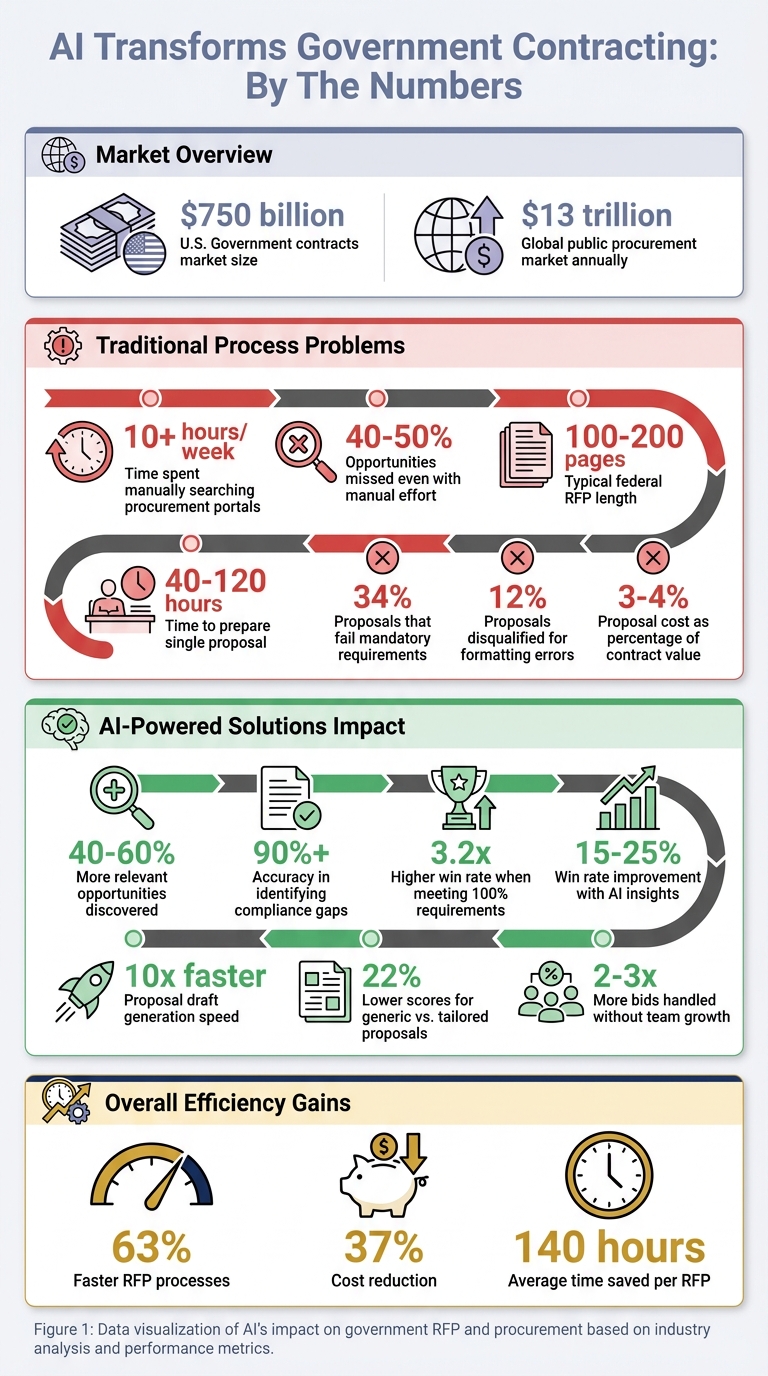
AI Impact on Government RFP Process: Key Statistics and Efficiency Gains
Problems with Traditional RFP and Government Procurement
The current government procurement process heavily favors large, established companies over smaller, more nimble competitors. Despite the public procurement market exceeding $13 trillion annually, outdated methods for identifying and securing contracts create significant inefficiencies. These challenges are especially evident in the manual processes used to search for opportunities.
Manual Search for Opportunities
Government procurement is spread across thousands of independent portals – ranging from federal systems like SAM.gov to state, county, and municipal platforms. Each of these has its own search tools and notification schedules. For organizations relying on manual searches, just keeping up with a dozen portals can take over 10 hours per week. Even with this effort, teams often uncover only 40–50% of the opportunities they qualify for.
Adding to the complexity, agencies describe their needs using inconsistent terminology. For example, a contract for "IT consulting" might be labeled as "digital transformation services", "technology advisory", or "ICT professional services", depending on the agency. Traditional keyword searches often miss these variations, creating a "discovery gap." Opportunities posted on less prominent portals with short deadlines are especially hard for small teams to track, putting startups with limited resources at a distinct disadvantage.
Difficult Compliance and Documentation Requirements
Finding opportunities is just the first hurdle. The next challenge lies in navigating the complex compliance and documentation requirements of federal RFPs, which are often 100–200 pages long. Critical details – like evaluation criteria and mandatory requirements – are scattered across sections such as Section C (Description/Specs), Section L (Instructions), and Section M (Evaluation Factors). Teams must painstakingly extract and organize this information, often juggling massive Word files and spreadsheets. This manual process is not only time-consuming but also prone to mistakes.
Statistics show that 34% of losing proposals fail to meet mandatory requirements, while 12% are disqualified for simple formatting errors, such as incorrect font sizes or margins. Preparing a single response can demand 40–120 hours of work, translating to 3–4% of the proposed contract value. To make matters worse, late-stage amendments often arrive just days before a deadline, leaving teams scrambling to update sections and ensure compliance. Without automated tools, managing these changes and maintaining version control across multiple documents becomes an overwhelming task – especially for startups with limited manpower.
Low Win Rates and Missing Data Insights
Perhaps the most critical issue is the lack of data-driven decision-making in traditional procurement. Many organizations base their "go/no-go" decisions on intuition rather than leveraging historical award data, win probability models, or competitor intelligence. This approach wastes countless hours on low-probability bids, often due to an incumbent’s advantage or a poor alignment between the company’s capabilities and the opportunity.
Without access to insights like historical pricing benchmarks or competitor performance data, it’s nearly impossible to craft competitive bids. Companies lacking predictive analytics face low win rates, significant resource strain, and team burnout. On the other hand, organizations that use data-backed strategies report 15–25% higher win rates and build pipelines that are three times more qualified. For startups aiming to enter the government contracting space, the absence of these insights creates a steep barrier to success.
sbb-itb-bb3960c
How Startups Use AI to Change the RFP Process
Startups are revolutionizing the traditionally cumbersome procurement process by leveraging AI-driven systems that streamline how businesses discover, evaluate, and win government contracts. These tools tackle inefficiencies that have historically given large companies an edge, leveling the playing field for smaller, more agile competitors. Here’s how AI is reshaping every stage of the RFP process.
AI-Powered Bid Discovery and Matching
AI platforms simplify bid discovery by monitoring thousands of procurement portals simultaneously, including major ones like SAM.gov and CanadaBuys, as well as state and local systems. Instead of relying on basic keyword searches – which often miss opportunities due to varied terminology – AI employs semantic search to grasp the intent behind queries. This means a search for "cybersecurity" might also surface tenders related to "penetration testing" or "information security consulting", uncovering opportunities that traditional methods might overlook.
Platforms such as Narwin.ai take it a step further by analyzing complete solicitation documents, including detailed Statements of Work and attachments. This approach identifies critical compliance requirements – like specific certifications or security clearances – that might otherwise go unnoticed in a manual review. By doing so, AI tools help businesses uncover 40–60% more relevant opportunities, ensuring a steady flow of high-quality leads.
Instant Qualification with Go/No-Go Signals
After identifying opportunities, AI tools quickly evaluate whether a company meets the necessary criteria. These systems extract compliance requirements, technical specifications, and evaluation benchmarks from RFPs to flag any potential disqualifiers. They then compare this data against a company’s capabilities, past performance, and strategic goals to generate a bid/no-bid recommendation.
This process isn’t just fast – it’s highly effective. Proposals that meet 100% of mandatory requirements are 3.2 times more likely to win than those that miss even one. AI tools achieve over 90% accuracy in spotting gaps, ensuring that teams address critical issues before submitting their bids. By categorizing opportunities as "Exceptional Fit", "Good Fit", or "Slight Fit", these systems allow teams to focus their energy on the most promising leads, reducing wasted effort and avoiding burnout.
Win Probability Prediction and Risk Analysis
AI doesn’t stop at qualification – it also predicts the likelihood of success. By analyzing historical data, buyer behavior, and risk factors, these tools estimate the chances of winning a bid before significant resources are invested. Predictive analytics evaluate patterns in past awards, competition, and buyer preferences, offering a data-backed win probability instead of relying on guesswork. Companies using these insights report a 15–25% improvement in win rates compared to traditional methods.
AI tools also provide vendor-specific insights, such as metrics on "Propensity to Spend", "AI Adoption Scores", and "Startup Friendliness", helping businesses prioritize agencies with the highest potential. Additionally, historical contract data is used to benchmark pricing, ensuring bids are both competitive and profitable. This shift from opaque processes to a transparent, data-driven approach enables startups to compete on equal terms with larger, more established players in the government contracting space.
Changing Proposal Writing and Compliance Management
AI isn’t just changing how startups discover and qualify bids – it’s also reshaping how they develop proposals and manage compliance. By automating these processes, startups can now compete with larger firms, delivering polished, error-free submissions with fewer resources and tighter deadlines.
Once a startup identifies the right opportunity, the next hurdle is crafting a proposal that’s not only competitive but also fully compliant. Traditionally, this meant manually sifting through dense PDFs, creating compliance matrices in spreadsheets, and juggling contributions from multiple writers. AI is revolutionizing this by automating the groundwork and catching errors early, reducing the risk of disqualification.
Automated Proposal Drafting with AI
AI tools can extract and organize requirements from solicitation documents – a task that once took hours – into a tailored draft in just minutes. These tools categorize requirements as mandatory, desirable, or evaluation factors and cross-reference them with a company’s internal database of past projects, technical approaches, and key themes. This process allows teams to produce initial drafts 10 times faster than traditional methods, freeing up senior staff to focus on strategy and crafting compelling narratives instead of formatting or repetitive tasks.
But AI doesn’t just regurgitate generic content. Platforms like Narwin.ai use retrieval-augmented generation (RAG) to analyze solicitation documents and generate responses grounded in a company’s proprietary data. This ensures the content is specific and aligned with the opportunity. Why does this matter? Proposals relying on generic boilerplate content tend to score 22% lower on technical evaluations than those tailored to the specific solicitation.
Once the draft is ready, AI steps in again to ensure every requirement has been addressed.
Compliance and Risk Gap Identification
Missing a single mandatory requirement can derail an otherwise strong proposal. AI-powered compliance tools solve this problem by creating live compliance matrices that link every requirement back to its source text. These matrices automatically update when amendments are issued, ensuring nothing slips through the cracks. Before the proposal even reaches human reviewers, AI conducts quality checks, flagging unsupported claims, missing citations, and inconsistent terminology. This proactive approach pays off: proposals that meet 100% of mandatory requirements win at a 3.2 times higher rate, ensuring critical issues are resolved before submission.
Beyond drafting and compliance, AI now oversees the entire proposal process from start to finish.
Complete RFP Lifecycle Management
Modern AI platforms go beyond individual tasks, managing the entire proposal lifecycle – from bid discovery to submission. These systems centralize everything: document management, task tracking, and version control. When a government agency releases an amendment, the platform highlights changes and updates compliance items automatically, preventing last-minute errors.
Collaboration is also more seamless. Teams can allocate effort based on evaluation criteria (e.g., dedicating 40% of resources to the Technical Approach if it accounts for 40% of the score), assign specific tasks to writers, and track progress in real time. Security is another priority – leading platforms adhere to certifications like SOC 2 Type II and CMMC Level 2 to safeguard sensitive data. Many also implement zero-day data retention policies, ensuring proprietary information remains secure and isn’t used for AI training.
This comprehensive approach allows small teams to handle multiple proposals simultaneously, acting as a force multiplier in a highly competitive environment.
Practical Steps for Organizations: Using AI for RFP Success
Knowing how AI can reshape the RFP process is one thing – putting it into action is another. The good news? You don’t need to overhaul everything overnight. By focusing on discovery, decision-making, and collaboration, you can make meaningful improvements right away. These areas are interconnected, and progress in one can amplify results in the others, boosting both efficiency and win rates.
Improve Opportunity Discovery
Say goodbye to endless manual searches on platforms like Sam.gov and CanadaBuys. With AI-powered tools, you can automate the process of finding opportunities that align with your capabilities, certifications, and geographic focus. These platforms monitor opportunities 24/7 and deliver a daily feed of matches tailored to your business. This proactive approach not only saves 15+ hours per bid cycle but also ensures you never miss a deadline. To make the most of this, train the AI by uploading your company’s profile, including past wins, certifications, and service offerings. This helps the system understand what a "good fit" looks like for your organization.
Use Data-Driven Decision-Making
Successful firms don’t chase every opportunity – they focus on the right ones. AI can help by providing win probability scores and go/no-go recommendations, guiding you on where to invest your resources. Start by rating your alignment with evaluation factors on a 1–5 scale. If your score is below a 3 on key criteria, it might be better to skip that bid. Build a compliance matrix early by using AI to extract mandatory requirements, creating a "single source of truth" for your team. This approach can be a game-changer – proposals that meet 100% of mandatory requirements win at a 3.2 times higher rate. With data refining your opportunity pool, your team can focus on collaboration to turn these insights into winning proposals.
Improve Collaboration and Proposal Quality
Streamline your proposal process with centralized platforms that manage everything – from requirement extraction and compliance tracking to automated drafting. These tools eliminate the confusion of scattered email chains and outdated documents, keeping everyone aligned with the latest information. AI can generate tailored first drafts by analyzing tender requirements and comparing them to your library of successful bids. Then, allocate your team’s effort based on evaluation criteria. For instance, if the Technical Approach makes up 40% of the score, dedicate 40% of your resources to perfecting that section. Before submission, use AI for a final quality check to catch unsupported claims, terminology inconsistencies, and compliance gaps.
When treated as a strategic partner, AI helps organizations win more contracts while cutting down on the time spent on proposals. Start small, track your results, and expand on what delivers the best outcomes.
Conclusion: The Future of RFPs and Government Bids
The world of RFPs is changing fast. What used to take weeks of manual effort can now be done in minutes, thanks to advanced AI tools. Tasks that once needed large teams and deep networks are now within reach for smaller, more nimble companies.
By automating repetitive tasks – like finding opportunities, tracking compliance, and drafting proposals – AI tools allow teams to focus on what really matters: strategy and setting themselves apart. These tools can make RFP processes 63% faster, cut costs by 37%, and save 140 hours per RFP on average. In some cases, this has even led to a dramatic increase in the number of proposals submitted. Real-world examples show how automation is transforming the way organizations approach government contracts.
This newfound efficiency is leveling the playing field. Big firms that used to dominate because of their resources and networks now face real competition from smaller and mid-sized businesses leveraging AI. This shift promotes a more competitive, merit-driven environment for government bids.
AI is already reshaping how government procurement works. The key question is: will your organization adopt these tools in time to stay ahead? Those who integrate AI into their strategy now will be the ones leading the charge in the next phase of government contracting.
FAQs
How do AI tools find government bids I’d normally miss?
AI tools simplify the process of finding bids by scanning various procurement portals – covering federal, state, and local sources – in real time. They use criteria like NAICS codes, keywords, and jurisdictions to sift through data and pinpoint relevant opportunities. With the help of machine learning and natural language processing, these tools can prioritize bids, send instant alerts, and even recommend opportunities that match your expertise. This reduces the need for manual work and minimizes the risk of overlooking valuable chances.
What’s the safest way to use AI without compliance mistakes?
To use AI responsibly and avoid compliance pitfalls, it’s crucial to have strong oversight, clear traceability, and strict adherence to regulations. Implement human oversight mechanisms to maintain transparency and allow for intervention when needed. Build systems with traceability in mind, ensuring that decisions can be verified and understood.
Additionally, align your processes with federal compliance plans, regularly update internal policies, and provide thorough training for staff on AI governance. These steps help reduce risks while ensuring ethical and legal standards are upheld.
How can I tell if a bid is worth pursuing before I write?
Evaluating whether a bid is worth pursuing starts with comparing your organization’s strengths and resources to the bid’s requirements. Does your team have the skills, experience, and capacity to meet the expectations? Beyond that, think about the likelihood of success by factoring in the buyer’s intent and the level of competition.
It’s also crucial to weigh the bid’s strategic importance. Ask yourself: Does this align with our long-term goals? Is it profitable enough to justify the effort?
Using AI tools can make this process more efficient. They can help pinpoint opportunities that offer the most value, allowing your team to focus on bids with the greatest potential for success.