
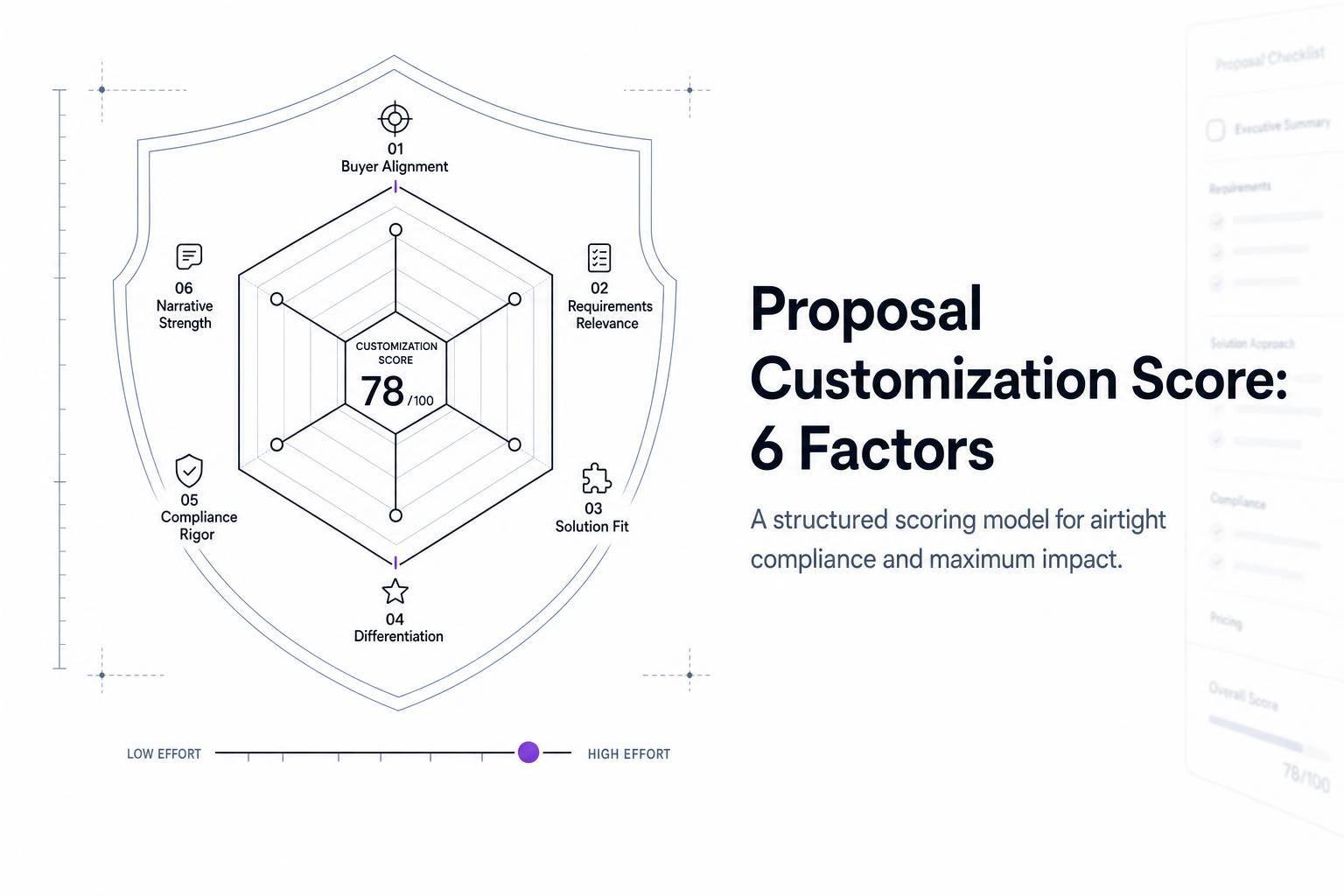
Most government RFPs do not need the same level of writing effort. I’d use six checks to decide how much work a bid should get: buyer language match, section relevance, win theme fit, compliance edits, resume fit, and case study fit.
Here’s the short version:
- If I can reuse 70%–80% of past content with light edits, the bid is usually low-effort
- If the contract is above $1 million, has detailed scoring, or faces a strong incumbent, it often needs high-effort tailoring
- Compliance is the one factor that stays strict in every bid
- Resumes and case studies matter more when evaluators score staff quality and past performance
- A $5,000,000 federal IT contract on SAM.gov usually needs far more custom work than a $250,000 local tender on BCBid
What I like about this scoring idea is that it keeps bid decisions simple. Instead of guessing, I can review six factors, check the deal size, scoring rules, deadline, and incumbent status, then set the effort level before the team burns hours.
Quick Comparison
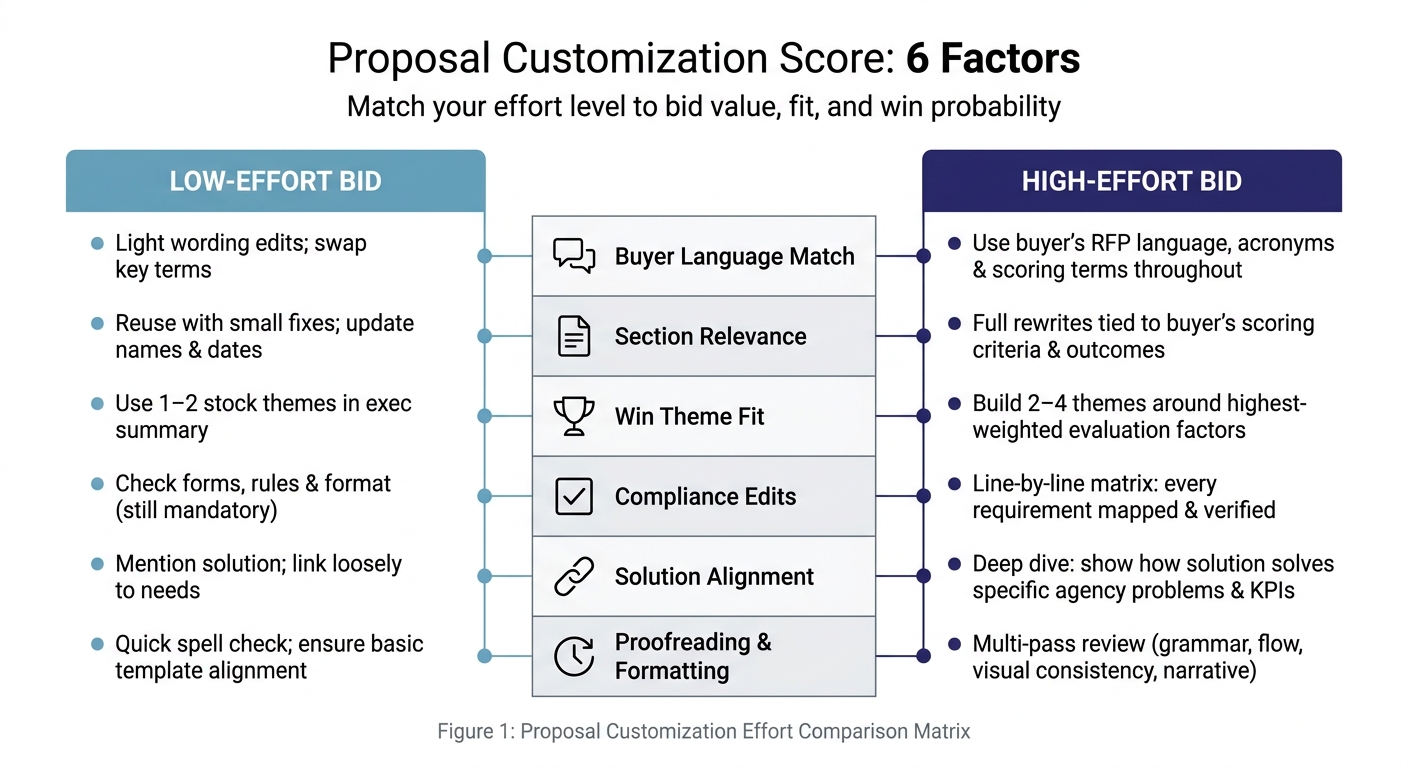
Proposal Customization Score: 6 Factors – Low vs. High Effort
| Factor | Low-Effort Bid | High-Effort Bid |
|---|---|---|
| Buyer language match | Light wording edits | Use buyer terms across the full proposal |
| Section relevance | Reuse with small fixes | Rewrite scored sections for this RFP |
| Win theme fit | Use 1–2 stock themes | Build 2–4 themes around scoring factors |
| Compliance edits | Check forms, rules, and format | Track each requirement line by line |
| Resume fit | Pick the closest resume | Rewrite bios to match scored roles |
| Case study fit | Use the nearest example | Pick proof that matches sector, scale, and scope |
If I had to boil the article down to one point, it’s this: customize where it changes the score, and never cut corners on compliance.
1. Low-Effort Opportunities
A low-effort opportunity is a bid you can answer with mostly prewritten material and only light edits to fit the RFP. The idea is simple: if deeper tailoring won’t do much to improve your odds, don’t sink extra time and money into it.
A good example is a city government issuing a standard IT support services RFP that looks a lot like ones your team has already won. The wording feels familiar. The sections follow the usual pattern. The compliance rules line up with work your team has handled before. In that kind of bid, heavy customization often adds cost without doing much for your win rate.
A common rule many proposal managers use is this: if you can reuse 70–80% of prior content with small edits, treat it as low-effort and cap writing time.
Buyer Language Match
In a low-effort bid, the buyer’s wording usually lines up well enough with your usual language. It’s not an exact match, but it’s close. Your standard value statements, company messaging, and technical descriptions can often do the job without a full rewrite.
For example, the buyer may ask for “quality service” while your boilerplate says “enterprise-grade delivery.” That gap is small. A light keyword pass is often enough.
The practical move is straightforward: use the buyer’s exact wording in headings and opening lines, then keep most of the body copy as is. You’re not rebuilding the story. You’re making the response sound like it belongs to this RFP.
Section Relevance
This is where a strong content library pays off. Standard sections like Company Overview, Quality Assurance, and Risk Management can usually be dropped in with light edits. Update the buyer name, fix the dates, and match the RFP’s section order and headings.
The goal here is solid coverage, not a perfect match.
Before you reuse any section, do a quick three-part check:
- Does it clearly answer the question?
- Does it reflect this buyer’s priorities?
- Does it line up with the scoring criteria?
If any answer is “no,” fix that section, even if the edit is small.
Win Theme Fit
Generic win themes usually work well in this type of bid. Competitive pricing, reliable delivery, proven past performance, and low risk through standard methods and certifications tend to hold up when the buyer is running a more commodity-style procurement and award decisions come down to price and compliance.
Pick one or two themes from your library that match the stated evaluation criteria. Mention them in the executive summary and in the main technical sections, then keep moving. You don’t need to build a custom narrative around the buyer’s internal goals if the RFP doesn’t point in that direction.
Compliance Rigor
This is the one place where low-effort does not mean low attention. In government procurement, compliance is binary. One missed form or the wrong font size can knock out an otherwise strong response.
Use a basic compliance matrix before writing starts. Map every required item to the section where you’ll answer it. You can reuse standard compliance language, certifications, and legal clauses, but you still need to check the current RFP line by line for formatting rules, page limits, and submission instructions.
"Missing a comma can cost you millions." – Narwin
Narwin.ai can flag compliance gaps and unusual RFP requirements before you commit resources. That makes it easier to tell whether a bid fits a low-effort profile or needs a closer review.
2. High-Effort Opportunities
Low-effort bids can lean on reuse. High-effort bids can’t.
These opportunities need custom writing in every scored section. Generic content usually falls flat because it doesn’t line up closely enough with how the buyer grades the response. That’s common in large, high-stakes, or very competitive RFPs, like multi-year government contracts or major IT or AEC master agreements.
In these bids, evaluators often use detailed scoring matrices. Each section is judged against clear criteria. So the more sections you need to rewrite, the more tailoring the bid demands.
Buyer Language Match
Simple keyword swaps won’t do the job. You need to use the buyer’s own scoring language throughout the proposal.
A good way to handle this is to build a shared terminology list from the RFP. Pull terms from the Statement of Work, evaluation criteria, and any addenda. Then use that list across the team so everyone writes in the same language.
For example, if a city RFP uses "resident experience" instead of "user experience," your solution sections and win themes should follow that wording. When your proposal mirrors the buyer’s language and rubric, evaluators can connect your response to the score with less effort.
Section Relevance
Every major section, including Project Understanding, Technical Approach, Management Plan, and Transition Plan, should be written for this buyer and this RFP.
That means reworking core content around the buyer’s legacy systems, regulations, geography, and stakeholders. If the section could be dropped into another proposal with only minor edits, it’s probably not tailored enough.
Win Theme Fit
Stick to 2–4 win themes that connect straight to the highest-weighted evaluation factors.
Each theme should make a clear benefit claim and back it up with proof. Put those themes in the executive summary, then repeat and support them across every scored section. Done well, this gives the evaluator a clear thread to follow instead of a pile of disconnected points.
Compliance Rigor
In high-effort opportunities, compliance has to be built in from day one. A single missed mandatory requirement can knock the whole proposal out.
Start with a live compliance matrix. Map every "shall" and "must" requirement to a section, page number, and owner. Forms, certifications, and attachments need the same attention as the written response. They’re not admin leftovers. They’re score-critical workstreams.
Narwin.ai can help automate requirement extraction and flag compliance gaps early, so your team spends writing time where it actually affects the score.
The same level of fit applies to resumes and case studies too.
Resume Fit
In high-effort bids, staff bios need to match the buyer’s priorities, certifications, and contract type.
Rewrite summaries so they spotlight the exact roles and credentials the RFP scores. A generic bio from your content library will often lose points to a competitor whose resume lines up tightly with the evaluation criteria.
Case Study Fit
Choose case studies that match the buyer’s sector, scale, and complexity.
Swap out broad examples for proof that maps straight to the RFP. If an evaluator is scoring past performance, they should see a reference that looks like their world, not a loosely written success story from a different industry or a much different contract size.
Side-by-Side Comparison of All 6 Customization Factors
These six factors don’t matter to the same degree, and they don’t take the same amount of work.
Some are fairly quick fixes. You can tighten them up with a few smart edits. Others take more time because they call for bigger choices, deeper rewrites, or net-new material. The table below lays out where the light-lift changes sit and where you may need to rebuild parts of the bid.
| Factor | Low-Effort Bid | High-Effort Bid | Score Impact |
|---|---|---|---|
| Buyer Language Match | Basic terminology swaps; standard professional tone | Consistent use of RFP language, acronyms, and evaluation criteria throughout every section | Moderate–High: Makes the proposal feel written for this buyer specifically |
| Section-Level Relevance | Reordering content, deleting off-topic material, adding a few requirement-specific sentences | Full rewrites tied to the buyer’s scoring criteria, risk concerns, and desired outcomes | High: Reduces evaluator inference; easier to award points |
| Win Theme Fit | Threading an existing win theme through the cover letter and executive summary | Rebuilding the proposal around a value proposition tied to the buyer’s goals and evaluation criteria | Very High: Determines whether the proposal feels generic or strategically targeted |
| Compliance Edits | Basic fixes to headings, file naming, and required language | Line-by-line matrix linking each requirement to its response section | Critical: Binary pass/fail; a single miss can disqualify the entire bid |
| Resume Fit | Selecting the closest available resume and highlighting relevant certifications | Rewriting summaries to match the roles, credentials, and priorities the RFP scores | High: Evaluators score staff quality partly by who will actually do the work |
| Case Study Fit | Choosing the nearest relevant project and lightly reframing the narrative | Selecting proof that mirrors the buyer’s sector, scale, and complexity | High: Turns general capability into buyer-specific proof |
Use this comparison to weigh the tradeoffs in the pros-and-cons section.
sbb-itb-bb3960c
Pros and Cons of Each Customization Approach
The table lays out the tradeoffs. This section gets into the day-to-day cost. The issue isn’t whether you should customize. It’s how much each bid is worth.
Low-effort customization keeps labor down and speeds up turnaround. That’s useful when you’re handling a lot of smaller tenders or trying out a new opportunity. But there’s a downside: more compliance risk. Templates can miss small but important submission rules, and generic copy tends to get scored like generic copy.
High-effort customization takes more labor and more time. It usually pulls in solution architects, legal, finance, and delivery leads. Costs go up when buyer language, section relevance, win themes, resumes, and case studies all need to be rewritten. But that extra work can improve your customization score and your fit with the rubric, especially when evaluators use detailed scoring matrices and want to see direct alignment with the outcomes they listed.
The comparison below shows where each route saves time and where it can strengthen your score.
| Factor | Low-Effort | High-Effort |
|---|---|---|
| Bid cost | Lower; minimal SME time | Higher; cross-functional involvement |
| Cycle time | Days; fast turnaround | Weeks; iterative drafts and reviews |
| Resource burden | Light; mostly proposal coordinators | Heavy; SMEs, legal, delivery leads |
| Compliance exposure | Higher; templates may miss nuanced requirements | Lower; systematic requirement mapping |
| Rubric fit | Adequate on basic criteria; weak on tailored factors | Strong; directly matches the rubric |
Lean too hard on low-effort responses in competitive markets, and you can end up in a loss pattern that keeps feeding itself. Go all-in on high-effort customization for every bid, and you drain your best people while pushing up cost per bid without getting better returns.
A smarter move is a tiered model. Save deep customization for high-value, high-fit opportunities. Use lighter methods for smaller or early-stage bids. But every submission still needs a compliance sweep, no matter how much effort goes into it.
Narwin.ai cuts down compliance grunt work with automated requirement extraction, so your team can spend more time on the writing that helps move scores. That leads straight to the next issue: when does deeper customization pay off?
How to Decide When High Customization Is Worth It
Use the six-factor score to judge whether a bid deserves deep customization. Think of those six factors as your filter for each opportunity.
Start with contract value and economics. Bids above $1 million or multi-year vehicles often deserve deeper work. On the other hand, a one-off local government contract under $50,000-$100,000 usually points to a lighter approach. The main exception is when the bid matters for a bigger reason, like landing your first win in a target state or city.
Next, look at incumbent strength. If the incumbent is strong and well established, a generic response usually won’t get far. At that point, you have two honest options: go deep with sharp win themes and case studies that set you apart, or no-bid. If there is no incumbent, or the incumbent is weak or underperforming, a tailored proposal has more room to matter.
Then check the evaluator scoring structure. This is where many teams waste time. Put your effort into the highest-weighted sections first. If the RFP is mostly pass/fail, deep customization tends to pay off only when the requirements are complex or tied closely to the mission.
Finally, weigh deadline pressure and staffing capacity. If the deadline is less than 1-2 weeks away and the team is already stretched, deep customization often drags down quality instead of improving it. The key question is simple: can the team do this level of work without weakening other bids?
Use these four filters together, not one at a time, to choose the right effort level.
Conclusion
A proposal customization score measures fit, not effort. The smart move is to match your level of customization to the bid value, your fit, and your odds of winning. Bigger chances call for deeper work. Smaller or weaker-fit bids usually don’t.
When all six factors line up, the proposal feels built for the buyer. That’s what shifts scores: alignment across buyer language, section relevance, win themes, compliance, resumes, and case studies.
That same thinking should shape your bid/no-bid call. Narwin.ai gives win-probability estimates and instant go/no-go signals, so you can set the right effort level before you spend time and budget.
Low-effort bids still need tight compliance and basic language alignment. High-effort bids need more depth across all six factors, with each part tied to what the buyer cares about. Track which customization levels win, then reuse the patterns that push scores up.
FAQs
How do I score a bid quickly?
Use an AI-powered platform like Narwin.ai to review solicitation documents in 1 to 2 minutes instead of days. It pulls out key requirements, compliance clauses, and evaluation criteria, then matches them against your internal data.
It can also weigh factors like technical merit, pricing competitiveness, and buyer relationships to produce a win probability score and an instant go/no-go recommendation.
When should I no-bid instead of customize more?
No-bid when your probability of success is too low.
If your AI-calculated win score is below 30%, it’s usually a pass unless the deal has unusual strategic value. If the score falls between 30% and 49%, take a hard look at the gaps before moving ahead.
You should also no-bid if you can’t meet every mandatory requirement. And if closing major fit, risk, or technical gaps would take too much customization, your time is better spent on opportunities with a stronger chance of winning.
Which factor usually changes the score most?
Past performance often carries the most weight in federal procurement. In many cases, it makes up 20% to 30% of the total score.
That matters because agencies use historical bid data to judge how likely a vendor is to deliver. So while pricing, technical approach, and agency relationships all matter, past performance often has more influence on win probability than any of them.
The strongest way to improve scoring potential is usually simple: show recent, relevant experience and tie it to clear results.