
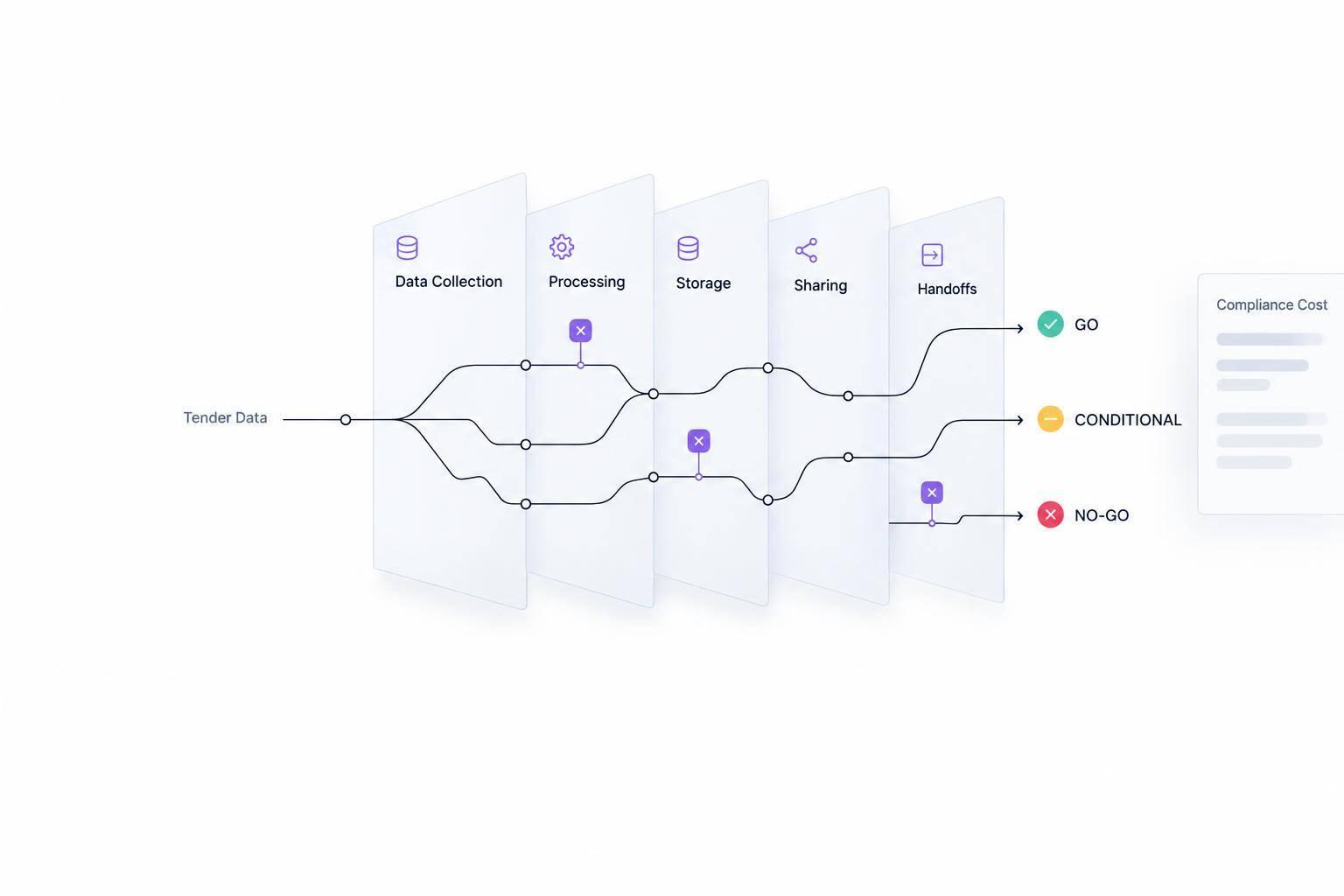
I treat any mandatory privacy requirement we cannot meet by its deadline as a no-go – not a problem that more revenue can fix. Before pricing a bid, I check where data goes, who can access it, what proof is due, and whether we can accept the contract’s costs and liability.
I use three decision paths:
- Go: We can meet the requirements, cover the costs, and secure the required approvals.
- Go with conditions: Each fix has an owner, budget, deadline, and written approval.
- No-go: A mandatory gap remains, or the cost, timing, or legal exposure exceeds approved limits.
My review covers storage, backups, support access, subcontractors, deletion, data reuse, incident reporting, and audit duties. I use AI tools only for first-pass review, with permission to upload the material – not final approval.
The rule I keep in view: <u>check before committing</u>. I record the decision and its supporting records, recheck buyer amendments, and hand approved commitments to the delivery team.
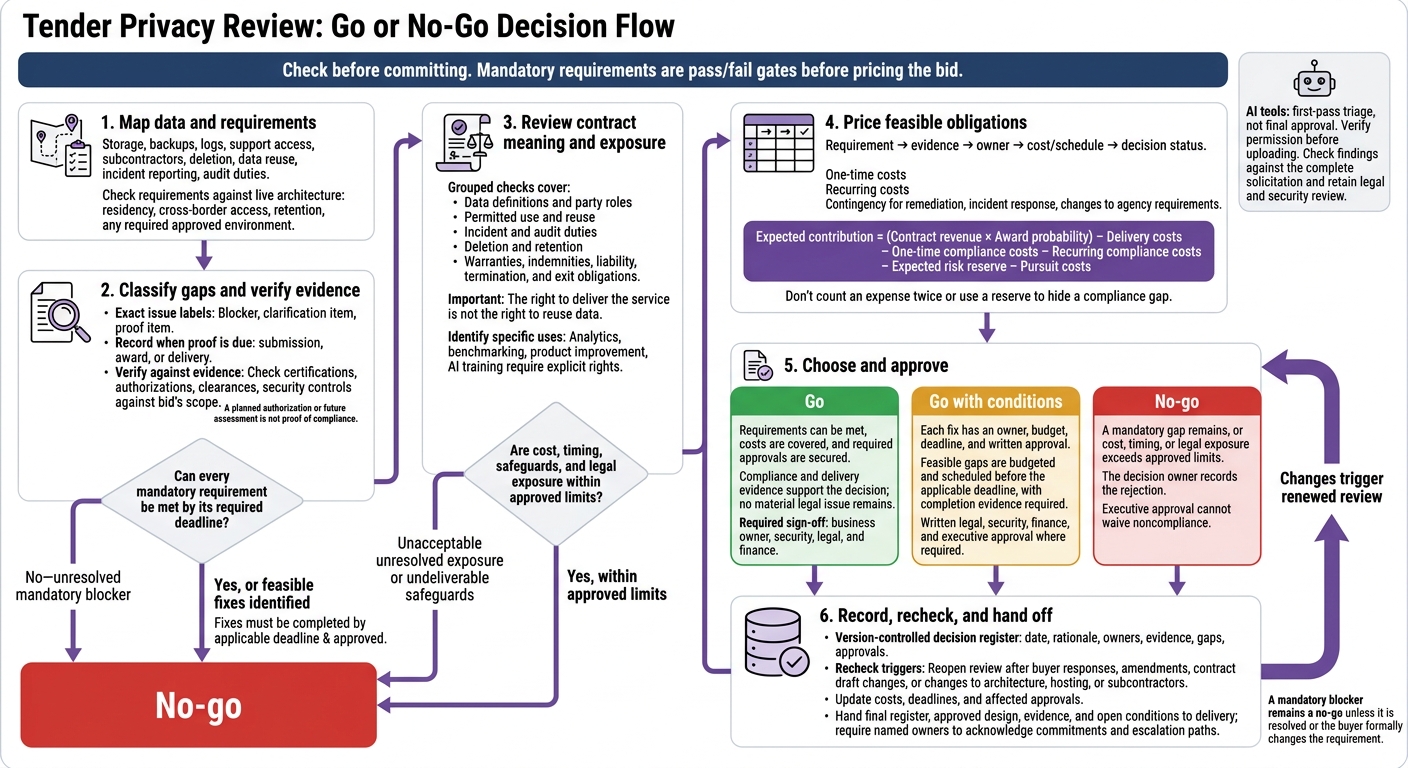
Tender Privacy Review: Go or No-Go Decision Flow
Privacy Red Flags That Can Mean No-Go
Use the data-flow map from the previous section to check each term against the live architecture.
A mandatory term becomes a blocker when the company cannot meet it by the required deadline or cannot accept the cost of doing so. Each red flag can move the decision from go to go with conditions or no-go. Label each issue blocker, clarification item, or proof item, and record when proof is due: submission, award, or delivery.
The Architecture Cannot Meet Data Restrictions
Blockers include unmet data residency rules, prohibited cross-border support access, and unapproved embedded providers or subcontractors. Check each restriction against the mapped production data, backups, logs, support access, and subcontractors. Missing location records are a blocker. Do not promise a restriction you cannot verify. Ask technical owners whether they can remove each conflict.
Apply the same test to retention and deletion terms. Can required deletion reach immutable backups, replicas, logs, and subcontractor systems? Account for any permitted retention exceptions.
Sensitive government data may require an approved environment – not just encrypted storage. If that environment cannot be ready on time, treat the gap as a no-go unless the buyer confirms an acceptable alternative in writing. Send any blocker that cannot be removed to legal and risk review.
Required Controls or Liability Exceed Capacity
Compare mandatory certifications, authorizations, clearances, and security controls with current evidence that covers the bid’s scope. A planned authorization or future assessment is not proof of compliance. Assign an owner, cost, dependency, and deadline to each gap. Do not give firm dates for uncertain approvals or provider changes.
If the architecture passes, review the remaining legal exposure. Escalate uncapped liability, broad indemnity, fines, and responsibility for subcontractor breaches to legal and risk owners. Compare that exposure with insurance limits, exclusions, deductibles, and response capacity.
Control gaps and liability terms should affect the bid decision now. Insurance does not prove compliance, and revenue cannot override a mandatory requirement. If the exposure exceeds approved risk tolerance – or the required safeguards cannot be delivered – the bid should not proceed on its current terms.
sbb-itb-bb3960c
Privacy Terms for Legal and Security Review
A sound architecture doesn’t guarantee acceptable contract terms. Technical capability does not settle contract meaning. Send the contract, privacy terms, security exhibits, and incorporated policies to legal, privacy, and security reviewers together.
Log each clause, issue, owner, and required fix: buyer clarification, an approved exception, or revised contract language. Before proposing an exception, check whether the solicitation allows it. Use the review to separate data definitions, service delivery duties, and data reuse rights.
Check Data Definitions, Roles, and Allowed Uses
Use the mapped data flows to define whether protected data includes personal information, confidential or government information, FCI, CUI, logs, support tickets, prompts, outputs, metadata, and model-generated data.
Assign each party’s role and duties for notices, consent, individual requests, records, and subcontractor approvals. Confirm whether residency limits cover remote access and how the parties must handle mandatory government disclosures.
The right to deliver the service is not the right to reuse data. Check ownership and licensing terms for customer content, outputs, and derived data. Require explicit rights for analytics, benchmarking, product improvement, and AI training.
Do not assume “service improvement” permits all four.
Confirm that subcontractor terms preserve these limits and that de-identified data isn’t automatically exempt.
Review Incident, Audit, Deletion, and Liability Terms
Once data use is defined, check how the contract enforces those limits. Translate incident language into specific requirements: the reporting trigger, deadline, recipient, update schedule, cooperation costs, and control over external notices.
Under DFARS 252.204-7012, covered DoD contractors generally must report qualifying cyber incidents within 72 hours and preserve relevant evidence for 90 days.
Verify the clause in the solicitation – not another contract. For audit rights, specify scope, notice, evidence access, confidentiality, and cost. For NIST references, identify the publication, revision, control, and contractual clause. Guidance alone is not binding.
Have counsel reconcile deletion deadlines with backup cycles, legal holds, and records duties, including what a deletion certificate can prove.
Review warranties, indemnities, liability caps, termination rights – including immediate termination for suspected incidents – refunds, data-export obligations, transition assistance, and continuing audit or retention duties as one package. Factor unpriced or unworkable obligations into the go/no-go decision. Add approved limits, exclusions, or cure periods to the clause log before bid submission.
Compare Deal Value With Compliance Costs
Treat mandatory requirements as pass/fail gates before pricing the bid. Confirm that privacy, residency, security, subcontractor, and contract terms can be met by the deadline. Then weigh contract revenue, award probability, compliance-adjusted margin, and the deal’s fit with business goals.
Build the cost case from the data-flow map and blocker log. Use the blocker log from the last section to price each remaining gap.
Build a Requirements and Cost Matrix
Link each requirement to evidence, an owner, and a cost estimate for the full contract term. The rows below are prompts. Replace them with the actual clauses and deadlines, and mark missing information as unknown.
For every unresolved privacy term, spell out the effect on cost, timing, and margin.
| Requirement or risk | Evidence needed | Delivery or storage impact | Review owner | Cost or schedule effect | Decision status |
|---|---|---|---|---|---|
| Backup residency | Region map, backup policy, provider attestation | Approved-region backups; restricted cross-region recovery | Security and legal | Dedicated architecture; longer recovery time | Open – confirm feasibility |
| Support access | Access policy, personnel locations, support procedures | Foreign-based access may be prohibited | Security and operations | Local or screened staffing; higher support cost | Conditional |
| Deletion | Deletion workflow, retention schedule, provider certificates | Data and replicas deleted by deadline | Legal, security, and engineering | Engineering and verification | Open |
| Subcontractor approval | Provider register, flow-down clauses, approval process | Written approval before adding providers | Procurement and legal | Onboarding delays; replacement costs | Conditional |
| Encryption and key control | Control documentation, test results, key design | Customer-managed or region-specific keys | Security | Implementation and recurring administration | Conditional |
| Audit and certification | SOC 2, FedRAMP, ISO 27001, or tender-specific evidence | Audit access and evidence production | Compliance and legal | Certification, audits, and staff time | Review required |
| Incident notification | Response plan, notification workflow | Short deadlines may require continuous monitoring | Security and legal | Monitoring and response retainers | Conditional |
Finance should split costs into two groups:
- One-time costs: Architecture redesign, migration, legal and security review, testing, certification prep, policy updates, and proposal clarification.
- Recurring costs: Regional hosting, encrypted backups, specialized support staff, personnel screening, 24/7 monitoring, audit participation, penetration testing, compliance tooling, cyber insurance, subcontractor oversight, and secure deletion at contract closeout.
Add contingency for remediation, incident response, and changes to agency requirements. Base estimates on supplier quotes and internal labor rates.
Expected contribution = (Contract revenue × Award probability) − Delivery costs − One-time compliance costs − Recurring compliance costs − Expected risk reserve − Pursuit costs.
Don’t count an expense twice or use a reserve to hide a compliance gap.
Choose Go, Go With Conditions, or No-Go
| Decision | Compliance feasibility | Unresolved legal exposure | Remediation effort | Required approvals |
|---|---|---|---|---|
| Go | Supported by compliance records and delivery evidence | No material unresolved issue | Covered by the approved plan and budget | Business owner, security, legal, and finance sign-off |
| Go with conditions | Feasible gaps have owners, deadlines, and completion evidence | Documented and acceptable only under approved terms or controls | Budgeted and scheduled before the applicable deadline | Written legal, security, finance, and executive approval where required |
| No-go | Mandatory requirements remain unresolved | Unacceptable liability or unresolved exposure | Cost or timing exceeds approved limits | Decision owner records the rejection; executive approval cannot waive noncompliance |
Use Narwin.ai for Initial Bid Review
Use Narwin.ai for first-pass triage, not final approval. It can help extract requirements, flag risks, and produce initial go/no-go signals. Use that first-pass list to start the matrix – not to approve the bid.
Check findings against the complete solicitation, attachments, incorporated clauses, questions and answers, and amendments. Keep legal and security review in place.
Before uploading, verify permission for third-party processing. Check the applicable storage locations, access controls, retention, deletion, subcontractor, and data-use terms. Upload only permitted material needed for the review. If permission or compliance is unclear, hold the upload pending review.
Conclusion: Document and Recheck the Bid Decision
Record the Decision and Evidence
Keep one version-controlled decision register that records the evidence behind the privacy go/no-go decision. Include the decision date, rationale, owners, evidence, gaps, and approvals – not just the outcome. Use it to support the final go, conditional go, or no-go call.
Use NIST SP 800-161 Rev. 1 as a reference for documenting supply-chain risk assessments and mitigation decisions. It is not a binding requirement for every tender. Before submission, have the delivery owner confirm that the recorded commitments can be met within the proposed price and schedule.
Recheck After Clarifications and Amendments
Check the completed register against buyer answers and amendments. Keep each question, response, date, and affected clause version. Under FAR 15.206, changes to U.S. federal solicitations require an amendment. Informal assurances do not change the requirement.
Reopen the decision after buyer responses, amendments, contract draft changes, or changes to architecture, hosting, or subcontractors. Compare versions, update costs and deadlines, and renew any affected approvals. A mandatory blocker remains a no-go unless it is resolved or the buyer formally changes the requirement. Update the register before final submission and contract closeout.
Before implementation, hand off the final register, decision rationale, approved design, evidence, and open conditions to delivery. Require named owners to acknowledge their commitments and escalation paths.
FAQs
How can we verify a subcontractor’s data residency claims?
Treat verification as a formal compliance requirement, with a named owner and a firm deadline. Require written evidence, such as control mappings or audit letters, that shows how the subcontractor’s infrastructure meets the RFP’s data residency requirements.
If compliance is still uncertain, track the gap as a bid blocker. Missing the validation deadline must automatically trigger a no-go decision for the bid.
When should we seek legal review of ambiguous privacy terms?
Seek legal review when unclear privacy terms involve indemnity, liability caps, intellectual property, termination clauses, or audit rights. Legal and contracts teams must manually review unusual insurance limits or liability terms that fall outside your standard risk appetite.
Always verify these high-impact items after AI flags them. Before committing to a bid, have legal counsel formally assess any clause that’s unclear, conflicts with other terms, or could cause harm.
How should we price uncertain privacy compliance costs?
Factor uncertain privacy compliance costs into your capture and proposal planning with data-driven risk analysis. Use Narwin.ai to map requirements – including data residency, encryption, and data destruction – against your technical capabilities and spot gaps.
Identify mandatory security clauses early, then turn compliance obligations into specific cost line items, such as specialized storage or required data destruction. This helps your team price bids using realistic compliance costs instead of gut feel.