
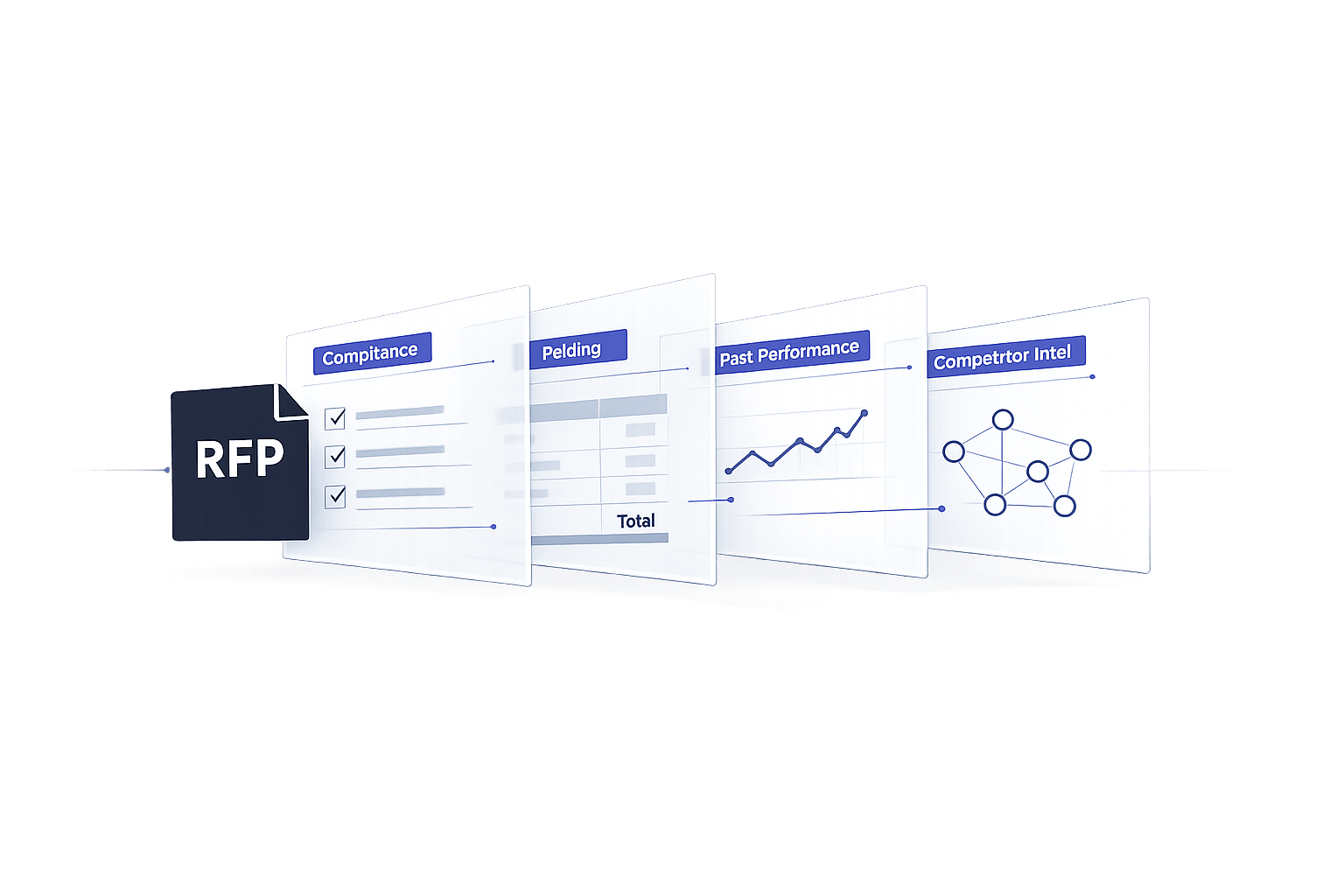
Winning government contracts is about understanding your competition and creating a proposal that stands out. Federal agencies spend over $700 billion annually, but 80% of proposals fail due to non-compliance. To succeed, you need to combine strict compliance with competitive analysis to highlight your strengths and address gaps.
Key takeaways:
- Compliance is critical: Proposals meeting 100% of requirements win 3.2x more often.
- Competitive analysis boosts success: Understand rivals’ weaknesses (e.g., pricing, past performance) and position your bid strategically.
- Early engagement matters: Contractors engaging 12–18 months before awards achieve 40–60% win rates.
- AI tools save time: Platforms like Narwin.ai analyze competitors, pricing, and compliance in minutes, improving win rates by up to 35%.
Steps to improve RFP success:
- Research past awards and competitors using platforms like SAM.gov and FPDS.
- Analyze competitors’ strengths, weaknesses, and pricing strategies.
- Create a comparison matrix to identify advantages.
- Use findings to refine your proposal and ensure compliance.
Competitive analysis transforms your proposal into a persuasive argument while tools like Narwin.ai simplify the process, letting you focus on opportunities with the highest chances of success.
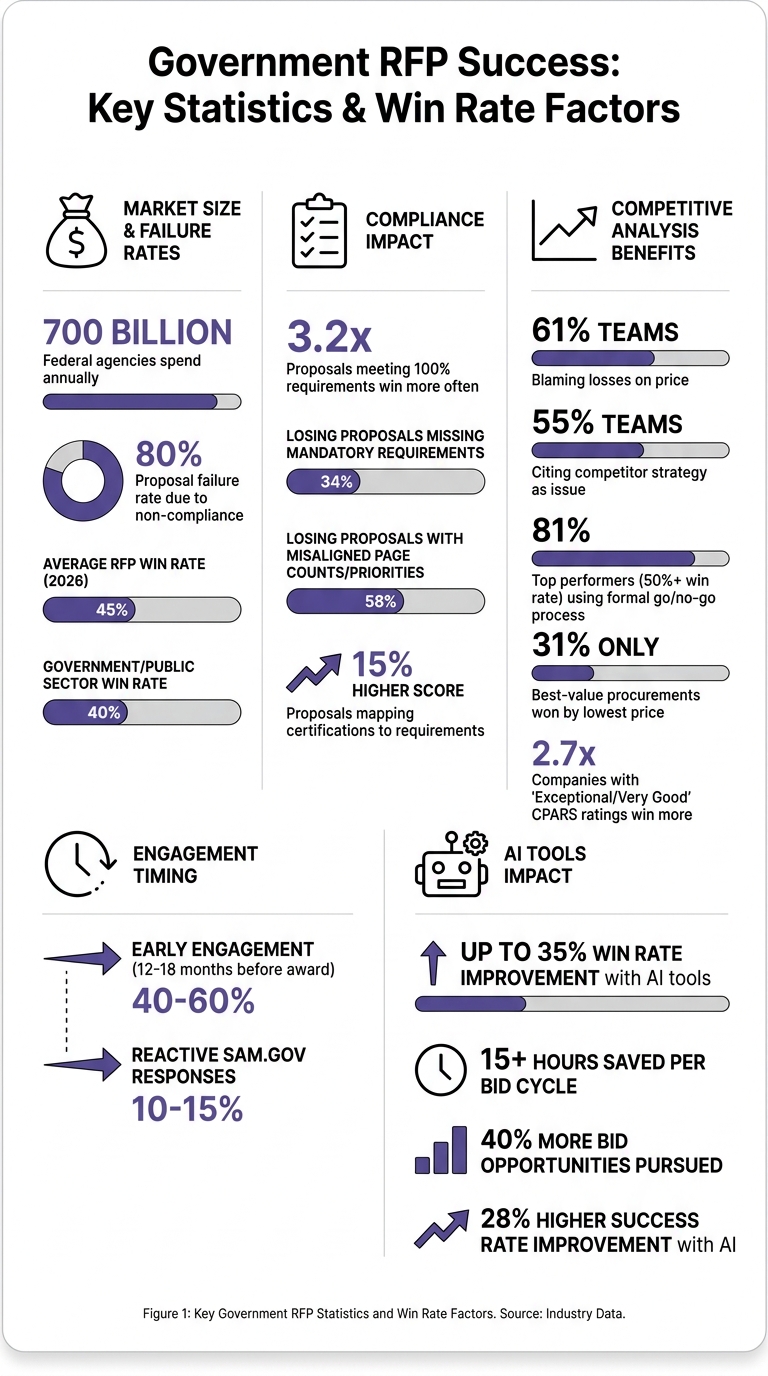
Government RFP Success Statistics: Win Rates, Compliance Impact, and Competitive Analysis Benefits
How Competitive Analysis Improves RFP Win Rates
Competitive analysis can have a direct impact on your success rate in winning RFPs. By 2026, the average RFP win rate is 45%, but this dips to 40% for government and public sector bids. Data reveals that 61% of teams blame bid losses on price, while 55% cite competitor strategy as the culprit. Top-performing teams, with win rates exceeding 50%, focus their efforts on high-probability opportunities. In fact, 81% of these teams use a formal go/no-go decision process to prioritize bids they’re more likely to win, rather than wasting resources on every opportunity listed on platforms like SAM.gov. This approach highlights the importance of identifying and addressing competitive gaps.
Competitive analysis isn’t just about knowing your rivals; it’s also about strategically positioning your bid. For instance, calculating your Price to Win (PtW) involves estimating competitors’ wrap rates, which include indirect costs like overhead and benefits. A small business might have a median labor rate of $102.05, while a competitor operating in a higher-cost region, like the Northeast, could average $110.15. By understanding regional and business size differences, you can fine-tune your pricing to stay competitive without undercutting your profit margins.
Additionally, competitive intelligence helps you stand out in a crowded field. When customers perceive no real difference between bidders, they often default to the lowest price. However, in best-value procurements, the lowest-priced proposal only wins 31% of the time. As OST Global Solutions puts it:
"Failure to include this crucial step [competitive analysis] in your bid development can mean, in effect, that you’ve lost the bid before it’s even submitted."
Main Goals of Competitive Analysis
The ultimate aim of competitive analysis is to identify who your competitors are and understand where they’re vulnerable. This starts with examining past contract awards to assess incumbents’ performance. If a competitor has faced issues like protests or negative CPARS ratings, their position weakens significantly. Companies with "Exceptional" or "Very Good" CPARS ratings win at 2.7 times the rate of those rated merely "Satisfactory."
Black Hat reviews are another valuable tool. These involve third-party analyses to simulate a competitor’s strategy and predict their likely approach. This process, sometimes called "ghosting", can reveal weaknesses without directly naming competitors. For example, if a rival is known for low-balling bids that lead to high employee turnover, you can emphasize your retention rates and workforce stability to differentiate yourself.
Competitive analysis also informs strategic teaming decisions. By identifying contractors who have won related contracts but lack certain capabilities – like technical expertise, geographic reach, or security clearances – you can position yourself as a valuable partner. Alternatively, you can select subcontractors to counterbalance a competitor’s strengths.
Staying ahead of market trends is just as important. Contractors who engage with agencies 12–18 months before an award enjoy win rates between 40–60%, compared to just 10–15% for those responding reactively to SAM.gov postings. Early engagement allows you to refine your technical approach, respond effectively to RFIs, and educate decision-makers on the risks of low-priced bids before the RFP is even released.
Compliance Requirements in Government RFPs
Beyond identifying competitor weaknesses, aligning your proposal with strict compliance standards can further boost your chances of success. Regulations like FAR 15.204-1 and the evaluation criteria in Section M outline how agencies score proposals. Understanding these requirements through a competitive lens can make your bid stand out.
Proposals that meet 100% of mandatory requirements are 3.2 times more likely to win than those that miss even one. A study of 200 government IT RFPs found that 34% of losing proposals failed because they overlooked mandatory requirements, while 58% lost due to misaligned page counts or failure to match the government’s evaluation priorities.
Analyzing Section M early on can help you tailor your proposal to the agency’s priorities. For example, if the agency places more weight on technical approach than price, you can adjust your narrative accordingly. If you know a competitor struggles with specific certifications, such as security controls, you can highlight your SOC 2 Type II or FedRAMP authorizations to demonstrate compliance. Proposals that map certifications to requirements typically score 15% higher.
The evolution from Generative AI to Agentic AI in 2026 is also changing the game. Advanced AI tools now handle complex tasks like compliance checks and document analysis, streamlining bid management. As Loopio research points out:
"Strategy – not technology – is the new differentiator. While tech adoption is almost universal, top performers stand out by using it for high-impact tasks: analyzing proposal quality, verifying accuracy, and interpreting data."
sbb-itb-bb3960c
How to Conduct Competitive Analysis for Government RFPs
To conduct a competitive analysis for government RFPs, you need to tap into publicly available contract data and leverage regulatory transparency. The federal procurement system offers access to contract histories, pricing information, and performance records – if you know where to look and how to interpret the data.
Step 1: Research Past Contract Awards and Competitors
Start by determining if the RFP involves new work or is a re-compete. For re-competes, identifying the incumbent contractor is key. Use SAM.gov to search for live and archived opportunities, then cross-reference with the Federal Procurement Data System (FPDS) to find detailed records of contract actions. FPDS allows filtering by NAICS codes and agencies, helping you pinpoint companies that frequently win in your area of expertise.
For broader insights, check USAspending.gov, which provides visual dashboards on agency spending trends. If you’re pursuing Canadian opportunities, CanadaBuys offers award notices with details like winning supplier names, locations, and contract values.
Once you’ve identified key competitors, investigate whether the incumbent has outgrown size standards or lost socio-economic eligibility (e.g., 8(a) or HUBZone status). These changes could push them to bid as subcontractors instead of prime contractors.
Explore agency announcements, contractor press releases, GAO protest decisions, and the FFATA Subaward Reporting System (FSRS) through USAspending.gov. These sources can reveal evaluation criteria, competitor weaknesses, and teaming patterns.
| Platform | Primary Use | Key Data Points |
|---|---|---|
| SAM.gov | Opportunity Tracking | Solicitations, pre-solicitations, and award notices |
| FPDS | Historical Research | Awardee names, dollar values, NAICS codes, and set-asides |
| USAspending.gov | Market Analysis | Agency budget trends, obligation history, and sub-awards |
| CanadaBuys | Canadian Procurement | Supplier names, cities, and contract values |
With your competitor list in hand, move on to analyzing their capabilities and track records.
Step 2: Analyze Competitor Capabilities and Track Records
Now that you’ve identified competitors, dive into their capabilities and performance history. Use FPDS to analyze trends in their award volumes – are they growing, shrinking, or entering new markets? Investigate which IDIQ contracts, GWACs, or GSA Schedules they hold to understand their strategies for securing work.
Although CPARS reports remain private, you can infer performance quality from public signals. For example, check if the government exercised all option years on a competitor’s contract or if the contract ended early. As federal contracting expert Tiatun T. from GovBidLab explains:
"A contract that ends after the base period without options exercised is often a red flag for performance problems."
Use the Federal Awardee Performance and Integrity Information System (FAPIIS) on SAM.gov to check for terminations, defective pricing, or administrative agreements. Compare labor rates using the GSA CALC tool to benchmark your pricing against awarded rates for similar roles and qualifications. Finally, verify whether competitors genuinely operate in required regions or if their claims lack supporting past performance.
This research forms the basis for creating a competitor matrix in the next step.
Step 3: Create a Competitor Comparison Matrix
A competitor comparison matrix is a tool that organizes the strengths, weaknesses, and capabilities of rival firms against the RFP’s evaluation criteria. Structure your matrix columns based on factors like Technical Approach, Past Performance, and Price. This matrix is particularly useful during "Black Hat Reviews", where you predict competitor strategies.
| Competitor Name | Technical Strengths | Known Weaknesses | Pricing Strategy | Your Advantage |
|---|---|---|---|---|
| Incumbent Co. | Deep agency knowledge; existing staff | Potential complacency; higher overhead | Historically high; relies on "best value" | Highlight innovation and cost-saving automation |
| Niche Specialist | High certifications (ISO, CMMC) | Limited geographic reach; small staff | Mid-range | Emphasize larger scale and regional presence |
| Large Prime | Massive resources; past performance | High price; slow response times | Premium pricing | Focus on agility, lower indirect costs |
Check if competitors qualify for specific socio-economic categories like 8(a), WOSB, SDVOSB, or HUBZone. These designations can significantly narrow the competition. Look at press releases and partner pages to identify teaming relationships – incumbents unable to bid as primes may join as subcontractors to new primes.
Step 4: Apply Findings to Your Proposal Strategy
Use your competitive insights to refine your proposal. Highlight areas where you outperform rivals while ensuring strict compliance with RFP requirements. For instance, if a competitor lacks a local presence, emphasize your established operations in the region and community connections.
Adjust your Price to Win (PtW) strategy based on public pricing data from sources like GSA CALC or FPDS. Document these sources to avoid any procurement integrity concerns. Pair your competitor matrix with a compliance matrix to ensure you’re meeting all mandatory requirements while showcasing your unique strengths.
Finally, if your proposal isn’t selected, request a debrief within three days (as outlined in FAR 15.505/15.506). This feedback offers valuable insights into how your proposal compared to the winner, feeding directly into your next competitive analysis cycle.
Using AI Tools for Competitive Analysis
Performing competitive analysis manually can take countless hours, especially when combing through platforms like SAM.gov, FPDS, and USAspending.gov to build a competitor matrix. AI tools, however, simplify this process significantly. AI platforms automate data extraction, scanning thousands of contract records to uncover competitor trends and identify compliance issues in just minutes. This shift lets proposal teams focus on crafting strategies rather than drowning in data collection. A standout example of this automation is Narwin.ai, which transforms how competitive analysis is done by handling data collection and analysis effortlessly.
Narwin.ai provides Competitive Intelligence on Tenders, offering insights into past awards and competitor bids across government RFPs in the US and Canada. The platform examines which companies win specific contracts, their pricing strategies, and their compliance track records. For instance, in a US federal construction RFP, Narwin.ai discovered that Competitor A secured 60% of similar bids by offering lower prices but had compliance failures in 20% of cases. Meanwhile, Competitor B excelled in technical capabilities. This analysis allowed the user to create a proposal that emphasized superior compliance while matching Competitor B’s technical strengths.
The platform also calculates win score probabilities by analyzing historical data, competitor performance, compliance adherence, and your own track record. These scores help predict success rates – for example, a 75% chance of winning an IT consulting RFP – empowering users to make informed go/no-go decisions. IT consulting users have reported a 35% increase in win rates after adopting Narwin.ai. One architecture firm even secured a $10 million US Army contract by leveraging the platform’s Competitive Intelligence feature to uncover a competitor’s pricing strategy.
Narwin.ai Features for Competitive Analysis
Narwin.ai offers a range of features designed to refine and enhance competitive insights. Here’s what makes it stand out:
- AI Bid Search: Monitors federal, state, and local procurement sources around the clock, matching opportunities to your firm’s profile, certifications, and past performance.
- Risk Analysis: Cross-references RFP compliance requirements – like FAR clauses and small business set-asides – against competitor data and your capabilities. It flags potential gaps, such as a competitor’s weak cybersecurity certifications, reducing disqualification risks by 50%, according to the platform’s data.
- Instant Go/No-Go Signals: Saves time by identifying low-probability bids early. For example, Carter Hawthorniwaite from App Growth Network shared that in 2026, his team saved over 15 hours per bid cycle and generated $25,000 by using Narwin.ai to pinpoint high-probability opportunities.
- AI Bid Recommendations: Suggests the best opportunities based on your firm’s strengths.
- Bid Writing: Uses Retrieval-Augmented Generation (RAG) technology to draft compliant proposals by pulling from your past RFPs and case studies. On average, users bid on 40% more opportunities with a 28% higher success rate due to precise competitor benchmarking.
Adding Narwin.ai to Your RFP Process
Getting started with Narwin.ai is simple. Sign up and enter your NAICS codes to receive personalized bid recommendations. Integrate with Slack to get daily competitive alerts – opportunity matches are updated every day at 3:00 AM EST, ensuring you stay ahead of new tenders. Use the Risk Analysis feature on shortlisted RFPs to build a detailed competitor comparison matrix and rely on win scores to make more confident go/no-go decisions.
Narwin.ai also integrates seamlessly with Google Drive and major CRMs, allowing you to export insights directly into your proposal workflow. This reduces analysis time from weeks to just hours. Mike W. from Yolo County’s Innovation Office in California shared his experience in 2026:
"Narwin’s detailed analysis and suggestions around things like NAICS codes, contractual wording, etc. are very on-point."
To maximize the platform’s potential, upload your company’s data – such as past bids, safety records, and certifications – into the "Company Profile" for highly tailored AI recommendations. Plus, Narwin.ai’s Chrome extension enables real-time insights directly on government portals like SAM.gov and CanadaBuys. From compliance checks to competitor tracking and proposal drafting, this tool streamlines every step, helping you align automated insights with your overall strategy.
Conclusion
In the world of government RFPs, competitive analysis isn’t just helpful – it’s essential. It can make the difference between securing a contract or missing out on a valuable opportunity. The process starts with researching past awards on platforms like SAM.gov, evaluating competitor capabilities, creating a detailed comparison matrix, and using those insights to refine your proposal strategy. These steps let you pinpoint opportunities with higher chances of success, decode buyer intent from Section M evaluation criteria, and highlight your strengths effectively – all without directly referencing your competitors.
On top of this, AI tools like Narwin.ai streamline the process, turning weeks of manual research into just minutes. The platform provides compliance insights, win probability scores, and competitor intelligence, all tailored to your RFP strategy. Its Risk Analysis feature is especially powerful, comparing RFP requirements against your capabilities and competitor data to identify potential gaps before you commit to a bid.
By using tools like these, teams can save over 15 hours per bid cycle and add more than $25,000 in value by focusing only on the most promising opportunities. Uploading your company profile – complete with past bids, certifications, and case studies – enables the AI to refine its recommendations, delivering match scores and strategies that are increasingly precise and actionable.
Success in government contracting requires precision, speed, and strategic insight. Competitive analysis equips you to excel in weighted evaluation factors, avoid disqualification through proper compliance mapping, and make smart, data-driven decisions about where to invest your efforts. Whether your focus is on federal construction contracts, IT consulting, or architecture projects, understanding your competitive landscape is the cornerstone of every winning proposal.
FAQs
What’s the fastest way to identify the incumbent and likely bidders?
The fastest way to figure out who the current and potential bidders are is by checking public records of existing contracts and past awards. These records show who has previously secured similar projects and whether they can bid again. This insight lets you plan your approach effectively before RFPs are even released.
How do I estimate a realistic Price to Win without guessing?
To come up with a realistic Price to Win (PTW), start by diving into detailed competitive and market data related to the specific government RFP. Carefully review the RFP’s evaluation criteria, scope, and requirements, and think about how competitors might structure their pricing.
Make use of tools like Narwin.ai, which offers AI-driven insights such as win probability predictions and historical pricing trends. These tools help you create a data-backed estimate, steering clear of guesswork and assumptions.
How can I prove compliance without bloating my proposal?
To demonstrate compliance without overwhelming your proposal, include a clear compliance matrix. This matrix should directly connect each RFP requirement to specific sections in your proposal. It’s a simple yet effective way to show you’ve addressed every requirement while keeping your submission concise and focused.
Pay close attention to key RFP sections like C, L, and M, as these often outline critical compliance elements. By following a structured approach, you can show adherence to requirements effectively without bogging down your proposal with unnecessary details. This keeps your submission professional and to the point.