
Before sealing, I check the bid’s contents. Before opening, the agency checks receipt and custody – not the contents. Under FAR 14.401, bids received before opening must remain secure and unopened until the scheduled opening.
I use this checklist to keep those roles separate:
- Prepare: Check signatures, bidder details, bid guarantees, pricing, amendment acknowledgments, required forms, and final files.
- Deliver: Follow the exact submission instructions, finish any portal submission step, and save proof of receipt at the designated location.
- Secure: Log receipt details, report delivery problems, and track custody without reviewing sealed contents.
- Open and record: Confirm the opening time and staff, prepare the bid abstract, and preserve originals, review records, and any required holds.
My rule: <u>keep bidder and agency sign-offs separate</u>. A completed checklist supports recordkeeping; it does not prove timely receipt, bid responsiveness, or eligibility for award.
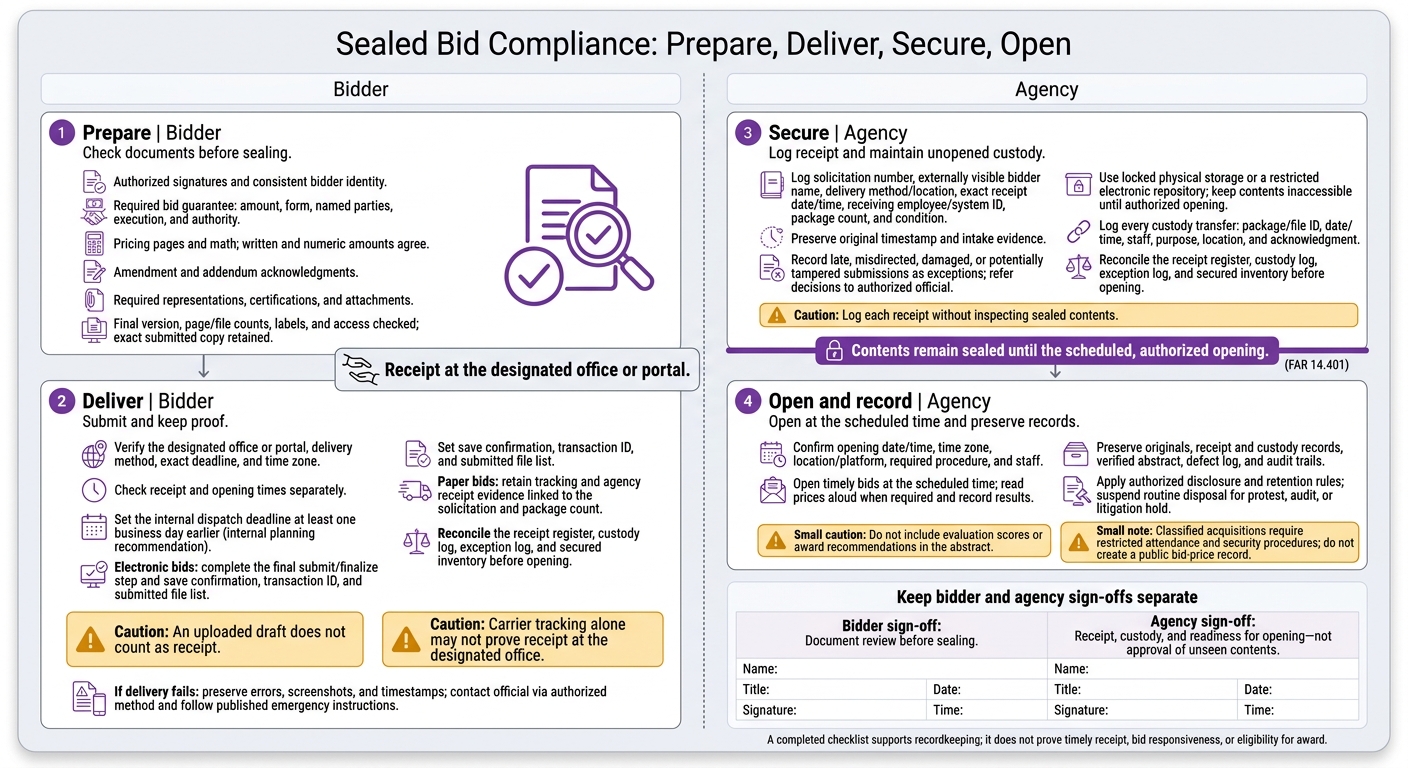
Sealed Bid Compliance: Prepare, Deliver, Secure, Open
Bidder Checklist: Check Documents Before Sealing
Signatures and Bidder Identity
Check the items most likely to affect responsiveness first. Across every bid document, verify the legal business name, address, tax or registration identifiers, solicitation number, entity type, and required signatures, dates, initials, and certifications.
Confirm that the signer has authority to sign. Check whether the solicitation accepts original, electronic, digital, typed, stamped, or facsimile signatures. Do not assume a missing signature can be waived or corrected after opening.
Bid Bond or Other Bid Guarantee
If a guarantee is required, make sure it matches the solicitation exactly.
| Check | Verify before sealing |
|---|---|
| Amount and form | Required percentage or dollar amount, prescribed form, and permitted submission format |
| Named parties | Exact principal and obligee names, solicitation number, and project identification |
| Execution and authority | Required signatures, execution date, surety eligibility, and valid power of attorney |
A missing, late, improperly executed, or materially defective guarantee may affect responsiveness.
Pricing Pages and Math
Match every pricing page to the solicitation. Independently check item numbers, descriptions, and quantities, then recalculate unit prices, extensions, subtotals, grand totals, alternates, options, allowances, discounts, freight, taxes, and delivery costs where required. Use a consistent U.S. currency format.
Example: $125,000.00.
Make sure written and numeric amounts agree. Flag blank cells, unexplained zeroes, conditional prices, minimum-order terms, escalation clauses, and any disallowed qualifications.
Amendment and Addendum Acknowledgments
Create an amendment register with each amendment or addendum number, issue date, affected section, required acknowledgment method, responsible reviewer, and completion status. Check it against the official amendment source.
Update the quantities, specifications, forms, delivery instructions, pricing, clauses, and deadlines affected by each issuance. Follow the acknowledgment requirements exactly. Treat a missing acknowledgment as material when the amendment changes price, quantity, quality, or delivery.
Representations, Certifications, and Attachments
Use an attachment matrix to check that all required representations, certifications, disclosures, licenses, registrations, subcontractor information, insurance evidence, small-business or socioeconomic certifications, and responsibility information are present, current, and consistent with the bid package.
Compare legal names, addresses, UEI/CAGE information, and answers with the technical and pricing volumes. Mark each item as due with the bid, on file, or allowed later. SAM.gov records do not replace solicitation-specific forms or uploads.
Final Version and Document Control
Once the content checks pass, lock the package format and submission set. Compare the final package with the controlling solicitation, remove outdated drafts, and resolve discrepancies before the deadline.
Check the attachment index, cross-references, page counts, legibility, file formats, copy counts, envelope labels, and file access to protect submission integrity. Freeze the final package and retain the exact submitted files and paper copy.
sbb-itb-bb3960c
Delivery Checklist: Submit and Keep Proof
Once the final package is frozen, check the delivery path and keep proof of submission.
Submission Address, Portal, and Deadline
Verify the solicitation number, delivery method, and receiving office or portal. Check the receipt and opening times separately, including the date and time zone. The bid must reach the designated office or portal by the exact deadline. This check confirms delivery only – not whether the bid is responsive.
Confirm the building, room, recipient office, security procedures, and courier restrictions. Set your internal dispatch deadline at least one business day earlier, with more time if needed.
For electronic bids, check account access, upload limits, file formats, naming conventions, and required processing time. Complete the final submit/finalize step. An uploaded draft does not count as receipt.
Delivery Evidence and Submission Copy
For paper bids, keep the tracking number, delivery timestamp, and agency receipt confirmation. Carrier tracking alone may not prove receipt at the designated office. Request an agency time stamp or written receipt linked to the solicitation and package count.
For electronic bids, save the confirmation page, transaction ID, and submitted file list. Save a record of the status showing submitted, not draft. Match each proof item to the final submission by file name and version.
If receipt is unconfirmed or the portal fails, immediately save error messages, screenshots, tracking records, and timestamps. Contact the designated procurement official through the authorized contact method, and follow the published emergency instructions. An attempted delivery is not receipt. Don’t assume a late-bid exception applies.
After submission, the agency’s receipt log and custody controls take over.
Agency Checklist: Log and Secure Unopened Bids
Receipt Log and Delivery Issues
Log each receipt without inspecting sealed contents. Follow the designated intake process and official timekeeping method. Create a sequential register entry for every bid, modification, or withdrawal. Include the solicitation number, externally visible bidder name, delivery method and location, exact receipt date and time, receiving employee or system ID, package count, and condition. Keep the original timestamp and intake evidence – not just a retyped entry.
Log late, misdirected, damaged, improperly marked, or potentially tampered submissions as separate exceptions. Record the facts and preserve evidence of the package’s condition. Intake staff should not decide whether a submission is acceptable. Send exceptions to the contracting officer or designated procurement official.
Secure Storage and Chain of Custody
Move each bid directly into secure custody after intake. Keep physical bids in locked storage and electronic bids in a restricted repository. Contents must remain inaccessible until the authorized opening. Share bidder identities and submission counts only with personnel who need to know.
Log every transfer, including the package or file ID, date and time, releasing and receiving staff, purpose, storage location, and signatures or authenticated acknowledgment.
If external markings and delivery records don’t identify an envelope, open it only when the rules permit and a designated official conducts the identification review. Do not inspect contents. Record the authorization, who opened it, when, why, what was observed, and how it was resealed. If someone opens an envelope accidentally, stop handling it and notify the designated official. Have the person who opened it initial the envelope and add their title, date, and time.
Before opening bids, reconcile the register, custody log, exception log, and secured inventory. Resolve discrepancies or obtain an authorized decision before proceeding. Document the handoff to the opening official, and keep all receipt and custody records in the procurement file.
Opening Checklist: Prepare and Preserve Records
Opening Schedule, Staff, and Bid Abstract
Once custody is reconciled, proceed to the opening event. Confirm the solicitation number, opening date and time, time zone, location or approved platform, and required procedure. Check whether the rules require a public opening, bidder attendance, price reading, or abstract posting.
Identify the opening officer, recorder, witnesses, technical or portal support staff, and permitted attendees. For an unclassified federal sealed-bid opening, the officer opens timely bids at the scheduled time, reads prices aloud when required, and ensures the results are recorded.
Prepare the abstract with bidder legal names, required line-item prices, alternates, discounts, and stated exceptions. Include the opening details, recorder identification, officer verification, and a bid count reconciled to the receipt log. Do not include evaluation scores or award recommendations. Classified acquisitions require restricted attendance and security procedures; do not create a public bid-price record.
After opening, record any irregularities in the defect log.
Defect Log and Review Decisions
Record observed issues after opening, but leave responsiveness and correction decisions to the authorized official. Keep agency findings separate from bidder pre-submission checks. In the log below, replace each provision description with the exact solicitation citation.
An omission is not automatically correctable. Decisions about materiality, responsiveness, responsibility, and corrections must follow the applicable review process.
| Item | Observed defect | Solicitation provision | Review status | Required action | Approving official |
|---|---|---|---|---|---|
| Signature | Unsigned signature page | Signature requirement | Pending | Responsiveness review; no informal correction without authority | Contracting officer |
| Bid guarantee | Required guarantee not located | Bid guarantee requirement | Pending | Submission preservation and responsiveness review | Contracting officer |
| Amendment | Missing amendment acknowledgment | Applicable amendment acknowledgment requirement | Pending | Complete-submission and amendment-record comparison | Contracting officer |
| Pricing | Conflicting cover-page and schedule amounts | Pricing instructions | Pending | Original-bid reconciliation and formal review | Contracting officer |
Original Bids and Opening Records
Keep originals secured until the abstract is verified. After verification, maintain controlled custody without unrestricted handling. Preserve the receipt log, custody-transfer record, attendance sheet, verified abstract, opening certification, defect log, portal audit trail, permitted recordings, and irregularity correspondence.
For disputed timestamps, damage, suspected tampering, or interruptions, create an incident entry. Identify the affected bid or package, observed condition, date and time with time zone, witnesses, evidence, and action taken. Preserve the packaging and relevant system records.
Apply authorized disclosure and retention rules. Keep public-release copies separate from restricted originals, and suspend routine disposal when a protest, audit, investigation, or litigation hold applies.
Conclusion: Keep Bidder and Agency Sign-Offs Separate
Agency receipt is not bid approval. Bidder sign-off covers the review before sealing. Agency sign-off covers receipt, custody, and readiness for opening – not whether unseen contents are complete, responsive, correctly priced, or compliant.
Use this final record to reconcile bidder preparation, delivery proof, and agency custody before opening.
One-Page Readiness Record
Record the solicitation number, bidder name, submission deadline, opening date and time with time zone, version ID, record owner, reviewer, receipt evidence reference, receipt timestamp, and saved submission location. Keep the two sign-offs separate until opening.
Bidder Document Review
- [ ] Authorized signatures and bidder identity verified.
- [ ] Bid guarantee, pricing, addenda, certifications, and attachments checked against the solicitation.
- [ ] Page/file count verified, drafts removed, and exact submitted copy retained.
Agency Receipt, Custody, and Readiness for Opening
- [ ] Receipt time, location, package condition, and delivery evidence logged.
- [ ] Unopened custody and custodian documented.
- [ ] Opening schedule, staff, and required records ready.
Give each group separate sign-off fields for name, title, signature, date, and time. Add one exception field covering the issue, affected requirement, decision-maker, escalation action, and decision timestamp. Internal sign-off does not waive solicitation requirements.
FAQs
Can I replace my sealed bid before opening?
Whether you can replace a sealed bid before opening depends on the solicitation’s rules. Check the Instructions to Offerors or the equivalent section for submission and modification procedures.
If changes are allowed, follow the stated process. You may need to formally withdraw your bid and submit a new one, or amend your existing submission. Confirm the steps early, and make sure any replacement meets all original deadlines and formatting requirements.
What makes a bid defect material?
A bid defect is material when the bid fails to meet the solicitation’s mandatory requirements, making it nonresponsive. These requirements follow a strict pass/fail standard. A missing document, signature, certification, or amendment acknowledgment can mean immediate disqualification.
Narwin.ai helps reduce these risks with AI gap detection, flagging missing certifications or unanswered mandatory questions early in the drafting process.
What if the agency opens my bid early?
Early opening usually happens when someone doesn’t follow the solicitation’s delivery or administrative rules. Mishandled files or the wrong submission method can lead to disqualification or improper handling before the official review.
To reduce this risk, use the agency’s required portal or submission method and follow every file naming and formatting instruction. Aim to submit at least 24 hours before the closing deadline.