
Securing government contracts can transform small architecture and construction firms by providing steady work and long-term opportunities. The U.S. government spends over $600 billion annually, with $132 billion allocated to federal facilities and construction in FY 2024. Small businesses benefit from contracts reserved exclusively for them, especially those valued between $10,000 and $250,000. However, navigating this space requires precision, compliance, and strategy.
Key Steps to Win Government Contracts:
- Register on SAM.gov: Obtain a Unique Entity ID (UEI), ensure your business details are accurate, and list relevant NAICS codes (e.g., 541310 for Architects, 236220 for Construction).
- Apply for Certifications: Gain access to set-aside contracts by qualifying for programs like 8(a), HUBZone, WOSB, or SDVOSB.
- Use AI Tools for Opportunities: Platforms like Narwin.ai help identify relevant contracts, analyze RFPs, and assess your chances of winning.
- Evaluate RFPs Carefully: Focus on opportunities that align with your expertise and resources. Avoid contracts with high risks or misaligned requirements.
- Write Compliant Proposals: Leverage AI to draft, refine, and ensure your proposals meet all requirements.
- Build a Strong Track Record: Start with subcontracting or smaller set-aside contracts to establish your past performance, a critical factor in federal evaluations.
With the right tools and approach, small firms can tap into billions of dollars in federal contracts, turning challenges into opportunities for growth.
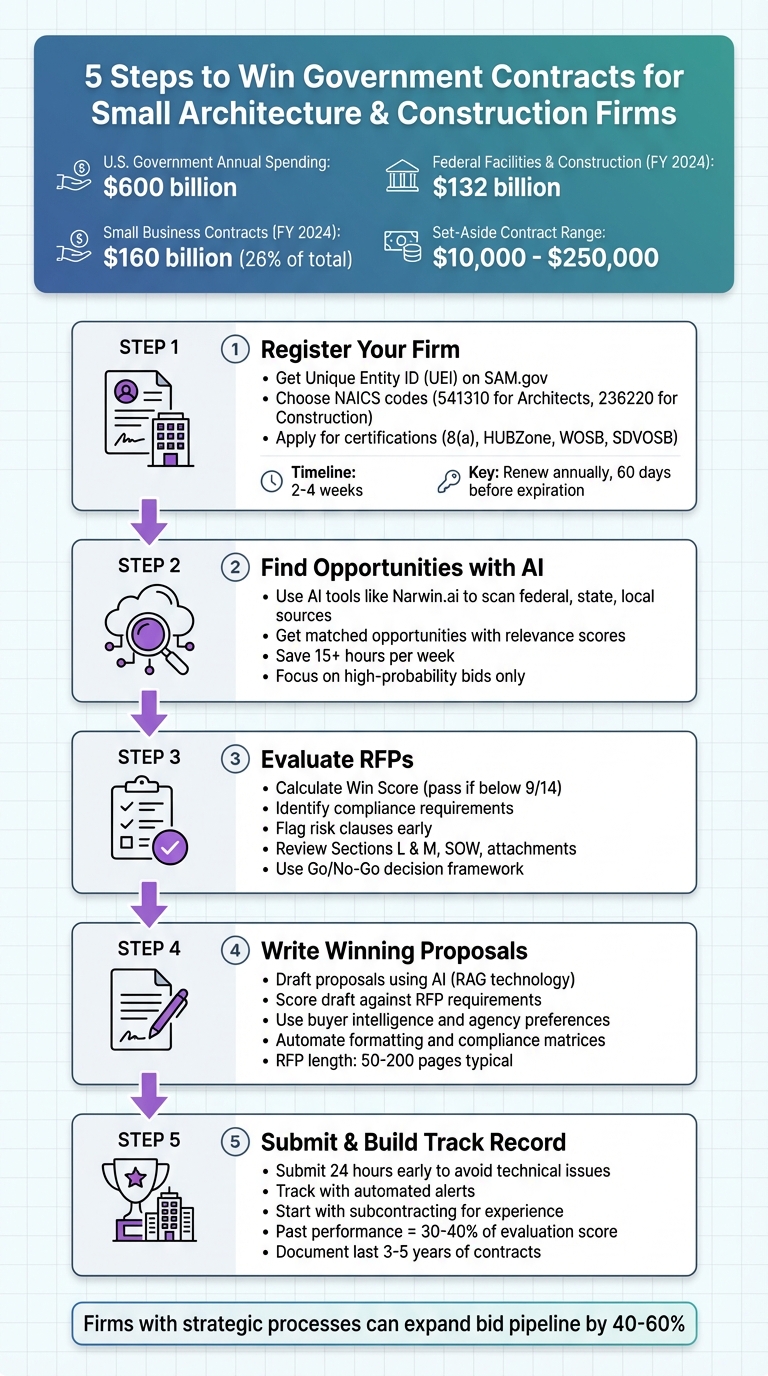
5-Step Process for Small Firms to Win Government Contracts
Step 1: Register Your Firm for Government Contracting
Getting your firm properly registered is the first step toward bidding on government contracts. Even small discrepancies – like how your business name is written – can cause issues, so accuracy is key.
Get Your Unique Entity ID (UEI) and Register on SAM.gov
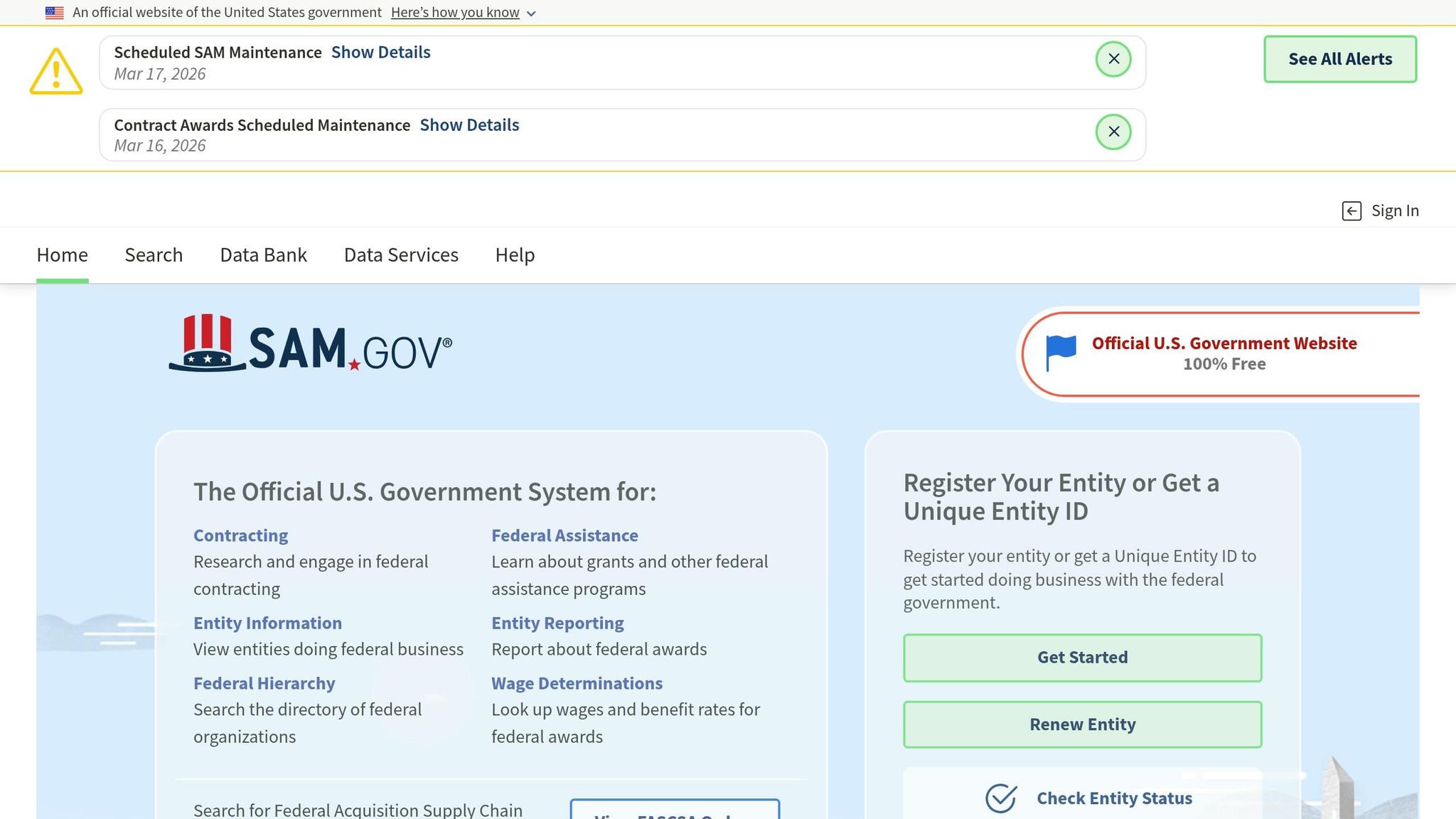
The Unique Entity ID (UEI) is a 12-character alphanumeric code that replaced the DUNS number in April 2022. It acts as your firm’s primary identifier for federal government transactions. You’ll get this code automatically when you register on SAM.gov, and the process is completely free – don’t pay third-party services to do it for you.
Here’s what you’ll need to register:
- A Login.gov account with your business email and multi-factor authentication (MFA)
- Your IRS CP-575 or 147C letter, ensuring your legal business name matches IRS records exactly
- Your Employer Identification Number (EIN)
- A physical business address (P.O. Boxes aren’t allowed)
- Bank account details for Electronic Funds Transfer payments
- A Notarized Entity Administrator Appointment Letter (EAAL), which can usually be notarized locally for $5–$15
When choosing industry codes, focus on those that best represent your expertise. For example, 541310 applies to Architectural Services, and 236220 is for Commercial and Institutional Building Construction. Listing 3–5 primary codes is ideal – too many can make your firm seem unfocused to contracting officers.
After registration, you’ll be assigned a CAGE code (Commercial and Government Entity code) automatically by the Defense Logistics Agency. While SAM.gov estimates the process takes 7–10 business days, it’s safer to plan for 2–4 weeks, as IRS TIN validation and notarized letter processing can add time.
| Registration Phase | Estimated Time | Key Requirement |
|---|---|---|
| Login.gov & UEI Assignment | Same Day | Business Email & Physical Address |
| IRS TIN Validation | 3–7 Business Days | EIN matching CP-575/147C |
| Entity Validation (EAAL) | 7–14 Business Days | Notarized Appointment Letter |
| CAGE Code Assignment | 5–10 Business Days | Automated via DLA |
| Total Timeline | 2–4 Weeks | Active Status |
Don’t forget: SAM.gov registrations must be renewed annually. Set a reminder to renew at least 60 days before it expires to avoid interruptions in bidding or payments.
Apply for Small Business Set-Aside Certifications
Once your SAM.gov registration is active, you can apply for small business set-aside certifications, which open up exclusive opportunities. In FY 2024, small businesses were awarded nearly $160 billion in federal contracts – over 26% of total spending. Under the “Rule of Two” (FAR 19.502-2), contracts are set aside for small businesses if at least two qualified firms are expected to bid.
The main certifications include:
- 8(a) Business Development: For firms 51% owned by socially and economically disadvantaged individuals, with a nine-year program limit.
- HUBZone: For businesses in Historically Underutilized Business Zones that employ at least 35% of staff from the area, often with a 10% price evaluation preference.
- Women-Owned Small Business (WOSB/EDWOSB): For businesses 51% owned by women.
- Service-Disabled Veteran-Owned Small Business (SDVOSB): For firms 51% owned by service-disabled veterans.
These certifications require formal approval from the SBA – self-certification is no longer an option. The process takes 90–120 days, and while it’s free, you’ll need to prepare financial statements and ownership documents. Construction firms should also note that they must perform at least 15% of the work for general construction or 25% for specialty trades to qualify for set-aside contracts.
Check Federal Size Standards for Your Firm
Not all firms qualify as “small” under federal rules. The SBA determines size standards based on your primary NAICS code, using either average annual receipts over five years or average employee count over the past 24 months. For example:
- Architecture firms (NAICS 541310): $16.5 million in average annual receipts
- Construction firms (NAICS 236220): $45 million in average annual receipts
Use the SBA size standards tool on sba.gov to confirm your eligibility. Be aware that affiliation rules apply, meaning you must include revenue or employee counts from any affiliated businesses under shared management or control. If your numbers are close to the threshold, you may need to recertify your size status every five years for long-term contracts or within 30 days of a merger or acquisition.
Completing your SAM.gov profile also makes your business visible in the Small Business Search (SBS) database, which contracting officers use to find qualified small firms. A complete and accurate profile can greatly improve your chances of being noticed for federal procurement opportunities.
sbb-itb-bb3960c
Step 2: Find Contract Opportunities Using AI Tools
Once you’re registered, the next step is to identify the right contracts. With thousands of opportunities posted daily on SAM.gov, manually sifting through them is far from practical. That’s where AI tools like Narwin.ai come in. These tools simplify the process by scanning federal, state, and local sources to pinpoint contracts that align with your company’s capabilities.
Use AI-Powered Bid Search
Searching on SAM.gov often requires precise NAICS codes or keywords, which can result in missed opportunities due to varying terminology. Narwin.ai solves this issue with its AI-driven search powered by Natural Language Processing (NLP). This allows you to use plain language queries like “small construction projects in Florida under $500,000” to find matches – even if those exact terms aren’t in the RFP.
The platform also analyzes lengthy documents to uncover hidden opportunities. For instance, if a 2,000-page RFP for general construction includes a requirement for LEED-certified solar installation, the AI flags this as a subcontracting opportunity for firms with that expertise. Anil Gupta, owner of The Shelter Construction, shared how Narwin.ai helped his firm avoid costly mistakes: “bidding blunders” that could have cost 2,000 times the price of the software subscription were identified through the tool’s AI analysis of risk clauses in large-scale bridge construction tenders.
By using AI tools, your business can focus on opportunities that match its strengths, making the process of securing government contracts more efficient and effective.
Get Opportunities Matched to Your Business Profile
Narwin.ai functions like a virtual assistant, reviewing thousands of bids daily and delivering tailored alerts straight to your inbox. The platform builds a detailed profile of your business using information like NAICS codes, certifications, geographic preferences, past performance, and specific capabilities. It then matches new opportunities to your profile, assigning a match score (e.g., 92%) and explaining why the opportunity is relevant – whether due to NAICS alignment, keyword matches, or eligibility for set-asides.
Carter Hawthorniwaite, Director of Operations at App Growth Network, highlighted the benefits: Narwin.ai saved his team over 15 hours each week and helped generate more than $25,000 by focusing only on high-probability opportunities.
“Narwin gives you a dashboard of opportunities ranked in order of relevance… This list is not just a typical keyword search list, it’s a curated list created after a deep understanding of your company’s capabilities.”
– Narwin.ai
The more detailed your company’s profile – such as including secondary NAICS codes, specific equipment details, and past performance summaries – the better the AI can match you with relevant contracts. This eliminates irrelevant options, allowing your team to focus on bids where you have a genuine edge.
Step 3: Evaluate and Analyze RFPs Before Bidding
Deciding which opportunities are worth your time and resources can be tricky. In government contracting, the goal is to reassure the buyer that you can deliver without issues. Agencies want to avoid risks like poor performance or delays, so they tend to favor firms that demonstrate reliability. A systematic evaluation process helps you filter opportunities and focus your efforts on the ones that align with your strengths.
Quickly Determine Bid Viability
Before committing to a detailed review of an RFP, you need a quick way to gauge whether it’s worth pursuing. That’s where Narwin.ai steps in. This platform calculates a Win Score by analyzing RFP requirements against your firm’s capabilities, past performance, and certifications. It provides an objective match score and explains its relevance – whether it’s based on NAICS alignment, keyword matches, or eligibility for set-asides.
Narwin.ai evaluates opportunities using factors like past performance, staff readiness, scope fit, customer familiarity, time to prepare the bid, pricing flexibility, and competitor strength. If your Win Score falls below 9 out of 14, it’s a clear signal to pass on that opportunity.
“If you bid on everything, you lose time, money, and energy. You need a fast ‘Go or No-Go’ call.” – Tiatun T., Federal Sales Consultant, GovBidLab
Once you’ve identified a viable opportunity, the next step is to assess potential risks that could impact your ability to deliver.
Identify Risks and Compliance Requirements
Spotting deal-breaking risks and compliance issues early on is crucial. Narwin.ai makes this easier by identifying key compliance requirements, risk clauses, and evaluation criteria in RFPs. The platform benchmarks over 10 metrics to ensure you don’t miss critical details that could lead to disqualification.
Narwin.ai highlights high-risk elements such as liquidated damages, performance bonds, or unusual insurance requirements, giving you a clear view of how these factors could affect profitability. It also flags gaps in your compliance profile – like missing certifications, weak areas in past performance, or staff shortages – so you can address them before submitting your proposal.
“Our biggest issue is identification of risk clauses and quick Narwin reports have helped us identify and fix bidding blunders worth 2000 times what we paid for Narwin.” – Anil Gupta, Owner, The Shelter Construction
Start by reviewing Sections L and M of the RFP to understand the requirements and evaluation criteria. Then examine the Statement of Work (SOW) and any attachments. This approach helps you identify red flags early, saving you from investing time in proposals that don’t align with your firm’s capabilities.
Step 4: Write Winning Proposals with AI
Once you’ve assessed risks and chosen the best opportunities, the next step is crafting a proposal that stands out. Government RFPs for architecture and construction projects can be daunting, often stretching 50 to 200 pages and packed with technical details. Missing even a single requirement could mean automatic disqualification. Here’s how AI can simplify this process and help you deliver a winning proposal.
Draft Proposals Using AI
Narwin.ai takes the headache out of proposal writing by automating key steps. It extracts requirements, questions, and deadlines directly from extensive RFP documents, saving you hours of manual work. Using Retrieval-Augmented Generation (RAG), the platform pulls relevant content from your firm’s previous successful proposals, certifications, and case studies to create a solid first draft that reflects your brand and expertise.
The platform goes a step further by scoring your draft against the original RFP, pinpointing any compliance gaps before submission. It also handles repetitive tasks like formatting, creating compliance matrices, and inserting boilerplate content. This frees you up to focus on showcasing your firm’s strengths and unique value. The result? A consistent, professional proposal crafted in a fraction of the time.
Once the draft is ready, you can refine it further using insights into the buyer’s preferences.
Use Buyer and Agency Intelligence
Knowing what agencies prioritize can give your proposal an edge. Narwin.ai provides this advantage by analyzing historical award data, buyer behavior, and agency-specific preferences. For instance, the Innovation Leadership Office at Yolo County DA in California used Narwin.ai to review their draft RFP. By asking the AI specific questions about clarity, they received actionable feedback, allowing them to make adjustments and avoid potential confusion during the evaluation process.
This kind of intelligence enables you to tailor your proposal to align with what the agency values most. Instead of submitting generic responses, you can craft a proposal that speaks directly to the buyer’s intent and aligns with their past procurement trends. The platform also identifies high-risk clauses and compliance requirements unique to each agency, ensuring your proposal checks every box. By combining AI-generated drafts with buyer insights, you’re not just meeting requirements – you’re positioning your proposal to win.
Step 5: Submit Proposals and Build Your Track Record
Getting your proposals in on time and creating a solid track record are critical steps for long-term success in government contracting.
Submit and Track Your Proposals
Missing a submission deadline? That’s an automatic rejection. To avoid this, upload your final proposal at least 24 hours early to safeguard against technical hiccups on SAM.gov or agency-specific portals. Once submitted, keep your SAM.gov confirmation receipt handy – this serves as proof of timely submission.
To stay on top of things, set up automated alerts through tools like SAM.gov or Narwin.ai. These alerts will notify you of updates or amendments to your proposals, as even a minor missed acknowledgment can disqualify your bid. Narwin.ai’s “Journey Hub” is particularly useful, offering a centralized space to upload documents, track conversations with contracting officers, and jot down notes for each bid.
“The platform’s ability to provide reminders and updates on contracts I’m interested in is a huge time-saver. It allows me to focus on other aspects of my business without missing out on opportunities.” – Bobby Hughes, Business Owner, BH Consulting LLC
Once your proposal is in, shift your focus to building a strong performance history.
Build Your Firm’s Past Performance Record
After submitting proposals, the next step is to establish a solid past performance record. This is a big deal – past performance often makes up 30–40% of your evaluation score on federal bids. If you’re a small architecture or construction firm without much federal experience, subcontracting is a smart way to start. Platforms like SBA’s SubNet or GSA directories can connect you with prime contractors who need niche expertise. Even smaller roles in subcontracting can provide the government-specific references you’ll need to win larger contracts down the road.
Target set-aside opportunities like WOSB, SDVOSB, HUBZone, or 8(a) programs. These are tailored for small businesses, often have fewer competitors, and feature smaller contract sizes – perfect for quickly building your portfolio. Instead of spreading yourself too thin, focus on delivering standout results on a handful of “anchor” projects. Under FAR 36.604, ensure completed projects are documented for CPARS reviews. Right after winning a contract, schedule a meeting with the Contracting Officer’s Representative (COR) within 1–2 weeks to clarify what “Exceptional” performance means for that specific project.
Keep a detailed one-page summary for each project, including the contract number, performance period, dollar value, measurable outcomes, and CPARS rating. Federal agencies typically look at the last 3–5 years of contract history, so staying organized now will save you from scrambling later. And if you lose a bid? Ask for a post-award debrief to understand what you can improve next time.
Conclusion: How Small Firms Can Win Government Contracts
Securing government contracts as a small architecture or construction firm requires a clear, step-by-step strategy. Start by completing an accurate SAM.gov registration using your UEI and relevant NAICS codes – this alone can expand your bid pipeline by 40–60%. From there, tools like Narwin.ai can save time by automating the process of discovering new opportunities.
Once your registration and bid discovery are in place, focus on pursuing only the most relevant opportunities. The key is to be selective – don’t waste resources bidding on every contract. Use a go/no-go scoring system to target projects where your firm’s technical expertise and past performance align well with the requirements. Building a strong track record, whether through subcontracting or set-aside programs, lays the groundwork for sustained success.
Narwin.ai adds another layer of efficiency by analyzing lengthy RFP documents in minutes, pinpointing compliance requirements, flagging potential risks, and even drafting customized proposals. This tech-driven approach allows smaller teams to compete effectively on both quality and compliance. With $132 billion in federal facilities and construction contracts awarded in FY2024, there’s a wealth of opportunity – but capturing it requires the right strategy.
Always submit bids well before deadlines and request debriefs after any losses. Every bid is an opportunity to learn and improve. Firms that succeed consistently treat government contracting as a repeatable process, not a one-time effort.
FAQs
What can I do if my SAM.gov registration gets stuck in validation?
If your SAM.gov registration seems stuck in the validation process, start by ensuring that your business details – like your legal name, physical address, and EIN (Employer Identification Number) – match exactly with the records on file with the IRS. Even small mismatches can cause delays.
Use a business email address when setting up your Login.gov account, and carefully review all required fields to make sure nothing is missing or incorrect. While validation usually takes around 2 to 4 weeks, delays often clear up once the system successfully verifies your information. Take the time to double-check for any discrepancies and allow for processing time. Sometimes, a little patience goes a long way.
How do I choose the best NAICS codes without hurting my chances with contracting officers?
To pick the right NAICS codes, make sure they truly represent what your business does and align with the projects you’re targeting. Focus on codes that match your main services or products, and steer clear of ones that are too broad or unrelated – those can hurt your credibility. It’s also a good idea to regularly check and update your NAICS codes in SAM.gov. This keeps your details accurate and helps contracting officers view your business as a strong match for potential opportunities.
What should I include in my past performance if I’ve never done a federal project?
If you don’t have experience with federal projects, you can still prove your reliability and expertise in other ways. Highlight similar non-government projects you’ve completed, emphasize your technical skills, and showcase your quality management processes. Don’t forget to underline your team’s qualifications and any certifications they hold.
You can also strengthen your position by partnering with well-established firms or making the most of your existing resources. The key is to show that you can meet contract requirements through solid evidence and strategic partnerships.