

Manual tender reviews waste time and lead to missed opportunities. AI-powered tools can reduce document reading time by 90%, save over 10 hours per week, and improve bid success rates from 18–25% to 35–45%. These tools automate tedious tasks like requirement extraction, risk analysis, and bid/no-bid decisions, allowing teams to focus on winning bids rather than paperwork.
Here’s a quick overview of the tools covered:
- Narwin.ai: Tailors opportunities to your strengths, generates 10-minute qualification reports, and integrates with Slack, Notion, Google Drive, major ERPs and CRMs.
- Bid Ops: Uses machine learning to predict win likelihood and streamline bid/no-bid decisions.
- OpenGov Procurement: Speeds up tender drafting with AI Scope Assistant and reduces development time by 75%.
- ProcureNow: Summarizes procurement documents and centralizes tender management in a dashboard.
- Procore Tender Management: Connects tendering with project management tools for seamless workflows.
Quick Comparison:
| Tool | Key Features | Integration Options | Ideal For |
|---|---|---|---|
| Narwin.ai | Smart AI matching, quick qualification reports, requirement analysis | Slack, Notion, Google Workspace, CRM | Govt. Contractors, Architecture, IT, Construction, professional services |
| Bid Ops | Win probability scores, historical performance analysis | Salesforce, Slack, Microsoft Teams | Contractors, procurement teams |
| OpenGov Procurement | AI Scope Assistant, scope-to-solicitation automation | Shared calendars, email reminders | Government procurement |
| ProcureNow | Document summarization, centralized dashboard | Salesforce, ZOHO, Pipedrive | Contractors |
| Procore | Tender leveling, vendor project history, financial integration | ERP, accounting, project management | Construction projects |
AI tools not only save time but also improve accuracy, helping businesses pursue more tenders with better results. Choose a tool that aligns with your workflow and test it on a challenging RFP to ensure it meets your needs.
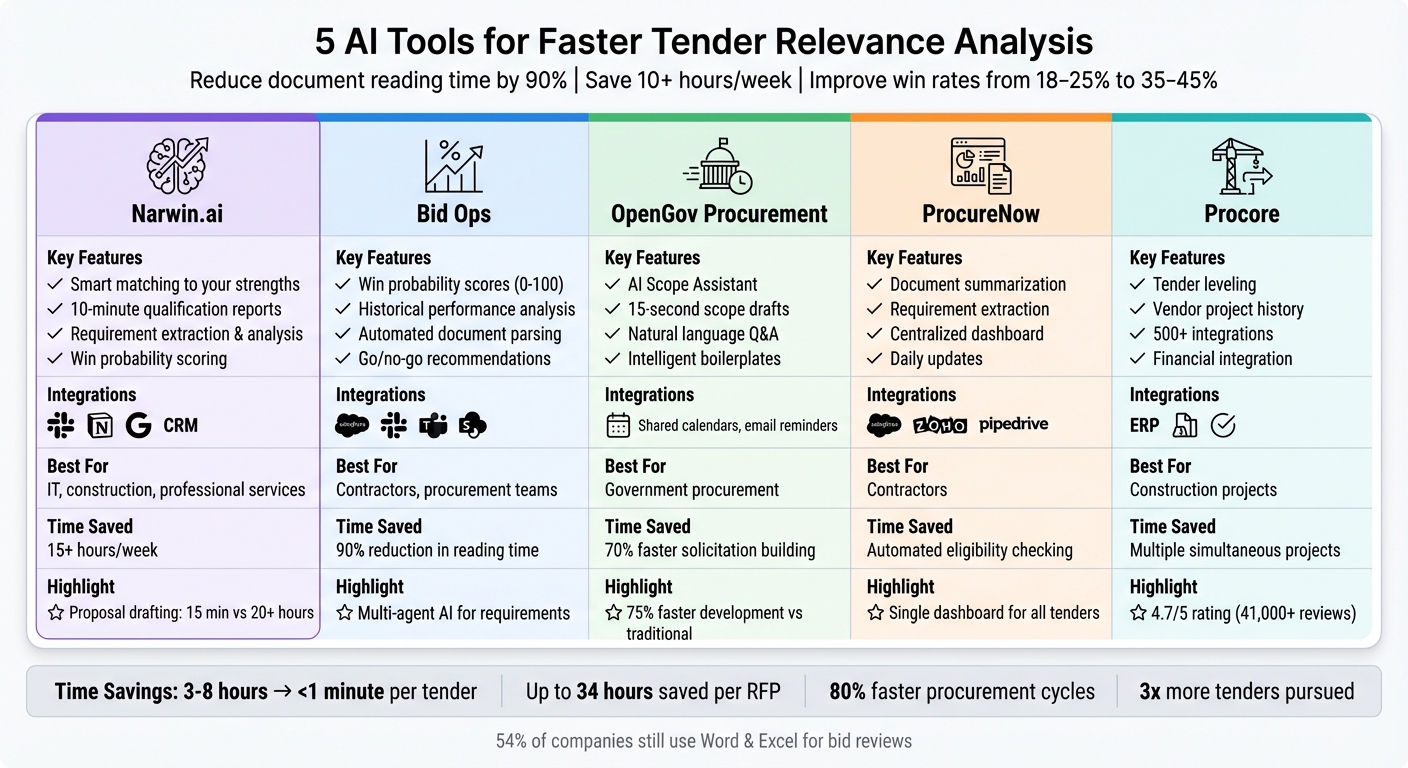
AI Tender Analysis Tools Comparison: Features, Integrations & Best Use Cases
1. Narwin.ai

AI-driven tender discovery
Narwin.ai simplifies the hunt for public procurement opportunities by scanning sources like Sam.gov and CanadaBuys. Its AI digs through documents as lengthy as 2,000 pages, uncovering sub-contract opportunities and niche requirements that are easy to overlook – such as LEED certifications for sustainability projects.
What sets Narwin apart is its smart matching engine. It factors in your previous wins, certifications, geographic focus, and industry expertise to deliver opportunities that fit your business. Instead of wasting time sifting through irrelevant postings, you get a curated list tailored to your strengths. For example, in 2024, Carter Hawthorniwaite, Director of Operations at App Growth Network in Vancouver, saved over 15 hours of manual work using Narwin. His team focused on high-potential opportunities, generating more than $25,000 in revenue. They even earned a referral fee by passing along a low-fit tender to a competitor – an opportunity they spotted early thanks to Narwin’s precision.
Bid/no-bid decision-making
Narwin speeds up the decision-making process with qualification reports generated in just 10 minutes. These reports analyze fit, risk, competition, and buyer intent using over 10 key metrics. You’ll also receive a win probability score that evaluates your compliance, past performance, and how well you meet the RFP’s requirements.
Anil Gupta leveraged these quick reports to identify hidden risk clauses buried in lengthy documents, helping him avoid costly errors. In fact, the savings were estimated at 2,000 times the cost of the software subscription – proof of how effective this feature can be.
Requirement extraction and analysis
Narwin excels at breaking down RFP documents, pulling out critical requirements, compliance factors, deliverables, and deadlines. It then compares these requirements against your capabilities, flagging any gaps – like missing certifications or weak compliance areas – before you commit to a proposal. This level of analysis is a game-changer for industries like IT consulting, construction, and professional services, where even a minor oversight can disqualify an otherwise strong bid.
Integration with existing workflows
Narwin integrates seamlessly with tools like Slack, Notion, and Google Workspace, keeping your current communication channels intact. It also supports CRM and document repository integrations via API. By using your past RFPs, internal documents, and website content to train its AI models, Narwin ensures that its drafts align with your brand voice and compliance standards. Importantly, your data stays secure – it’s not used for public model training. This thoughtful design makes Narwin.ai a standout in the world of RFP automation.
2. Bid Ops
AI-driven tender discovery
Bid Ops leverages advanced keyword tracking and CPV codes to scan procurement platforms, identifying opportunities even when titles are unclear. Its machine learning engine evaluates historical bid data, agency preferences, and past performance to assign a win probability score between 0 and 100. The platform also automates document parsing, pulling out critical details efficiently.
This process sets the stage for a more efficient and informed bid/no-bid evaluation.
Bid/no-bid decision-making
With Bid Ops, you can compare your historical performance against the requirements of new tenders. The platform offers a structured framework for making go/no-go decisions, moving away from time-consuming manual reviews. By analyzing past results to predict win likelihood, Bid Ops helps contractors focus their efforts on opportunities with higher success potential, saving time and resources.
Integration with existing workflows
To ensure smooth adoption, Bid Ops integrates effortlessly with tools you already use. It works with platforms like Salesforce, Slack, Microsoft Teams, and SharePoint, making tender alerts and team collaboration a natural part of your workflow. This means less disruption and more productivity.
3. OpenGov Procurement
AI-driven tender discovery
OpenGov Procurement employs its AI Scope Assistant to speed up the process of finding and drafting tenders, producing scope-of-work drafts in less than 15 seconds. By utilizing a Government Scope Library, which includes scopes from hundreds of agencies, the platform significantly reduces the time needed to build solicitations – by 70%. This AI-powered approach also makes the development process up to 75% faster compared to traditional methods. This efficiency ensures a smoother start to requirement extraction.
Requirement extraction and analysis
The platform uses natural language generation to quickly analyze project descriptions and draft essential sections of the scope of work. With intelligent boilerplates, users respond to policy-related prompts, and the system automatically generates bid instructions, insurance requirements, and pricing structures. This logic-based automation eliminates uncertainty and provides uniformity across all tender documents. After analyzing the details, the tool seamlessly integrates its findings into your existing workflows.
Integration with existing workflows
OpenGov Procurement connects directly to your drafting and approval processes through scope-to-solicitation automation, which transfers scope data into solicitations automatically. A centralized intake module allows stakeholders to collaborate on requirements and review past scopes before finalizing a solicitation. Features like shared calendars and automatic email reminders ensure teams stay aligned, reduce delays, and eliminate the need to switch between multiple tools. This streamlined process helps maintain efficiency and consistency in tender management.
4. ProcureNow
ProcureNow takes things a step further by not just summarizing procurement documents but also focusing on extracting key data and managing tenders in one unified platform.
Automated Document Summarization
With AI-powered summarization, ProcureNow turns lengthy procurement documents into short, clear overviews. This makes it easier for contractors to quickly grasp the critical details needed to evaluate potential opportunities. Beyond summaries, it pinpoints specific assessment criteria, giving contractors a sharper focus on what matters.
Requirement Extraction and Analysis
ProcureNow identifies essential requirements, such as technical skills or software expertise, and simplifies the process of checking eligibility. This helps contractors determine how well they match project needs without wasting time.
Centralized Opportunity Dashboard
The platform also offers a single, centralized dashboard where all tenders can be managed at a glance. This keeps teams organized and ensures they stay focused on the opportunities that best fit their goals.
5. Procore Tender Management
Procore weaves tender management directly into its broader construction project management platform. Instead of functioning as an isolated tool, it connects tendering with drawings, specifications, and financial systems, creating a centralized “single source of truth” for managing multiple projects efficiently.
AI-Driven Tender Discovery
Procore simplifies finding and qualifying subcontractors and suppliers by centralizing directories. With the Procore Construction Network, contractors in the U.S. and Canada can search for trade partners based on office location, city, or region, ensuring broader tender coverage. Automated notifications encourage higher response rates, providing more bid options. Plus, with over 500 integrations available – including accounting, ERP, and project management tools – Procore fits seamlessly into existing workflows, making the discovery and evaluation process much smoother.
Bid/No-Bid Decision-Making
Procore’s tender leveling feature allows for side-by-side comparisons of bids by cost code, making it easy to spot gaps, outliers, or discrepancies in scope. A recent update (October 2025) added vendor project history data to the leveling tab, giving users insights into a bidder’s past performance and financial history before awarding contracts. Paul Zasitko of The Concosts Group shared his perspective on Procore’s efficiency:
“The way the tendering tool connects directly to drawings and documents makes that process so much more efficient. It’s a very strong tool that has saved us a lot of time and has allowed us to run multiple projects at the same time.”
Integration with Existing Workflows
Procore’s seamless workflow integrations keep tender management both fast and accurate. Once a bid is awarded, it can be converted into a subcontract or purchase order with a single click. Standardized templates ensure data flows directly into Procore Financials, eliminating the need for manual entry. With a 4.7/5 rating from over 41,000 reviews, users frequently highlight how its direct connection to project documents saves time and ensures data consistency throughout the project lifecycle.
Feature Comparison
When choosing tender analysis tools, differences in AI features, speed, and integration options can significantly influence how efficiently your team makes bid decisions. Here’s a quick breakdown of the strengths each tool offers:
Narwin.ai takes a comprehensive AI approach, handling requirement extraction, buyer analysis, and scoring bids based on fit, profitability, and risk. It integrates seamlessly with Slack and Notion, reducing proposal drafting time to just 15 minutes compared to the usual 20+ hours.
Bid Ops employs multi-agent AI to identify key requirements and deliver clear go/no-go recommendations. Users report cutting document reading time by up to 90%. The platform supports common file formats like Word, Excel, PDF, and PowerPoint, making it versatile for document processing.
OpenGov Procurement stands out with its natural language Q&A feature, enabling users to ask questions about deadlines, budgets, and requirements in plain English. It also provides clickable source citations, making it easy to verify tender details.
ProcureNow specializes in automated specification analysis, highlighting award criteria, references, and risks. It updates daily and matches tenders to search profiles automatically. The tool integrates with popular CRM systems like Salesforce, ZOHO, and Pipedrive, ensuring smooth workflow continuity.
Organizations leveraging AI in procurement have reported up to 80% faster cycle times and a threefold increase in the number of tenders pursued. The key is finding a tool that aligns with your team’s size, technical needs, and existing software setup.
Conclusion
AI-powered tools have reshaped the way contractors approach tender evaluations. Tasks that used to take anywhere from 3 to 8 hours now wrap up in less than a minute. Teams that once spent days extracting requirements can now complete that process before their kickoff meetings even begin. This efficiency slashes review and decision-making times, saving companies up to 34 hours per RFP.
But it’s not just about speed – accuracy has taken a major leap forward too. AI ensures every requirement is accounted for, spotting constraints and red flags that manual reviews often overlook in lengthy documents. The results speak for themselves: companies using these tools have seen win rates climb from 18–25% to 35–45% in just six months. Why? Because they can tackle more opportunities while delivering stronger, more polished responses.
“What used to take us four hours of screening, we now do in one. That extra time goes into creating better plans and sharper arguments.” – William Bakker, Tender Coordinator, Salverda Bouw
To make the most of these advances, choosing the right proposal management tools is critical. Start by identifying your biggest bottleneck – whether it’s understanding complex documents or generating proposals – and look for a solution that excels in analysis, requirement extraction, and seamless integration with tools like your CRM, SharePoint, or project management software. During your trial phase, test the AI on a particularly challenging past RFP to ensure it captures every requirement accurately.
The best tools don’t just analyze – they integrate smoothly into your existing workflow. Features like clickable source citations for AI-generated answers can make all the difference, especially when transitioning from manual processes to how AI is transforming the RFP process. With 54% of companies still relying on basic tools like Word and Excel for bid reviews, adopting a fully integrated solution can directly translate into a competitive edge.
FAQs
How can AI-powered tools help improve success rates in tender analysis?
AI-powered tools are transforming how businesses approach tender analysis by streamlining the review process. These tools can quickly scan tender documents, pinpoint key requirements, and flag potential risks. This means teams can evaluate opportunities faster and prioritize bids that are more likely to succeed.
One standout feature is their ability to deliver instant Go/No-Go recommendations, allowing businesses to focus their efforts on tenders that align with their goals. Beyond that, these tools help in creating more customized and competitive proposals, boosting the chances of securing contracts.
What tools does Narwin.ai integrate with to simplify workflows?
Narwin.ai works hand-in-hand with Google Drive and Slack, simplifying how you handle workflows and collaborate with your team. These integrations make it easier to share documents, communicate effectively, and coordinate projects, creating a more efficient bidding process.
How do AI tools help speed up and improve tender evaluations?
AI tools simplify the tender evaluation process by automating the review of complex documents. This not only saves time but also helps minimize errors. These tools can swiftly pinpoint key requirements, evaluate relevance, and deliver actionable insights – cutting down the need for labor-intensive manual reviews.
Take Narwin.ai, for instance. It supports contractors by locating relevant bids, analyzing RFPs, and even crafting customized proposals. Additionally, these tools assist in making Go/No-Go decisions by assessing success probabilities based on past data and specific tender details. By taking over repetitive tasks and offering data-backed insights, AI tools allow teams to concentrate on strategic opportunities, boosting both productivity and efficiency.