

AI is transforming how businesses respond to RFPs (Requests for Proposals). It helps teams quickly analyze lengthy documents, predict buyer priorities, and focus on opportunities with the highest chances of success. By using tools like Natural Language Processing (NLP) and machine learning, AI identifies hidden requirements, assesses win probabilities, and creates tailored proposals – saving time and improving outcomes.
Key benefits of AI in RFPs:
- Faster analysis: Breaks down 2,000-page RFPs into actionable insights in minutes.
- Improved focus: Predicts win probabilities to prioritize high-value bids.
- Tailored responses: Aligns proposals with buyer needs using past performance data.
- Cost savings: Reduces procurement costs by up to 20% and response time by 40%.
For example, companies like Narwin.ai use AI to deliver instant risk reports, compliance checks, and draft proposals, helping businesses save hours and avoid costly mistakes and red flags. AI ensures every proposal is aligned with buyer intent, increasing win rates and efficiency.
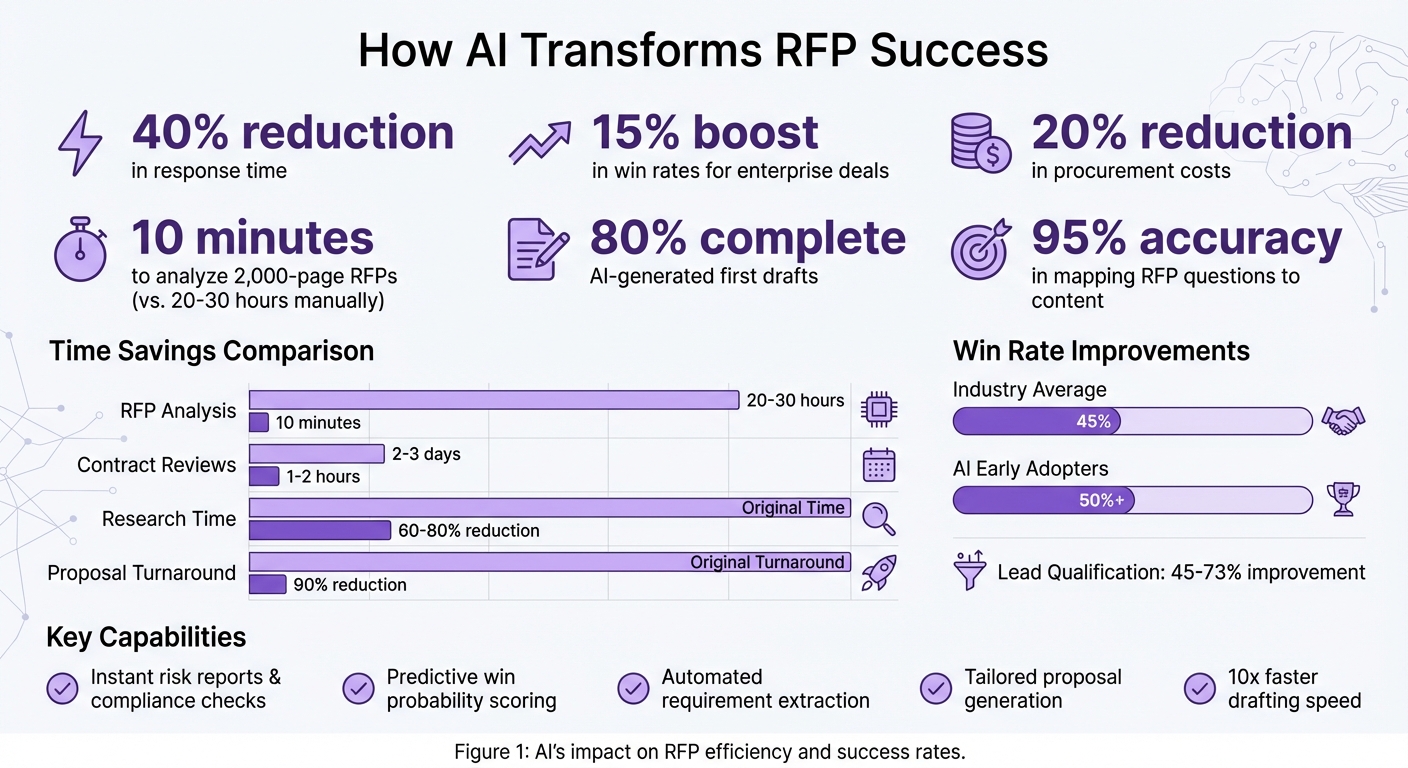
AI Impact on RFP Response Times and Win Rates
What is Buyer Intent in RFPs?
Let’s break down what buyer intent really means in the context of RFPs and why it’s a game-changer.
In the RFP process, buyer intent refers to the deeper motivations, strategic goals, and specific needs of the purchasing organization – things that aren’t always spelled out in the requirements. It’s about understanding the “why” behind the buyer’s questions. What challenges are they trying to solve? What outcomes are they aiming for? It goes beyond just ticking off boxes on a compliance list.
By understanding buyer intent, response teams can craft customized, meaningful proposals that go beyond surface-level answers. This approach can turn a good proposal into a winning one. When you align your response with the buyer’s deeper goals, you show that you’re not just a service provider – you’re a partner who gets their priorities.
Buyer intent also plays a key role in deciding whether to pursue an opportunity. Before committing hours of work to a response, it’s crucial to understand whether the RFP aligns with your capabilities and goals.
How Buyer Intent Affects Procurement Decisions
Buyer intent has a direct impact on how proposals are evaluated. Buyers aren’t just looking for vendors who meet the technical requirements – they want partners who understand their challenges and can add value. Addressing buyer intent in your proposal demonstrates that you’ve put thought into their specific needs, which can set you apart from competitors who rely on generic, boilerplate responses.
Procurement teams are increasingly favoring proposals that speak directly to their pain points. This means tailoring your response to match the buyer’s industry language, priorities, and goals. Even the same concept – like a “backup strategy” or “business continuity plan” – might need a different emphasis depending on what the buyer is truly after. If your proposal doesn’t address these nuances, it risks coming across as impersonal, even if it technically meets all the requirements.
However, figuring out buyer intent isn’t easy, especially when done manually.
Why Predicting Buyer Intent is Hard Without AI
Manually analyzing buyer intent is a tough, time-consuming process. RFPs can be massive, often running 50+ pages, with some reaching up to 2,000 pages. Sorting through these documents manually is exhausting and prone to errors. Important details – like critical keywords, subcontracting opportunities, or hidden risks – can easily be overlooked. For complex RFPs, traditional analysis can take 20–30 hours per response.
One of the biggest obstacles is scattered knowledge. Key information is often spread across various sources, such as product documents, security policies, or past proposals. This makes it nearly impossible to create a cohesive response that reflects the buyer’s intent. When multiple teams contribute to a manual response, inconsistencies or contradictions can creep in, leaving evaluators confused. Without data-driven insights, companies often rely on gut feelings to make bid/no-bid decisions, which can lead to wasted time on low-value opportunities or missed chances on high-potential ones.
“Manual, high-stakes grind is expensive, inefficient, and vulnerable to human error. Proposal teams burn out. SMEs are constantly interrupted. Great opportunities get missed.”
- Narwin.ai
Take Anil Gupta, for example, the owner of The Shelter Construction. He used AI-powered RFP analysis while bidding on large-scale bridge construction projects. This tool helped his team spot hidden risk clauses that could have led to costly mistakes. By avoiding these “bidding blunders”, his firm saved an amount estimated to be 2,000 times the cost of the software. It’s a clear example of how manual analysis can miss the subtle but critical details buried in complex documents.
This challenge highlights the need for AI tools to reliably uncover buyer intent and make the RFP process more efficient and accurate.
sbb-itb-bb3960c
How AI Predicts Buyer Intent in RFPs
AI systems analyze vast amounts of data to uncover buyer priorities that might go unnoticed during manual reviews. This ability reshapes how teams handle RFP responses, moving from simply assembling documents to crafting strategic, data-driven proposals. The result? A process that better aligns responses with buyer needs, ultimately increasing RFP success rates.
The journey begins with intelligent extraction. AI tools use automated classifiers and indexing systems to break down lengthy RFPs into structured tasks and requirements. Instead of relying on manual searches or “Ctrl+F” to sift through hundreds – or even thousands – of pages, AI identifies key elements like compliance checklists, technical specs, evaluation criteria, and deadlines. For RFPs that can stretch to 2,000 pages, this technology can generate detailed qualification and risk reports in under 10 minutes.
Once the data is extracted, AI leverages Retrieval-Augmented Generation (RAG) to align RFP requirements with your organization’s capabilities. This approach combines advanced Large Language Models (such as GPT-4.1) with your internal resources – like past proposals, case studies, certifications, and product documentation. The result is tailored, context-aware responses that address both explicit RFP requirements and the implicit priorities hidden within the document. This refined data lays the groundwork for predicting buyer intent, as explored further below.
Data Points AI Uses to Predict Intent
AI sifts through a variety of data points to form a comprehensive view of buyer intent:
- Past contract awards: By analyzing historical awards, AI identifies patterns in vendor selection, such as a preference for specific compliance certifications or pricing models. This insight helps determine whether a buyer leans toward certain qualifications or approaches.
- Compliance requirements: When an RFP emphasizes standards like SOC 2, ISO 27001, GDPR, or HIPAA, AI flags these as key priorities. Automated compliance checks can quickly assess whether your strengths align with the buyer’s needs. For instance, repeated mentions of security controls or service-level commitments signal areas to emphasize in your response.
- Language patterns: AI goes beyond basic keyword searches to analyze the phrasing and tone within RFPs. Semantic similarity matching helps detect industry-specific terminology, pain points, and evaluation criteria emphasis. For example, terms like “business continuity” versus “disaster recovery” indicate subtle differences in what the buyer values, and AI adjusts responses accordingly.
- Buyer behavior and market trends: By studying RFP databases, AI tracks shifts in compliance standards, evaluation criteria, and competitive dynamics. This intelligence can guide go/no-go decisions, ensuring your team focuses on opportunities where you have a clear edge.
These data points aren’t just collected – they’re processed by advanced algorithms to generate actionable insights.
AI Algorithms That Power Buyer Intent Prediction
At the heart of AI’s ability to predict buyer intent is Natural Language Processing (NLP). NLP enables AI to understand the structure and context of RFP language, identifying question intent, constraints, and subtle nuances. Whether a section calls for technical details or high-level summaries, NLP ensures responses are tailored to match the buyer’s tone and style. It also pulls relevant information from your knowledge base, helping craft smart, contextually appropriate answers.
Building on NLP, machine learning models analyze historical data – such as win/loss outcomes, evaluator feedback, and RFP patterns – to generate predictive win probability scores. These scores estimate your chances of success by factoring in RFP requirements, competition, internal capabilities, and resource allocation. Over time, as more proposals are analyzed, the models refine their predictions, creating a feedback loop that improves accuracy.
These predictive tools also enable portfolio optimization. Instead of chasing every opportunity, AI recommends which RFPs to pursue based on win probability, resource demands, and overall strategic fit. This approach saves time, optimizes resources, and boosts efficiency.
Another key feature is competitive intelligence. AI examines competitive dynamics within RFP pipelines and loss analyses, simulating evaluator scoring scenarios to prioritize efforts. It identifies capability gaps based on recurring RFP requirements and past losses, offering actionable insights for improvement. This replaces gut feelings with measurable, data-driven insights, helping teams focus on high-value opportunities while avoiding resource-draining pursuits with low potential.
Narwin.ai: AI-Powered Buyer Intent Analysis

Narwin.ai takes AI-driven solutions to a new level, offering a platform specifically designed for government contractors and businesses responding to RFPs in the US and Canada. The tool analyzes public procurement sources like Sam.gov and CanadaBuys, breaking down RFPs that can run over 2,000 pages. In under 10 minutes, it delivers detailed risk reports. Using natural language processing and retrieval-augmented generation, Narwin.ai extracts essential requirements, identifies compliance gaps, and even drafts tailored proposals – all while learning from your company’s past successes and internal knowledge.
The platform connects effortlessly with tools like Google Drive, Slack, Salesforce, and major ERPs. This integration ensures that Narwin.ai doesn’t just review RFPs in isolation – it factors in your unique data, such as certifications, past performance, and resource availability. The result? A system that doesn’t just automate tasks but actively supports strategic decisions, offering precise bid recommendations, win scoring, and customized proposal drafts.
AI Bid Recommendations and Go/No-Go Signals
Narwin.ai’s Qualification Analyzer simplifies decision-making with instant go/no-go recommendations. It evaluates RFP requirements against your organization’s assets and historical performance, considering factors like buyer intent, compliance needs, and resource demands. This objective, data-driven scoring replaces guesswork, helping teams avoid wasting resources on low-probability opportunities.
In practice, the platform has shown its ability to save time and focus efforts on high-potential bids, streamlining what used to be a tedious manual process.
Win Score and Probability Analysis
With its Win Score feature, Narwin.ai calculates the likelihood of winning an RFP by analyzing buyer behavior, historical contract data, and your past proposal performance. For instance, in a federal IT consulting RFP emphasizing cybersecurity standards like SOC 2 and HIPAA, Narwin.ai could assign a 75% Win Score based on language patterns, your track record, and the competitive landscape. It also flags risks such as tight deadlines or resource constraints, ensuring no compliance items are overlooked.
This scoring system evaluates over 10 metrics, providing a thorough analysis that minimizes the risk of disqualification. By identifying hidden challenges and opportunities, Narwin.ai helps optimize your bid strategy.
AI-Generated Proposals Customized to Buyer Intent
Narwin.ai takes proposal drafting to another level by aligning responses with buyer priorities. Using retrieval-augmented generation, it pulls from your company’s past wins, certifications, and case studies to create first drafts that are about 80% complete. These drafts are tailored to match the tone and focus of the buyer’s language, addressing both explicit requirements and subtle priorities found in the RFP.
For example, the Innovation Leadership Office at the Yolo County District Attorney’s Office in California used Narwin.ai to refine their draft RFPs. They shared:
“Narwin gives us some of the best recommendations on our RFPs. We uploaded our draft to Narwin and asked it several questions regarding the clarity of our proposal. It provided great feedback and motivated us to make changes to avoid confusion on our tenders.”
Every response is stored in a centralized Knowledge Hub, enabling the AI to continuously learn and refine its alignment with your brand voice and winning strategies over time.
How AI Improves RFP Success Rates
AI’s ability to predict buyer intent with precision is transforming the RFP (Request for Proposal) process, delivering tangible results. Companies leveraging AI for RFP analysis have reported a 15% boost in win rates for enterprise-level deals and a 40% reduction in response time. By tailoring proposal content to align with buyer intent, AI helps businesses achieve better outcomes at every stage of the process.
The financial benefits are also noteworthy. Anil Gupta, owner of The Shelter Construction in Kanpur, India, shared how AI-powered tools helped his company avoid costly mistakes when bidding for major bridge construction projects. The AI identified risk clauses and compliance gaps that could have led to disqualification. Gupta valued these insights at an astonishing 2,000 times the cost of the software:
“Detailed Narwin reports have helped us identify and fix bidding blunders worth 2000 times what we paid for Narwin.”
Creating Proposals That Match Buyer Needs
AI’s ability to analyze buyer intent ensures proposals are tailored to what evaluators value most. Instead of recycling generic content from past submissions, AI extracts specific evaluation criteria directly from RFP documents. This allows teams to craft responses that align perfectly with buyer priorities and scoring rubrics.
The process begins with intelligent requirement extraction. AI scans lengthy RFPs – some exceeding 2,000 pages – to identify compliance requirements, technical questions, and evaluation criteria, ensuring no critical detail is overlooked. It then maps these requirements to relevant proposal sections, reducing the risk of disqualification due to omissions.
Using Retrieval-Augmented Generation (RAG), AI pulls from a company’s repository of successful proposals, certifications, and case studies to create highly relevant first drafts. These drafts are approximately 80% complete, saving time while reflecting the buyer’s tone and addressing both explicit and subtle priorities embedded in the RFP language.
AI also ensures compliance throughout the process. By comparing draft proposals against RFP requirements, it scores them for compliance and highlights “win factors.” This automated review benchmarks 10+ metrics, enabling teams to identify and fix weaknesses before submission deadlines.
Reducing Time and Cost in RFP Responses
AI doesn’t just improve proposal quality – it also slashes response times and costs. Tasks that traditionally took weeks can now be accomplished in minutes. For example, AI platforms can generate detailed qualification, competition, and risk analyses for 2,000-page RFPs in just 10 minutes, a process that would take days or weeks manually.
Proposal drafting speeds increase by up to 10x as AI leverages verified knowledge libraries and past responses. Teams no longer waste hours searching for subject matter experts or digging through old files for reusable content. Instead, the AI automatically maps RFP questions to approved content with 95% accuracy, provided it’s grounded in verified company data.
AI also reduces manual research time by 60-80% through advanced prospect and intent analysis. Contract reviews that once took 2-3 days can now be completed in 1-2 hours using AI-powered term extraction. Sales cycles are shortened by 30-50% as teams focus on high-probability prospects rather than chasing every lead.
The benefits extend across the organization. Companies report a 90% reduction in proposal turnaround time, enabling teams to pursue more opportunities without increasing staff. Lead qualification rates improve by 45-73% when AI predicts buyer intent, ensuring resources are directed toward bids with the highest likelihood of success.
The Future of AI in Predicting Buyer Intent
The RFP process is undergoing a dramatic transformation, thanks to the rise of Agentic AI. These systems are reshaping procurement workflows by taking on tasks that go far beyond drafting proposals. Soon, they’ll handle everything from document analysis and compliance checks to strategic decision-making, requiring minimal human input. This evolution builds on the efficiency gains and improved win rates discussed earlier.
According to Gartner, by 2030, AI could manage up to 80% of project management tasks. This isn’t just about working faster – it’s about getting smarter with every submission. AI learns continuously, refining its ability to predict what works and what doesn’t. Early adopters of these advanced tools are already seeing the payoff, achieving win rates of 50% or more, compared to the industry average of 45%.
These developments don’t just help predict outcomes – they’re starting to shape procurement strategies themselves.
New Trends in AI-Powered Procurement
The next wave of AI tools is stepping into the role of strategic advisor. One standout feature is predictive win scoring, which uses historical data to estimate success probabilities before teams commit resources. These systems are already cutting evaluation times by as much as 70%, and future iterations will offer real-time insights while proposals are being crafted, pointing out weak areas that could hurt the chances of winning.
Another game-changer is integration. AI platforms now connect directly with CRMs to pull customer histories, ERPs for live pricing data, and supplier databases to verify credentials. This interconnected setup eliminates the need for the manual research that currently eats up 60-80% of preparation time. Organizations using these systems report 2.3x higher response accuracy and complete submissions 40% faster than those relying on standalone tools.
AI is also revolutionizing search capabilities. Intent-based search now outperforms basic keyword matching by understanding the meaning behind queries. When combined with real-time sentiment analysis, these tools can ensure proposal content aligns with buyer personas and specific needs, making every section more impactful and relevant.
Expanding AI Buyer Intent Analysis to Other Industries
AI’s success in government RFPs is now spilling over into industries like SaaS, healthcare, and finance. The demand for AI-driven solutions is skyrocketing as workloads for strategic responses – such as security questionnaires and due diligence forms – have grown by 77% in the past year.
In SaaS, AI is streamlining security questionnaires, which often involve repetitive elements. Healthcare organizations are using it to manage compliance documentation, while financial firms are applying the technology to Due Diligence Questionnaires for investor relations. Meanwhile, the growing importance of Environmental, Social, and Governance (ESG) criteria is pushing AI to assess how proposals meet sustainability mandates instantly.
This cross-industry adoption highlights AI’s ability to transform operations wherever complex, high-stakes documentation plays a critical role in business success.
Conclusion
The procurement landscape is shifting dramatically, thanks to AI’s ability to inject precision and data-driven insights into the process. Gone are the days of spending countless hours manually reviewing documents and relying on intuition. With AI, teams can now predict buyer intent with accuracy, qualify opportunities in minutes, and focus their efforts on bids with the highest chances of success. This new approach is redefining how businesses tackle RFPs, making the process more strategic and efficient.
Take, for instance, recent case studies that highlight how AI-driven tools have saved teams over 15 hours while significantly boosting revenue through smarter bid targeting. In another example, construction firms have used AI-powered risk analysis to pinpoint critical clauses in large-scale tenders, helping them sidestep costly compliance issues.
Narwin.ai is at the forefront of this transformation, offering features like automated opportunity matching, instant go/no-go decisions, win probability scoring, and customized proposals. These tools remove manual delays, improve response times, and enable teams to scale their bidding efforts without needing to expand their workforce. By leveraging precise buyer intent analysis, companies gain a strategic edge that translates into higher win rates and better resource management.
As outlined in this guide, adopting AI for buyer intent analysis can revolutionize your approach to RFPs. Whether you’re pursuing government contracts, private sector opportunities, or intricate procurement requests, understanding and addressing buyer needs in your proposal is crucial. The tools are available, the results are clear, and the moment to act is now.
Ready to transform your RFP process? Try Narwin.ai free for 14 days.
FAQs
What data does AI use to infer buyer intent in an RFP?
AI leverages natural language processing (NLP) and machine learning to break down RFP content, pulling out critical details such as requirements, compliance standards, and buyer preferences. Tools like Narwin.ai take it a step further by identifying buyer intent signals, potential risks, and priorities. This helps vendors gauge how well they align with buyer needs. By focusing on what buyers value most during evaluations, this analysis sharpens decision-making and boosts the chances of creating winning proposals.
How accurate are AI win scores, and how should I use them?
AI win scores can deliver impressive accuracy – often surpassing 90% – when tailored to an organization’s specific data. But remember, these scores are meant to guide decisions, not replace human judgment. They’re particularly useful for prioritizing bids, evaluating risks, and efficiently allocating resources. To get the most out of them, pair AI-generated insights with human expertise and a thoughtful strategic review. This approach ensures you account for client needs and industry subtleties that AI might overlook.
What do I need to connect or upload for AI to draft RFP answers safely?
To allow AI to effectively analyze and create RFP responses, you’ll need to upload or link the RFP documents, including any questions and specific requirements. This step ensures the AI can pull out the relevant details and craft precise, customized responses based on the information you provide.