
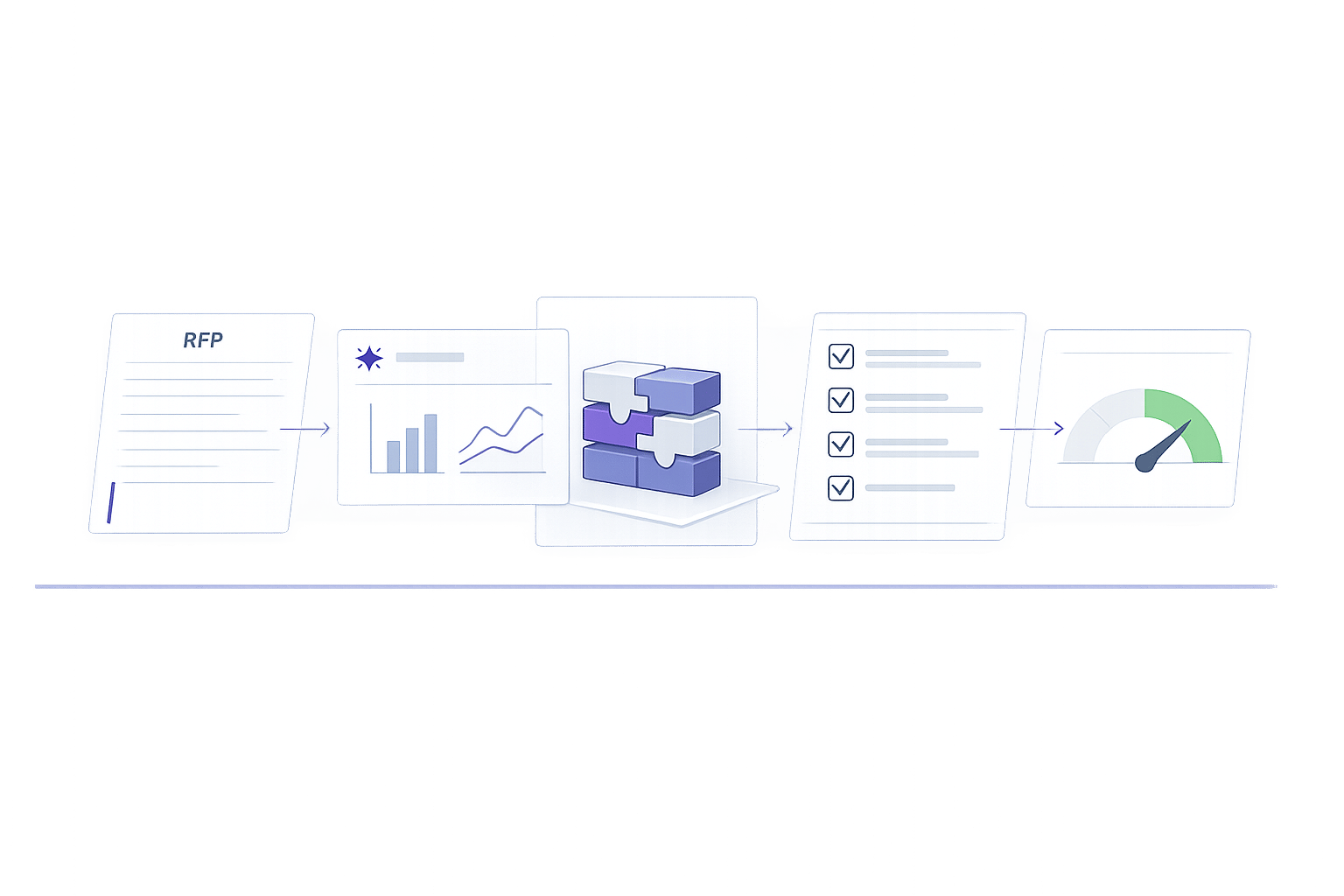
AI is transforming how proposal teams work, making processes faster, more efficient, and focused on what matters most: winning contracts. Here’s how AI tackles the biggest challenges in proposal development:
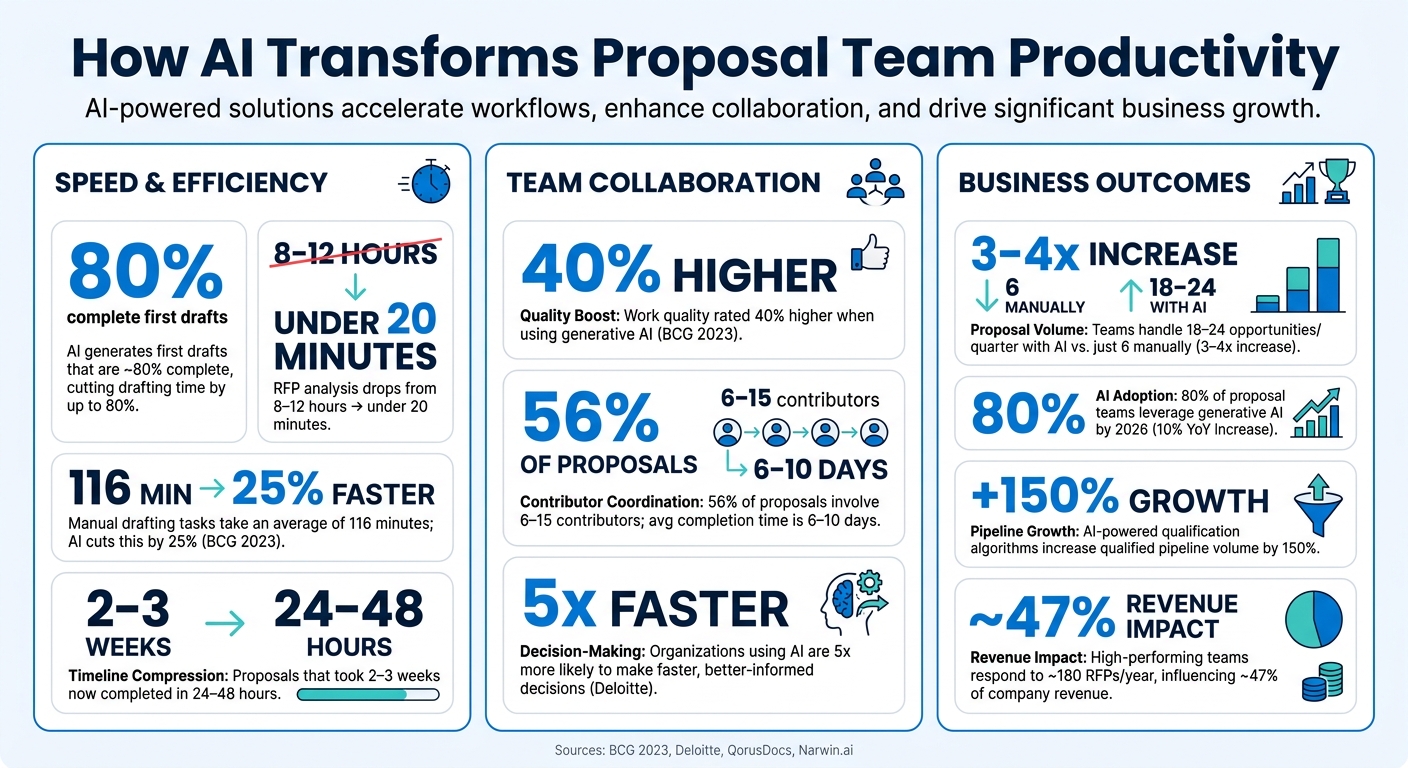
- Cuts drafting time by up to 80%: AI generates first drafts using past proposals and centralized content libraries, allowing teams to focus on refining instead of starting from scratch.
- Reduces manual effort: AI tools analyze RFPs, extract key requirements, and create compliance matrices in minutes, saving hours of tedious work.
- Improves team alignment: Centralized platforms eliminate version control issues and streamline workflows, ensuring everyone works on the same document in real-time.
- Supports better decisions: AI provides go/no-go signals and win probability scores, helping teams prioritize high-potential opportunities.
- Boosts productivity: Teams using AI can handle 3–4x more proposals per quarter without increasing staff.
How AI Transforms Proposal Team Productivity: Key Stats
Common Collaboration Problems in Proposal Teams
Before diving into how AI can help, it’s crucial to pinpoint the common challenges proposal teams face. These issues are often predictable but can quickly spiral out of control.
Scattered Information and Poor Communication
Most proposal teams lack a centralized system to store and manage critical content. Instead, important information is scattered across emails, local drives, and outdated spreadsheets. When a writer needs a past performance example or a technical specification, they often waste valuable time searching for it rather than focusing on writing. This disorganization leads to multiple document versions, conflicting edits, accidental overwrites, and redundant questions for subject matter experts (SMEs). The answers may exist, but no one knows where to find them.
"Federal proposal teams don’t lose because they ‘didn’t automate enough.’ They lose because they… spent the final week fighting formatting, compliance, and version chaos." – Cabrillo Club
On top of that, manual processes amplify these communication breakdowns, making collaboration even harder.
Time Lost to Manual Work
Disorganized information isn’t the only problem. Manual tasks also eat up significant time during proposal development. Teams often have to sift through dense RFP documents, build compliance matrices by hand, and copy-paste boilerplate content from previous proposals. These repetitive tasks steal time that could be better spent on strategic efforts. For example, drafting content-heavy sections like FAQs or technical documentation takes an average of 116 minutes per task. Multiply that by the number of sections in a proposal with a tight deadline, and the lost time adds up fast.
The final 48 hours before submission are especially chaotic. Instead of refining win themes or polishing the narrative, teams are stuck dealing with formatting issues, reconciling conflicting versions, and tracking down missing sections. This last-minute scramble to fix preventable problems is one of the biggest drains on productivity.
Stakeholder Alignment and Review Delays
56% of proposal responses involve between 6 and 15 contributors. That’s a lot of people to coordinate. These delays only make the problems of scattered information and manual inefficiencies worse. When one contributor is slow to review or approve their section, it creates a domino effect that holds up the entire process. On average, completing an RFP takes between 6 and 10 days, with much of that time spent waiting rather than writing.
"As volume rises, teams hit a hard ceiling. Not because they lack skill or motivation, but because coordination, not writing, becomes the bottleneck." – Jennifer Tomlinson, QorusDocs
The review process often drags on because there’s no clear ownership of files or a structured way to track feedback. Comments get lost in email threads, and unresolved issues resurface in later drafts. This leads to inconsistent results and forces teams to operate reactively rather than strategically – setting the stage for AI-driven solutions in the next section.
sbb-itb-bb3960c
AI Features That Directly Improve Team Collaboration
Dealing with scattered files, manual processes, and sluggish reviews can bog down any team. AI tools tackle these challenges head-on, offering teams a faster, more organized way to collaborate.
Automated RFP Analysis and Requirement Extraction
Sifting through lengthy RFPs to extract every requirement, deadline, and evaluation detail is a tedious task. AI tools simplify this process by using natural language processing (NLP) to automatically identify key details like eligibility criteria, submission deadlines, scoring weights, mandatory forms, and technical requirements.
By creating a shared, structured list of extracted information, everyone on the team works from the same baseline instead of interpreting the RFP differently. This clarity enables direct task assignments and keeps discussions focused on specific requirements, avoiding the chaos of scattered email threads. Tools like Narwin.ai take it a step further by organizing extracted data into structured reports covering buyer intelligence, risks, requirement analysis, and profitability. With this approach, teams can start working on deliverables within minutes of uploading a document, eliminating delays and confusion.
AI-Generated Proposal Drafts and Shared Content Libraries
Starting from a blank page often slows down progress. AI eliminates this hurdle by generating first drafts that are about 80% complete, pulling content from a centralized library of past proposals and key documents. This lets writers and subject matter experts focus on refining and customizing the draft rather than starting from scratch.
A shared, AI-powered content library also solves version control issues. For example, when a core description – like a new service offering or updated performance data – is revised, the update becomes instantly accessible to everyone. Platforms like Narwin.ai use Retrieval-Augmented Generation (RAG) to pull from your company’s private knowledge base, ensuring drafts are built on verified, company-specific data rather than generic content. According to a 2023 BCG study, workers using generative AI tools completed drafting tasks 25% faster and delivered work rated 40% higher in quality compared to those relying solely on manual processes.
"AI doesn’t remove the human touch. It amplifies it, by giving writers more time to think strategically, tell better stories, and fine-tune responses." – Narwin.ai
This streamlined drafting process allows teams to focus on making informed decisions.
Go/No-Go Signals and Win Probability Scores
Once collaboration is running smoothly, AI also supports better decision-making. Spending time on poorly aligned opportunities wastes valuable resources. AI-driven go/no-go signals replace guesswork with objective scoring based on factors like buyer history, contract value, geographic fit, past performance, and compliance risks.
Win probability scores add transparency, showing exactly why a score was given, so leadership and capture managers can quickly align without unnecessary debates. Research from Deloitte shows that organizations using AI for decision-making are 5x more likely to make faster, better-informed choices than those relying on manual methods. For example, in January 2026, App Guardians, a mobile marketing firm, used Narwin.ai to evaluate two simultaneous RFPs. The AI flagged geographic concerns on a UK enterprise bid (with a 50% fit score), prompting the team to refer it to a partner, earning $10,000 in referral revenue. Meanwhile, they focused on a better-aligned opportunity, securing a $15,000 subcontract. This process saved over 15 hours of manual effort.
"Narwin helped us save 15+ hours & generate over $25,000 by participating only where we had a real shot. Since we receive around 5 major RFPs per quarter, the annual subscription pays for itself quickly." – Carter Hawthornwaite, Operations Director, App Guardians
What AI Collaboration Looks Like in Practice
Faster Turnaround and Higher Productivity
AI has transformed the proposal process, tackling inefficiencies like scattered workflows and coordination issues. By 2026, 80% of proposal teams are leveraging generative AI, marking a 10% increase from the previous year. What once took 2–3 weeks to complete can now be done within 24–48 hours, thanks to AI’s ability to streamline tasks. For example, RFP analysis, which previously required 8–12 hours of manual effort, is now completed in under 20 minutes.
The productivity boost is undeniable. With AI, teams can handle 18–24 opportunities per quarter, compared to just six with manual processes. That’s a 3–4x increase without needing additional staff. High-performing teams – those winning over 51% of their bids – respond to approximately 180 RFPs annually, influencing nearly 47% of their company’s total revenue through proposals.
"RFP automation isn’t just operational efficiency – it’s revenue acceleration." – Narwin
This newfound efficiency not only speeds up the proposal timeline but also fosters better team collaboration.
Better Team Alignment and Fewer Errors
For industries like government contracting, where precision is critical, AI minimizes errors by detecting obligations hidden deep within technical specifications or referenced clauses. These could include labor categories or administrative deliverables that are often overlooked during manual reviews.
Centralized platforms further enhance alignment by eliminating the confusion caused by scattered workflows. Tools like Narwin.ai, when integrated with Slack, Google Drive, and major CRMs, ensure all team members – writers, subject matter experts, and reviewers – work on the same structured document with real-time updates and role-specific access. This eliminates the "which version is final?" dilemma. Additionally, AI-powered qualification algorithms have been shown to increase qualified pipeline volume by 150%, allowing teams to focus on better-fit opportunities without increasing staff.
Here’s an example of how this works in practice.
Case Example: A Government Contractor Using Narwin.ai
Take a mid-sized IT consulting firm pursuing federal contracts through SAM.gov and Canadian opportunities via CanadaBuys. Before adopting Narwin.ai, their three-person proposal team spent two days per RFP manually reviewing documents exceeding 100 pages, creating compliance matrices, and chasing subject matter experts for input.
After implementing Narwin.ai, the team uploaded their company certifications, past project summaries, and successful proposals into the platform. When a federal IT services RFP became available, Narwin’s AI quickly extracted 150+ distinct requirements and flagged a missing small business certification as a compliance risk – before any writing began. The AI Writer then generated an 80% complete draft by using the firm’s past submissions as reference material. This shifted the team’s focus from assembling content to refining strategy, ensuring technical accuracy, and perfecting the narrative. As a result, their proposal timeline dropped from 12 days to under 48 hours, and their capacity increased from 5–6 bids per quarter to more than 18.
How to Roll Out AI for Proposal Team Collaboration
Start with the Biggest Bottlenecks First
One common pitfall when introducing AI to proposal teams is trying to automate everything at once. A better approach? Pinpoint the tasks that eat up the most time and tackle those first. For most proposal teams, this means focusing on repetitive, time-heavy activities like requirement extraction, compliance mapping, and filling in boilerplate content.
To ensure you’re on the right track, start with a pilot program. This lets you gather baseline metrics such as how long it currently takes to produce a first draft or how many revision cycles a proposal typically requires. Without this data, it’s tough to prove whether AI is making a real difference. Before automating drafting, standardize your Word templates and clean up your source material. Outdated product descriptions or old references can lead to poor outcomes – bad input equals bad results.
"The goal isn’t to hand over the wheel completely – it’s to automate what’s repetitive, enabling your team to focus on strategic work." – Narwin
Streamlining these processes is just the beginning. You also need to ensure your data stays secure throughout the automation process.
Data Privacy and Security Considerations
Proposal work often involves highly sensitive information, from contract terms and pricing structures to certifications and, at times, controlled unclassified information (CUI). Before uploading any documents, classify your data. Organize solicitation materials into categories like public, procurement-sensitive, or restricted. That way, you’ll know exactly what’s safe to include in AI prompts.
Tools like Narwin.ai ensure your data remains secure by isolating it within your workspace. They use secure indexing with private Vector Databases and role-based access control (RBAC), so sensitive RFP analysis is only visible to the right team members. Always verify an AI tool’s data handling policies before uploading proprietary files. Specifically, confirm whether your data is used to train shared models or kept strictly private.
"Every workflow step is protected by enterprise-grade security." – Narwin
Once security is locked down, the next step is measuring how AI impacts your team’s workflow.
Tracking the Impact of AI on Your Team
After implementing AI, tracking the right metrics helps ensure it delivers lasting benefits. Instead of trying to monitor everything, focus on 3 to 5 core metrics that matter to leadership. Reduced manual workloads – like faster RFP analysis and quicker drafting – can lead to measurable improvements in several key areas:
| Metric Category | What to Track |
|---|---|
| Efficiency | Cycle time (RFP receipt to submission), time to first compliant draft |
| Collaboration | SME turnaround time, comment closure time, approval throughput |
| Quality | Revision counts per proposal, compliance issues caught in final review |
| Outcomes | Win rate, win probability scores, total bid volume per quarter |
Pay close attention to how subject matter experts (SMEs) interact with AI-generated content. If SMEs can’t review and approve content in under two minutes, the workflow might be too complicated, forcing teams back into inefficient email chains. Keeping the process smooth and straightforward is key to consistent adoption.
"Proposal leaders are now tracking win rates, time-to-response, and team capacity – turning proposal management into a strategic function, not just a support role." – Narwin
Conclusion: What AI Means for Proposal Teams Going Forward
AI is transforming the RFP process and how proposal teams operate, and it’s not just about doing things faster – it’s about working smarter at every step. From automating requirement extraction to making data-informed go/no-go decisions, AI removes unnecessary hurdles and replaces guesswork with clear, actionable insights.
These advancements elevate proposal management into a strategic role. Instead of spending countless hours on manual tasks, teams can now focus on what truly wins contracts: creating persuasive narratives, training AI on past RFPs to maintain brand voice, highlighting unique value propositions, and crafting responses tailored to the client’s needs. As Narwin.ai puts it:
"Proposal management is no longer a reactive function. It’s becoming a core part of how businesses sell, scale, and stand out."
For businesses bidding on government contracts across the US and Canada, this shift is especially impactful. AI-powered tools ensure no opportunity slips through the cracks while delivering tangible results – from saving hours on each proposal to driving revenue growth by concentrating on high-probability bids.
But the benefits don’t stop there. Every AI-enhanced proposal adds to a cycle of continuous improvement. Each bid, analysis, and refined draft builds on the last, creating a momentum that drives future success. As Narwin.ai emphasizes:
"The future belongs to teams who can move fast and well. AI makes that possible."
FAQs
What should we automate first with AI?
Automating qualification and opportunity screening is a smart first step. AI tools can sift through RFPs in record time, flagging compliance issues, evaluating how well the scope matches your capabilities, and even estimating win probabilities. This lets teams make informed bid decisions in just minutes.
The next move? Automate proposal drafting. By pulling from past responses and internal company data, AI can create initial drafts quickly, cutting down on time and minimizing mistakes.
Lastly, streamline your process with automated compliance checks and workflows. This ensures accuracy, simplifies collaboration, and makes the entire operation much more efficient.
How do we keep RFP data secure in AI tools?
AI tools, such as Narwin.ai, safeguard RFP data with encryption and enterprise-level security protocols like SOC 2 Type II and GDPR compliance. They also adhere to strict privacy standards, ensuring data is not used for AI model training. Additionally, access is limited exclusively to workspace users, keeping your information secure and private.
How do we measure AI’s impact on proposal work?
AI’s influence on proposal work can be evaluated through two types of metrics: operational metrics and outcome metrics.
- Operational metrics focus on efficiency indicators like cycle time, the number of SME hours saved, and the extent of draft coverage.
- Outcome metrics measure effectiveness, tracking factors such as win rate, qualified win rate, revenue gained, and enhancements in proposal quality.
These metrics provide a clear way to monitor both the productivity and success of proposal processes.