
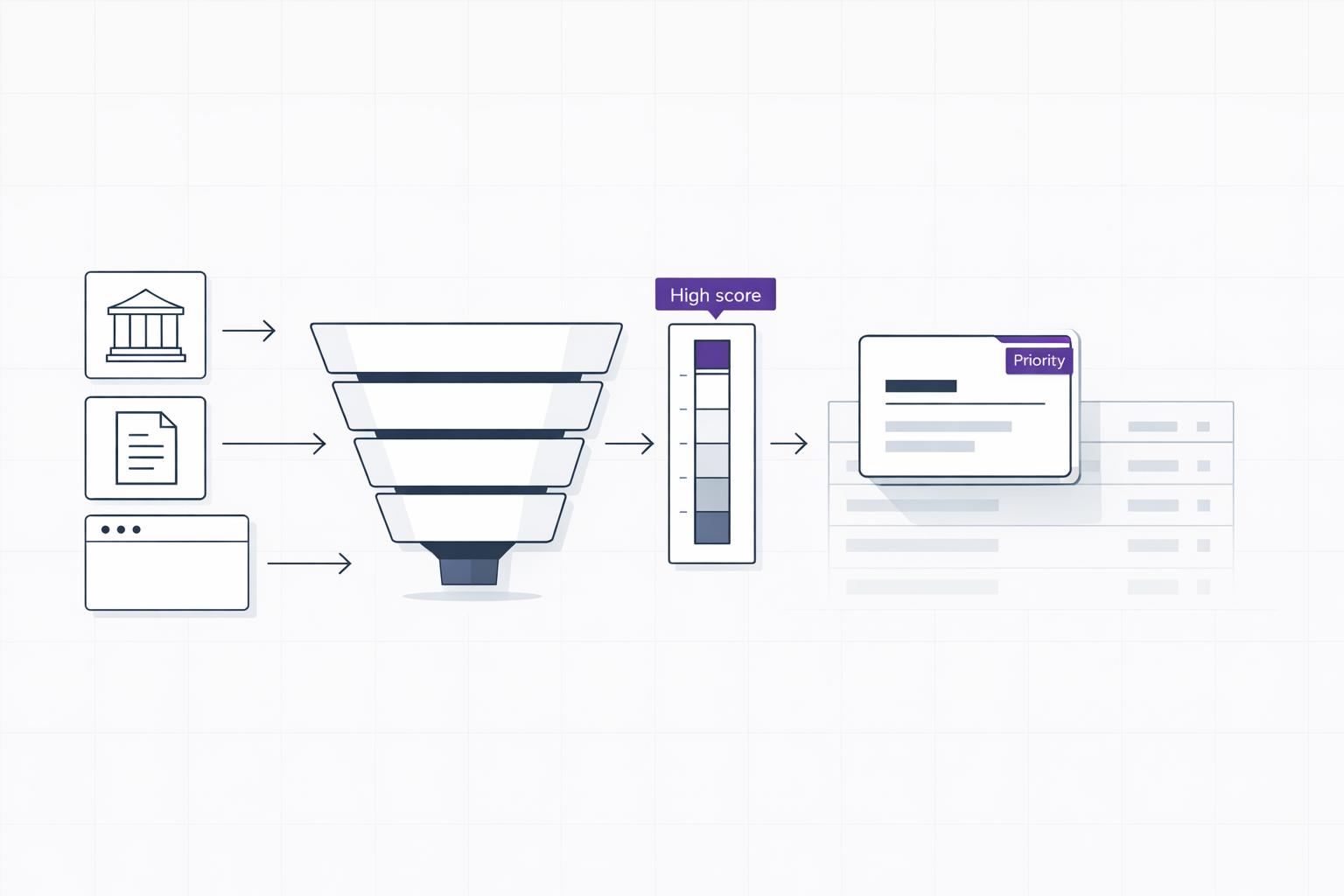
AI tools are transforming how businesses identify government contracts by automating searches, analyzing opportunities, and saving time. Instead of manually sifting through thousands of procurement portals, these tools use semantic search to match contracts to your company’s strengths, even when terminology varies. Key features include:
- Centralized searches across federal, state, and local sources.
- Match scoring to prioritize the best opportunities.
- Automated data extraction to save hours on RFP reviews.
- Risk analysis to flag potential issues early.
For example, platforms like Narwin.ai help businesses discover up to 150% more opportunities weekly, reduce manual effort, and focus on contracts they have a realistic chance of winning. By leveraging AI, you can streamline your search process, evaluate contracts faster, and improve your success rate.
Key Features of AI Tools for Contract Discovery
Understanding how AI tools function behind the scenes can help you make the most of them. The most impactful features aren’t about flashy gimmicks – they’re the ones that save time and highlight opportunities you might otherwise miss.
AI Bid Search and Aggregation
AI tools don’t just search; they analyze and interpret key details to help you find high-value contracts faster. Unlike traditional keyword searches, which can be restrictive, AI understands the context and meaning of terms. This allows it to identify related opportunities that might not contain the exact keywords you’re using.
What’s more, these tools aggregate information from thousands of fragmented sources – like SAM.gov, CanadaBuys, BCBid, state procurement portals, and municipal bid boards – into one centralized dashboard. Some advanced platforms even monitor over 2,000 procurement sources daily, a level of coverage that would be impossible to achieve manually. With this robust search capability, AI tools also refine results by applying relevance scoring.
Relevance Scoring and Match Analysis
AI tools assign a match score (on a 0–100 scale) to each opportunity, evaluating how well it aligns with your business’s certifications, past projects, capacity, and strategic goals. This transforms an overwhelming list of results into a manageable shortlist of top priorities.
For example, Narwin.ai pairs this scoring with a go/no-go signal, which helps your team quickly decide whether to pursue an opportunity. By assessing the fit with your company profile, the platform flags strong candidates without requiring someone to sift through the entire document. AI-driven bid matching can uncover 30% to 50% more relevant opportunities than manual keyword searches, and it does so much faster. Beyond scoring, these tools also streamline decision-making by pulling out the most critical contract details.
Extracting Key Contract Data
Reviewing a lengthy federal RFP can take anywhere from 8 to 16 hours. AI tools drastically reduce this time by automatically extracting the information that matters most – like contract value, submission deadlines, Statement of Work requirements, evaluation criteria, mandatory certifications, bonding clauses, and compliance checkpoints.
"Narwin acts as an AI Business Analyst, scanning tenders of any length to quickly identify critical details." – Narwin.ai
AI’s ability to deeply analyze documents also ensures that no critical requirements – hidden in attachments or appendices – are overlooked. Missing these details during a manual review could lead to disqualification, but AI tools deliver a structured summary of the essentials in mere minutes, saving your team days of effort.
sbb-itb-bb3960c
Step-by-Step: Using AI to Find High-Value Contracts
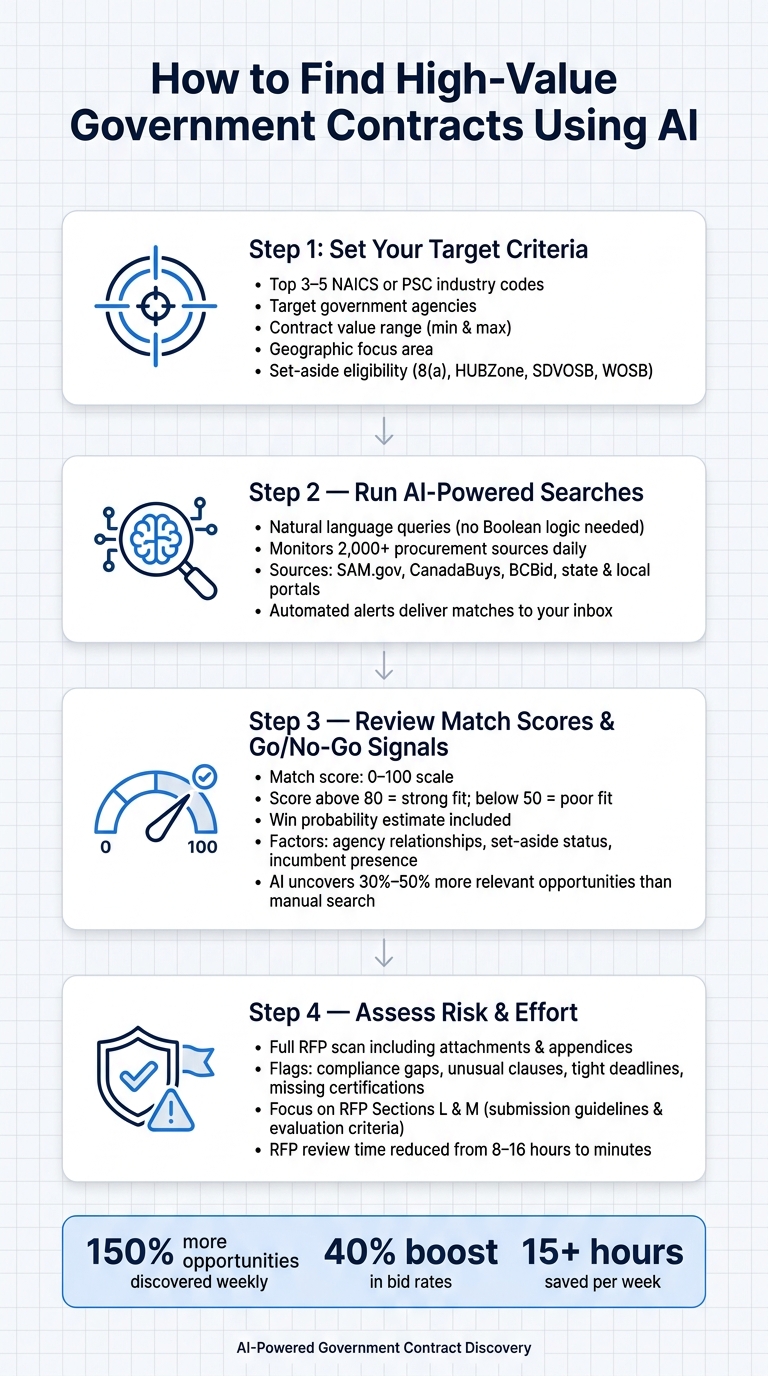
How to Find High-Value Government Contracts Using AI: 4-Step Process
Now that you’ve got a handle on what AI tools are capable of, let’s walk through how to use them effectively – from setting up your criteria to making that final bid decision.
Step 1: Set Your Target Criteria
Before diving into searches, it’s crucial to define what a "high-value" contract means for your business. Tools like Narwin.ai make this easier by starting with a Company Profile. This profile captures details like your services, certifications, past projects, and capacity. The goal? To ensure the platform matches opportunities to your strengths, not just random results.
Here’s what to focus on when setting filters:
- Industry codes: Identify your top 3–5 NAICS or PSC codes.
- Target agencies: Pinpoint the government agencies most aligned with your work.
- Contract value range: Set a realistic minimum and maximum value based on your team’s capacity.
- Geographic focus: Define the areas you can serve.
- Set-aside eligibility: Filters like 8(a), HUBZone, SDVOSB, or WOSB can help you find contracts with fewer competitors.
By narrowing down these five dimensions, you’ll create a clear roadmap for your AI searches. Once your criteria are locked in, it’s time to bring them to life with targeted searches.
Step 2: Run AI-Powered Searches
With your profile ready, you can start searching – no technical jargon required. Just type in a query like, “IT modernization contracts from the VA between $1M and $10M,” and the AI handles the rest. It automatically translates your input into the right filters and codes, eliminating the need for complicated Boolean logic.
To save time, set up automated alerts for your most important searches. Platforms like Narwin.ai continuously monitor sources like SAM.gov, CanadaBuys, BCBid, and hundreds of state and local portals. Matched opportunities are sent straight to your inbox, keeping your pipeline active without daily manual checks.
Now, it’s time to evaluate the results and fine-tune your bid strategy.
Step 3: Review Match Scores and Go/No-Go Signals
Once your searches are running, the AI assigns each opportunity a match score (ranging from 0 to 100) based on your profile and the RFP’s requirements. High scores – typically above 80 – indicate strong alignment, while scores under 50 suggest a poor fit.
Narwin.ai takes it a step further with a win probability estimate. This feature considers factors like agency relationships, set-aside status, and whether there’s an incumbent contractor. This allows your team to zero in on bids where you have a realistic chance of success, saving time and effort.
Step 4: Assess Risk and Effort
After narrowing down opportunities, it’s important to evaluate the risk and effort involved. Narwin.ai’s risk analysis goes beyond surface-level details, scanning the full RFP, including attachments and appendices. It flags issues like compliance gaps, unusual clauses, tight deadlines, or missing certifications – any of which could disqualify your proposal before it’s even reviewed.
Pay close attention to Sections L and M of the RFP. These sections outline submission guidelines and evaluation criteria, giving you a clear picture of how much effort a proposal will require and how it will be scored. If the workload outweighs your win probability, it’s a smart move to pass and focus on stronger opportunities instead.
How to Get More Out of AI Contract Tools
Refining Your Search Parameters
Getting the most from AI contract tools isn’t about running endless searches; it’s about running smarter ones. Be specific in your instructions to the AI. For example, you might direct it to "Focus on structural steel requirements; ignore mechanical." This approach narrows the scope, avoids irrelevant risk flags, and ensures your analysis stays focused.
Another smart strategy? Set up saved searches tailored to your goals. Instead of relying on one broad search, create separate categories. For instance, one search could target "Quick Wins" (smaller contracts with fast turnarounds), while another hones in on "Strategic Targets" (larger, long-term opportunities). This method keeps your pipeline organized and ensures you’re evaluating opportunities with the right benchmarks in mind. These refined approaches lay the groundwork for deeper insights and smoother collaboration.
Using Buyer and Agency Intelligence
Once you’ve fine-tuned your search parameters, the next step is verifying the viability of opportunities through buyer intelligence. After spotting a promising contract, check whether the awarding agency typically works with firms like yours. AI platforms can analyze an agency’s historical behavior, such as their preference for certain set-aside types, how often they stick with incumbents, and the typical price points of past winners. These tools can also highlight recompete opportunities – contracts nearing expiration – giving your team 12 to 18 months to build relationships and position yourselves before the RFP is released.
Here’s a key insight: In some agencies, up to 85% of contracts go to incumbents. If you’re not the incumbent and the data shows this trend, a strong AI tool will flag it directly in your win probability score. This saves you from wasting weeks on a proposal that’s unlikely to succeed.
Bringing AI Insights Into Team Workflows
AI tools churn out valuable data – like match scores, risk flags, and compliance gaps – but it’s only useful if your entire team can act on it. By combining refined searches and buyer intelligence, you can integrate these insights into your workflows to ensure everyone has access to consistent, actionable information.
Platforms like Narwin.ai make this seamless by integrating with tools like Slack, Google Drive, and major CRMs. This allows instant sharing of AI-generated RFP reports and bid recommendations. Pair this with a weekly 30-minute bid review meeting where leadership reviews AI-curated shortlists, and you’ve got an efficient decision-making process. Assigning a Contract Intelligence Coordinator to prioritize results and flag opportunities ensures nothing slips through the cracks – especially as your pipeline grows.
"Narwin helped us save 15+ hours & generate over $25,000 by participating only where we had a real shot." – Carter Hawthorniwaite, Director of Operations, App Growth Network
The time you save adds up quickly. With less time spent on manual research, your team can focus on what truly matters: crafting stronger proposals and building lasting agency relationships.
Conclusion: Finding Better Contracts with AI
The difference between businesses that consistently win government contracts and those that don’t often boils down to one key factor: how effectively they identify and evaluate opportunities. As mentioned earlier, manual research can eat up countless hours and still overlook critical opportunities – wasting your team’s most precious resource: time.
AI tools completely shift this dynamic. With semantic search, contracts that traditional keyword searches miss are uncovered. Automated go/no-go signals ensure your team focuses only on bids where you have a real chance, and RFP review time is slashed from hours to mere minutes.
Platforms like Narwin.ai bring all of these capabilities together. From daily opportunity matching across sources like SAM.gov and CanadaBuys to win probability scoring, risk analysis, and AI-assisted proposal drafting, everything you need is in one place. Regardless of the size of your business, the process becomes clear: identify smarter, evaluate faster, and focus on bids where success is most likely.
AI-powered tools have been shown to boost bid rates by up to 40%, giving your team more time to concentrate on crafting strategic proposals and building relationships.
The goal isn’t to replace your expertise – it’s to free it up for what matters most: developing strong partnerships, creating persuasive proposals, and securing contracts.
FAQs
How do I set “high-value” criteria for my business?
To pinpoint what makes an opportunity "high-value" for your business, it’s essential to align potential bids with your strengths, certifications, and strategic objectives. Start by creating a comprehensive company profile that highlights your qualifications, past performance, and core competencies. This profile will serve as a foundation for identifying the best opportunities.
AI tools like Narwin.ai can simplify the process by helping you spot and prioritize bids that align with your expertise. These tools streamline the evaluation process, saving time and ensuring you focus on contracts that truly match your capabilities.
When evaluating opportunities, consider three key factors:
- Compliance: Does the opportunity meet your business’s qualifications and certifications?
- Technical Fit: Are your services or products well-suited to fulfill the contract requirements?
- Strategic Alignment: Does the bid align with your long-term business goals?
Narwin.ai’s scoring system can further refine your decision-making by assessing the likelihood of success and identifying potential risks. This ensures your efforts are directed toward contracts with the highest potential for success.
How accurate are match scores and win probability estimates?
Narwin.ai calculates match scores and win probability estimates using advanced AI algorithms. These algorithms evaluate RFP requirements, historical data, and key factors such as compliance, relevance, and competitor performance. The predictions are based on established accuracy standards and are regularly updated to maintain dependable results.
What should I verify before trusting an AI RFP summary?
Before relying on an AI-generated RFP summary, take a moment to cross-check the details for accuracy. Make sure all compliance requirements are clearly understood and addressed. Assess whether the bid aligns with your organization’s strategy and consider any associated risks. Lastly, verify that the AI’s findings match your company’s resources and success criteria to ensure they genuinely support your objectives.