
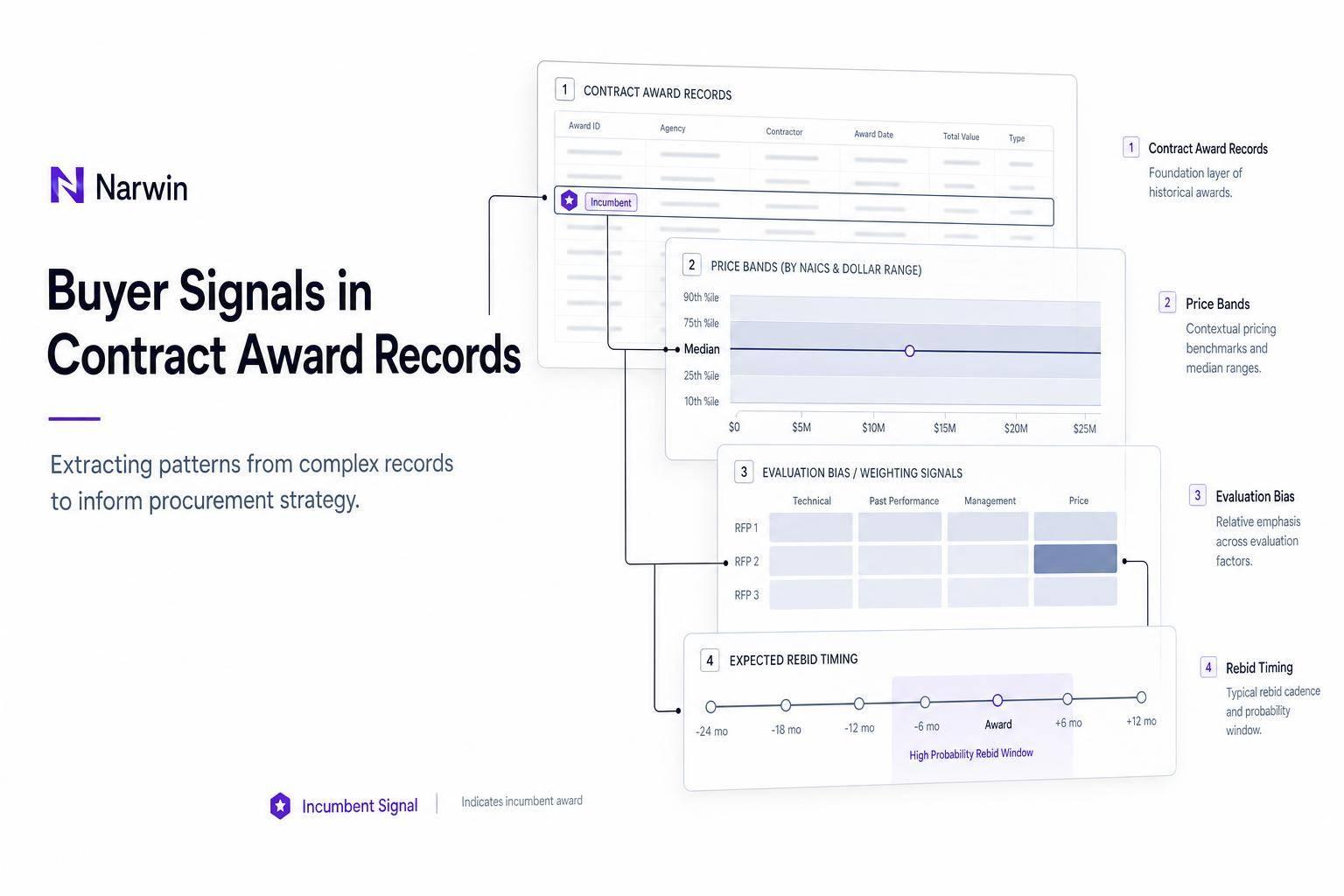
If I review past award records before I bid, I can answer three high-stakes questions early: Can I win this? What should I charge? When should I start?
Most teams focus on live bids. But award history often gives me a better read on buyer behavior than the next solicitation alone. When I look at several records over time, I can spot:
- who holds the work now
- how often the same vendor keeps winning
- what price range the buyer has paid
- how long contracts tend to run
- whether the buyer leans toward low price or best value
- when the next rebid is likely to show up
That matters because bad timing and weak bid selection are expensive. If I start capture work 6 to 18 months before a likely recompete, I have more time to shape my position. If I compare at least 3 to 5 similar awards, I can build a rough price band instead of guessing. And if one firm has a long win streak, I know I need a clear reason to displace them.
Here’s the short version:
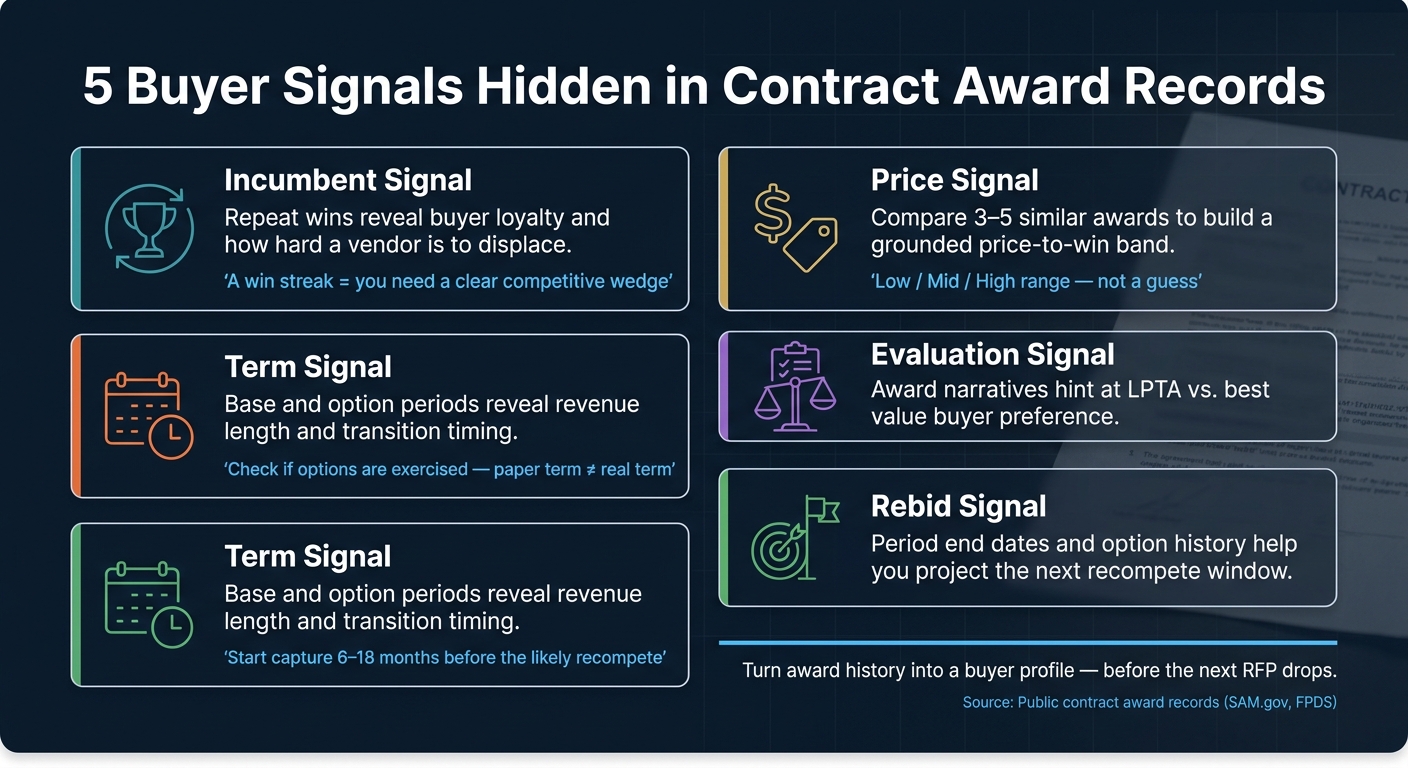
- Incumbent pattern: repeat wins can mean a hard swap-out
- Price signal: old awards help me set a price-to-win range
- Term signal: base and option periods show likely revenue length
- Evaluation signal: award notes can hint at LPTA vs. best value
- Rebid signal: end dates and option use help me time entry
I’d treat award records as a working bid input, not admin paperwork. The goal is simple: turn old awards into a short buyer profile I can use for go/no-go, pricing, teaming, and timing.
5 Buyer Signals Hidden in Contract Award Records
Bid planning gaps that award records can fix
Award records can clear up three common planning blind spots: incumbent control, pricing, and evaluation timing. A simple way to start is with four checks:
- Incumbent
- Price
- Evaluation
- Recompete timing
Not knowing who holds the work or who keeps winning it
Start by figuring out who actually has the work now.
If the same vendor has picked up several awards in a row, that usually points to buyer comfort, internal know-how, and a harder swap-out job. A generic proposal won’t change that. You need a clear positioning plan built around what the incumbent doesn’t bring to the table.
Award records can also show whether a buyer tends to pick a certain vendor type. Say an agency’s recent IT support awards all went to small businesses under a set-aside like 8(a) or HUBZone. In that case, a large business without access to that vehicle may be looking at a go/no-go call, and it’s far better to spot that early than waste months chasing the wrong deal.
No price band or contract term to work from
Next, use the award record to ground your price-to-win target and contract length.
Award notices often list total value, base value, options, and ceiling amounts. When you compare similar awards, you can spot a realistic price band. That gives your price-to-win model something solid to stand on instead of guesswork.
Contract term patterns matter just as much. Some buyers keep using a one-year base with four one-year options. Others lean toward a two-year base with three option years. Those setups shape staffing plans, transition timing, and revenue forecasts. Award records make those patterns visible before you build your internal business case.
Late visibility into how buyers evaluate and when they rebid
Then read the record to see how the buyer tends to pick winners.
Past awards can show whether the buyer leans toward lowest price, minimum compliance, or best value. If the record keeps showing winners among the lowest-priced offerors, and the write-up focuses on meeting minimum requirements, treat the next bid as LPTA-oriented. That usually means a lean, compliant solution will fit better than a long technical pitch.
The dates in the record also help you estimate the next bid window. Use award dates and period-end dates to project recompete timing. If the buyer usually recompetes at the end of the term, start capture 6 to 18 months ahead. That gives you time to shape the buyer’s approach before the solicitation drops.
sbb-itb-bb3960c
How to read award records for buyer signals
Award records can tell you a lot about how a buyer acts: who keeps winning, what they spend, how long they stay committed, and how they judge offers.
A single award only gives you a snapshot. But when you review several awards from the same buyer over time, scattered transactions start to form a pattern. That’s where things get useful. Start with incumbency, then look at price, contract term, and evaluation trends.
Spot incumbent patterns, win streaks, and vendor preferences
Start by filtering awards from your target agency using the awarding office, recipient name, and NAICS or PSC code. Then sort by award date and look for the same vendor name showing up again and again in the same category. Repeat wins usually point to incumbency.
Don’t stop at repeat wins. Look at the award model too. Does the buyer tend to issue single-award contracts, or do they use multiple-award IDIQs with several vendors on the same vehicle?
That distinction matters.
- Single-award patterns often suggest a stronger pull toward the incumbent.
- Multiple-award vehicles usually mean more competition at the task-order level.
That shifts your capture plan. In some cases, you need to get onto the vehicle early. In others, the main solicitation is the main event.
Once you know who holds the work, use award values to figure out the likely price band.
Pull price ranges, contract length, and option structure
Find similar awards in your target category and compare total award value, scope, and geography across at least three to five contracts. Group like awards together, then compare annualized spend to build a grounded price band across low, middle, and high ranges.
Contract length matters just as much as contract value. Check the base period start and end dates. Then review whether option years were exercised in the contract mods. On paper, a contract may look like a five-year vehicle. In practice, the buyer may only keep it going as long as options are exercised.
That pattern should feed straight into your revenue forecasts and staffing models. If options are often skipped, a long paper term may not mean much.
Then turn to evaluation details to see how the buyer picks winners.
Read evaluation clues and likely recompete windows
When award records include evaluation details from public award notices or procurement summaries, pull out three things:
- the number of offers received
- the evaluation criteria and weights
- any narrative rationale for the award
Across multiple awards, those details start to show a pattern. Some buyers lean harder on price. Others put more weight on technical quality. Some land in a best-value middle ground.
For recompete timing, use period end dates and option history to estimate the likely window. Check whether the buyer has a habit of exercising every option or letting contracts end early. Then use the end date to set your capture start date.
Turn award data into a repeatable bid decision process
Award records only matter if they change how you bid. That’s the point of this process: make buyer intelligence a standard input at each stage of capture, from early targeting to pricing and teaming.
Build a buyer dossier for each target agency or account
Once the patterns are clear, put them into a standard buyer dossier the team can use in every capture review. A buyer dossier is a short, standardized profile for each agency or major account you actively pursue.
Track six fields:
- Buyer – agency or office name
- Incumbent strength – who holds the work and how firmly they hold it
- Award value – the usual annual or total contract value range
- Term and options – base period length and option year structure
- Evaluation model – how the buyer weighs price, technical, and past performance
- Rebid signal – the likely recompete window based on period end dates and option history
Update the dossier after each new award notice. That way, award history becomes something the team can use in go/no-go, teaming, and pricing calls instead of just filing away.
Use award signals to support go/no-go and price-to-win decisions
Before proposal work starts, the dossier should answer three questions: Is this winnable? At what price? Which team?
Use the dossier as a decision tool, not just a record. If the same incumbent keeps winning and options keep getting exercised, that’s a warning sign. You should bid only if you have a clear competitive wedge. If awards stay within a tight price band, the buyer likely knows what the market should cost. If your cost structure doesn’t fit that range, that should shape the go/no-go call. The evaluation model shows how to shape the solution and which partners belong on the team. Miss those answers early, and you can burn months chasing a weak bid.
Scale the process with Narwin.ai
Teams can scale this by automating dossier updates. Narwin.ai pulls buyer intelligence from public bid sources across the U.S. and Canada and turns it into go/no-go signals, pricing guidance, and risk analysis, so your dossiers stay current without manual research.
Conclusion: What award records tell you before the next bid drops
Once the buyer dossier is ready, award records are the last check before a go/no-go call. Before the next solicitation drops, award history shows who the incumbent is, what the buyer tends to pay, how long contracts usually last, and how winners get picked. That’s documented buyer behavior, plain and simple.
Use those signals to decide if the bid is worth it, how to price, and how to position your team. The same patterns show up again and again: incumbent win streaks show how tough it may be to knock out the current vendor; pricing bands show where the buyer has been willing to award; base and option structures show how long performance may run and when the next recompete could land; evaluation patterns point to where your proposal team should spend time; and rebid timing helps you start capture early instead of rushing after the RFP goes live.
Key points to carry into your next capture review
Award history should be a standard input before qualification, not something you check at the last minute. Pull prior awards under the same agency, NAICS code, or contract vehicle. Write base and option periods in MM/DD/YYYY format. Convert total award values into annualized figures in $ so you can benchmark pricing on equal terms. If your bid lands outside the past award range, you’ll see that before proposal work starts.
Teams that win on a steady basis don’t treat each bid like day one. They build from documented buyer patterns, update their dossiers after every award notice, and use the same evidence-based logic for every go/no-go call. That kind of discipline turns award data into a decision framework the team can use again and again.
FAQs
How many award records should I review?
Review enough past award records to spot buyer habits that show up again and again, along with patterns tied to current incumbents. If you base your view on too little history, your predictions can fall apart fast.
You can do this by hand, but it takes a lot of time. Narwin.ai speeds the process up by scanning millions of records from sources like SAM.gov and FPDS. It pulls out trends in pricing, protest history, vendor selection, and objective win-probability scores.
What makes an incumbent hard to displace?
An incumbent is often tough to unseat because they begin with built-in advantages long before a solicitation goes public. In many cases, the requirements can mirror their staffing, past performance, and narrow specialty skills – especially when the scope is thin but the contract value is high.
Agencies may also lean toward continuity when the incumbent has done the job well. If performance has been steady, sticking with the same vendor can feel like the safer bet.
For challengers, the bar gets even higher when a few things show up at once:
- Response windows under 14 days
- Highly specialized technical requirements
- The incumbent’s deep knowledge of the agency, its systems, and how the work gets done
That mix can make the playing field feel uneven from the start.
How can I estimate the next rebid date?
Review past award data to find contracts that are likely to expire 18 to 26 months before the RFP shows up. Also watch agency procurement forecasts, which often list upcoming opportunities 6 to 18 months ahead.
It also helps to check inactive contract records on Sam.gov. Those records can point to expired agreements that may turn into a recompete.
Narwin.ai can help you track these patterns and surface relevant historical data early.