
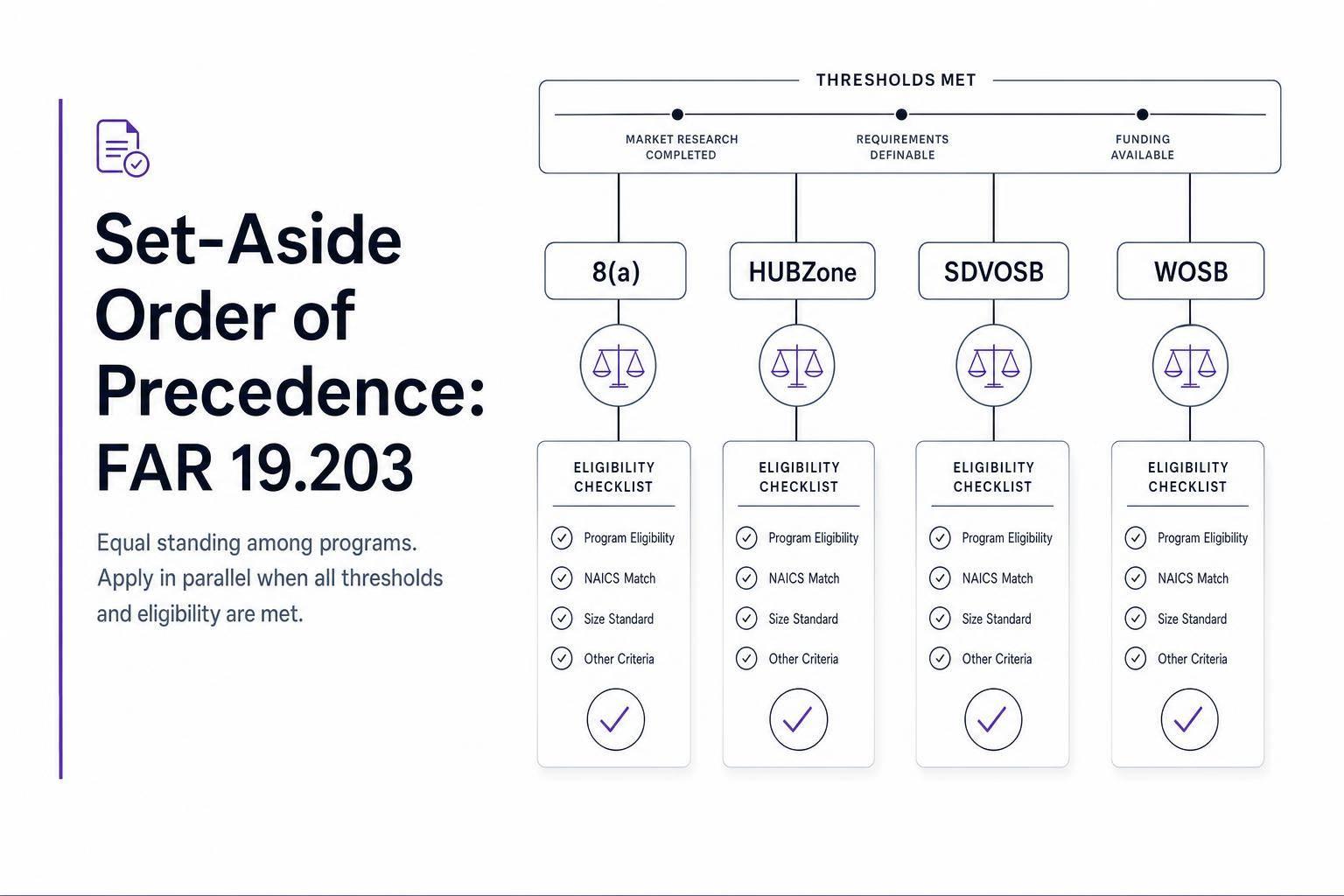
Here’s the short answer: FAR 19.203 does not rank 8(a), HUBZone, SDVOSB, and WOSB. If I’m checking a bid, I should treat those four programs as equals and then look at three things in order: dollar threshold, set-aside path, and firm eligibility.
If the buy is above the simplified acquisition threshold, now generally $350,000, the contracting officer looks at the four socioeconomic programs first. If the buy is over the micro-purchase threshold but at or below $350,000, the starting point is usually a general small-business set-aside under the rule of two. That means the officer needs a reasonable expectation of at least 2 responsible small businesses offering fair-market pricing.
Before I say yes or no to an opportunity, I’d check:
- The solicitation NAICS code, not my company’s main NAICS
- The size standard tied to that NAICS
- The set-aside type listed in the solicitation
- Current certification status for 8(a), HUBZone, SDVOSB/VetCert, WOSB, or EDWOSB
- SAM.gov status, reps, and any SBA records
- Limits on subcontracting, place of performance, and JV or affiliation issues
A lot of teams miss bids for the wrong reason. They assume the agency had to go to 8(a) first or that a certification alone makes them eligible. It doesn’t. Program parity is about no fixed sequence; eligibility is about whether you meet the rules for that solicitation.
Quick comparison
| Topic | What I should remember |
|---|---|
| 8(a), HUBZone, SDVOSB, WOSB | No fixed ranking under FAR 19.203 |
| Above $350,000 | Agency considers socioeconomic programs before a general small-business set-aside |
| At or below $350,000 | General small-business set-aside usually comes first |
| Rule of two | Usually means 2 or more responsible small businesses at fair-market price |
| NAICS check | Use the solicitation’s NAICS and size standard |
| Certification check | Certification alone is not enough |
If I keep those checks separate, I’m less likely to misread the solicitation or screen out a bid that still fits.
How Contracting Officers Apply the Set-Aside Rules
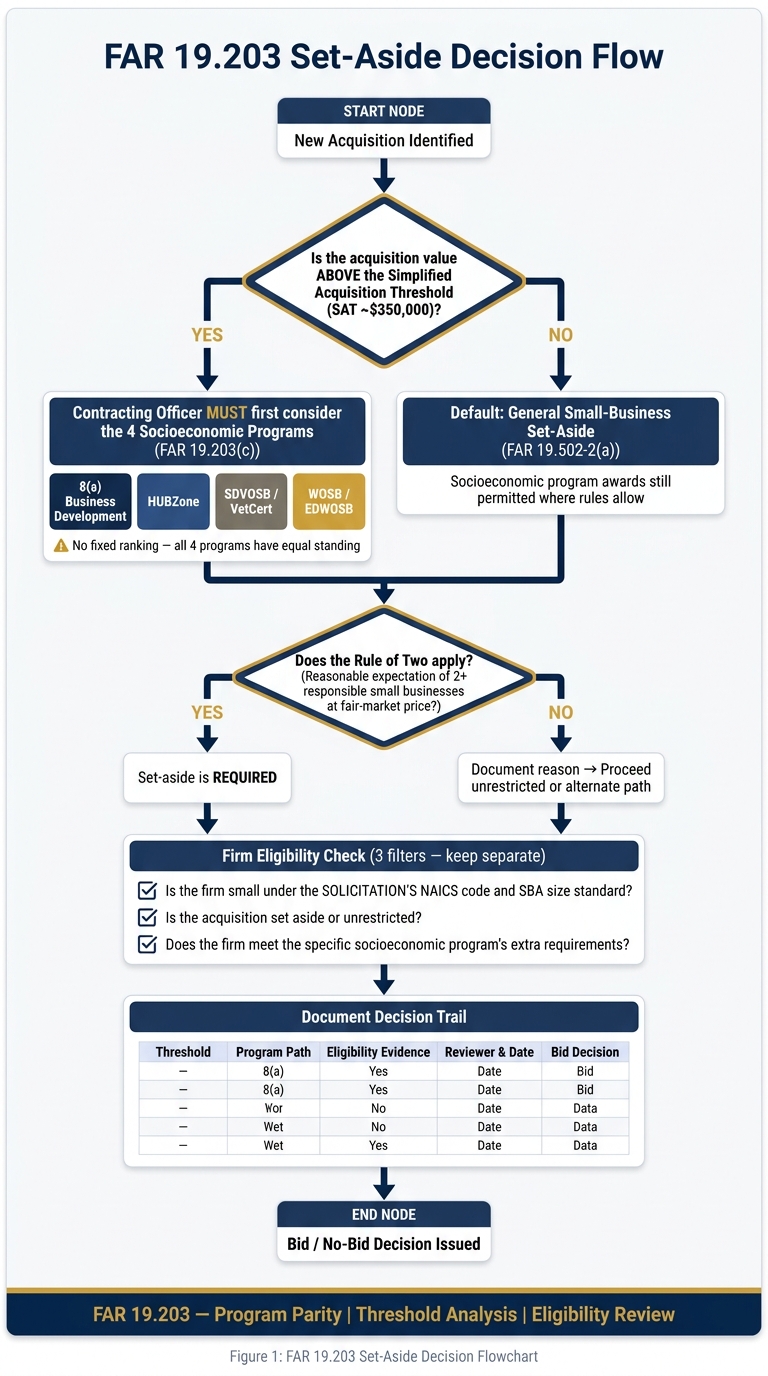
FAR 19.203 Set-Aside Decision Flow: Threshold, Program & Eligibility
Once parity is in place, the next step is simple on paper but more nuanced in practice: the contracting officer works from the threshold up. The starting points are the dollar value, the threshold, the type of requirement, and whether the work fits a socioeconomic program.
Before anything else, the officer identifies the value of the acquisition, confirms the right thresholds under FAR 2.101, and conducts market research. That groundwork matters because it shapes every set-aside decision that follows.
Acquisitions above the simplified acquisition threshold
When an acquisition is above the SAT, FAR 19.203(c) says the contracting officer must first consider whether the requirement fits one of the four socioeconomic programs:
- 8(a)
- HUBZone
- SDVOSB
- WOSB/EDWOSB
This is not a fixed ladder where one program always comes before another. The officer is choosing among allowed options. That choice turns on market research, program eligibility, agency goals, and the nature of the requirement itself.
If the officer does not use one of those programs, the next step is to look at a general small-business set-aside under FAR 19.502-2(b).
Acquisitions at or below the simplified acquisition threshold
At or below the SAT, the analysis starts in a different place. Here, the officer begins with the general small-business set-aside.
For purchases above the MPT but at or below the SAT, the default rule under FAR 19.502-2(a) is a general small-business set-aside. In plain English, that means the contracting officer must reserve the buy for small business unless there is no reasonable expectation of getting offers from at least two responsible small businesses that can compete on fair-market price, quality, and delivery.
That starting point does not block 8(a), HUBZone, SDVOSB, or WOSB treatment where the rules allow it. For bid/no-bid calls, the threshold tells you where the analysis starts. Eligibility tells you where it can end.
How the rule of two affects the set-aside choice
The rule of two is the working test behind a general small-business set-aside. The contracting officer must reasonably expect offers from at least two responsible small-business concerns that can compete at fair-market prices and provide acceptable quality and delivery.
If that expectation is there, the set-aside is required.
If it is not, the officer documents the reason and moves forward under the proper unrestricted path or another allowed acquisition route.
The rule of two also isn’t one single formula that works the same way everywhere. Program-specific rules and the terms of the solicitation still control.
For bid teams, it helps to map the threshold logic first and check program eligibility second. Contingency operation rules and allowed deviations can shift the threshold analysis. Once that path is clear, teams can compare which program fits the requirement.
sbb-itb-bb3960c
Comparing the Programs Covered by FAR 19.203
Once you finish the threshold analysis, the next filter is program eligibility. At this stage, the key is simple: compare the programs by eligibility, not by rank.
8(a), HUBZone, SDVOSB, and WOSB/EDWOSB at a glance
Each program has its own rules. And those differences matter when a team is deciding whether it can bid.
| Program | Eligibility | Required status | Typical set-aside authority | Common disqualifier |
|---|---|---|---|---|
| 8(a) | Small business accepted into SBA’s 8(a) Business Development Program | Active SBA 8(a) participation and program compliance | Competitive 8(a) set-aside; 8(a) sole-source | Assuming disadvantaged status or a SAM.gov profile equals active 8(a) eligibility |
| HUBZone | Small business meeting SBA HUBZone ownership, principal-office, and employee-residency requirements | SBA HUBZone certification and continuing location/workforce compliance | HUBZone set-aside; HUBZone sole-source | Principal office relocated or employee residency no longer satisfies HUBZone rules |
| SDVOSB | Small business at least 51% owned and controlled by one or more service-disabled veterans | SBA VetCert certification with ownership, control, and veteran-status records | SDVOSB set-aside; SDVOSB sole-source | Ownership alone is not enough if a non-veteran controls long-term decisions or daily operations |
| WOSB | Small business at least 51% owned and controlled by women who are U.S. citizens | WOSB certification or qualifying status documentation, plus eligibility under the solicitation’s NAICS code | WOSB set-aside; WOSB sole-source | Failing to verify whether the solicitation’s NAICS code is eligible for WOSB treatment |
| EDWOSB | WOSB that also satisfies SBA’s economic-disadvantage requirements | EDWOSB certification or qualifying status documentation, plus required economic-disadvantage records | EDWOSB set-aside; EDWOSB sole-source | Meeting WOSB ownership rules but not the additional economic-disadvantage criteria |
This is where many qualification mistakes start.
HUBZone eligibility depends on location and workforce, not just ownership. A company can lose HUBZone eligibility after moving its principal office or falling short of the employee-residency test. SDVOSB has a similar trap: ownership by itself doesn’t do the job if a non-veteran controls long-term decisions or daily operations.
WOSB and EDWOSB have their own catch. Women’s ownership alone does not make every procurement eligible. The solicitation’s NAICS code has to be one the program covers. Miss that step, and a bid team can think it’s lined up for a set-aside when it isn’t.
Those gaps are where teams most often misread the order of the rules.
General small-business set-asides are not lower-status options
A general small-business set-aside is not some backup lane or lower-status option. It’s the tool agencies use when no socioeconomic program matches the acquisition.
What matters here is more direct:
- Eligibility under the applicable NAICS size standard
- An accurate SAM.gov registration
- Compliant solicitation representations
If those pieces are in place, the business may qualify for the general small-business set-aside even when none of the named socioeconomic programs apply.
Where Bid Teams Misread FAR 19.203 During Qualification
The most common error: assuming a fixed program sequence
After the eligibility checklist, the next place teams slip up is sequence. A lot of bid teams read FAR 19.203 like it sets a ranking. It doesn’t.
Under the rule, 8(a), HUBZone, SDVOSB, and WOSB have equal standing. For acquisitions above the SAT, agencies must consider those programs before using a general small-business set-aside. GAO backed that reading in EDWOSB Transformer Services, LLC.
That changes the screening question. The issue is not whether one program should have come before another. The issue is whether your firm qualifies for the program the agency actually chose.
So if a solicitation is HUBZone, a capture manager should not toss it out just because it isn’t 8(a). That’s reading a ranking into the rule that isn’t there.
Qualification errors that appear in live bids
These mistakes tend to show up in the middle of bid/no-bid review, when people are moving fast and filling in gaps from memory.
| Common team assumption | Correct interpretation | Practical consequence |
|---|---|---|
| FAR 19.203 requires 8(a) first, then HUBZone, SDVOSB, and WOSB. | No order of precedence exists among those four programs. | Don’t disqualify a bid because it skips a program you expected to come first. |
| HUBZone status alone is not enough; size and current HUBZone compliance still control. | The firm must also meet the solicitation’s NAICS size standard and all current HUBZone requirements. | Validate size and certification on their own before bid/no-bid approval. |
| The solicitation NAICS controls size, not the company’s primary NAICS. | Size is determined under the NAICS code assigned to the procurement, not the company’s primary code. | Recalculate eligibility using the solicitation NAICS – even if you’re small under another code. |
| Certification does not make every set-aside available; program, size, ownership, and solicitation terms still control. | Certification is not the same as eligibility for every solicitation. Program, NAICS, size, ownership, and solicitation conditions all matter. | Match the certification to the exact procurement and submission requirements. |
| Agency practice is acquisition-specific, not a FAR-wide ranking. | Agency practice reflects a specific acquisition strategy – not a universal FAR ranking. | Analyze the actual solicitation; don’t assume another agency’s pattern applies. |
A qualification checklist to use before bid/no-bid
Before the team gives a bid/no-bid answer, check the basics and keep dated proof. This is the part people skip when they’re in a hurry, and it’s often where avoidable mistakes start.
- Solicitation basics: Record the solicitation number, agency, release date, proposal deadline, and any amendment dates. Use U.S. date formatting and the time zone stated in the solicitation.
- Acquisition value and structure: Note the estimated value, option periods, contract type, and whether the requirement is above the SAT. Use the solicitation, the current FAR, and the SBA rules that apply instead of relying on an old threshold figure.
- NAICS and size: Copy the exact NAICS code from the solicitation and confirm the matching SBA size standard, whether that’s based on revenue or employee count. Include affiliates and any joint-venture issues in the check.
- Set-aside type: Identify whether the requirement is unrestricted, a general small-business set-aside, 8(a), HUBZone, SDVOSB, WOSB, or EDWOSB. Don’t assume there’s a fixed order.
- Socioeconomic status: Confirm current certification, ownership, control, location, program-specific timing rules, and any continuing program requirements.
- SAM.gov and SBA records: Check that SAM.gov registration is active, representations and certifications are accurate, SBA records are in place, and any solicitation-specific database requirements are met.
- Performance eligibility: Review place-of-performance rules, subcontracting limits, similarly situated entity rules, key personnel, licenses, security requirements, and past performance requirements.
- Document control: Save dated evidence for the NAICS review, size analysis, certification check, SAM.gov status, amendments, and internal approval.
- Escalation: Send unresolved issues about NAICS challenges, size status, affiliation, ownership and control, certification validity, joint ventures, or material solicitation ambiguity to qualified procurement counsel or the right SBA or contracting-officer contact before submitting an offer.
Use this reading to test the qualification workflow below.
A Practical Compliance Workflow and Key Takeaways
Review steps for proposal and capture teams
Take the earlier checklist and turn it into a written decision trail. The goal is simple: make the bid/no-bid call easy to trace later if someone reviews it internally or challenges it in a protest.
Start by confirming the SAT, which is generally $350,000, while keeping an eye out for exceptions and agency-specific rules. Then confirm the solicitation’s NAICS code and size standard from the solicitation itself. After that, identify the set-aside path: full and open, a general small-business set-aside, or a socioeconomic program.
Before you issue a written qualification record, verify the firm’s status in SAM.gov and with SBA. From there, note any solicitation-specific obligations, including subcontracting limits and place-of-performance rules. If you spot a conflict between the solicitation, FAR Part 19, SBA rules, or an agency supplement, put that conflict in writing and escalate it.
The three decision layers are threshold, program path, and firm eligibility. Keep them separate. That’s what makes the record traceable and easier to defend.
Record each decision in a format that shows the rule, the evidence, and the final call.
| Field | What to record |
|---|---|
| Opportunity and acquisition details | Solicitation number, agency, title, response deadline, contract type, vehicle, anticipated value, applicable threshold |
| NAICS and size standard | Solicitation NAICS code, size standard, affiliate and JV analysis |
| Program path considered | 8(a), HUBZone, SDVOSB, WOSB/EDWOSB, general SB, or full and open |
| Eligibility evidence and open issues | SAM.gov status, SBA certification or program record, ownership docs, required representations, expired registration, affiliation uncertainty, ambiguous NAICS, clause conflicts |
| Reviewer and date | Capture lead, contracts reviewer, counsel, date, source documents checked |
| Bid decision | Bid, no-bid, bid subject to cure, or request for clarification |
| Decision basis | Decision tied to FAR rule, solicitation language, and eligibility evidence |
How Narwin.ai can support qualification without replacing legal review
Tools can help teams move faster, but they do not control the decision. The controlling sources are still the solicitation, the FAR, SBA rules, and legal review.
Narwin.ai can help at the screening stage by surfacing opportunities from U.S. and Canada public bid sources. It can also pull out set-aside language, deadlines, and compliance requirements straight from solicitation documents. That can save time when a team is sorting through a stack of opportunities.
Its bid/no-bid signals and compliance gap flags are useful for initial screening only. Final eligibility still turns on the solicitation, FAR, SBA rules, and counsel. In the qualification record, label any Narwin.ai output that way so no one treats it as the last word.
Key rules to remember from FAR 19.203
FAR 19.203 requires teams to separate three decision layers: program parity, threshold analysis, and eligibility review.
Above the SAT, the contracting officer must consider the socioeconomic programs before using a general small-business set-aside. At or below the SAT, the default is a general small-business set-aside, although an award under a socioeconomic program is still allowed.
Use these three checks before making a bid/no-bid call:
- Is the concern small under the solicitation NAICS and the SBA size standard that applies?
- Is the acquisition set aside or unrestricted?
- Does the firm meet the extra requirements of the specific socioeconomic program?
Keeping those checks separate helps teams avoid the most common reading mistakes. It also gives the file a defensible record if a size protest or eligibility challenge comes up.
FAQs
How do I know which set-aside rules apply first?
First, identify the governing framework for the opportunity. Contracting officers follow FAR 19.203. It does not give automatic priority to 8(a), HUBZone, SDVOSB, or WOSB. The choice depends on the rule of two and the agency’s own goals.
A common mistake is thinking one program always comes first. That’s not how it works. Check the solicitation’s set-aside status, then confirm your eligibility in SAM.gov for the listed NAICS code.
Can my certification still fail me on a bid?
Yes. Your certification can sink a bid if it doesn’t line up with the solicitation.
Contracting officers check your socioeconomic status – such as 8(a), HUBZone, WOSB, or SDVOSB – against your SAM.gov registration and the solicitation’s NAICS code. If that status has expired, was self-certified the wrong way, or doesn’t match the set-aside requirement, you may be disqualified.
What should I verify before a bid/no-bid decision?
Before you commit to a bid, make sure you’re eligible and that you meet every required solicitation item. Miss one pass/fail requirement, and you can be out right away.
Start with the basics. Check that your SAM.gov registration is active, your UEI/CAGE data is up to date, and your socioeconomic certifications line up with the right NAICS code.
During intake, review the pass/fail items first:
- Bonding
- Security clearances
- Insurance limits
It also helps to build a compliance matrix for Sections C, L, and M so you can track what the solicitation asks for and what your team needs to submit. At the same time, complete an OCI review to catch conflict issues early.