
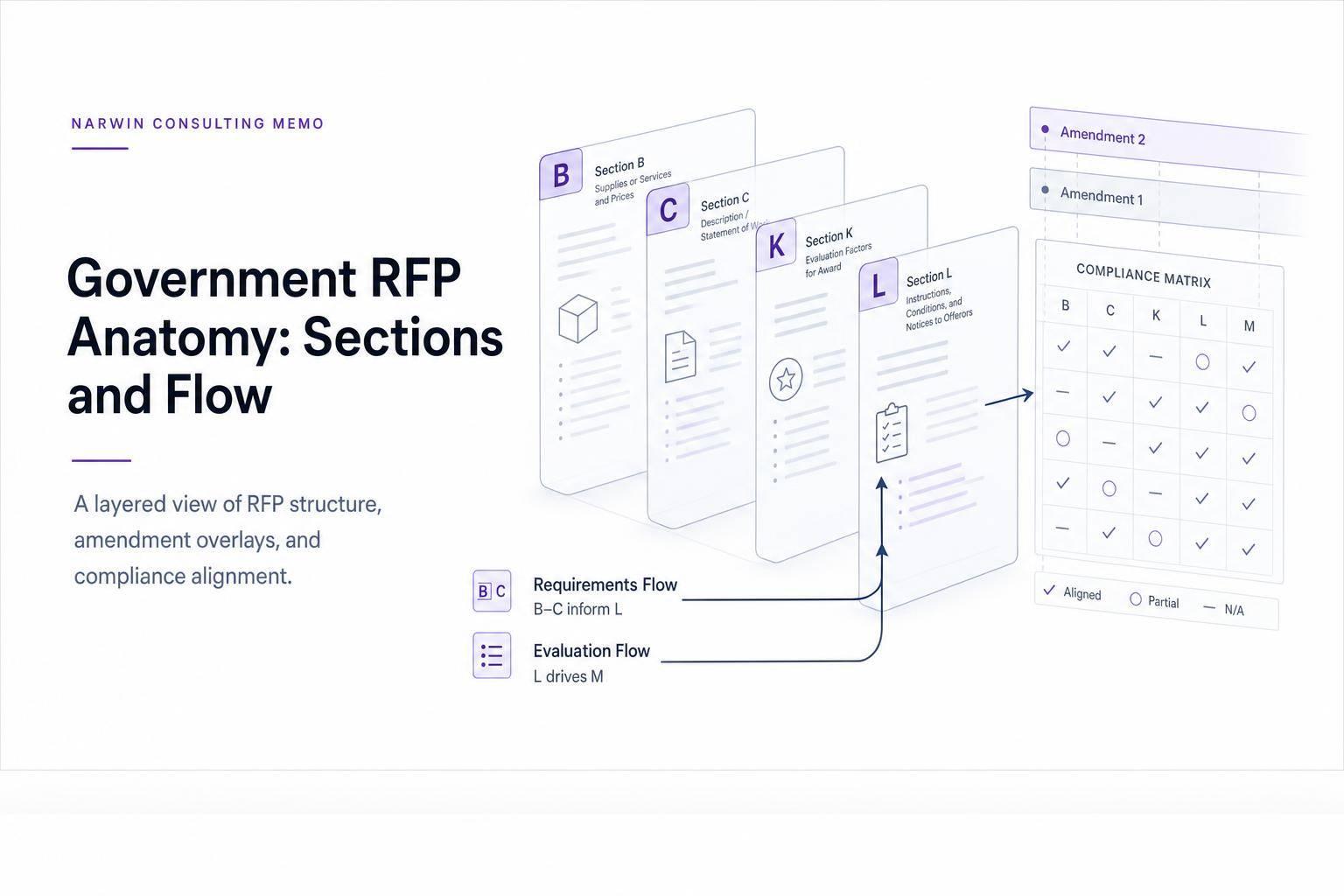
If you read a government RFP like one PDF, you can miss the bid. I read it as one package: notice, main sections, clauses, attachments, and every amendment.
Here’s the short version:
- Sections B and C tell me what the agency is buying and how it will be priced.
- Section M tells me how proposals will be judged.
- Section L tells me how to format and submit the response.
- Section K covers reps, certs, and eligibility checks.
- Attachments, Q&A, and amendments can change instructions, scope, and due dates.
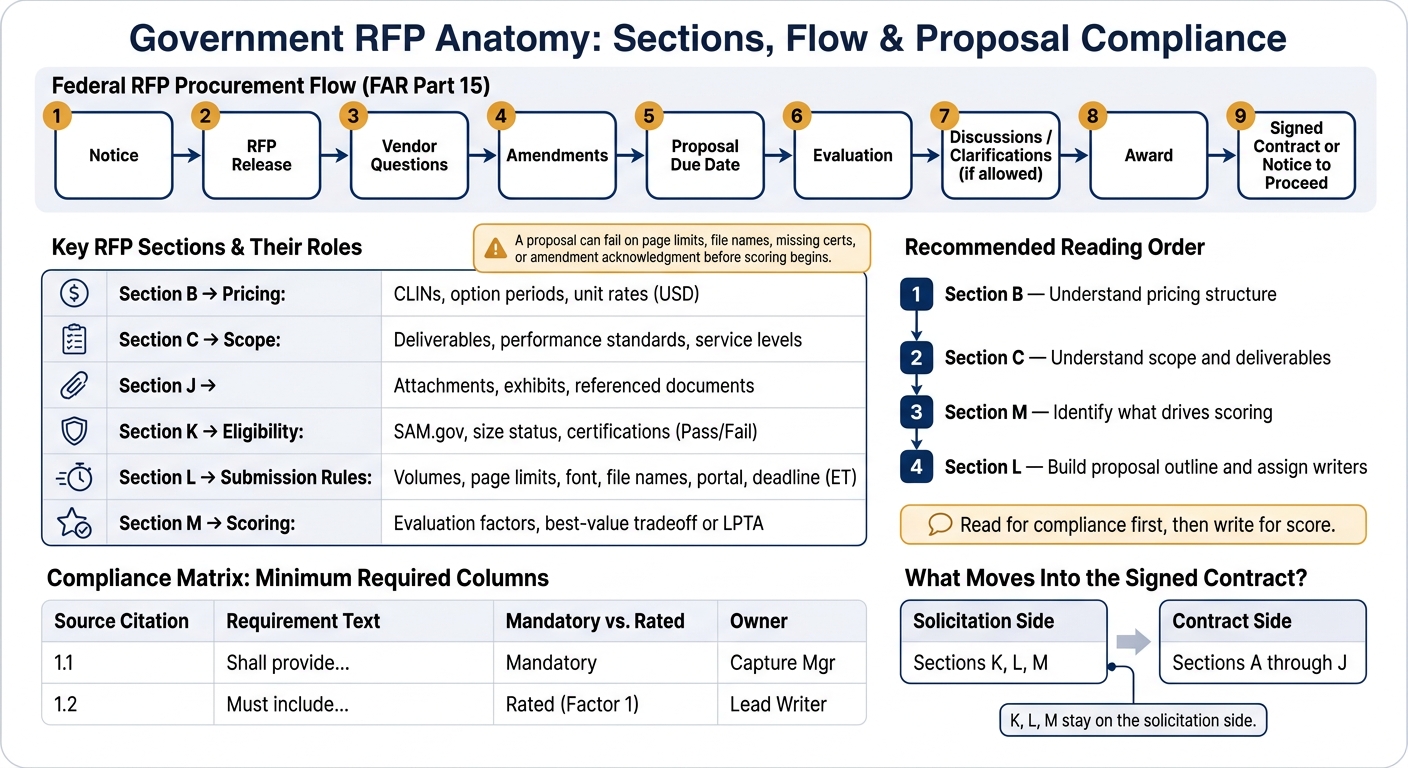
- A proposal can fail on page limits, file names, missing certs, or amendment acknowledgment before anyone scores the technical approach.
In U.S. federal work, this flow is common: notice → RFP release → vendor questions → amendments → proposal due date → evaluation → discussions or clarifications if allowed → award → signed contract or notice to proceed.
A few facts matter here:
- Federal negotiated buys often use FAR Part 15 rules.
- Section M drives scoring, including best-value tradeoff or LPTA.
- The signed contract is usually built from Sections A through J.
Sections K, L, and M stay on the solicitation side.
I use one rule every time: read for compliance first, then write for score. That means building a compliance matrix early, tracking every shall, must, deadline, attachment, and amendment before drafting starts.
This article explains that flow in plain English so you can see where each requirement lives and how the parts connect.
Government RFP Anatomy: Sections, Flow & Proposal Compliance
Core RFP Structure: Notice, Schedule, Clauses, and Attachments
How to Read a Solicitation as a Linked Set
Treat the RFP as one connected package: the notice, schedule, clauses, attachments, amendments, and any documents it points to. Start with the notice. Then move through the schedule, clauses, attachments, and amendments in that order.
Before you draft anything, map how those pieces connect. Think of it like tracing wires before you flip the switch. Once your document map is clear, follow every cross-reference all the way back to its source.
How to Track Cross-References Across the Main Sections
A missed cross-reference usually means a missed requirement. That’s where teams get into trouble.
Mark a requirement as EXTRACTED when the solicitation states it directly. Use INFERRED only when a cited source clearly points to it. No guesswork. No filling in blanks because something “probably” applies.
Then check every referenced file against the current amendment set. If an amendment changed the file, your map should show that right away.
Attachments and Referenced Documents Are Part of the Requirement Set
Attachments, exhibits, cited regulations, and amendments are all part of the requirement set. They’re not side material. They carry instructions, terms, and scoring details that may not appear in one place.
Link each source back to the related section of the main solicitation, and update your map when amendments come in. That map helps you keep instructions, evaluation rules, and contract terms tied to the right source document.
This matters most when the solicitation splits key items across sections, especially instructions, certifications, and scoring rules.
sbb-itb-bb3960c
The Sections That Drive Proposal Work: Instructions, Certifications, and Evaluation
Sections K, L, and M: Eligibility, Proposal Format, and Scoring
Once you have the document map, shift your attention to the three sections that run proposal work: K, L, and M. They each play a separate role, and together they shape what you can submit, how you submit it, and how it will be scored.
Section K is the eligibility gate. It covers representations and certifications, SAM.gov registration, size status, socio-economic status, and statutory compliance. These items are usually pass/fail. That’s why this section should go to contracts, legal, or compliance before drafting starts.
Section L is the rulebook for the submission itself. It spells out required volumes, page limits, font and margin rules, and the submission method, including the portal, file format, file names, and deadline, often down to the hour in ET. Miss a small formatting rule in Section L, and even a strong proposal can be rejected before an evaluator reads a single word.
Section M lays out the scoring factors and weighting. It also tells you whether the source selection uses best-value tradeoff or LPTA, which shapes both your technical approach and your pricing plan.
How Sections B, C, L, and M Work Together
These four sections work as one system.
- Section C defines the work: deliverables, performance standards, and service levels.
- Section B defines how that work is priced: contract line items (CLINs), option periods, and unit rates in U.S. dollars.
- Section L defines how your response must be arranged and submitted.
- Section M defines how the government will judge it.
A simple reading order helps: B, C, M, then L.
Start with B and C so you understand what the government is buying and how the deal is set up. Then move to M to see which parts of that scope will drive scoring. After that, use L to build the proposal outline and assign writers.
This is also where teams get tripped up. What you promise in the technical volume, driven by Section C, has to match what you price in the cost volume, driven by Section B. And both have to follow the structure in Section L while speaking to what Section M rewards. If a proposal is strong on paper but placed in the wrong volume, or if the pricing doesn’t line up with the technical claims, it will underperform no matter how good the underlying solution is.
That’s the job of the compliance matrix: to track that alignment and catch technical, pricing, and format mismatches before they become a problem.
How to Track Requirements Across the Full Document Set
Build a Compliance Matrix Before Drafting Starts
Start with the section map from the previous step, then turn it into a compliance matrix before anyone starts drafting.
That matrix should track every instruction, requirement, evaluation factor, certification, deliverable, and deadline in the solicitation. As you review the documents, look for mandatory verbs like shall, must, and will. Those words help turn the solicitation into a traceable path from the notice language to the items your team has to address.
At a minimum, each row in the matrix should include:
| Column | What to Capture |
|---|---|
| Source citation | Section or document reference |
| Requirement text | Exact language from the document |
| Mandatory vs. rated | Whether the item is mandatory or scored |
| Owner | Name of the person responsible |
This sounds simple, but it saves a lot of trouble later. Instead of hunting through files and asking, “Did we cover that requirement?”, you have one place that ties each item to the person handling it.
Treat Amendments, Attachments, and Referenced Documents as Live Inputs
Keep the matrix current every time a new amendment comes in. A solicitation doesn’t sit still. Amendments, revised pricing sheets, and updated Q&A documents can override earlier instructions, so they need version control from the moment they arrive.
Treat Section J and its attachments as required inputs, not side material. The same goes for referenced clauses. If a clause is incorporated by reference, it can still carry binding instructions that affect the full response package.
Where AI Can Help With Extraction and Tracking
Manually parsing a large solicitation package takes time, and that creates room for missed requirements. AI can help pull out directive language, tag requirements by document section, flag deadlines, and point out compliance gaps for human review.
Narwin.ai can extract requirements, questions, deliverables, and deadlines, then help teams keep the compliance matrix current across the full document set.
Human review still owns the final compliance check.
Award Flow, Contract Terms, and Key Takeaways
From Evaluation to Notice of Award and Contract Formation
Once the compliance matrix is done, the next job is to follow how the agency moves from review to award.
After submission, the agency uses Section M to score proposals. That usually starts with mandatory pass/fail checks, then moves to technical and price factors. If the solicitation allows clarifications or discussions, those steps happen before the final decision. Clarifications are narrow. Discussions can open the door to revisions. That difference matters before the source selection decision is final.
An award notice or intent-to-award notice means your team was selected. It does not automatically mean a contract exists. Before anyone starts work, confirm whether performance can begin right away or only after a signed contract, task order, or notice to proceed is issued. Contract formation happens when an authorized contracting officer signs the final terms.
After award, the solicitation’s clauses, pricing tables, and special requirements are no longer just proposal material. They become binding contract terms. And this is where small mistakes can turn into big headaches. A pricing error or flow-down issue often doesn’t show up until performance starts, when fixing it is expensive and messy.
Key Points to Remember When Reading Any Government RFP
Use the award flow above as a gut check on the details that most often decide whether a proposal makes it through submission and award review.
A proposal has to line up across pricing, scope, instructions, and evaluation criteria. If one piece drifts from the others, you can lose the award or run into problems during performance. The safest approach is to use the same reading order every time: Sections B and C, then M, then L, with attachments and amendments checked along the way.
Before final submission, do one last compliance review:
- Confirm the latest amendment is acknowledged
- Make sure pricing matches the schedule
- Check that all required certifications are included
- Verify that every mandatory attachment is present
FAQs
What is a compliance matrix?
A compliance matrix is a tool that helps you make sure every mandatory RFP requirement is covered in your proposal. It links each requirement to the right proposal section and page, which helps you avoid compliance slipups that can get a bid thrown out.
Most compliance matrices track each item by source, such as Section L instructions or Section M evaluation criteria. They also usually include a unique ID, status, and owner.
When do amendments override the RFP?
Formal amendments override the RFP when they’re issued as part of the solicitation and change requirements, evaluation factors, page limits, or deadlines.
Once an amendment is out, your proposal needs to match the new terms for those updates. That means going back through your compliance matrix, checking the revised language, and tracing those changes across the full document set. In some cases, a formal amendment also resets the timeline.
What makes a proposal non-compliant?
A proposal becomes non-compliant when it misses a mandatory agency requirement. And that can lead to automatic disqualification.
The most common problems are pretty simple on the surface, but they can sink the whole submission. These include:
- Missing signatures
- Going over page limits
- Leaving out required certifications
- Skipping mandatory questions
- Not following Section L instructions
- Not aligning with Section M evaluation criteria
Even small mistakes can get a proposal rejected. Things like using the wrong font size or leaving out administrative documents may seem minor, but agencies often treat them as hard compliance failures.