

Want to win more government contracts? Start with pWin.
pWin, or Probability of Win, is a percentage-based metric that helps you decide which government bids are worth pursuing. It evaluates factors like past performance, pricing, relationships, and technical capabilities to estimate your chances of success.
Here’s why it matters:
- Save Time and Money: Government bids cost around $100,000 on average, and win rates are often just 10–20%. pWin helps you focus on bids with the highest potential.
- Better Decisions: Use data, not guesswork, to prioritize opportunities and allocate resources.
- Spot Weaknesses Early: Improve your chances by addressing gaps in compliance, staffing, or technical solutions before submitting your proposal.
Key Takeaways:
- Top Factors: Past performance, pricing strategy, buyer relationships, and technical fit heavily influence pWin.
- How to Calculate: Assign weights to critical factors (e.g., compliance, pricing) and score each on a 1–5 scale.
- AI Tools Help: Platforms like Narwin.ai can automate pWin analysis, flag risks, and suggest improvements.
Want to improve your win rate? Focus on high-pWin opportunities, track your scores over time, and refine your approach with tools and data.
Factors That Influence pWin
Your pWin score is shaped by a variety of measurable factors that evaluators consider when ranking proposals. Understanding these criteria helps you pinpoint where to focus your efforts. Below, we break down how evaluation criteria, pricing strategies, and relationships impact your pWin score.
Evaluation Criteria and Past Performance
Meeting compliance standards is non-negotiable. Missing even one mandatory requirement can disqualify your proposal outright. A study of 200 IT RFPs revealed that 34% of losing proposals failed to meet a mandatory requirement, while fully compliant submissions were 3.2 times more likely to win.
Past performance is another critical factor, often contributing 20% to 30% of your evaluation score. Agencies value recency, scope, and complexity in prior contracts that closely resemble the current opportunity. Winning proposals clearly connect past successes to RFP requirements. For example, saying, "Our migration of Agency X aligns with the scope in Section C.3", is far more effective than vague claims of "extensive experience." Specific metrics like "99.97% uptime" or "$3.2M in cost savings" also carry more weight than general descriptions.
Strong CPARS ratings and qualified personnel, such as those holding PMP or CISSP certifications, can significantly boost your chances – firms with these credentials win 2–3 times more often. In IT contracts, 72% of RFPs require SOC 2 Type II compliance, and 48% mandate FedRAMP authorization. Each of these factors directly influences your pWin score, helping you prioritize resources effectively.
Competitive Landscape and Pricing
Your pricing strategy must align with the evaluation method outlined in the RFP. For instance, in best-value tradeoff evaluations – which make up 77% of analyzed IT RFPs – the lowest bidder only won 31% of the time. Instead, winners often priced their bids 10–15% higher but excelled in technical merit and past performance.
Price realism reviews can penalize bids that severely underestimate the work outlined in the Statement of Work. Historically, the most successful bids fall within the 25th to 50th percentile of winning prices. Teaming agreements can also enhance competitiveness, especially for small businesses.
In re-compete scenarios, challengers win 38% of the time, compared to just 12% for brand-new competitive solicitations. Bridge contracts – short-term extensions – often signal dissatisfaction with the incumbent, creating better opportunities for challengers to secure the win.
Relationships and Buyer Intelligence
While technical and pricing factors are crucial, relationships and buyer insights can tip the scales in your favor.
Customer intimacy gives you access to critical insights that shape your proposal before the RFP is even released. Building strong relationships with program managers and contracting officers helps you understand how requirements will be interpreted, what evaluation priorities exist, and any budget constraints. These relationships also allow you to validate your solution against real-world needs.
Pre-solicitation calls and competitor "Black Hat" reviews can uncover potential gaps in your proposal that might lower your pWin. For incumbents, the strength of customer relationships can account for as much as 30% of pWin calculations. However, relationships alone won’t secure a win – you still need a compliant proposal, competitive pricing, and technical solutions that meet the evaluation criteria.
Monitoring contract end dates and tracking procurement trends by agency can also help you identify the most promising opportunities. Different agencies have unique purchasing habits, preferred contract vehicles, and evaluation priorities. By analyzing your historical win rates by NAICS code and agency, you can spot where your strengths align with buyer needs and avoid wasting resources on low-probability pursuits.
sbb-itb-bb3960c
How to Calculate pWin
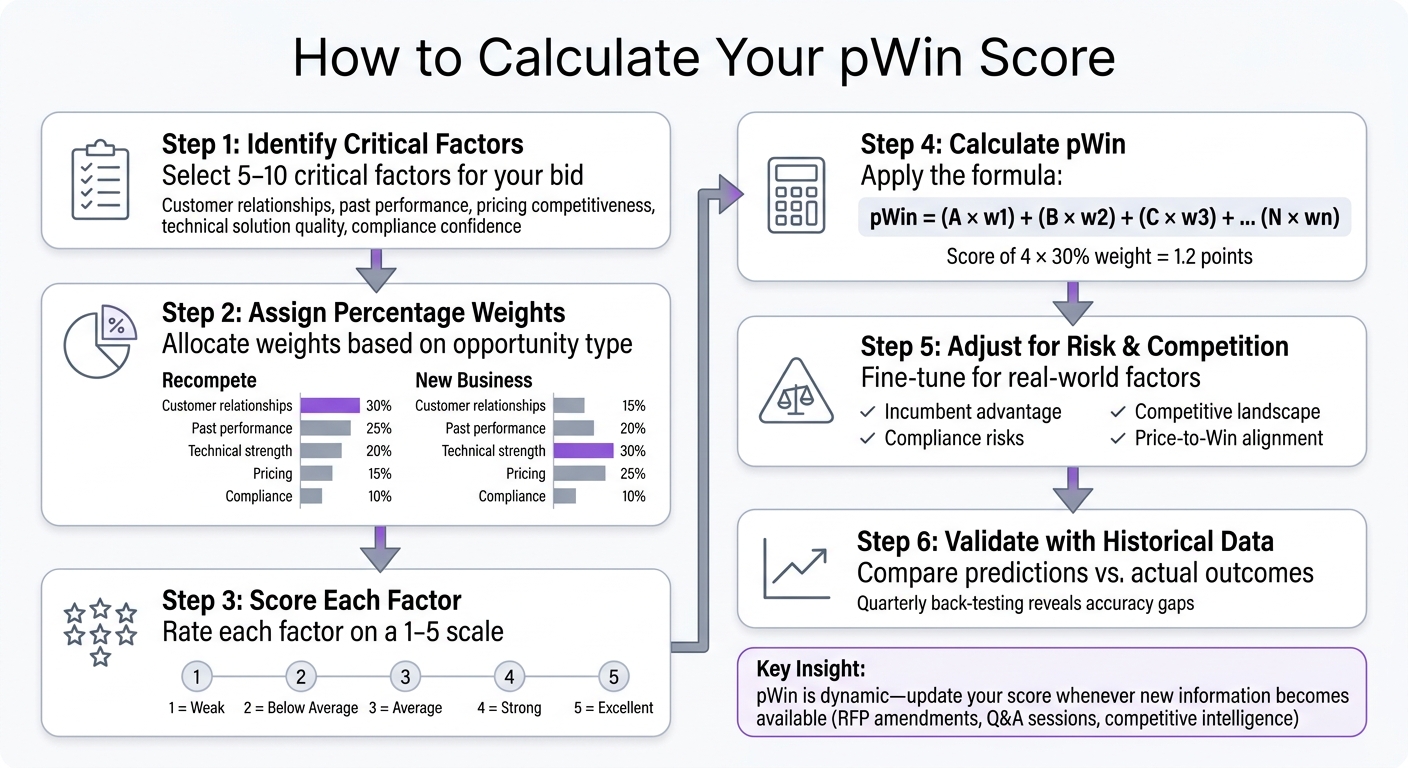
How to Calculate pWin Score for Government Bids: Step-by-Step Process
Calculating pWin transforms observations into actionable numbers that guide bidding decisions. It involves creating a scoring system, factoring in real-world risks, and testing your model against past outcomes. Here’s how to approach it step by step.
Building a Weighted Scoring System
Start by identifying five to ten critical factors for the opportunity at hand. Common criteria include customer relationship strength, relevance of past performance, pricing competitiveness, technical solution quality, and compliance confidence. Assign percentage weights to each factor based on its importance for that specific bid.
For example, in a recompete scenario, you might allocate 30% to customer relationships, 25% to past performance, 20% to technical strength, 15% to pricing, and 10% to compliance. On the other hand, for a brand-new opportunity, you’d likely shift the focus by reducing the weight for relationships and increasing emphasis on technical and pricing factors.
Once weights are set, rate each factor on a 1–5 scale (1 = weak, 5 = excellent). Use this formula to calculate pWin:
pWin = (A × w1) + (B × w2) + (C × w3) + … (N × wn)
Here, each letter represents a factor’s score, and "w" is its assigned weight. For instance, a customer relationship score of 4 out of 5 with a 30% weight contributes 1.2 points (4 × 0.30) to the overall pWin score.
"The weight assignment process requires careful consideration of factors and historical win patterns." – Procurement Sciences
Adjust your weights to fit the type of opportunity. Whether it’s a recompete, a new business venture, or a complex engineering task, tailoring the scoring system ensures relevance. A standardized rubric also minimizes bias and keeps evaluations consistent across team members.
Adjusting for Risk and Competition
Your initial pWin score needs fine-tuning to reflect real-world dynamics. Analyze the competitive landscape, considering factors like incumbent advantage, known competitors, and your organization’s unique strengths. If a strong incumbent is in the mix, adjust your score to reflect that challenge.
Evaluate risks individually, including compliance, proposal, and operational risks. Issues like missing key personnel, unresolved OCIs, or non-compliant facilities should trigger explicit risk flags rather than simply lowering the average score. Use conditional thresholds to determine whether pursuing the bid is viable – proceed only if specific risks are resolved.
For a more precise calculation, apply a logistic transform:
=1/(1+EXP(-8*(NormalizedScore-0.5)))
Scenario modeling can also be helpful. For instance, simulate a 4% budget cut or assume a particular rival wins the incumbent bid to see how these factors shift your chances.
Align your pWin score with your Price-to-Win (PTW) analysis. A high technical score won’t mean much if your pricing is off. If your risk review highlights strong technical alignment but weak pricing, your overall pWin should reflect that imbalance. This comprehensive approach strengthens strategic planning for bids.
Using Historical Data to Validate pWin Scores
Historical data is essential for fine-tuning your pWin model. Regularly compare predicted pWin scores with actual outcomes – this process, often called quarterly back-testing, helps identify whether your team tends to overestimate or underestimate win probabilities. For example, if bids with a 60% pWin score only win 30% of the time, it’s time to adjust your weights.
Dig into the data to uncover which factors consistently drive wins. If customer relationships were decisive in 80% of past wins, increase their weight for similar future bids. Conversely, if technical strength rarely influenced outcomes in a specific agency, reduce its weight for comparable opportunities.
Leverage resources like SAM.gov and your internal bid history to refine your scoring. Create a centralized repository of CPARS data, SOW excerpts, and past bid results to back up your scoring decisions. Advanced AI tools can also analyze large datasets to reveal patterns or correlations that might not be immediately obvious, enriching your pWin calculations with data-driven insights.
"Organizations should calibrate their weighting systems against historical win/loss data to ensure predictive accuracy." – Procurement Sciences
Keep in mind that pWin is dynamic. Update your score whenever new information becomes available, such as RFP amendments, Q&A updates, or fresh competitive intelligence. As the situation evolves, so should your pWin model. Pair these scores with a confidence rating (Low/Medium/High) to indicate the reliability of your data for that specific bid. These steps lay the groundwork for more advanced, AI-driven predictions down the line.
Advanced pWin Analysis with Narwin.ai
While manual pWin calculations lay a strong groundwork, incorporating AI-powered tools significantly boosts both accuracy and efficiency. Narwin.ai seamlessly integrates with your existing pWin framework, pulling data from sources like SAM.gov and CanadaBuys to deliver precise win probability scores in just minutes. Below, we’ll explore how Narwin.ai enhances every step of the pWin process, from prediction to proposal refinement.
AI-Powered Win Score Predictions
Narwin.ai simplifies win probability analysis by categorizing opportunities into Low, Moderate, or High probability tiers. It evaluates factors like buyer alignment, risk levels, profitability, and operational feasibility. With access to over 1,000 government tender sources across the U.S. and Canada, the platform refreshes daily at 3:00 AM EST to ensure you’re working with the latest data.
Opportunities are initially ranked with a Preliminary Match Score, which considers your firm’s certifications, past performance, and strategic goals. For deeper insights, Narwin.ai conducts detailed RFP analyses, extracting requirements, compliance clauses, and evaluation criteria to generate a formal Win Probability score. Even for lengthy RFPs exceeding 2,000 pages, this process takes less than 10 minutes. As you upload certifications (e.g., ISO, CSA, OSHA), safety records, and past project details into Narwin’s private Vector Database, the AI refines its predictions, leveraging Retrieval-Augmented Generation (RAG) to improve accuracy over time.
Go/No-Go Decision Support
Narwin.ai builds on its scoring capabilities by offering clear Go/No-Go signals to streamline decision-making. By comparing RFP requirements against your company’s profile and assets, the platform provides instant recommendations like “Go for a Bid” or “Caution: Review Further.” These recommendations are backed by detailed evaluations of compliance clauses, eligibility criteria, and any missing information.
The system also flags "Red Flag" risks that could lead to disqualification, such as compliance gaps or incomplete requirements. Alongside each risk, you’ll receive actionable mitigation tips to address potential issues before submission. With over 10 metrics benchmarked during compliance checks, Narwin ensures no critical detail is overlooked. You can further customize the analysis by adding “Special Instructions” (e.g., “Focus on structural steel scope”), allowing the AI to tailor its recommendations to your specific needs.
Improving Proposals with AI Recommendations
Narwin.ai doesn’t just stop at scoring; it also provides actionable insights to enhance your proposals. These "Win Ideas" offer targeted recommendations to strengthen your content, aligning with buyer priorities, evaluation criteria, and scoring focus.
The platform’s AI Writer speeds up proposal creation by pulling from your private AI Knowledge Base, which includes past projects, certifications, and safety records. This feature is designed to draft personalized, compliant responses up to 10 times faster than manual writing. Additionally, you can create custom AI Prompt Templates for repetitive sections like Executive Summaries or Technical Approaches, ensuring consistency in your brand voice.
For real-time strategy refinement, the "Chat with RFP" feature allows you to ask questions and receive immediate, tailored guidance.
| Feature | Function in pWin Analysis |
|---|---|
| Opportunity Matching | Scans SAM.gov/CanadaBuys to provide a Preliminary Match Score based on your firm profile. |
| RFP Analyzer | Extracts requirements and generates a Win Probability score and Go/No-Go signal. |
| Red Flag Analysis | Identifies compliance risks and buyer intent to safeguard against auto-elimination. |
| Win Ideas | Provides strategy summaries and actionable recommendations to improve proposal quality. |
How to Maximize Win Rates Using pWin
Prioritizing High-pWin Opportunities
Allocating resources effectively is where pWin analysis can make a noticeable difference. In the government contracting world, win rates typically range between 10-20%, while proposal costs often exceed $100,000. Chasing low-probability bids can quickly drain your budget without delivering results.
To avoid this, set clear guidelines for bid decisions based on pWin scores:
- pWin ≥ 70%: Proceed with a "Bid."
- pWin 50–69%: Mark as "Conditional", requiring specific risk mitigation.
- pWin < 50%: Opt for "No-Bid" or consider teaming opportunities.
This structured approach replaces guesswork with disciplined decision-making. As Rommel Llanos, author of CLEATUS, explains:
"A disciplined PWin process isn’t about guessing – it’s about capital allocation."
By focusing on high-pWin opportunities, you can channel resources into crafting stronger technical solutions, refining pricing strategies, and engaging more effectively with customers. Many firms have seen better ROI by exclusively pursuing bids with a higher likelihood of success, rather than chasing every opportunity within their NAICS code. The key is to prioritize quality over quantity.
Keep in mind that pWin scores aren’t static. Regular updates are essential to account for new developments and insights.
Tracking and Adjusting pWin Over Time
To maintain accuracy, pWin scores need to be recalibrated regularly as new information becomes available. For example, after a Q&A session or solicitation amendment, reassess your pWin score. A 5% drop in probability could indicate new compliance requirements or a shift in evaluation criteria that might require revisiting your bid strategy.
Plan for quarterly reviews of your pWin predictions. Compare your initial scores with actual outcomes to identify patterns. If you find consistent overestimations – like inflating the Past Performance factor – adjust your weighting system or tighten your evaluation criteria. This process not only improves predictive accuracy but also highlights areas for improvement, such as low Key Personnel scores that might suggest a need for better recruiting or partnerships.
Pair each pWin score with a confidence level (Low, Medium, or High) based on the quality of the supporting evidence. For instance, a 75% pWin score backed by customer call notes and draft org charts holds more credibility than one built on assumptions. Ensure high ratings in any category are supported by tangible proof, such as RFP citations or meeting summaries.
Frequent updates to your pWin scores empower your team to make informed, data-driven decisions.
Integrating pWin Analysis with Team Collaboration
pWin analysis thrives when it’s a team effort. Involve stakeholders from across your organization – technical experts, financial analysts, proposal writers, and operational managers – to reduce bias and enhance accuracy. Each team member brings unique expertise, such as estimators focusing on Price-to-Win, subject matter experts assessing Technical Fit, and sales teams evaluating Customer Relationship strength.
Centralizing pWin data on platforms like Narwin.ai’s Document Hub allows teams to work seamlessly. Team members can share analysis reports, upload certifications, and collaborate on past performance records in real time. Integration with tools like Slack ensures instant notifications for RFP updates or amendments, enabling quick discussions without the need for lengthy meetings.
Features like "Chat with RFP" allow team members to ask specific questions about compliance or evaluation criteria and get immediate, AI-supported answers. This not only speeds up decision-making but also ensures everyone is working with the same information. By leveraging AI-powered analysis and collaboration tools, teams can save over 15 hours per bid cycle, freeing up time to focus on high-pWin opportunities. Some organizations have even reported a 2000x ROI by using these tools to detect risks and avoid costly mistakes before submission.
Conclusion
Analyzing the probability of win (pWin) transforms government contracting into a precise, data-driven process. By calculating pWin scores based on weighted factors – like customer relationships, technical fit, past performance, and pricing – you can make informed go/no-go decisions and focus your budget on opportunities with real potential. Considering that industry win rates often range between 10-20% and proposal costs can exceed $100,000, this methodical approach becomes essential for ensuring long-term profitability.
Think of pWin as a dynamic metric that evolves over time. Regular updates – after Q&A sessions, customer meetings, or RFP amendments – help keep your scores accurate and actionable. Pairing each score with hard evidence, such as RFP citations, customer call notes, or CPARS excerpts, not only strengthens your analysis but also ensures transparency and prevents inflated ratings. By maintaining an up-to-date pWin analysis and incorporating AI-driven insights, you can stay competitive throughout the bidding process.
Modern AI tools, like Narwin.ai, streamline this process, reducing what could take days into just minutes. These platforms not only save time but also help refine your overall strategy, giving your team a sharper focus during the bid cycle.
Successful contractors allocate resources to bids with strong pWin scores. As Christian Ferreira, CEO of Procurement Sciences, puts it:
"Pwin, or Probability of Win, represents the cornerstone metric that separates successful government contractors from those constantly chasing opportunities without strategic direction."
Apply these principles to your next contract pursuit. Build a weighted scoring system, validate it with past outcomes, and use AI tools to speed up the process. The difference between a 10% and 20% win rate could translate into millions of dollars in additional revenue – proof that knowing where to focus your efforts makes all the difference.
FAQs
What’s the difference between pWin and Price-to-Win (PTW)?
The key distinction between pWin (Probability of Win) and Price-to-Win (PTW) lies in what they prioritize.
- pWin gauges how likely you are to win a government contract by considering factors like your track record, the strength of your proposal, and the level of competition. It’s about assessing your overall chances of success.
- PTW, however, hones in on pricing. It’s all about determining the optimal price point that keeps you competitive while still meeting the client’s expectations.
In short, while pWin gives you the big picture of your chances, PTW focuses on nailing the price to secure the deal. Both are critical, but they serve different purposes in the bidding process.
How do I set factor weights without bias?
When determining factor weights for pWin (probability of win) calculations, it’s crucial to use a clear, data-driven process. Here’s how you can approach it:
- Base Weights on Importance: Assign weights according to how critical each criterion is, ensuring they reflect actual relevance to winning outcomes.
- Leverage Historical Data: Use past win/loss data to fine-tune these weights, minimizing personal or subjective bias in the process.
- Regularly Update Weights: Periodically revisit and adjust the weights to ensure they stay aligned with current trends and outcomes.
To make the process even more precise, tools like Narwin.ai can analyze historical bid data. This kind of analysis provides objective insights that help refine factor weights, ultimately improving the accuracy of your pWin calculations.
When should I update my pWin score during a bid?
Keeping your pWin score current is essential whenever new or better information arises that might influence your likelihood of success. This includes moments like reviewing RFP requirements or collecting fresh insights about the opportunity. By regularly updating your pWin score, you ensure it mirrors the most accurate assessment of your chances, enabling smarter go/no-go decisions.
Related Blog Posts
- Narwin vs BidPrime, 1/10 price for same bids data and more advanced matching
- Government Bid Keyword Finder
- RFP Requirement Extractor
- How AI Analyzes Past Performance for RFPs