
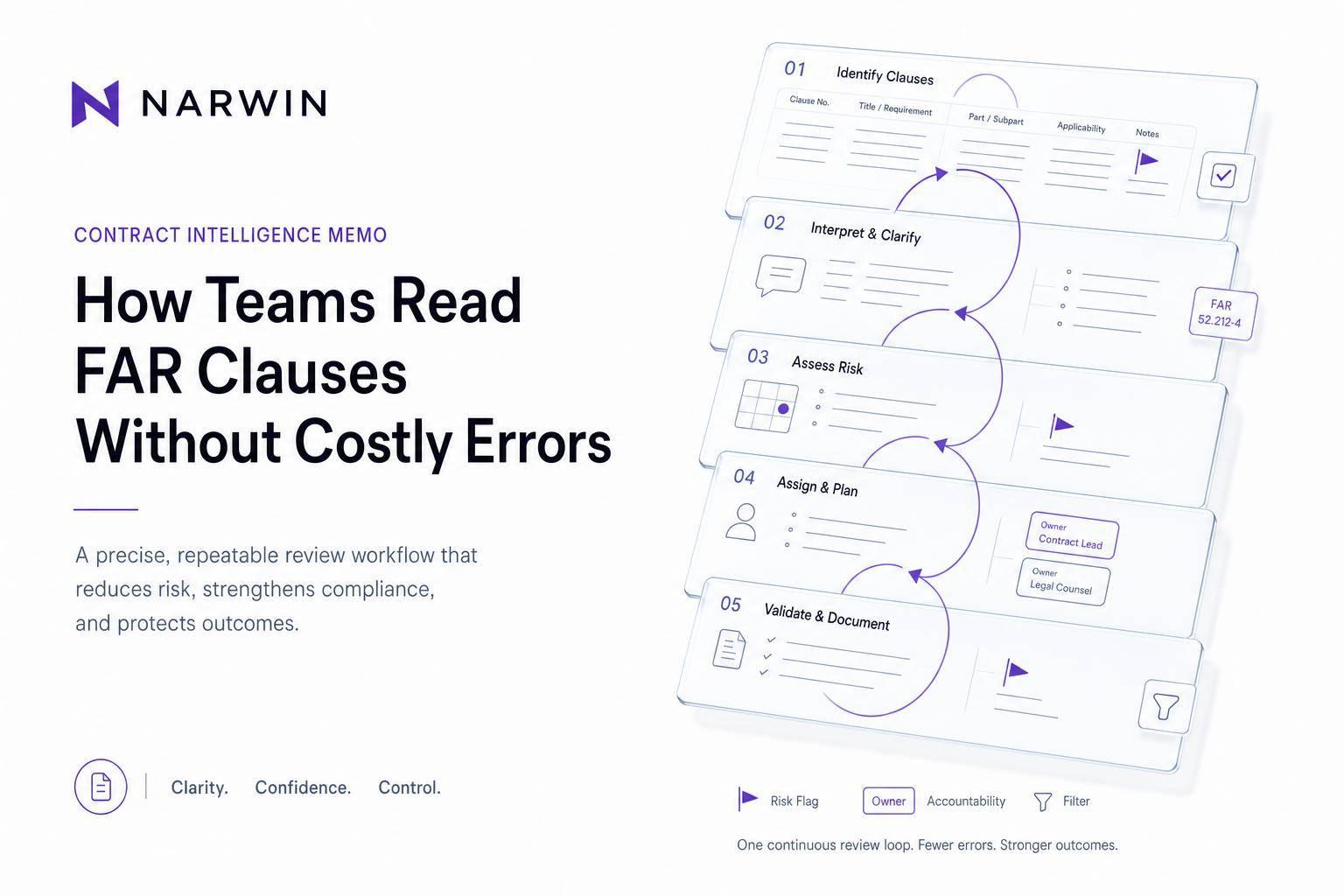
If I read FAR clauses late or from memory, I increase the odds of a proposal mistake. A missed clause, a changed alternate, or a supplement I failed to check can lead to extra work, pricing errors, or even award ineligibility.
Here’s the short version:
- I build a clause register before drafting starts
- I pull clauses from Section I, attachments, and every amendment
- I separate proposal duties from post-award duties
- I check DFARS, GSAR, VAAR, and other supplements
- I flag deviations, alternates, legal issues, pricing issues, and security issues
- I assign one owner to each clause-driven task
- I rerun the review after each amendment
One point stands out: under FAR 52.204-7, SAM registration issues can block award. And clauses tied to security, such as DFARS 252.204-7012, can affect both proposal work and contract performance. That’s why I treat clause review as a work plan, not background reading.
In plain terms, this article shows me how to turn a long solicitation into a short list of actions, risks, and owners – before the deadline gets tight.
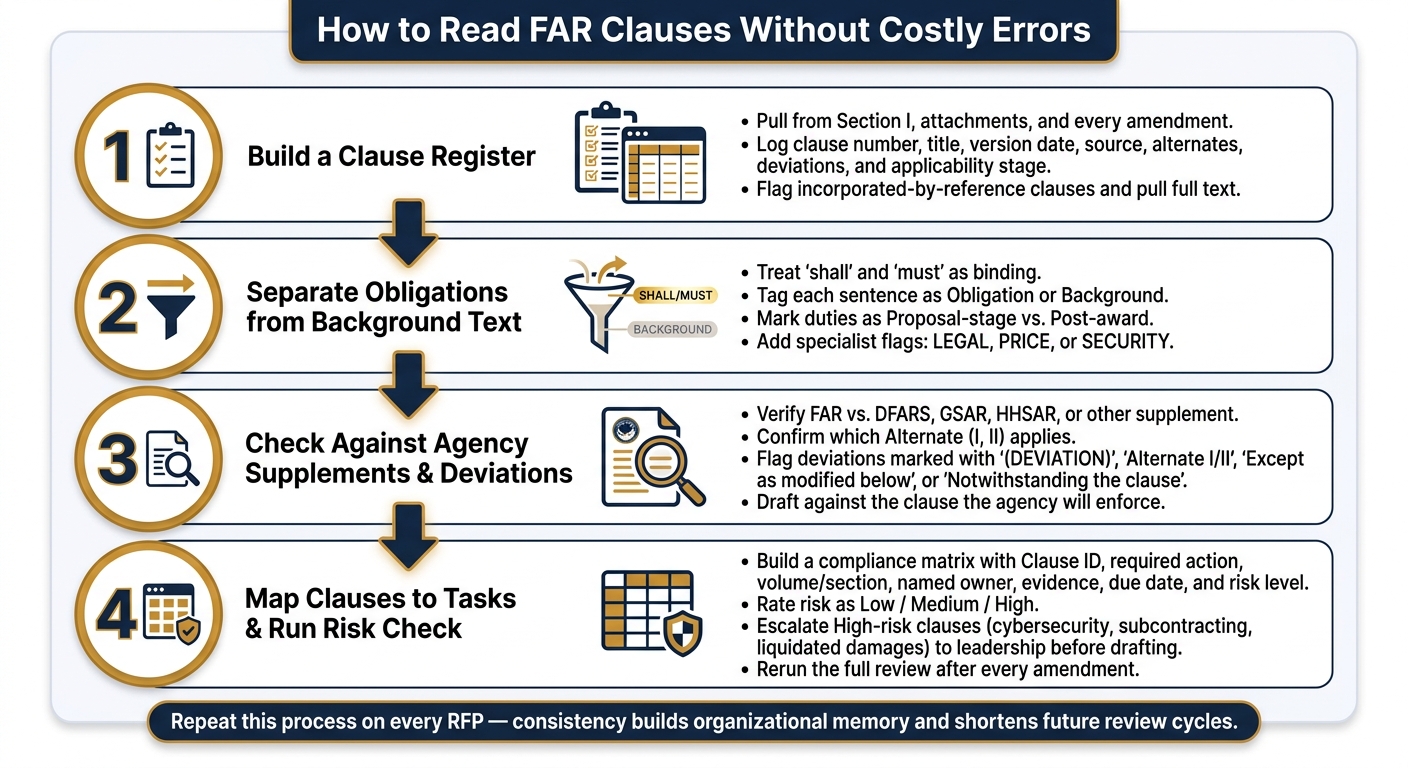
How to Read FAR Clauses Without Costly Errors: 4-Step Process
Step 1: Build a clause register from the solicitation
Build a complete clause register before anyone starts drafting. Think of it as your master checklist: clause number, title, version date, source, incorporation method, alternates, and deviations. The job at this point is simple: find every clause, log it, then review it later.
Pull clauses from Section I, attachments, and amendments
Section I is just the starting line. FAR and agency supplement clauses can also show up in Section H, Section J attachments, wage determinations, security appendices, and every amendment file. Each of those places needs its own review. The clauses buried in attachments and amendments are often the ones that get missed, and those misses can get expensive.
Amendments deserve extra attention. They don’t just tweak scope. They can add brand-new clauses, replace ones already in the package, or change effective dates. A clause that looked simple in the base solicitation can carry different duties after an amendment. Compare each amendment against the prior version of the solicitation, flag any clause changes, and log them right away.
Once you have the full register, the next move is to separate binding duties from background text.
For large packages, Narwin.ai can pull clause requirements from uploaded RFPs, attachments, and amendments. Even so, manual review of incorporated-by-reference clauses is still required.
Record clause details before reading them
Log first. Interpret later. At a minimum, each entry in the register should include:
| Field | Why It Matters |
|---|---|
| Clause number (e.g., FAR 52.219-9) | Connects the entry to the exact regulation and version |
| Clause title | Helps non-specialists see the topic at a glance |
| Version/effective date | Confirms the team is using current language |
| Source (FAR, DFARS, GSAR, etc.) | Shows when a specialist may need to step in |
| Full text or incorporated by reference | Incorporated-by-reference clauses still bind the contractor, so the full text must be pulled and stored |
| Alternates or deviations | Shows that the standard clause language may not apply |
| Applicability stage | Separates proposal-stage duties from post-award duties |
One field teams often skip is incorporated-by-reference status. If a clause appears only by number and title in Section I, it still binds the contractor. Pull the full text from the official FAR or DFARS source and link it in the register so reviewers aren’t guessing.
After the register is done, the team can sort duties, assign owners, and flag risk. That setup makes it much easier to separate proposal actions from post-award duties.
Step 2: Separate binding obligations from background text
Once your clause register is in place, go line by line and look for binding language. Treat "shall" and "must" as binding. Read "will" as Government action. Treat "may" and "is encouraged" as nonbinding unless the clause puts a duty on the offeror or contractor.
Here’s the simple test: if a sentence does not place a duty on the offeror or contractor, it’s not an action item. Tag each sentence as either obligation or background.
Read each clause sentence by sentence and label it that way. This helps teams avoid a common mistake: treating context like a requirement, or missing a duty buried later in the clause. After that, sort each obligation by when the action is due.
Mark proposal actions versus post-award duties
The subject of the sentence is usually your best clue. If the duty is aimed at the "Offeror" or "Bidder," it applies before award. If it’s aimed at the "Contractor" or refers to "contract performance," it applies after award.
Tag each obligation as Proposal or Performance. Keep that timing label in the same row as the clause entry so the register turns into a working checklist, not just a reference sheet.
From there, build two action lists:
- a proposal compliance matrix for items the team must submit, certify, or address now
- a separate implementation tracker for post-award duties
FAR 52.204-21 is a performance duty. FAR 52.204-24 can trigger a proposal-stage disclosure. That timing matters because it tells you who should own the task.
Then check whether any agency supplement or deviation changes that obligation.
Flag clauses that need legal, pricing, or security review
Add a specialist flag to each row in the register using short codes: LEGAL, PRICE, or SECURITY. Include a short note next to the flag, like "unusual data rights terms" or "certified cost or pricing data may be required," so the reviewer gets the point right away.
Use that same row for both the specialist flag and the owner assignment.
| Flag | Clause Types | Why It Matters |
|---|---|---|
| LEGAL | Unusual terms, IP, indemnification, export control | Can affect bid eligibility, liability exposure, or IP ownership |
| PRICE | Cost or pricing data, payment terms, CAS | Drives cost model structure, audit exposure, and cash flow assumptions |
| SECURITY | CUI, NIST SP 800-171, incident reporting | May require a security plan or controls narrative in the proposal |
Early routing cuts down on rewrites and last-minute specialist back-and-forth. Once obligations are tagged and assigned, check one more time whether the agency supplement or deviation changes the rule.
Step 3: Check FAR Clauses Against Agency Supplements and Deviations
The FAR clause listed in Section I may not be the one that controls.
Agencies often add to, or change, FAR requirements through supplements such as DFARS (Department of Defense), GSAR (General Services Administration), HHSAR (Health and Human Services), and HUDAR (HUD). That means the base FAR text may not be the rule the agency will use.
Before anyone starts drafting, check the supplement and confirm which clause version controls in practice. Use your clause register to verify the exact text that applies. The job here is simple: draft against the clause the agency will enforce, not just the FAR citation shown on the page.
Confirm Which Regulation Controls: FAR, DFARS, GSAR, or Another Supplement
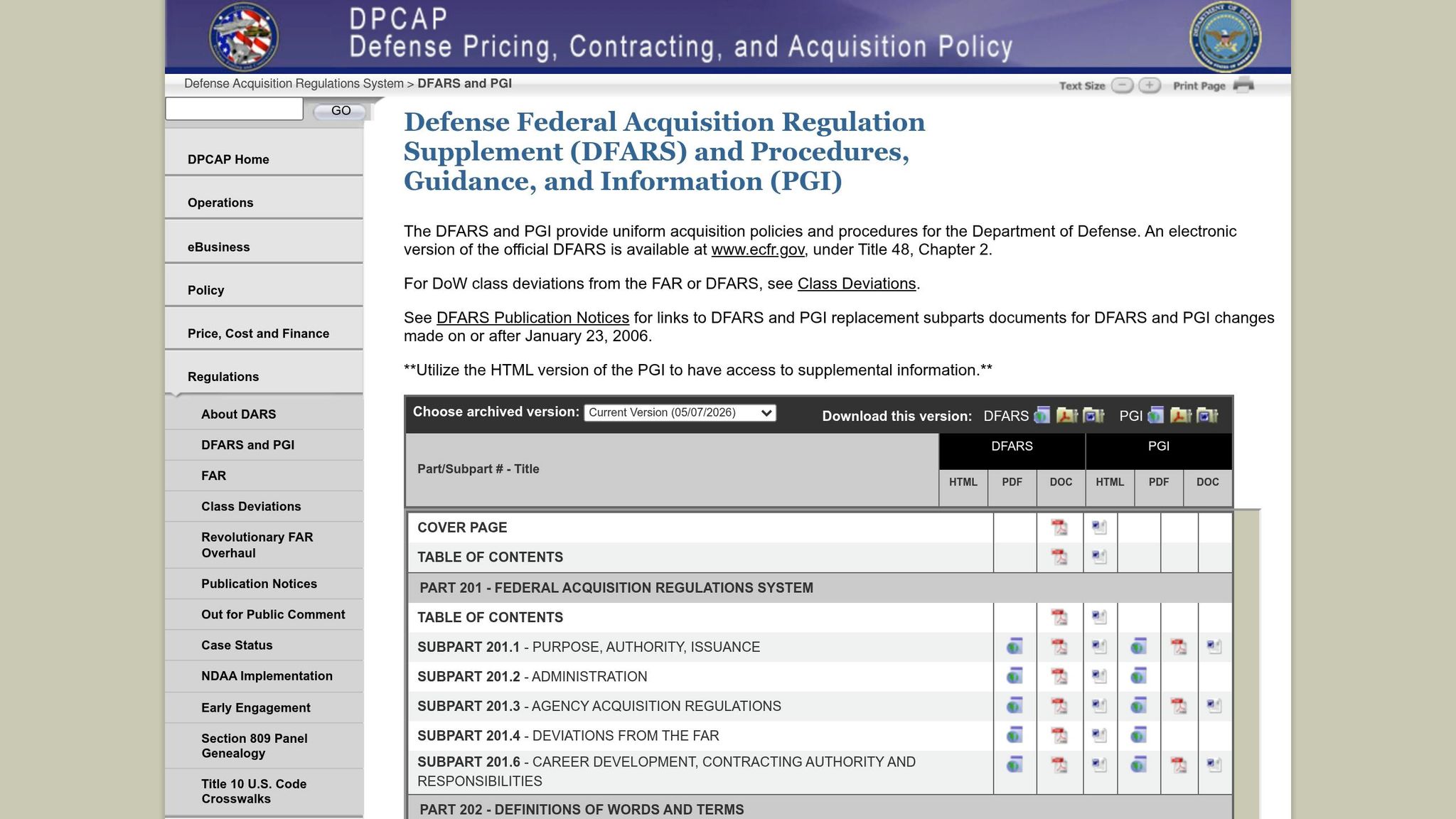
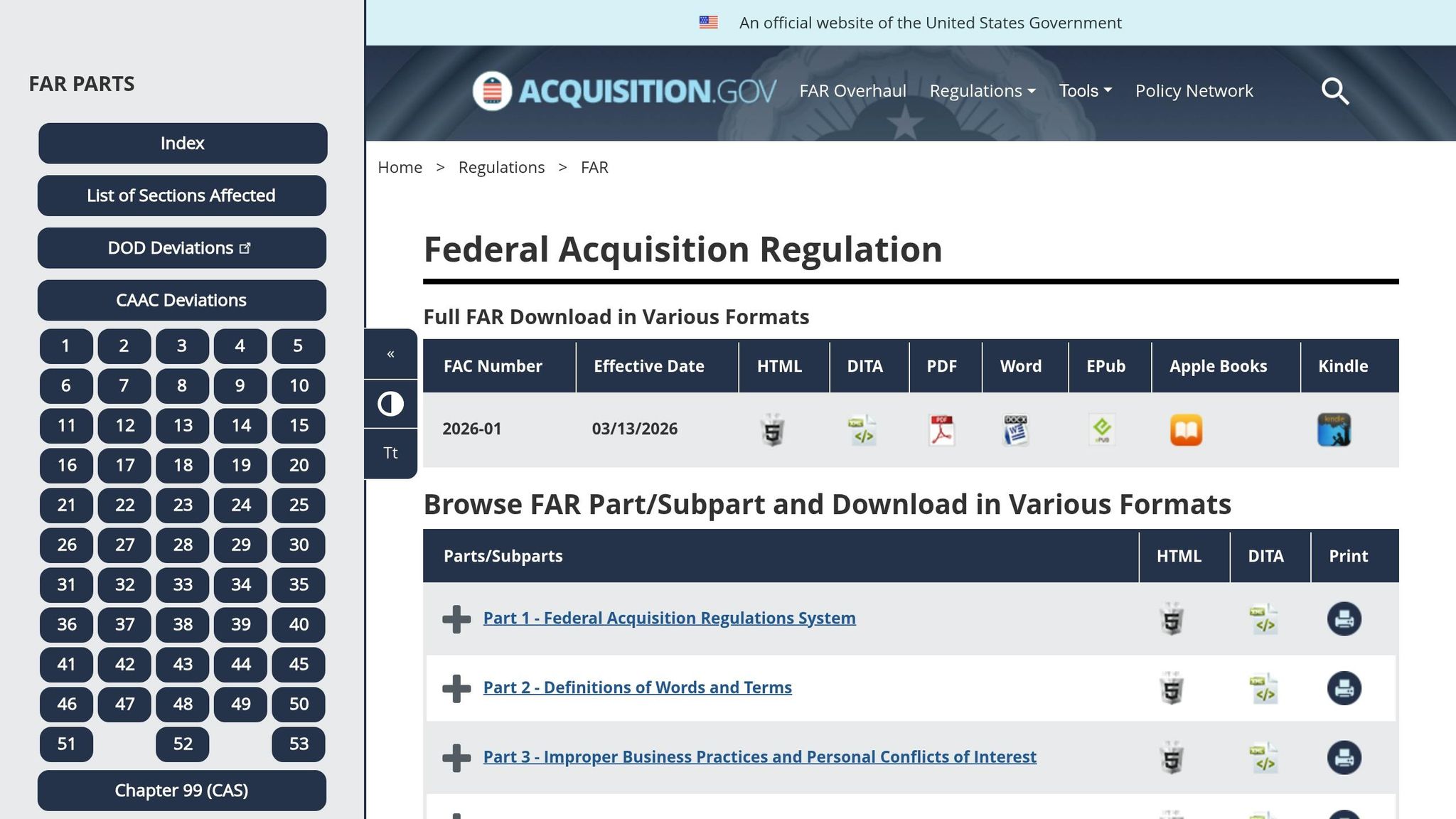
Start with the clause citation in the solicitation. Pull the official text from Acquisition.gov or the agency supplement source. Then compare that text against the solicitation and record any additions, deletions, or substitutions in the register.
Treat "Alternate I" and "Alternate II" as changed versions of the clause, not automatic defaults. That small label can shift what the offeror has to do.
Also check whether the clause is incorporated by reference or printed in full. A printed clause often includes paragraph-level edits, and those edits are easy to miss if you skim. Read amendment language line by line and flag every difference before drafting starts.
Flag Deviations Before Drafting Begins
A deviation is any change to FAR policy, procedure, or clause language that conflicts with the standard regulation. Under FAR Subpart 1.4, deviations need formal justification and approval.
There are two main types:
- Individual deviations, which apply to one action
- Class deviations, which apply to more than one action
This is where a clause stops being just a citation and starts affecting the proposal. A deviation can change response content, pricing, or both.
As soon as you find one, log it in the clause register, add a short note on the impact, and send it to the right owner before drafting begins.
| Deviation Signal | Where It Appears | Action |
|---|---|---|
| (DEVIATION) after clause date | Section I or clause list | Pull official text; compare to solicitation |
| "Alternate I / II" after clause title | Clause title or heading | Confirm which alternate version applies |
| "Except as modified below" | Clause body or attachment | Document the substituted language |
| "Notwithstanding the clause" | Special conditions or attachments | Escalate to the appropriate owner immediately |
Once the controlling version is fixed, move each obligation into the response task list.
sbb-itb-bb3960c
Step 4: Map Each Clause to a Response Task and Risk Check
Once you’ve confirmed the controlling text, turn each clause into a clear task. Every clause that applies should connect to at least one action: certification, narrative, form, pricing input, or internal review. Then assign that clause to the person who has to do the work.
This is where a compliance matrix earns its keep. It takes your clause register and turns it into assignments people can act on.
Use a Compliance Matrix to Assign Owner, Section, and Evidence
A compliance matrix helps the team avoid letting obligations slip through the cracks. Set it up as a shared spreadsheet with one row for each clause. At a minimum, include these columns: Clause ID, required action, proposal volume and section, named owner, evidence needed, due date (in MM/DD/YYYY format), and risk level.
Two rules matter more than anything else here.
- Every row needs one named owner. Not "contracts team." Not "TBD."
- The risk level column must be filled in. Rate each clause as Low, Medium, or High based on severity, implementation effort, cost impact, and your current compliance gap.
| Risk Level | What It Means | Typical Action |
|---|---|---|
| Low | Existing policies and capabilities fully cover the clause | Confirm and document; no new work needed |
| Medium | Some new work or cost is required, but the gap is manageable | Assign owner; schedule early in the proposal cycle |
| High | Major gaps in capability, certification, or financial tolerance | Escalate to leadership; may require solution or pricing changes |
High-risk clauses should go to the top of the schedule. That usually includes items tied to cybersecurity, subcontracting, or liquidated damages. If a clause could materially change your margin or calls for a certification you don’t hold yet, leadership should see it before anyone starts drafting the proposal. That’s not being overly cautious. It’s just smart.
Run the Same Review Cycle After Every Amendment
When an amendment comes in, run the same mapping and risk check again.
Treat each amendment like a new clause review. Log the date, rescan the changed sections, update the register, and revise the matrix. Add new rows for new clauses. Update existing rows when the language changes. Re-score risk when the amendment shifts obligations.
Then notify the affected owners right away. If the amendment touches sections that are almost done, move due dates up. And if it brings in a materially different requirement, like a new contract type, changed small business targets, or a new security obligation, send it to leadership before the next internal review milestone.
Teams using Narwin.ai can flag clause changes and update owners faster.
Conclusion: Apply the same clause review method on every RFP
These five steps work best when your team uses them on every RFP.
Even small wording changes can shift obligations, risk, and pricing. That’s why a standard method matters. It gives contracts, pricing, technical, and legal teams a shared, documented way to work from the same playbook.
There’s another upside too: consistency builds organizational memory. Over time, your clause register turns into a reusable record of how clauses were handled before, which ones changed pricing, and which terms tended to trigger internal escalation. That kind of internal knowledge can shorten review cycles on future bids and help new staff get up to speed fast.
This discipline pays off most when it starts during capture, not at the end. Use the method during capture and proposal work, not just in the final review. Risks spotted at the capture stage can shape solution design, teaming, and go/no-go calls before a single proposal page gets written. Narwin.ai supports this by centralizing RFP analysis, surfacing risk signals early, and helping teams track obligations across opportunities.
When that habit is in place, the review process gets easier to repeat. Build the register early, assign owners, verify the controlling source, and rerun the review after every amendment. That’s the difference between teams that stay on track and teams that end up scrambling at the last minute.
FAQs
What should a clause register include?
A clause register, sometimes called a compliance matrix, helps your team track every mandatory and optional RFP requirement in one place.
It should include:
- a unique requirement ID
- the source location
- the verbatim requirement text
- a plain-language summary
- the assigned owner
- where it appears in the proposal
- the current compliance status
Why does this matter? Because RFPs can get messy fast. One missed clause, one buried instruction, and the whole response can drift off course. A clause register gives you a single source of truth so everyone knows what needs to be done, who owns it, and where the answer lives.
Narwin.ai can automate this by extracting these details directly from solicitations.
How do I tell proposal duties from post-award duties?
Check where the requirement shows up in the RFP. Proposal duties usually sit in Section L, which covers response format and submission, and Section M, which explains how your proposal will be judged.
Post-award duties usually appear in Section C, such as the Statement of Work or Performance Work Statement, and in the FAR/DFARS clauses in Section I.
Narwin.ai helps by pulling out these requirements and sorting them into clear categories.
When should I escalate a clause for legal, pricing, or security review?
Escalate a clause as soon as it’s flagged as risky, unclear, or out of step with what you can deliver.
Trigger a review when your compliance matrix shows gaps. That includes missing certifications, technical demands you can’t meet, conflicting RFP requirements, amendment changes to critical terms, or mandatory language you can’t accept. If the issue needs an answer, decide fast whether to ask the Contracting Officer for clarification.