
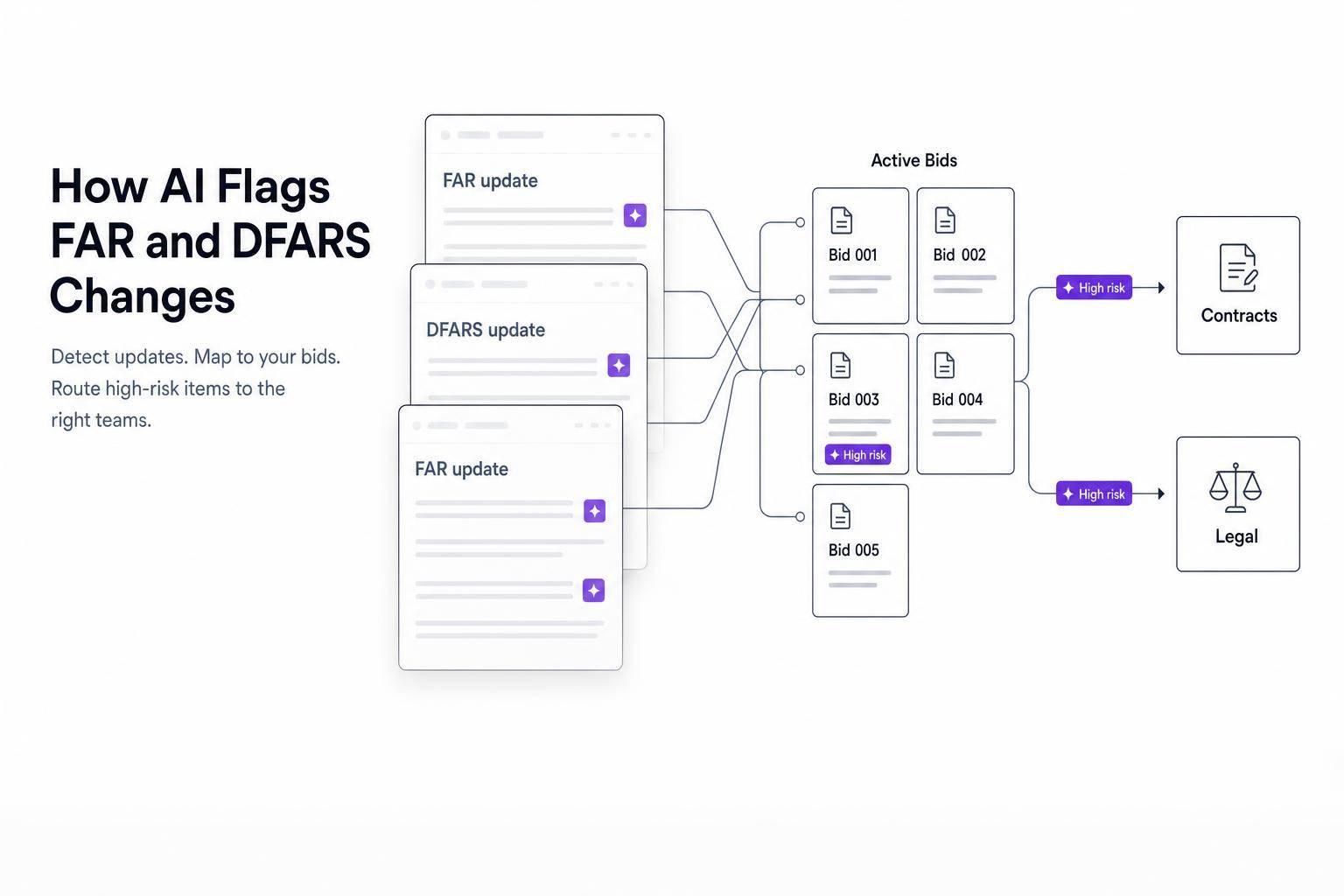
If you miss a FAR or DFARS update before bid submission, you can submit the wrong clauses, use old pricing rules, or miss a new flowdown. That can lead to a rejected proposal, a protest, or post-award trouble.
Here’s the short version:
- I need to watch Acquisition.gov, the Federal Register, DFARS notices, PGI updates, and DoD class deviations
- I need to spot changes that affect eligibility, clauses, pricing, cyber rules, and subcontract flowdowns
- I need to connect each update to active bids, compliance matrices, clause matrices, pricing files, and templates
- I can use AI for alerts, text comparison, clause tagging, and bid triage
- I still need people for applicability, exceptions, legal review, and final sign-off
In plain terms: AI helps me find and sort rule changes early. People still decide what applies and what must change before submission.
A late rule change can hit in the last 2–3 weeks of a proposal cycle, when pricing is locked, reviews are tight, and version control gets messy fast. That’s why the job is not just “track updates.” It’s also “route the right update to the right team before it affects the bid.”
Quick comparison
| Area | Manual review | AI-assisted review |
|---|---|---|
| Alerting | I check multiple sources by hand | AI monitors sources and sends alerts |
| Change review | I read full notices and compare versions myself | AI highlights inserts, deletions, and revised clauses |
| Proposal impact | I trace changes across files one by one | AI maps changes to matrices, templates, and bids |
| Final decision | Human only | Human only |
The core idea is simple: use AI for detection and first-pass sorting, then send high-risk changes through contracts, legal, and proposal review.
sbb-itb-bb3960c
Manual Tracking: Where the Process Slows Down
Fragmented Sources and Delayed Alerts
FAR and DFARS updates don’t show up in one neat dashboard. Teams usually have to monitor Acquisition.gov FAR pages and FAC tables, DFARS and PGI change notices, Federal Register entries, and agency memo pages or class deviations. Each source moves on its own timeline. And sometimes a change appears in Federal Register rulemaking first, long before it shows up in codified FAR or DFARS text.
Most teams handle this with a mix of personal calendars, browser bookmarks, and email subscriptions. That might work on a calm week. Under deadline pressure, it starts to crack. A notice gets missed, or it gets seen too late, and the bid is already in final review.
Once someone spots the update, the slow part kicks in.
Manual Document Review and Version Comparison
A contracts specialist has to download the rule, compare it against the prior version, and figure out which FAR parts, DFARS subparts, clauses, and PGI references changed. And that’s still before the proposal work starts.
After the new language is clear, the team has to trace the impact across a lot of moving parts:
- Clause matrices
- Compliance matrices
- Proposal sections
- Boilerplate language
- Pricing assumptions
- Internal policies
- Proposal templates
- Checklists
- Section outlines
For more complex changes, that can eat up hours of senior staff time.
Those delays tend to surface in four areas.
| Workflow step | Manual approach | AI-assisted approach |
|---|---|---|
| Alert speed | Depends on when someone checks each source | Automated monitoring and faster alerts |
| Document review time | Full notice read and manually marking the changes | Automated diff and summary |
| Clause mapping | Spreadsheet cross-reference by hand | Automated mapping to affected sections |
| Go/no-go triage | Reviewed case by case | Relevance scored across active pipeline |
Where Manual Review Still Adds Value
Manual review still has a place. Teams still need human judgment to sort out applicability, exceptions, and flowdown decisions. That’s the part you don’t want to rush.
The issue is everything that happens before that point. Too much time goes into monitoring sources, downloading files, and redlining text before anyone can make the call that matters.
That judgment sets up the clause mapping and impact scoring that follow.
How AI Flags FAR and DFARS Changes Faster
Automated Alerts from Authoritative Sources
AI keeps watch on sources like the Federal Register, Acquisition.gov, and DoD regulatory pages, then flags FAR and DFARS updates as soon as they go live. For teams working active bids, that kind of speed can help avoid late-stage rework. Before anyone digs into the full notice, AI can also screen the alert for relevance.
First-Pass Filtering for Relevance
Regulatory feeds come with a lot of noise: technical corrections, editorial clarifications, and administrative updates that may not affect an active bid at all. AI helps sort the signal from that noise before a reviewer reads the full notice.
It can compare clause text, flag inserted, deleted, or revised language, and pull out the clause numbers, effective date, subject area, and any new documentation, certification, or flowdown duty. That output can then feed clause mapping and impact scoring.
How Narwin.ai Supports Bid-Intelligence Workflows
Narwin.ai links FAR and DFARS alerts to active pursuits. In a FAR or DFARS setting, that workflow helps proposal teams connect a regulatory change to the solicitation it affects and review impacted requirements with less friction.
Its requirement extraction and risk analysis also help proposal teams spot compliance gaps before submission. That makes it easier to route the update into the proposal review process.
Clause Mapping and Bid Impact Scoring
Mapping Changed Clauses to Proposal Artifacts
After AI flags a change, the next step is to map that change to every proposal artifact it touches. In plain English, you link the changed clause number – say, FAR 52.204-21 or an updated DFARS cybersecurity provision – to every place it shows up in your proposal materials: compliance matrices, clause libraries, templates, flowdown language, and certifications.
AI can do that mapping across the stack. So if a DFARS cybersecurity clause changes, the system can show that it affects your technical narrative, a standard subcontract flowdown paragraph, and pricing assumptions – all in one pass instead of being found bit by bit.
Use both a compliance matrix and a clause matrix:
- A compliance matrix maps each solicitation requirement to a proposal section and owner.
- A clause matrix lists each FAR/DFARS clause, its flowdown status, and where it is addressed.
Keep both up to date with the same clause IDs and tags. That gives AI a clean way to trace one clause change across the full proposal stack with much less manual work.
Scoring Likely Impact on Go/No-Go and Pricing
Once the change is mapped, the next step is figuring out how much it matters. Not every update has the same weight. A fixed cross-reference in an admin clause is one thing. A new mandatory cybersecurity assessment rule is something else entirely.
Bid impact scoring helps proposal teams rank updates based on proposal impact.
The scoring logic usually blends rule-based logic, risk models, and past data across five dimensions: eligibility (does the change affect who can bid?), compliance burden (does it add documentation, audits, or controls?), cost impact (does it add tooling, labor categories, or overhead?), performance risk (does it tighten performance duties?), and schedule pressure (can you put the change in place before the proposal due date?).
Each dimension is weighted by contract type. Defense IT work may put more weight on cybersecurity. Construction bids may focus more on safety and labor compliance. That helps teams decide whether to update the bid, reprice it, or walk away.
| Impact Level | Typical Update | Proposal Effect | Recommended Action |
|---|---|---|---|
| Low | Minor wording, administrative corrections, updated references | Minimal template edits; no cost impact | Auto-update libraries and matrices; notify owners for awareness |
| Medium | Adjusted thresholds, expanded reporting, moderate new controls | Additional compliance effort; possible small pricing adjustment | Flag affected bids; update narratives and pricing assumptions; route for human review |
| High | New mandatory frameworks, major cybersecurity or supply chain rules, eligibility changes | Potential go/no-go change; major cost and risk issues | Escalate to leadership; trigger go/no-go reassessment; reprice and model mitigation scenarios |
When scoring is tied to live pursuits, Narwin.ai can surface affected bids and route high-impact changes into go/no-go review.
Human Review and the Final Compliance Decision
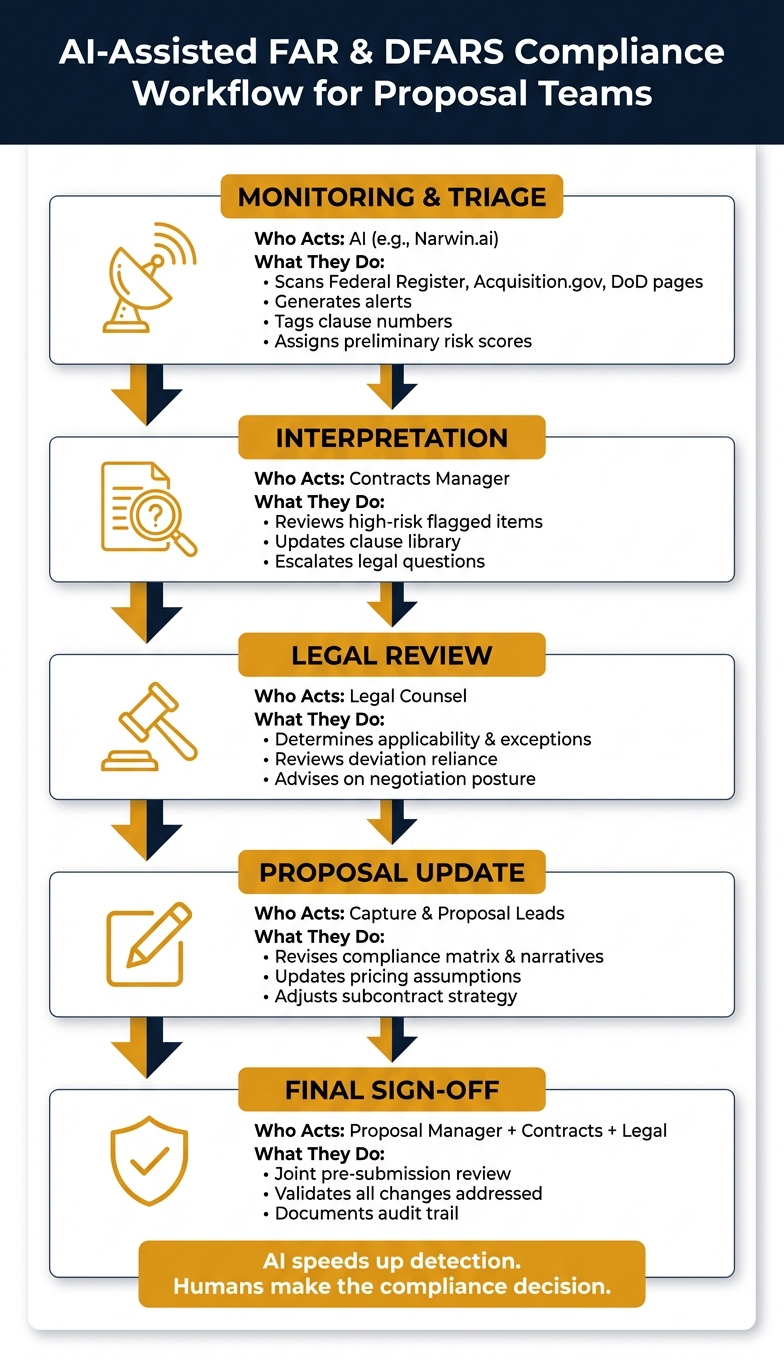
AI-Assisted FAR & DFARS Compliance Workflow for Proposal Teams
Applicability, Exceptions, and Flowdown Analysis
Once AI maps and scores a change, people still have to decide if it applies and what happens next. AI is a strong first pass. But the compliance call belongs to human reviewers.
AI can’t settle questions like applicability, thresholds, contract type, overrides, or subcontract flowdown on its own. A team still has to decide whether a rule is in force for a given procurement. The contract type matters too. A firm-fixed-price, cost-reimbursement, IDIQ, or time-and-materials contract can change how a clause applies in the base contract or in task orders. The same goes for flowdown: what has to move down to subcontractors, and what stays only with the prime contract. Those are human decisions.
Flowdown analysis needs special care. AI can flag clauses that often require flowdown and connect them to subcontract templates. That’s useful. Still, a contracts manager has to confirm the scope. Flowdown scope depends on subcontract type and tier, so it can’t be treated like a simple auto-alert. That call should sit in the review chain, not inside the alert itself.
Exceptions and deviations work the same way. AI can point to a class deviation or waiver provision. Legal counsel still has to answer the hard part: Does the deviation apply to this vehicle, and does the solicitation incorporate it by reference? If not, does a waiver create too much risk?
A Practical Operating Model for Proposal Teams
A simple way to run this: use AI for monitoring and triage, then send flagged changes through human review before submission.
Use this review chain:
| Stage | Who Acts | What They Do |
|---|---|---|
| Monitoring & triage | AI (e.g., Narwin.ai) | Scans sources, generates alerts, tags clause numbers, assigns preliminary risk scores |
| Interpretation | Contracts manager | Reviews high-risk items, updates clause library, escalates legal questions |
| Legal review | Legal counsel | Determines applicability, exceptions, deviation reliance, and negotiation posture |
| Proposal update | Capture and proposal leads | Revises compliance matrix, narratives, pricing assumptions, and subcontract strategy |
| Final sign-off | Proposal manager + contracts + legal | Joint pre-submission review validates that all changes are addressed and documented |
Narwin.ai can push alerts into Slack, Drive, and CRMs so the right reviewers see them fast, creating an audit trail for disputes or protests.
AI speeds up detection. Humans make the compliance decision.
FAQs
Which FAR and DFARS updates matter most to active bids?
Active bids are usually hit hardest by FAR and DFARS updates when the change affects required performance, security, or certification rules. Common examples include DFARS 252.204-7012, FAR 52.204-7, FAR 52.204-21, and FAR 52.204-24.
That matters for a simple reason: if a clause changes and the rule is mandatory, your bid may need updates right away. This is especially true when the clause touches cyber controls, registration status, or certification language.
Agencies can also tweak base rules through their own supplements. So don’t stop at the FAR or DFARS text alone. Check the exact clause version, along with any deviations or alternates required by the contracting agency.
How does AI decide whether a rule change affects my proposal?
AI checks the original solicitation against the new amendment to spot what changed. It uses natural language processing to pull out updated requirements and compare them with your current compliance matrix.
Then it flags the items that need attention, like revised technical specs, new mandatory clauses, or changed evaluation weights. Instead of reviewing the whole bid again, it checks compliance only in the sections touched by the amendment. Narwin.ai can also recalculate your win probability score based on those new requirements.
What still requires human review before submission?
AI can automate requirement extraction, amendment tracking, and compliance mapping. But human review still matters before submission.
Teams should do a manual check for a few things AI can miss:
- Clauses incorporated by reference
- Cross-references and final page or paragraph numbers
- Internal notes, comments, or staff names that should be removed
It also helps to run a final mechanical audit 24 to 72 hours before the deadline. That last pass should cover formatting, signatures, filenames, and other small errors that can slip through at the worst time.