
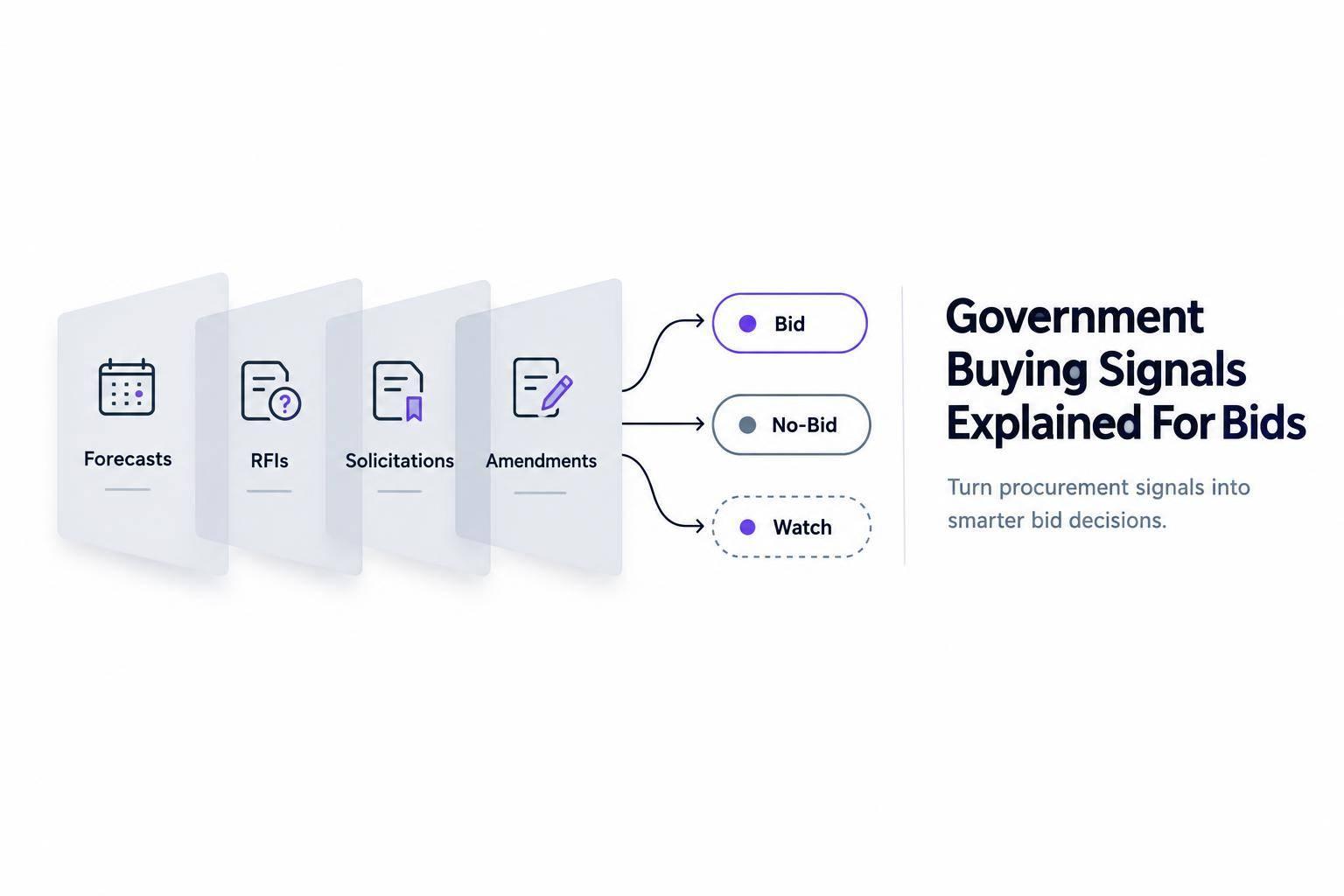
Government buying signals help me decide whether to bid, wait, or pass – not whether an award is guaranteed. Before spending on a proposal, I check the notice’s stage, eligibility rules, funding status, and deadline against the official documents.
For U.S. and Canadian bids, I use 3 checks: Can we win? Should we bid? Can we deliver?
- Early notices: I use forecasts, RFIs, and draft RFPs to check fit, ask questions, and find gaps.
- Issued solicitations: I review requirements, scoring, pricing, and delivery risks with the people who will approve and perform the work.
- Proposal preparation: I map requirements to supporting records, track amendments, and verify submission details. If I use AI tools, I check their output against the source documents.
My rule: early signals guide planning; <u>the issued solicitation and amendments control the bid</u>.
Buying Signals: What They Mean and When They Appear
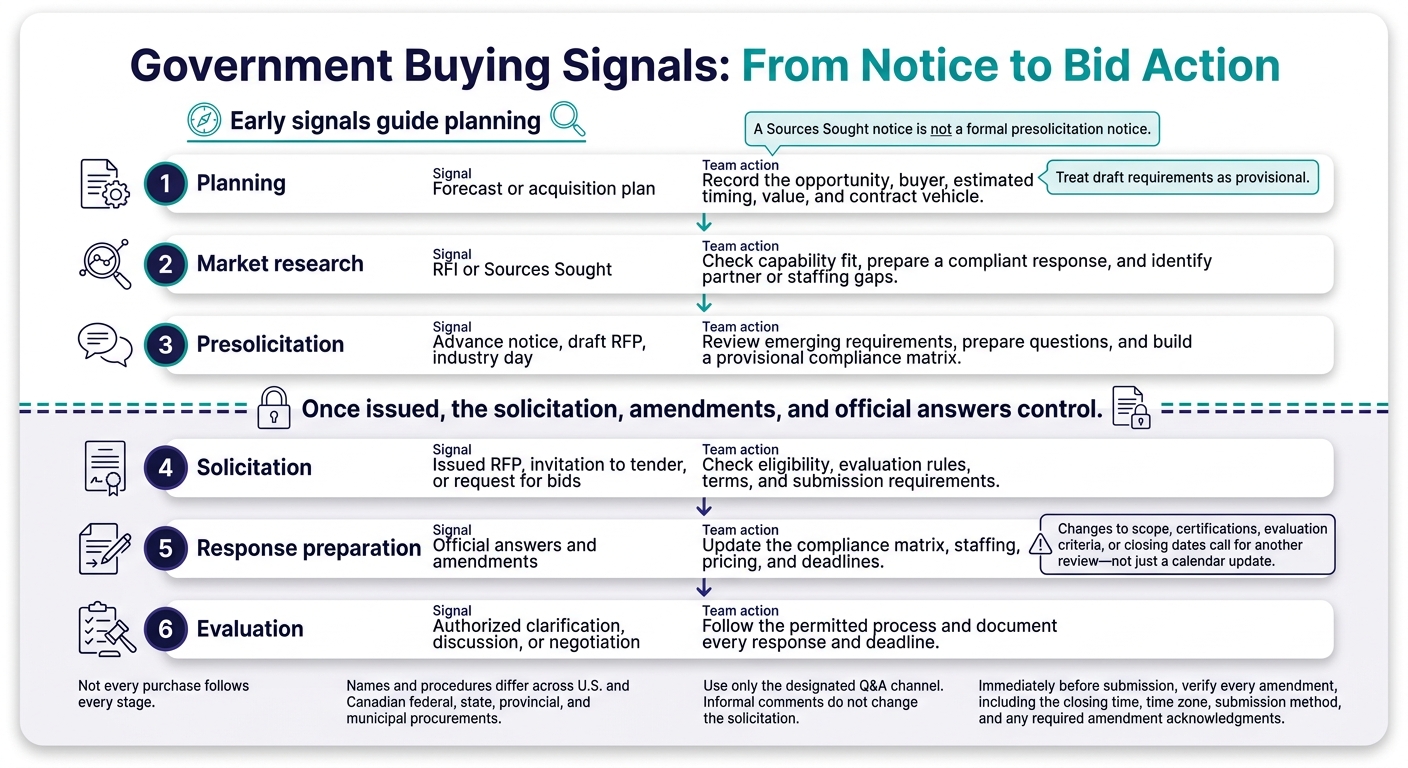
Government Buying Signals: From Notice to Bid Action
Procurement Forecasts, RFIs, and Sources Sought Notices
Forecasts and acquisition plans can tell you who expects to buy, what commodity or service they need, and the estimated value. They may also identify the contract length, contract vehicle, and assumptions about supplier eligibility.
RFIs and U.S. Sources Sought notices help agencies conduct market research. They may appear months or longer before a final solicitation, but timing depends on the agency, procurement type, funding, and jurisdiction. A Sources Sought notice is not a formal presolicitation notice. Respond in the requested format and provide only the evidence requested: qualifications, capacity, assumptions, and limits.
As the opportunity moves forward, shift from checking fit to tracking requirements.
Presolicitation Notices, Draft RFPs, and Industry Days
These exchanges can reveal the scope, schedule, location, contract structure, incumbent context, and security or licensing requirements. U.S. federal acquisition rules recognize presolicitation notices, conferences, one-on-one meetings, and other exchanges before proposals arrive.
Use permitted exchanges to check your capabilities against the buyer’s needs, prepare questions, arrange teaming that follows the rules, and gather supporting evidence. Treat draft requirements as provisional: scope, evaluation factors, contract type, dates, and eligibility conditions can change before release. This is the stage to decide whether to pursue, partner, or pass.
Issued Solicitations, Evaluation Rules, and Amendments
When the solicitation is released, review the full package: scope, instructions, deadlines, eligibility, certifications, pricing forms, clauses, security, deliverables, period of performance, contract type, and evaluation method. These details shape compliance, pricing, and win themes.
For U.S. federal negotiated RFPs, record the evaluation factors, significant subfactors, and their relative importance. For Canadian bids, separate mandatory criteria, point-rated criteria, and the basis of selection. Failing a mandatory criterion can disqualify a response. Rated criteria determine how qualifying bids compare.
Contract type matters, too. Firm-fixed-price work puts more estimating and scope risk on the contractor.
Match the depth of your review to the opportunity’s stage. Each signal should prompt a specific action.
| Stage | Signal | Team action |
|---|---|---|
| Planning | Forecast or acquisition plan | Record the opportunity, buyer, estimated timing, value, and contract vehicle. |
| Market research | RFI or Sources Sought | Check capability fit, prepare a compliant response, and identify partner or staffing gaps. |
| Presolicitation | Advance notice, draft RFP, industry day | Review emerging requirements, prepare questions, and build a provisional compliance matrix. |
| Solicitation | Issued RFP, invitation to tender, or request for bids | Check eligibility, evaluation rules, terms, and submission requirements. |
| Response preparation | Official answers and amendments | Update the compliance matrix, staffing, pricing, and deadlines. |
| Evaluation | Authorized clarification, discussion, or negotiation | Follow the permitted process and document every response and deadline. |
Once issued, the solicitation, amendments, and official answers control.
Names and procedures differ across U.S. and Canadian federal, state, provincial, and municipal procurements. Not every purchase follows every stage. Track the notice number, attachments, posting dates, and amendment history. Changes to scope, certifications, evaluation criteria, or closing dates call for another review – not just a calendar update.
Use only the designated Q&A channel. Informal comments do not change the solicitation. Immediately before submission, verify every amendment, including the closing time, time zone, submission method, and any required amendment acknowledgments.
sbb-itb-bb3960c
Using Signals to Decide Whether to Bid
Once you verify the signal, turn it into a bid, no-bid, or watch decision.
Choose Bid, No-Bid, or Watch
Assess three questions separately: Can we win? Should we bid? Can we deliver? Check mandatory criteria first. Then weigh the softer signals.
| Decision | Supporting evidence | Next action |
|---|---|---|
| Bid | Capabilities, eligibility, capacity, geography, schedule, and pricing fit; risks are within acceptable limits. | Approve a proposal budget, confirm partners, and assign the bid team. |
| No-bid | An unmet mandatory condition, delivery constraint, unacceptable commercial risk, or poor economics rules out the pursuit. | Record the specific reason, stop proposal spending, and identify what would need to change to revisit the decision. |
| Watch | Scope, funding, timing, or partner readiness is still uncertain. | Assign an owner, set a review date, and define the conditions for moving to bid or no-bid. Watch status does not pause deadlines. |
Let the decision guide your budget, ownership, and proposal effort. Record the reasoning, assumptions, confidence levels, and unresolved risks.
Use win probability to test the business case – not as permission to bid. Compare win probability × expected gross margin − bid cost. Express gross margin in dollars and keep the assumptions visible. Track estimates against actual outcomes so future decisions depend less on optimism.
Assign Reviewers Before Committing Resources
Require a formal review gate before spending anything on the proposal.
Assign each part of the review to the right role: business development checks buyer history and timing; contracts checks eligibility and clauses; technical leadership checks feasibility; finance reviews pricing, margin, cash flow, and bid cost; and operations checks delivery capacity. An executive sponsor approves the pursuit and resource commitment.
Small businesses can combine roles, using an owner and a technical or delivery reviewer, with specialist input where needed.
At each decision gate, reviewers should mark pass, concern, or fail and record why. After a material amendment, update costs and reconfirm partners. Get approval again if compliance, delivery, or risk changes.
Using Buying Signals to Guide Proposal Drafting
Once you decide to bid, turn each buying signal into a specific drafting task.
Link Requirements and Evaluation Criteria to Evidence
Build a compliance matrix before you draft. Include each requirement, its proposal location, owner, evidence source, status, and amendment reference. This turns your bid decision into a writing plan. Separate mandatory items from rated criteria, note minimum score thresholds, and use the buyer’s order and terminology.
Give priority to high-value criteria and areas where evidence is thin, without exceeding page limits. Link requested outcomes to deliverables, performance measures, risk controls, and records reviewers can verify. Keep past results separate from proposed commitments. Use early signals to spot missing evidence, then check the final draft against the issued solicitation.
Use the matrix to check every section and attachment.
Revise Drafts After Official Answers and Amendments
Send questions through the specified channel before the deadline, and cite the provision that needs clarification. Record each official answer and what it changes in the draft. Canadian federal answers may appear as amendments that also change scope, evaluation criteria, or closing dates. Treat only posted answers and amendments as binding changes to the draft.
After each update, revise the matrix, narrative, pricing, and schedule. Recheck forms, signatures, page limits, file formats, upload controls, closing time, and amendment acknowledgments. If scope or scoring changes, check the whole response against the revised requirements, not just the paragraph you edited.
If your team uses automation, use it to help with review – not as the source of truth.
Using Narwin.ai for Bid Review and Drafting
Narwin.ai supports U.S. and Canadian bid discovery, requirement extraction, signal tracking, go/no-go signals, win-score estimates, risk analysis, and draft response workflows. It also integrates with Google Drive and Slack.
Coverage may be incomplete, and scores are estimates. Have reviewers check extracted requirements, amendments, and every generated claim against authoritative documents and approved company records.
Conclusion: Verify Signals Before Acting
Treat early signals as a guide, not the final word. The issued solicitation and amendments control the bid.
Once you verify the signal, conduct a final bid, no-bid, or watch review. Before spending more hours on the proposal, check the current solicitation, confirm the closing date and time in the applicable time zone, and verify eligibility. Answer three questions: Should we pursue? Can we comply? Can we submit on time?
Require reviewer sign-off before approval. Leave no unresolved mandatory compliance gaps. If you can’t meet a requirement, stop or escalate. Stronger writing won’t fix it. Record the findings, remaining risks, decision owner, approval date, and final bid, no-bid, or watch decision.
For a bid decision, use the published evaluation criteria to guide drafting. For a watch decision, record what will trigger another review.
FAQs
What data sources and regions does Narwin cover?
Narwin.ai tracks public procurement sources to find government and private sector bids across the United States and Canada. It puts opportunities from federal, state, provincial, regional, and city-level portals into one dashboard.
Sources include SAM.gov for U.S. federal contracts, CanadaBuys and BCBid for Canadian opportunities, and municipal portals such as RampLA.