
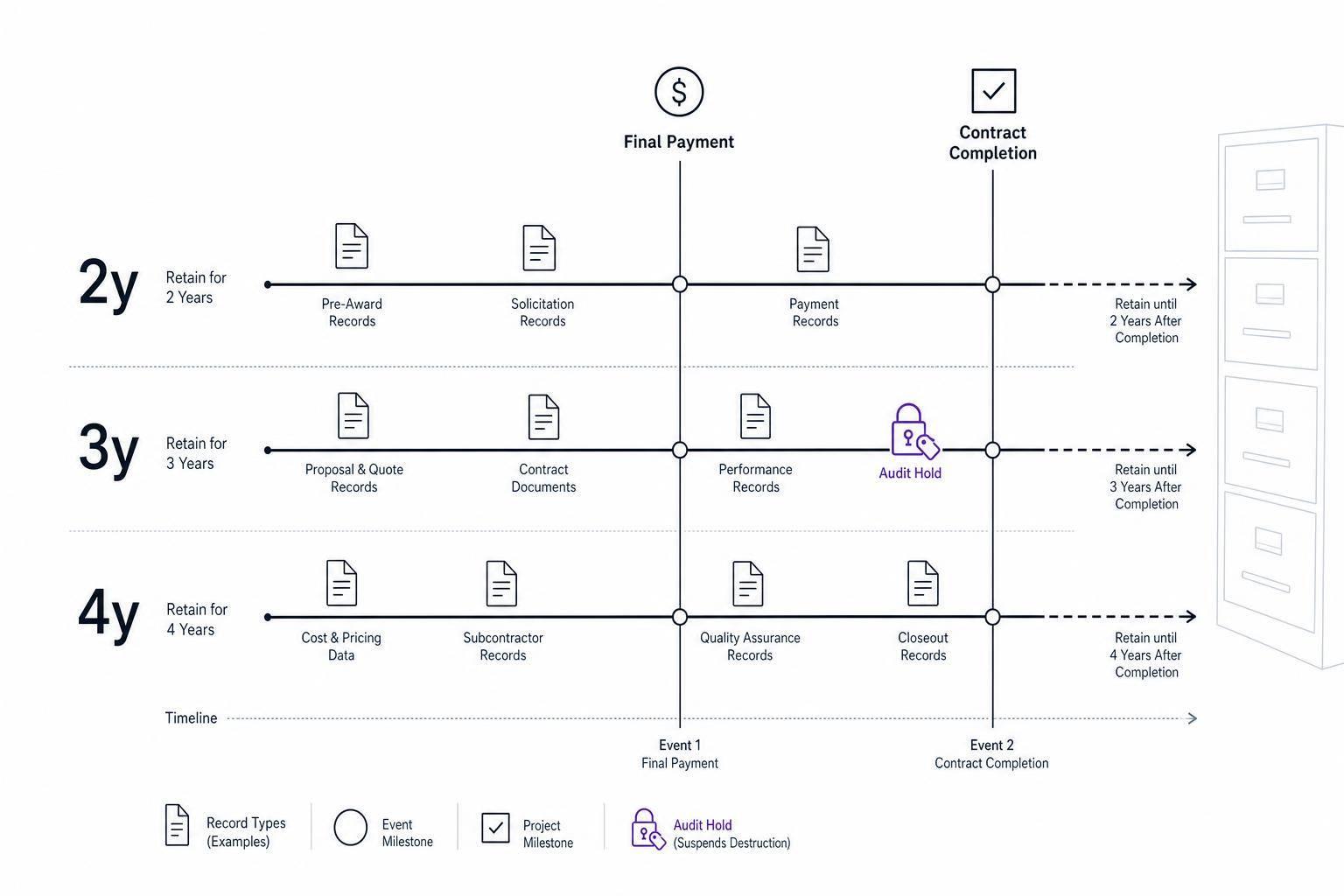
If you keep the wrong contract records for the wrong length of time, you can end up with audit trouble, payment issues, and closeout delays. The short answer is simple: under FAR 4.703, many contractor records must be kept for 3 years after final payment – but not all of them.
Here’s the part I’d want to know right away:
- FAR 4.703 is the starting rule, and it covers records in any format, including email, accounting data, shared drives, and paper files.
- There is no one-rule-fits-all retention period.
- Some records under FAR 4.705 through 4.705-3 must be kept for 4 years.
- Some records, like certain store requisitions, may be kept for only 2 years.
- Some construction payroll records under FAR 4.805 run 3 years after contract completion, not after final payment.
- Audits, claims, disputes, investigations, and litigation can stop destruction even after the normal date passes.
- Subcontractor records can still become your problem if you billed the government based on that work.
A few numbers matter most here: 2 years, 3 years, and 4 years. And the trigger date matters just as much as the length. In many cases, the clock starts at final payment. In some cases, it starts at contract completion. If you mix those up, your schedule can fail fast.
What I take from this article is straightforward: map records by type, track the right trigger date, and pause deletion when a hold applies. That’s the core of a working FAR retention process.
| Topic | Main takeaway |
|---|---|
| Baseline rule | FAR 4.703 sets the base rule for record access and retention |
| General retention period | 3 years after final payment |
| Longer record periods | Some record sets require 4 years |
| Shorter record periods | Some items under FAR 4.705-3 require 2 years |
| Different trigger | Some construction records run from contract completion |
| Hold risk | Audits, disputes, and claims can stop destruction |
| Subcontractors | Prime contractors still need access to support records |
If you work in contracts, finance, payroll, procurement, program management, or IT, this is not just a legal file issue – it affects billing, audit support, and closeout from start to finish.
What Records Contractors Must Keep Under FAR
Contractors need to keep records that back up pricing, performance, billing, and audit. A simple rule works here: if a record supports a cost, charge, or decision, keep it. The next step is figuring out which records fit that bucket.
Main Record Categories Contractors Keep
The table below covers the main record groups. Keep the source record and the support trail – not just the final file.
| Record Area | Typical Records | Why They Matter |
|---|---|---|
| Accounting and cost | General ledger, job-cost reports, indirect-rate calculations, cost-pool reconciliations, expense reports | Shows how costs were charged |
| Contract and billing | Solicitation, award, modifications, invoices, invoice registers, freight bills, acceptance evidence | Links invoices to accepted work |
| Labor and payroll | Timecards, labor distributions, payroll registers, wage records, overtime approvals | Supports labor charges |
| Purchasing and supply | Purchase orders, requisitions, receiving reports, material-usage records, equipment usage or ownership support | Supports material and equipment costs |
| Subcontracts | Subcontract agreements, amendments, invoices, payment records, lower-tier documentation, supplier certifications | Supports pass-through charges |
| Indirect costs and compliance | Indirect-rate support, allocation bases, provisional billing-rate documentation, representations and certifications | Supports indirect-rate treatment |
Once you define the record set, the next issue is retention length. That depends on the record type and the trigger date.
How Record Requirements Change Across the Contract Lifecycle
Before award, records should show what was proposed and how it was priced. The big ones are estimating workpapers, basis of estimate, and pricing models. FAR 15.4 also gives the contracting officer access to records that support the proposed price, including accounting procedures and other support data, even when that information was not physically attached to the proposal. So pre-award files can matter long after the contract is awarded.
Good pre-award file control makes the later handoff much easier. It also cuts down on the scramble when retention questions come up months – or years – later.
After award, the focus shifts. Now the file needs to show what was performed, billed, and accepted. That usually means keeping the executed contract, funding and modification history, approved billing structure, timekeeping and labor-distribution records, purchasing and subcontract files, deliverable submissions, acceptance evidence, and correspondence that affects scope, price, or schedule. It also helps to keep the original estimate alongside later modifications or rebaselines. That way, the full story stays in one place instead of being pieced together from scattered files.
Where Workflow Tools Can Help Before Award
Proposal teams often work across shared drives, email threads, and collaboration platforms at the same time. That’s where things get messy fast. Versions drift, approvals get buried, and pricing inputs end up spread across too many places.
Narwin.ai can help teams organize bid files, proposal versions, and support documents before award. Better pre-award organization also makes audits and disputes easier to support later.
From there, the retention clock becomes the next issue. Retention periods still come from FAR 4.703, FAR 4.705, contract clauses, and any hold notice.
sbb-itb-bb3960c
How Long Contractors Must Keep Records
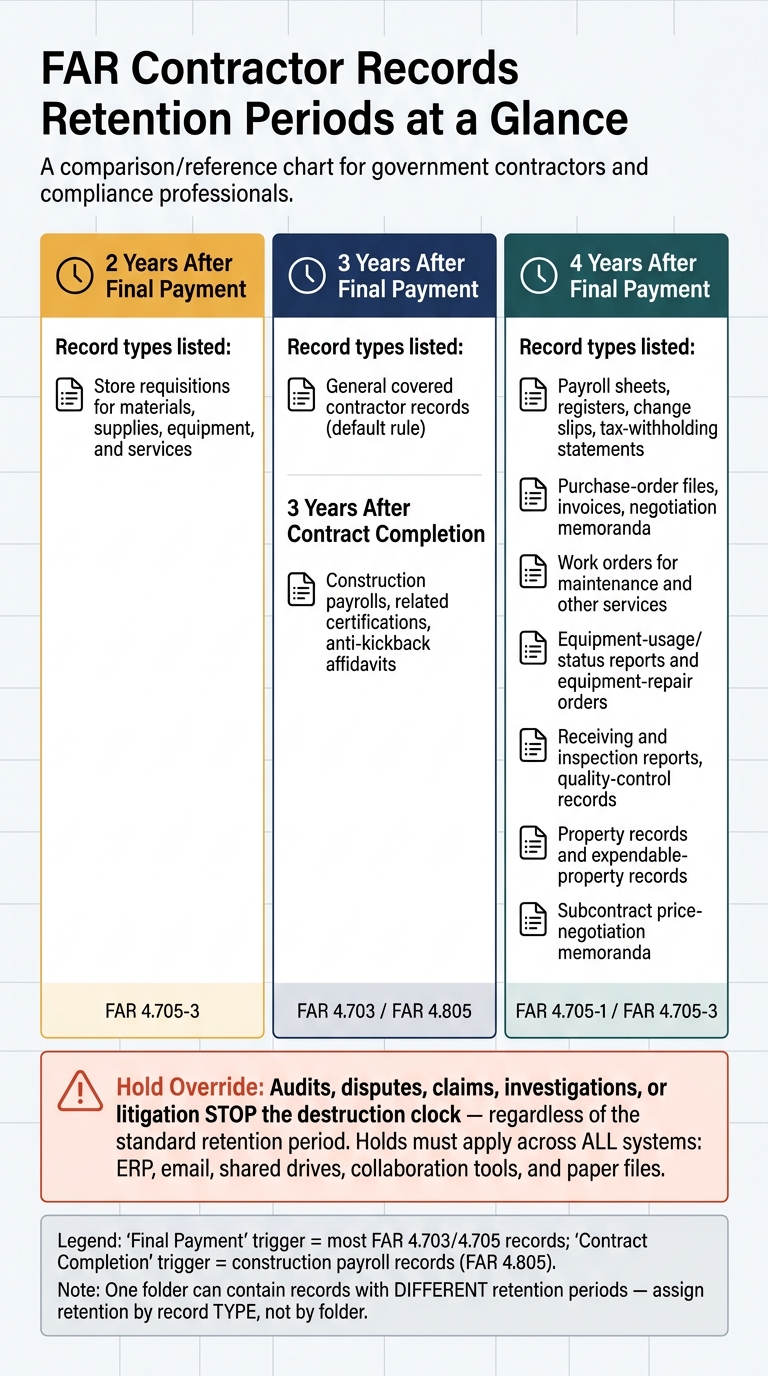
FAR Contractor Records Retention Periods at a Glance
Once you know which records are covered, the next step is making sure you destroy them at the right time. This is where a lot of teams slip up.
The General Rule: 3 Years After Final Payment
Under FAR 4.703, covered records must be kept for 3 years after final payment unless a specific FAR category sets a different period. That means you should not apply one company-wide destruction date to every record.
Record-Specific Periods Under FAR 4.705 Through 4.705-3
Some record categories have their own timelines. Several of them carry a 4-year retention period.
FAR 4.705-1 applies the 4-year period to payroll sheets, registers, change slips, and tax-withholding statements. FAR 4.705-3 also applies a 4-year period to purchase-order files, including invoices and negotiation memoranda; work orders for maintenance and other services; equipment-usage and status reports; equipment-repair orders; receiving and inspection reports; expendable-property records; and property records.
Use the table below to line up each record type with the right retention period. Before destroying anything, check the contract and any incorporated clauses.
| Record category | Retention period | Trigger date | Rule that controls |
|---|---|---|---|
| General covered contractor records | 3 years | Final payment | FAR 4.703, unless a specific FAR period applies |
| Payroll sheets, registers, change slips, and tax-withholding statements | 4 years | Final payment | FAR 4.705-1 category-specific period |
| Store requisitions for materials, supplies, equipment, and services | 2 years | Final payment | FAR 4.705-3 category-specific period |
| Work orders for maintenance and other services | 4 years | Final payment | FAR 4.705-3 category-specific period |
| Equipment-usage and status reports; equipment-repair orders | 4 years | Final payment | FAR 4.705-3 category-specific period |
| Purchase-order files, invoices, negotiation memoranda, and related backup | 4 years | Final payment | FAR 4.705-3 category-specific period |
| Receiving and inspection reports; quality-control, reliability, and inspection records; property records; expendable-property records | 4 years | Final payment | FAR 4.705-3 category-specific period |
| Construction payrolls, related certifications, anti-kickback affidavits, and related records | 3 years | Contract completion | FAR 4.805, subject to the enforcement-action exception |
Assign retention by record type, not by folder. That sounds like a small point, but it matters. One folder can hold records with different retention periods.
Final Payment vs. Contract Completion: Which Trigger Applies
These two dates are not the same, and mixing them up is a common cause of retention mistakes.
Most records under FAR 4.703 start the clock at final payment. Construction payroll records follow a different rule. Under FAR 4.805, payrolls submitted on construction contracts, plus related certifications and anti-kickback affidavits, must be kept for 3 years after contract completion.
Track final payment and contract completion as separate dates, because different record sets may begin their retention periods on different days. If an enforcement action is open, stop destruction until that action closes.
Audit holds or dispute holds can also override the normal schedule.
How Audits, Disputes, and Subcontractor Files Affect Retention
Standard FAR retention periods give you a starting point. But that starting point can change fast when an audit, dispute, or subcontractor issue shows up. That’s where a lot of contract teams get blindsided.
When Routine Destruction Must Stop
If you reasonably expect an audit, claim, dispute, investigation, litigation, or enforcement action, stop routine destruction right away.
That means issuing a documented hold that clearly states:
- the matter involved
- the affected contracts
- the record categories covered
- the custodians responsible
- the date normal deletion was suspended
The hold also needs to stop automatic deletion in every place those records might live. That includes email, ERP, shared drives, collaboration tools, databases, mobile devices, and paper files.
Keep native files and metadata. If anything is converted, document that step.
Later, when the hold is ready to be released, legal, contracts, finance, audit, and records management should check that no related matter still calls for preservation. If destruction can move forward, log that decision.
How to Handle Subcontractor and Supplier Records
The same hold rules apply when the records are with a subcontractor or supplier.
A lot of prime contractors leave subcontractor files in the subcontractor’s hands and move on. That’s risky. Subcontractor records are part of the same retention issue when the prime bills the government, goes through an audit, or closes out the contract.
If a subcontractor’s records are missing or incomplete, the prime can still face exposure for costs billed to the government based on that subcontractor’s work. In plain English: the file may sit with the subcontractor, but the problem can still land on the prime’s desk.
The subcontract is the best place to spell out what records the subcontractor must keep, how long to keep them, and the format required. Common record categories include invoices, labor and material support, timesheets, purchase orders, receiving reports, certifications, inspection results, change-order approvals, and lower-tier subcontract files.
There’s also a point many teams miss: FAR 4.705-3(f) requires 4-year retention of subcontract price-negotiation memoranda. So the executed subcontract and final invoices, by themselves, are not enough.
Each invoice should tie back to the right subcontract, period of performance, and acceptance evidence. At closeout, the prime should reconcile subcontractor billing against its own accounts payable ledger, cost accumulation records, and amounts billed to the government.
If a subcontractor sends incomplete support, document the gap and get corrected records before final payment is approved. If the subcontractor refuses to provide records tied to a government audit or a suspected overcharge, the prime should place a hold on its own related records and decide whether disclosure or corrective action is needed.
Prime, Subcontractor, and Shared Supporting Records: A Comparison
Use the table below to separate ownership from access responsibility.
| Record owner | Purpose | Retention trigger | Access responsibility |
|---|---|---|---|
| Prime record set | Demonstrate contract performance, billing, accounting, modifications, compliance, and closeout | Applicable FAR or contract-clause period from the required trigger, such as final payment, plus any active hold | Prime must organize and produce records to the government, auditors, contracting officials, and authorized representatives |
| Subcontractor record set | Support its pricing, labor, materials, invoices, deliveries, certifications, and performance | Period stated in the subcontract, applicable FAR flow-downs, or any longer active hold | Subcontractor must preserve and provide records to the prime and, where authorized, to government or audit personnel |
| Shared support trail | Connect subcontract performance and costs to prime invoices and government acceptance | Longest applicable requirement among the prime contract, subcontract, record category, and any unresolved matter | Both parties should retain the version used for billing and closeout, or reliable access to it |
Track hold status, ownership, and access as separate issues.
Conclusion: A Workable FAR Retention Approach for Contract Teams
FAR 4.703 is the starting point. It sets a baseline of 3 years after final payment, but that doesn’t mean every file follows the same rule. Each record needs to line up with its matching category under FAR 4.705 through 4.705-3. On top of that, contract clauses, audits, and disputes can stretch the retention period. After that, the task is pretty direct: put each file under the right rule.
The key is to match each record category to the right FAR period. For instance, maintenance work orders carry a 4-year retention period under FAR 4.705-3, while some supplies, equipment, and services records need only 2 years. A one-size-fits-all rule sounds easy, but it causes retention problems fast.
Trigger dates matter just as much as the retention period itself. You need to start the clock on the correct trigger date, write that date down, and keep the backup that supports it. Some records tied to terminations, claims, disputes, appeals, or litigation have to remain available until the issue is fully resolved.
Once the trigger date is set, the next step is control. Four controls do most of the heavy lifting:
- Map record categories
- Assign owners
- Calculate dates by category
- Document holds
Those holds need to apply across every system. That includes accounting platforms, email, shared drives, collaboration tools, and paper files. If one system gets missed, the whole setup gets shaky.
The same approach has to cover subcontractors too. Subcontractor files should sit inside the same framework. Record-access, audit, and retention terms need to flow down through subcontracts, and the supporting subcontractor records must stay available for government review.
FAQs
How do I know which retention rule applies to each record?
First, identify the governing contract clause. Under FAR 4.7, contract records are usually kept for three to six years after final payment, depending on the record type.
Check your contract clauses, any agency supplements, and the Statement of Work to confirm what applies. If the same record falls under more than one retention schedule, use the longest retention period.
What should I do if an audit or claim starts before records are destroyed?
If an audit, claim, or inquiry starts before records are destroyed, pause all scheduled destruction right away.
Keep those records in a clear, searchable, centralized repository until the matter is resolved. That way, you preserve a complete chain of custody for audits, disputes, and post-award compliance issues.
How should prime contractors manage subcontractor record retention?
Prime contractors should keep one centralized, audit-ready record system for subcontractor agreements and all supporting documents. Under FAR 4.7, keep those records for 3 to 6 years after final payment, based on the record type.
If more than one retention schedule applies, use the longest one. And because flowdown requirements can change based on subcontract type and tier, check those obligations manually.