
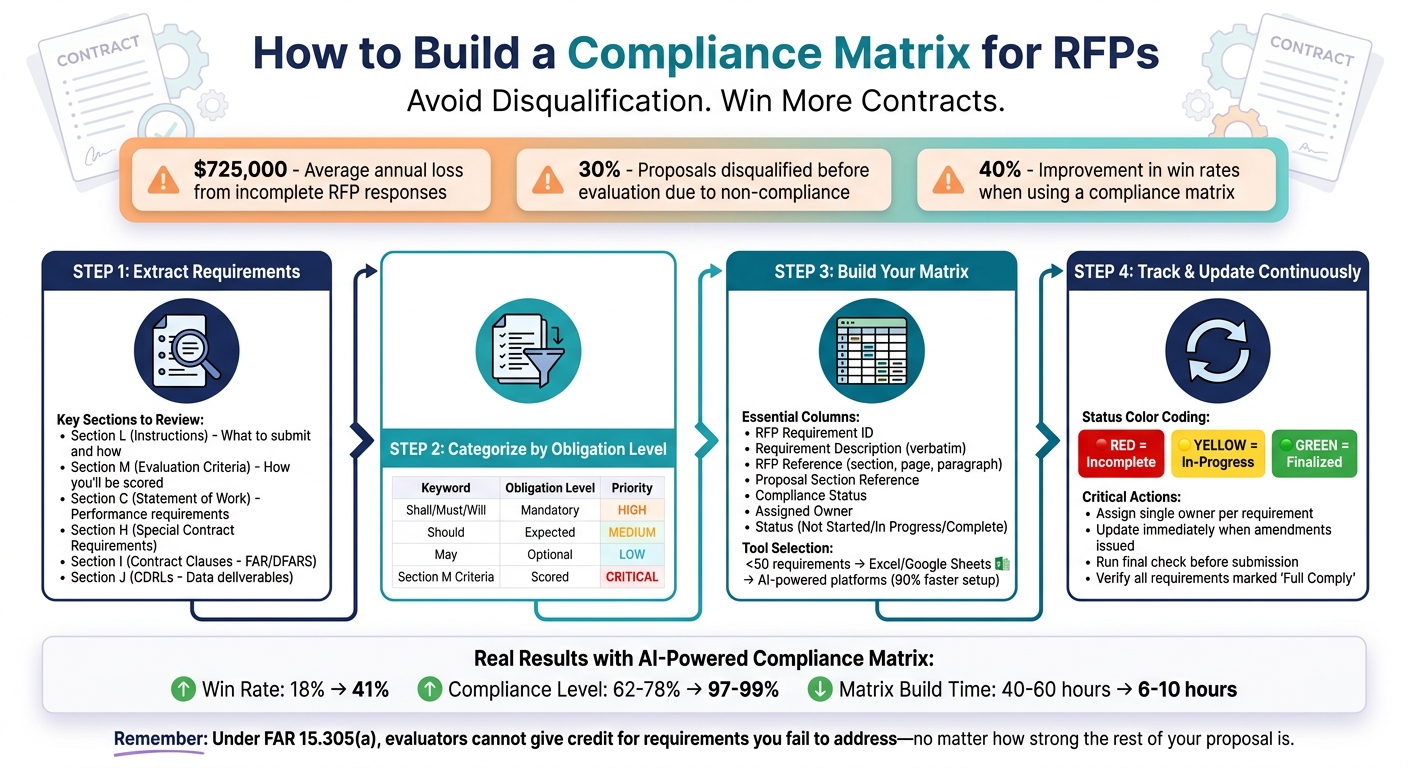
Avoid disqualification. Win more contracts. A compliance matrix is your tool to systematically track and address every RFP requirement, ensuring your proposal is complete and compliant. Missed requirements can cost companies up to $725,000 annually, and 30% of proposals are disqualified before evaluation due to non-compliance. Here’s how to avoid that:
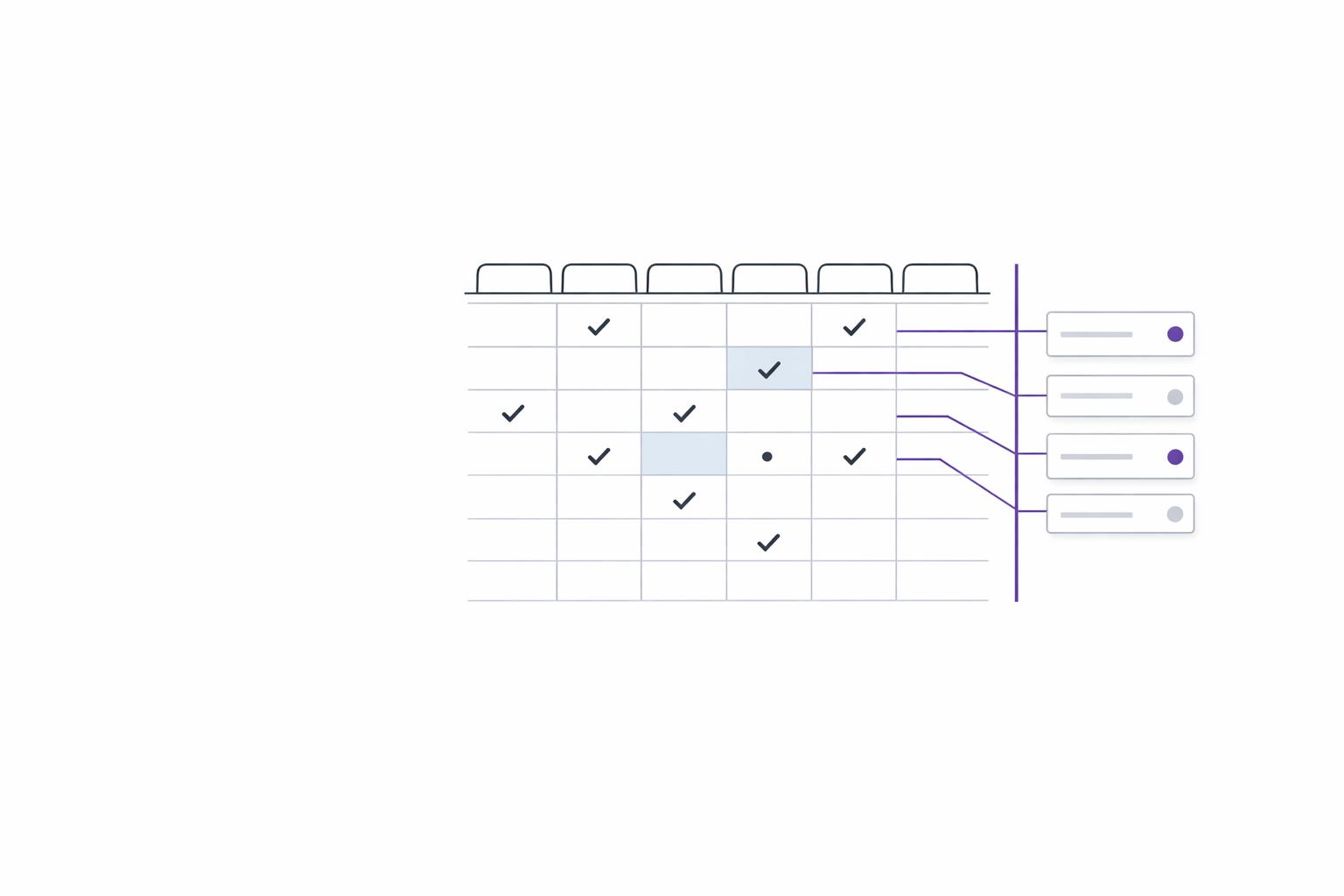
- What is it? A compliance matrix links RFP requirements to specific proposal sections, showing evaluators exactly where you meet each demand.
- Why use it? It reduces errors, assigns responsibility, tracks progress, and improves win rates by 40%.
- Who needs it? Proposal managers, subject matter experts, sales leaders, and review teams all benefit from this tool.
- How to create it? Extract requirements from key RFP sections (like Section L and M), categorize them by obligation level, and record exact references. Use tools like Excel for simpler bids or compare top RFP software tools for complex ones.
A well-maintained compliance matrix ensures you meet every requirement, avoids costly oversights, and improves your chances of winning contracts.
How to Build a Compliance Matrix for RFPs: 4-Step Process
Breaking Down RFP Requirements
Extracting every requirement from an RFP is the backbone of creating a solid compliance matrix. This step, often called detailed extraction, requires a meticulous review of the document, line by line, to identify all obligations, questions, and instructions. Missing even one requirement could put your entire bid at risk.
Finding Key RFP Sections
Not all sections of an RFP are equally important. Start by zeroing in on the parts where requirements are concentrated.
- Section L (Instructions): This section outlines what you need to submit and how to structure your proposal. Think of it as your main guide.
- Section M (Evaluation Criteria): Here, you’ll find how your submission will be scored. It often includes additional requirements not explicitly detailed in Section L.
- Statement of Work (Section C): This section contains the performance and technical requirements for the contract.
- Section H (Special Contract Requirements): Contains unique obligations tied specifically to this contract.
- Section I (Contract Clauses): Includes FAR/DFARS clauses, which may have technical implications.
- Section J: Features the Contract Data Requirements Lists (CDRLs), detailing data deliverables, formats, and delivery schedules.
"I have seen proposals lose because the team built a perfect compliance matrix against Section L and completely ignored the CDRL list." – Senior Proposal Manager, Large Defense Integrator
Don’t skip any cross-references. If the RFP mentions “see Section C, paragraph 3.2” or refers to external standards like NIST SP 800-171, follow those leads – they often point to additional requirements that are easy to overlook.
After identifying the key sections, the next step is to classify the requirements based on their level of obligation.
Categorizing Requirements
Once you’ve identified all the requirements, organize them by their obligation level. Pay attention to specific action words:
- "Shall", "must," and "will" indicate mandatory requirements you must address to stay compliant.
- "Should" suggests expectations that allow some flexibility.
- "May" points to optional elements.
- Words like "describe", "list," and "explain" highlight specific information requests that require a direct response.
Here’s a quick breakdown to help you categorize requirements:
| Requirement Type | Keyword/Source | Obligation Level |
|---|---|---|
| Mandatory | shall, must, will | High – Required for compliance |
| Expected | should | Medium – Expected with some flexibility |
| Optional | may | Low – Discretionary |
| Scored Criteria | Section M | Critical – Directly impacts win probability |
| Deliverables | CDRLs / Exhibit A | High – Contractual data obligations |
Group these requirements by proposal volume – such as technical, management, past performance, cost/price, and administrative. This makes it easier to assign the right subject matter experts to each area. Combining Section M’s scoring criteria with Section L’s instructions can also reveal hidden scoring elements that may not be explicitly stated but can influence your evaluation.
Recording RFP References
Assigning a unique identifier to each requirement ensures traceability throughout the proposal process. Use a format like L-4.2.1 (Section L, paragraph 4.2.1) to make it easy for team members to locate specific references. Always record the exact section, paragraph, and page number to avoid confusion.
Stick to verbatim text when adding requirements to your matrix. Copy the exact language from the RFP instead of paraphrasing. This reduces the risk of misinterpretation. Under FAR 15.305(a), evaluators cannot give credit for a requirement you fail to address, no matter how strong the rest of your proposal is. A detailed compliance matrix allows evaluators to quickly see where each requirement is covered in your submission, boosting both accuracy and confidence in your proposal.
Stay on top of amendments. When the government issues an RFP amendment, update your matrix immediately to account for any changes, additions, or deletions. Failing to reconcile amendments can lead to wasted effort addressing outdated requirements or, worse, missing new ones altogether.
sbb-itb-bb3960c
Setting Up Your Compliance Matrix
Once you’ve gathered all the requirements from the RFP, the next step is to create the compliance matrix. This tool will help you organize, track, and manage every requirement from start to finish. A well-built matrix becomes the central reference point for your entire proposal team.
Selecting Your Tools
For proposals with fewer than 50 requirements, tools like Microsoft Excel or Google Sheets work well. They’re easy to use, widely available, and familiar to most teams. However, if you’re dealing with a complex proposal – think 200+ requirements, like those often found in Department of Defense (DoD) solicitations – you’ll need more advanced tools. Platforms such as Narwin.ai can drastically reduce setup time by automating requirement extraction and tracking. While manual setup might take 3–5 days, AI-powered tools can cut this down by up to 90%, saving your team valuable time.
Creating Core Matrix Columns
Your matrix should include these critical columns:
- RFP Requirement ID: The specific clause or line number from the RFP.
- Requirement Description: The exact text from the RFP to ensure accuracy.
- RFP Reference: The section, page, and paragraph number for traceability.
- Proposal Section Reference: Where each requirement is addressed in your proposal.
- Compliance Status: Options like Compliant, Partially Compliant, or Not Applicable.
- Assigned Owner: A single person responsible for each requirement.
- Status: Indicates progress, such as Not Started, In Progress, or Complete.
For more complex matrices, you might also include:
- Risk Level: Categorized as High, Medium, or Low to flag potential issues.
- Evaluation Factor Alignment: Links requirements to Section M scoring criteria.
- Amendment Tracking: Keeps tabs on changes to the RFP over time.
These additional columns are especially useful during color team reviews, helping the team identify and address potential problems early.
Using Standard Formats and Tags
Consistency is non-negotiable. Use standardized tags such as "Full Comply", "Partial Comply", "Exception," and "Will Comply" to quickly communicate your level of compliance. Color coding can further highlight sections that need attention. Always include verbatim language from the RFP in the requirement description column to avoid any misinterpretation.
Additionally, categorize requirements by obligation level:
- "Shall/Must": Mandatory and high-risk items.
- "Should": Expected items with medium risk.
- "May": Optional elements with low risk.
This prioritization ensures your team focuses on the most critical requirements first. Missing even one RFP requirement can lower win rates by 73%, so these standardized formats and tags act as a safeguard against costly errors.
Mapping Requirements to Proposal Sections
Your compliance matrix is more than just a checklist – it’s the blueprint for crafting a thorough and winning proposal. By mapping each requirement to your proposal, you ensure that evaluators can quickly confirm you’ve addressed every detail, leaving no room for oversights.
Matching Your Proposal Structure to the RFP
To make your proposal seamless for evaluators, structure it to mirror the RFP. Align your content with Section L and incorporate the specific scoring criteria from Section M. This way, evaluators can follow their checklist step by step without searching for information.
Why does this matter? Missing even a single detail can cost you. For instance, Department of Defense RFPs often include 200 to 400+ distinct requirements, and about 30% to 50% of proposals reveal compliance gaps during Red Team reviews. Ignoring these details can lead to costly mistakes.
Don’t stop at Section L and Section M. Review the Statement of Work (SOW), Contract Data Requirements Lists (CDRLs), and any attachments. These often contain critical requirements that can be easily overlooked.
"I have seen proposals lose because the team built a perfect compliance matrix against Section L and completely ignored the CDRL list. We scored ‘Marginal’ on the management approach. The requirements were there, plain as day, in Attachment J-4."
- Senior Proposal Manager, Large Defense Integrator
Addressing these overlooked areas ensures your proposal is airtight and free of gaps.
Finding and Fixing Gaps and Overlaps
Once your proposal structure aligns with the RFP, it’s time to double-check for gaps and overlaps. Make sure every requirement in your matrix has a corresponding section in your proposal. Gaps signal unaddressed requirements, while overlaps can create unnecessary redundancies.
Assign ownership for each requirement to a specific team member. This accountability ensures no detail is missed, even if your proposal outline shifts. Clearly document the volume, section, and paragraph where each requirement is addressed. For requirements spanning multiple sections, designate a primary response location and include references to supporting sections. This prevents conflicting or repetitive content.
Using standardized compliance statuses like "Full Comply", "Partial Comply", "Exception," or "Not Yet Addressed" can help you track progress. Any "Not Yet Addressed" items highlight critical gaps that need resolution before your Gold Team review.
Using RFP Terminology
Speak the evaluators’ language – literally. Using the exact terminology from the RFP makes it easier for evaluators to verify compliance. Paraphrasing or rewording requirements might distort their intent, leading to missed points.
Under FAR 15.305(a), evaluators cannot award points if a requirement isn’t clearly addressed. As one evaluator noted after a $48 million contract loss:
"Not fully compliant."
Cross-references like "Attachment J-4" or "DFARS clauses" often hide additional requirements. Ensure these are included in your matrix to demonstrate attention to detail. This level of precision shows evaluators that you’re prepared, reliable, and ready to deliver on the contract.
Tracking Progress and Updating the Matrix
A compliance matrix isn’t something you create and forget about. It’s a dynamic tool that requires consistent updates throughout the proposal process. If you let it sit idle, you risk overlooking key changes, losing clarity on responsibilities, or even submitting an incomplete proposal.
Assigning Owners and Tracking Status
Each requirement in your matrix needs a dedicated owner – not a group, but one specific person. Shared ownership can lead to confusion, with team members assuming someone else is handling a task. Assigning a single individual ensures accountability. To track progress, use standardized status labels and color coding:
- Red: Incomplete
- Yellow: In-progress
- Green: Finalized
This visual system makes it easy to spot issues. Considering that 30% to 50% of proposals still show compliance gaps during the Red Team review, real-time tracking can help you address problems early.
Keep the matrix accessible to everyone by storing it in a shared, editable platform like cloud-based spreadsheets or specialized RFP management tools. This ensures your entire team works from the same "source of truth." Also, avoid marking any requirement as "Full Comply" until the content is written, reviewed, and verified in the draft. Treat the matrix as the backbone of your proposal, reinforcing its importance through continuous updates.
Adding RFP Amendments
Clarity on individual responsibilities is just the first step. To stay responsive, update the matrix whenever amendments to the RFP arise. Conduct a diff analysis between the amendment and the original solicitation to identify all changes – this process can take 8–12 hours if done manually.
For each change, update the corresponding rows in the matrix and notify the relevant writers with specific details about what has been modified.
"The compliance matrix is built once but maintained continuously. Every amendment modifies requirements. Every outline change shifts mappings."
- Projectory
Log the timestamps for every update to create an audit trail. Additionally, evaluate how amendments might affect your win strategy, pricing, or technical approach, and adjust your risk indicators as needed.
Running a Final Check
Once you’ve tracked progress and addressed amendments, it’s time for a final review. Before submission, confirm that every requirement in the matrix is marked "Full Comply" and that all references are accurate. Double-check that page and paragraph numbers align with your final, paginated proposal document, as these often shift during production.
Verify all cross-references, including CDRLs, attachments, and external standards like NIST or MIL-STD specifications. If your matrix is a required deliverable, make sure to remove any internal notes, reviewer comments, risk flags, or SME names before submission. The version you submit should be clean and professional.
Under FAR 15.305(a), evaluators can’t give credit for requirements that aren’t explicitly addressed. A complete and accurate matrix not only safeguards against disqualification but also streamlines the evaluator’s review process, which can work to your advantage.
Conclusion
Benefits of Using a Compliance Matrix
A compliance matrix can be the difference between securing a contract or losing out entirely. Missing even one mandatory requirement could disqualify your bid. For example, a defense contractor once lost a $48 million award because their proposal was marked as "Not fully compliant" during the evaluation process. On the flip side, a well-organized matrix makes it easier for evaluators to verify compliance, which could lead to higher scores.
The cost of non-compliance is no small matter. Businesses lose an average of $725,000 annually due to incomplete responses to RFPs. One defense IT company saw dramatic improvements after adopting an AI-driven approach: win rates jumped from 18% to 41%, compliance levels rose from 62–78% to an impressive 97–99%, and the time spent building matrices dropped from 40–60 hours to just 6–10 hours.
These results highlight how a compliance matrix not only ensures accuracy but also streamlines the proposal process, giving you a stronger foundation for success.
Getting Started
Ready to incorporate a compliance matrix into your process? Here’s how to get started effectively.
Begin creating your matrix as soon as you receive the RFP. Use the exact wording from the solicitation to avoid misinterpretations, assign clear ownership for each requirement, and treat the matrix as a dynamic document that evolves alongside your proposal. If you’re working on complex government contracts or high-stakes bids, consider leveraging AI-powered tools like Narwin.ai. These platforms can automate tasks such as extracting requirements, tracking amendments, and identifying compliance gaps in real time. This not only minimizes manual errors but also frees up your team to focus on crafting a compelling and competitive proposal.
FAQs
What’s the fastest way to extract every RFP requirement without missing any?
The quickest way to tackle an RFP is by carefully reviewing it and building a compliance matrix. This tool links every requirement in the RFP to your proposal response, ensuring nothing slips through the cracks. Break down sections like instructions, evaluation criteria, and performance standards, and document each requirement systematically. A compliance matrix serves as your roadmap, making it easier to stay on track and meet all the outlined requirements, reducing the risk of missing critical details or facing disqualification.
How do I decide whether a requirement is “shall/must” vs. “should” vs. “may”?
Deciding between "shall/must", "should," and "may" in an RFP comes down to understanding the level of obligation each term represents:
- "Shall" or "must": These indicate mandatory requirements. Failing to meet them can lead to disqualification.
- "Should": This signals a recommendation. While not required, addressing these items can strengthen your proposal.
- "May": This provides options, giving you flexibility in how to respond.
Carefully analyze each requirement to ensure you fully comply with mandatory items and appropriately address the others.
How do I keep my compliance matrix accurate after RFP amendments and proposal edits?
To stay on track, update your compliance matrix right after any RFP amendments or proposal adjustments. Make sure to include all changes or new requirements so your responses match the most current version of the RFP. By revising the matrix regularly as updates come in, you reduce the risk of overlooking requirements and keep your proposal aligned and effective throughout the process.