
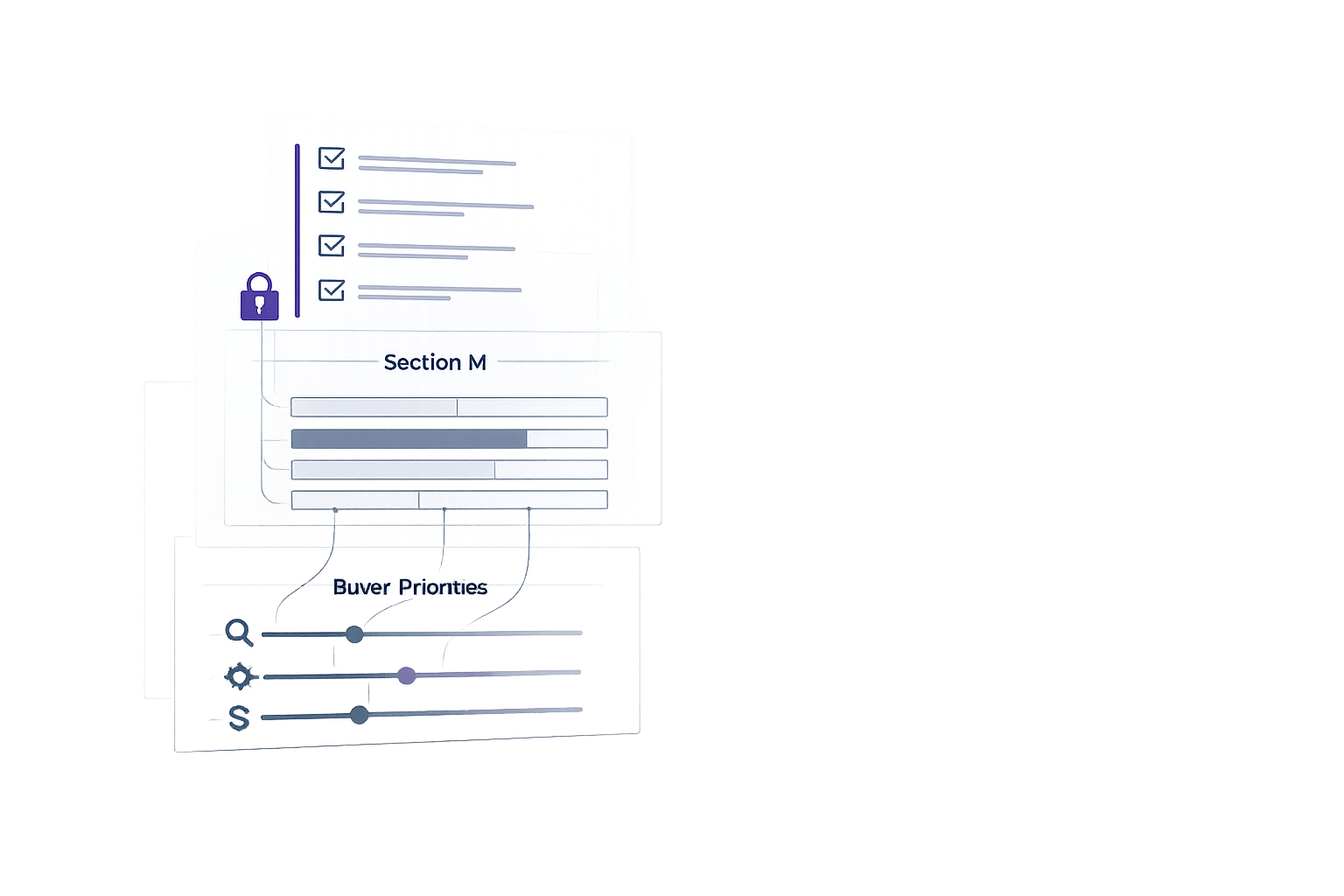
Winning RFPs isn’t just about meeting requirements – it’s about understanding what buyers truly value. Buyer preferences, often hidden within RFPs, influence everything from evaluation criteria to proposal success rates. Misreading these signals can lead to disqualification or lower scores, even for qualified vendors.
Key takeaways:
- RFPs reflect buyer priorities: Sections like L (Instructions) and M (Evaluation Factors) reveal what matters most – technical expertise, cost, or risk mitigation.
- Compliance is critical: Missing mandatory requirements (e.g., "shall") can result in disqualification.
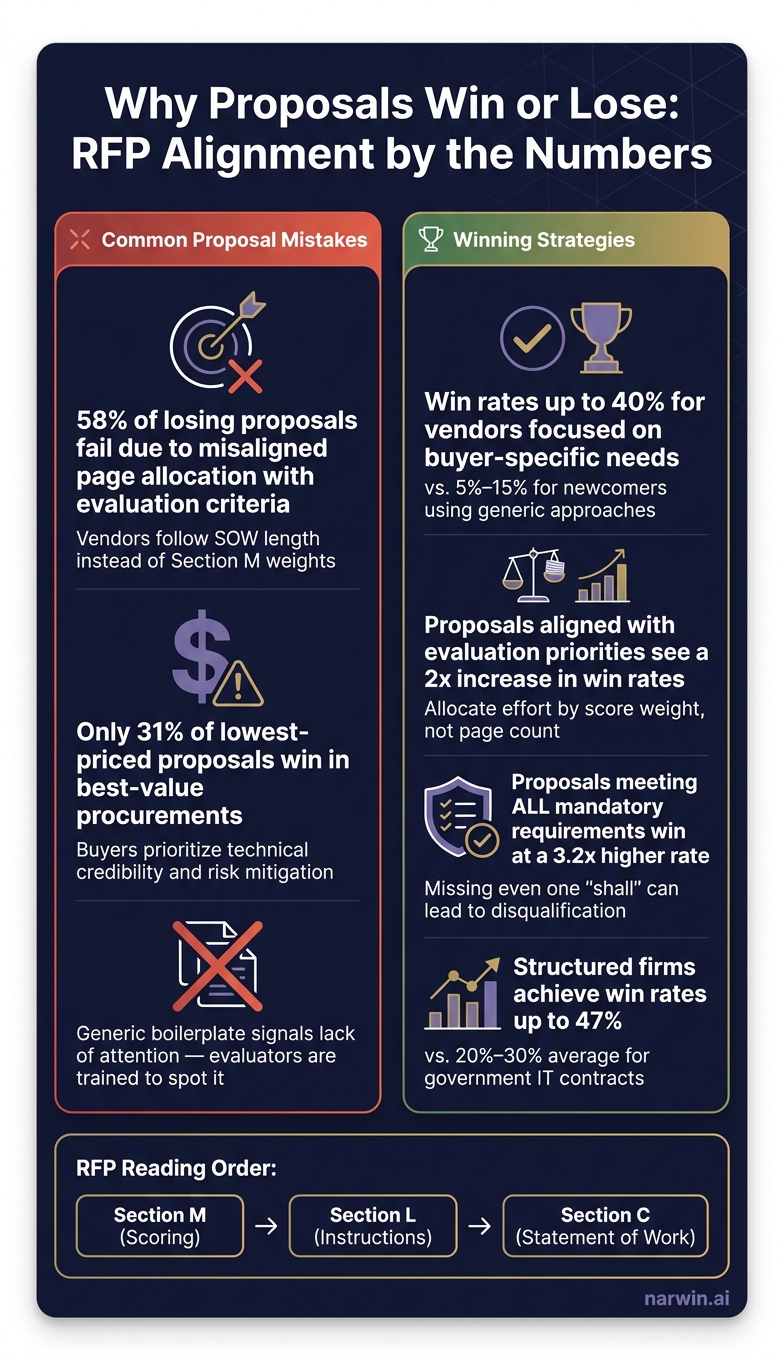
- Tailored proposals win: Vendors focusing on buyer-specific needs and evaluation criteria see win rates up to 40%, compared to 5%-15% for newcomers.
- Use a structured approach: Start with Section M to understand scoring, then align your proposal accordingly.
- AI tools save time: Platforms like Narwin.ai analyze RFPs quickly, flag risks, and help tailor responses.
In short, understanding buyer preferences isn’t optional – it’s the key to winning more contracts.
How Buyer Preferences Show Up in RFP Requirements
This section dives into how buyer preferences are woven into RFP requirements, providing insight into both explicit and implicit needs.
Stated vs. Unstated Needs
Every RFP operates on two levels: the clearly stated needs and the less obvious, unstated ones. Stated needs are straightforward and measurable – things like the Statement of Work (SOW), technical specifications, or compliance requirements. For example, requirements such as "must support 500 concurrent users" or "SOC 2 Type II certification required" are easy to identify and quantify.
Unstated needs, however, take a little more digging to uncover. These are often hinted at through the tone of the document, recurring themes, or the emphasis placed on specific evaluation factors. For instance, if a buyer has faced challenges with implementation in the past, they might not say this outright. Instead, they may heavily focus on areas like change management or transition planning. A great way to spot these hidden priorities is to analyze how the buyer describes their current situation. Frequent mentions of issues like delays, cost overruns, or security breaches can reveal what they’re eager to avoid.
"Generic descriptions lose to detailed, tailored approaches." – Humam Hawara, SamSearch
Understanding this dual-layered structure is key to aligning your proposal with both the explicit and implied priorities of the buyer.
Evaluation Criteria and Weighted Scores
When it comes to federal RFPs, Section M of the Uniform Contract Format (UCF) is where buyer preferences become crystal clear. This section acts as the government’s scoring guide, breaking down how each part of your proposal will be evaluated.
Pay close attention to how evaluation factors are weighted, particularly in relation to cost. For example, when you see a phrase like "technical factors are significantly more important than cost," it signals a Best Value Tradeoff approach. This means the buyer is willing to accept a higher price if it comes with better quality or reduced risk. On the other hand, a Lowest Price Technically Acceptable (LPTA) approach means price takes precedence once basic technical requirements are met.
"Section M tells you exactly how the government will compare proposals… That single sentence [on relative importance] shapes your entire proposal strategy." – Josef Kamara, CPA, CISSP, CISA
These weights also guide where you should focus your efforts. For instance, a requirement that spans 50 pages in the SOW might only account for 10% of the evaluation score, while a shorter five-page section could carry 50% of the weight. Chasing length over substance can be a costly mistake.
In addition to scoring, the language used in RFPs can highlight critical risk and compliance concerns.
Risk and Compliance Signals
Compliance terms in an RFP are more than just formalities – they reflect the buyer’s top concerns. For example, modal verbs like "shall" indicate mandatory requirements, and overlooking even one can disqualify a proposal.
Certain RFP sections are especially important for identifying risk signals. Section H (Special Contract Requirements) often outlines key details like security clearance levels, insurance requirements, and rules around organizational conflicts of interest (OCI). Similarly, Section J may include critical items like wage determinations or contract data requirements lists (CDRLs) – details that are sometimes easy to miss but crucial for compliance.
When an RFP includes an extensive list of certifications or detailed cybersecurity requirements (e.g., DFARS 252.204-7012 for handling Controlled Unclassified Information), it’s a clear sign that risk mitigation is a priority. Addressing these concerns with precise, well-thought-out responses – not vague promises – can make your proposal stand out as both compliant and trustworthy.
sbb-itb-bb3960c
Common Ways Vendor Proposals Miss Buyer Preferences
RFP Win Rates: Tailored vs. Generic Proposals
Even seasoned vendors can lose RFPs – not because they lack expertise, but because their proposals fail to align with what buyers prioritize. These missteps are often predictable and avoidable.
Over-Focusing on Features and Price
Vendors frequently emphasize product features and competitive pricing, but this approach can fall short if it doesn’t address the buyer’s deeper concerns, such as implementation risks or service reliability. A proposal loaded with technical specs may still leave buyers questioning whether the vendor truly understands their needs.
For instance, proposals that highlight advanced solutions but fail to outline risk management strategies can create uncertainty. Similarly, when the technical narrative promises high-touch support, but the pricing doesn’t reflect it, buyers may sense a disconnect between the proposal and their expectations. Data supports this: in best-value procurements, only 31% of lowest-priced proposals secured the win, showing that buyers often prioritize technical credibility and risk mitigation over cost alone.
Beyond focusing too much on features, vendors often stumble when interpreting evaluation criteria.
Misreading Evaluation Criteria
Another common error is misinterpreting the buyer’s evaluation instructions. Vendors often rely too heavily on the Statement of Work (SOW) to guide their proposal. While the SOW outlines what needs to be done, Section M (Evaluation Criteria) specifies how the buyer will score proposals. Confusing these sections leads to proposals that may be thorough but fail to deliver where it matters most.
"Section M should drive your writing strategy, Section L should drive your structure, and Section C should drive your solution." – Cabrillo Club Insights
Data shows that 58% of losing proposals fail because they misalign their page allocation with the evaluation criteria. Vendors often distribute their effort evenly across all sections, even when buyers explicitly state that certain factors – like Technical Approach – carry more weight. Proposals that align their focus with evaluation priorities see a 2x increase in win rates compared to those that don’t.
"The government does not award contracts to the most qualified firm; it awards them to the firm whose proposal best demonstrates qualification under the stated criteria." – Cabrillo Club Insights
Reusing Templated Proposals Without Tailoring
One of the most costly mistakes vendors make is recycling past proposals without customizing them for the current RFP. Government evaluators are trained to spot generic, boilerplate content, which often results in lower technical scores. A proposal that feels pieced together signals a lack of attention to detail.
"A proposal that sounds stitched together suggests to evaluators that execution may be stitched together too." – Hisham Hawara, SamSearch
Generic content also fails to address the buyer’s specific mission, challenges, and risk tolerance. Reused proposals often focus on compliance but overlook the buyer’s unique priorities. For example, vague claims like "we provide world-class service" or "our team is highly experienced" don’t resonate with evaluators. These statements lack verifiable evidence and fail to connect with the buyer’s stated requirements. To avoid this, every claim should pass two simple tests: Is it directly relevant to this RFP? Could a competitor say the same thing? If the answer to either is yes, it needs to be rewritten.
How to Decode Buyer Preferences in RFPs
Proposals often fail because they don’t align with buyer expectations. But here’s the thing: every RFP contains clues about what the buyer values most – you just need to know where to look.
A Step-by-Step Approach to RFP Analysis
To break down an RFP effectively, follow the M-L-C reading order: start with Section M (Evaluation Factors), move to Section L (Instructions to Offerors), and finish with Section C (Statement of Work). This approach ensures you understand how proposals will be scored before diving into the technical details.
Once you’ve gone through Section M, create a compliance matrix. This is a simple spreadsheet where you list every "shall", "must", and "will" statement from the RFP. Highlight each requirement based on its modal verb:
| Verb | Signal | Action |
|---|---|---|
| Shall / Must | Mandatory requirement | Address it fully – missing these can lead to disqualification. |
| Should | Strongly expected | Follow these unless you have a strong, justifiable reason not to. |
| May | Optional / permissive | Use at your discretion; often indicates areas that can add extra value. |
This step helps you separate the buyer’s non-negotiable needs from their "nice-to-haves", giving you a clear roadmap for prioritizing your efforts. With this foundation, you can then use historical data and AI tools to dig deeper into buyer preferences.
Using Past Awards and Buyer History
Once your compliance matrix is ready, explore the buyer’s award history for additional context. Public resources like SAM.gov and USASpending.gov are great for researching an agency’s past contracts. Look for trends: Do they prefer working with large prime contractors? Do they lean toward small businesses? Are they loyal to specific vendors, awarding them contracts repeatedly?
Check out Section J (Attachments) in previous RFPs from the same buyer. A brief Statement of Work (SOW) on a high-value contract might indicate that an incumbent vendor helped shape the requirements.
"A thin PWS on a large-dollar contract can signal that the incumbent helped shape the requirements – they don’t need detail because they already understand the work." – BidSparq
Post-award debriefs are another goldmine for insights. They can show why winning proposals stood out – whether due to lower perceived risk or better alignment with the buyer’s unstated priorities.
"Debriefs are where mature teams separate themselves. Mature teams use debrief feedback to improve bid decisions, refine discriminators, and fix patterns that keep costing them points." – Hisham Hawara, SamSearch
Using AI for Buyer Intelligence
While manual analysis is effective, it’s time-consuming. That’s where AI comes in – it can quickly uncover patterns and insights that might otherwise take hours to identify. For instance, a typical RFP spans 116 pages and might take 4–8 hours to analyze manually. Tools like Narwin.ai can process RFPs up to 2,000 pages in under 10 minutes. It identifies requirements, flags compliance risks, and even highlights incumbent signals automatically.
AI tools also excel at gathering buyer intelligence. Narwin’s Buyer Intel feature, for example, reveals an agency’s procurement history, inferred motivations, and risk tolerance – context that would be nearly impossible to compile manually. Combined with features like a Win Probability Score, AI enables teams to make informed go/no-go decisions instead of relying on gut feelings.
"Narwin helped us save 15+ hours & generate over $25,000 by participating only where we had a real shot." – Carter Hawthorniwaite, Director of Operations, App Growth Network
How to Align Proposals with Buyer Preferences
Understanding what buyers value is only half the battle. The real challenge lies in crafting a proposal that reflects those priorities. Here’s how you can translate buyer insights into a winning proposal.
Allocate Effort Based on Evaluation Weight
Once you’ve decoded the buyer’s scoring criteria, focus your energy where it matters most. As AmerifusionGovCon wisely advises:
"Allocate your proposal effort based on evaluation weight, not page count." – AmerifusionGovCon
For example, if the technical approach accounts for 40% of the evaluation and past performance is worth 20%, devote twice as much time and resources to the technical section. The procurement type also matters. In Best Value competitions, emphasize differentiation and creative solutions. For Lowest Price Technically Acceptable (LPTA) bids, focus on meeting every requirement efficiently and at the lowest cost.
Tailor Proposals to Different Decision-Makers
Most RFP evaluations involve a panel of decision-makers, each with a unique perspective. A typical team includes technical SMEs, program managers, and financial officers, all of whom assess your proposal differently.
Organize your proposal to address these varied viewpoints:
- The Technical volume should resonate with SMEs by showcasing your understanding of the work and your ability to execute it effectively.
- The Management volume should reassure leadership by demonstrating your team’s stability, proven processes, and a solid transition plan.
- The Price volume must align with the technical narrative, showing financial reviewers that your cost structure supports your proposed approach.
To ensure alignment, conduct color team reviews at critical stages. Use Pink Team reviews for compliance, Red Team reviews to evaluate against Section M criteria, and Gold Team reviews to finalize risk assessments. Each review phase helps catch potential misalignments before the proposal reaches the buyer.
Using AI to Align Proposals Faster
While manual alignment works, it’s time-consuming. AI tools like Narwin.ai can speed up the process dramatically. This platform automates compliance mapping and generates tailored drafts in minutes by analyzing your company’s profile and comparing it to the RFP’s requirements.
Narwin’s Company Profile feature is particularly effective. By uploading past projects, certifications, and case studies, you allow the AI to tailor proposal drafts to your actual strengths rather than relying on generic templates. As Narwin’s documentation explains:
"The richer your company profile, the more accurate your AI recommendations, match scores, and proposal drafts become." – Narwin.ai Documentation
Additionally, Narwin’s Buyer Intel tab provides insights into procurement history and inferred priorities, helping you fine-tune your tone and focus areas. These tools ensure your proposal aligns with what the buyer values most, giving you a competitive edge.
Conclusion: Matching Buyer Preferences to Win More RFPs
Landing an RFP isn’t just about meeting the requirements; it’s about showing that you genuinely understand what the buyer values most. While compliance ensures you’re in the game, true alignment is what seals the deal.
The numbers back this up. A study of 200 government IT RFPs revealed that proposals meeting all mandatory requirements win at a 3.2x higher rate than those that miss even one. Additionally, firms that rely on a structured, data-driven approach achieve win rates of up to 47%, far surpassing the typical 20%–30% average for government IT contracts. The difference? A proposal that mirrors the buyer’s priorities.
As Narwin.ai explains:
"Winning proposals aren’t just well-written. They’re strategic. And in 2026, that strategy includes the right tools, the right content, and the right mindset." – Narwin.ai
Narwin.ai simplifies this alignment with its suite of tools. Its Win Probability Score helps you decide whether an opportunity is worth pursuing before you invest resources, while the AI Writer uses historical performance data to create drafts that directly address buyer needs. By focusing on what matters most to the buyer, you can turn basic compliance into a competitive edge.
Every line of an RFP tells you what the buyer wants. The teams that learn to interpret and act on those signals with precision are the ones that consistently come out on top.
FAQs
How do I spot unstated buyer priorities in an RFP?
To better understand hidden buyer priorities, begin by examining Section M in the solicitation. This section provides key details about evaluation criteria, such as whether the decision will be based on LPTA (lowest price technically acceptable) or a best-value tradeoff. It’s a clear indicator of what the buyer values most.
Another valuable resource is the Q&A period. Questions raised by bidders during this time often shed light on the buyer’s specific concerns or priorities.
Tools like Narwin.ai can also simplify this process. By analyzing requirements, pinpointing evaluation focus areas, and mapping compliance, it helps ensure your proposal aligns with the buyer’s goals effectively.
What’s the fastest way to build a compliance matrix from an RFP?
Creating a compliance matrix doesn’t have to be a time-consuming task. With an AI-powered platform like Narwin.ai, you can streamline the process significantly. This tool leverages Natural Language Processing (NLP) to automatically extract requirements from RFPs, including attachments and specific clauses. Within minutes, it produces a structured matrix complete with unique IDs, allowing your team to concentrate on strategic planning instead of tedious manual data entry.
When should I use AI like Narwin.ai versus manual RFP review?
Managing high-volume or complex RFP tasks can be overwhelming, especially when manual reviews take 40–60 hours per proposal and leave room for errors. Tools like Narwin.ai simplify the process by automating critical tasks. It can extract requirements, offer data-driven bid/no-bid recommendations, pinpoint compliance gaps, and even draft proposals using your existing knowledge base. This not only saves time but also lowers the risk of disqualification.