
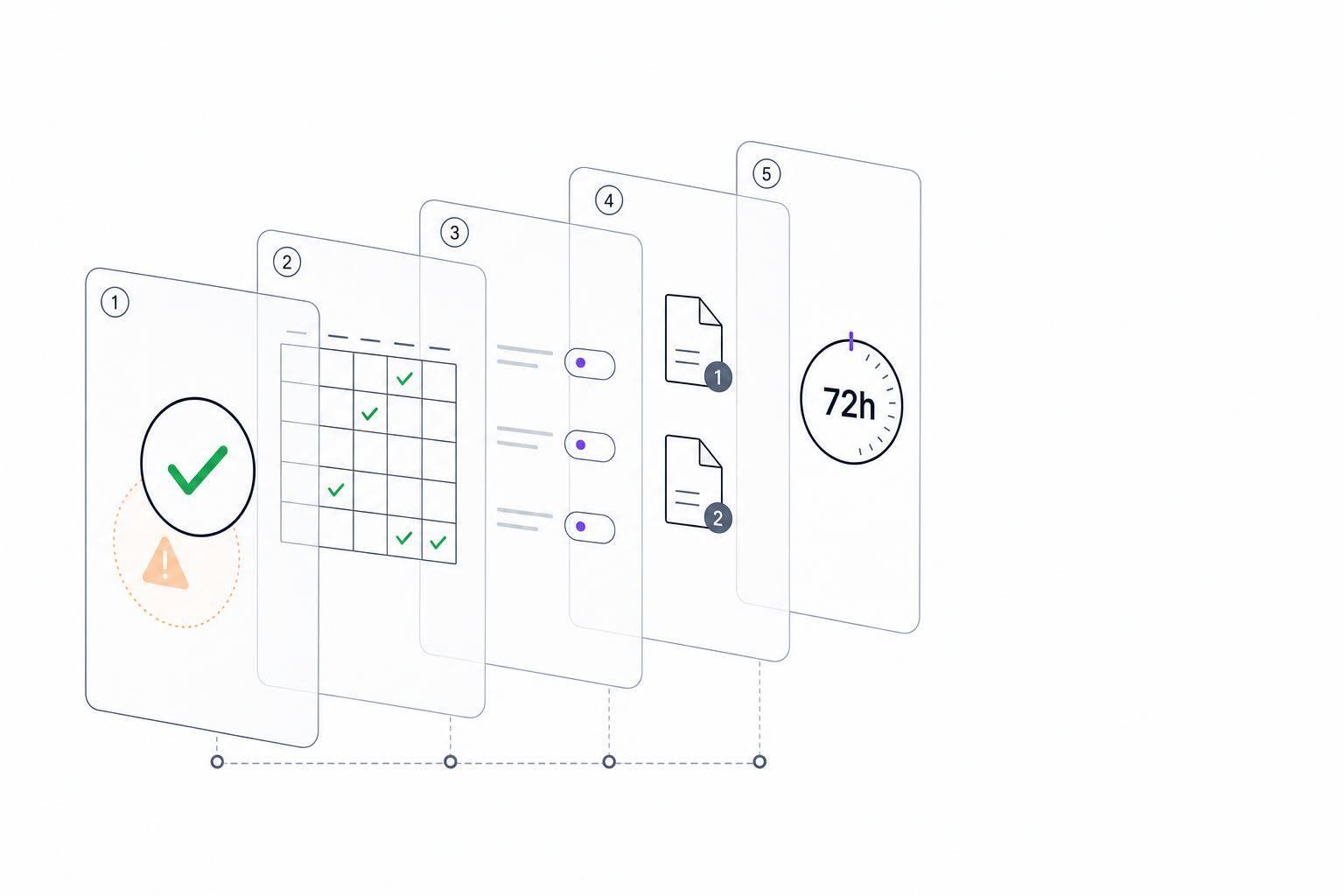
Miss one mandatory RFP item, and your bid can be rejected before price or technical scoring even starts. I’d sum it up like this: if the RFP says “shall,” “must,” or “required,” I treat that as pass/fail from day one.
Here’s the short version:
- Mandatory items are hard gates. They are not suggestions.
- Many bids fail in the first compliance review, often before evaluators read the proposal.
- A single miss can waste a lot of money. The article cites 62% of government proposals being screened out early and an average compliance-failed proposal cost of $840,000.
- The risk goes past disqualification. Missing clauses, forms, certifications, or deliverables can also lead to protests, audits, contract trouble, and delivery issues after award.
- Most of this can be avoided early with a compliance matrix, amendment tracking, clear owners, and a final compliance check in the last 24 to 72 hours.
I also see four main risk areas in the article:
- Early compliance failure from misreading pass/fail items
- Lost revenue and bid cost from disqualification
- Legal, audit, and performance risk after submission or award
- Process failure when teams do not use a repeatable compliance workflow
If I had to boil the whole piece down to one line, it would be this: <u>mandatory criteria should be checked first, tracked all the way through, and verified before submission.</u>
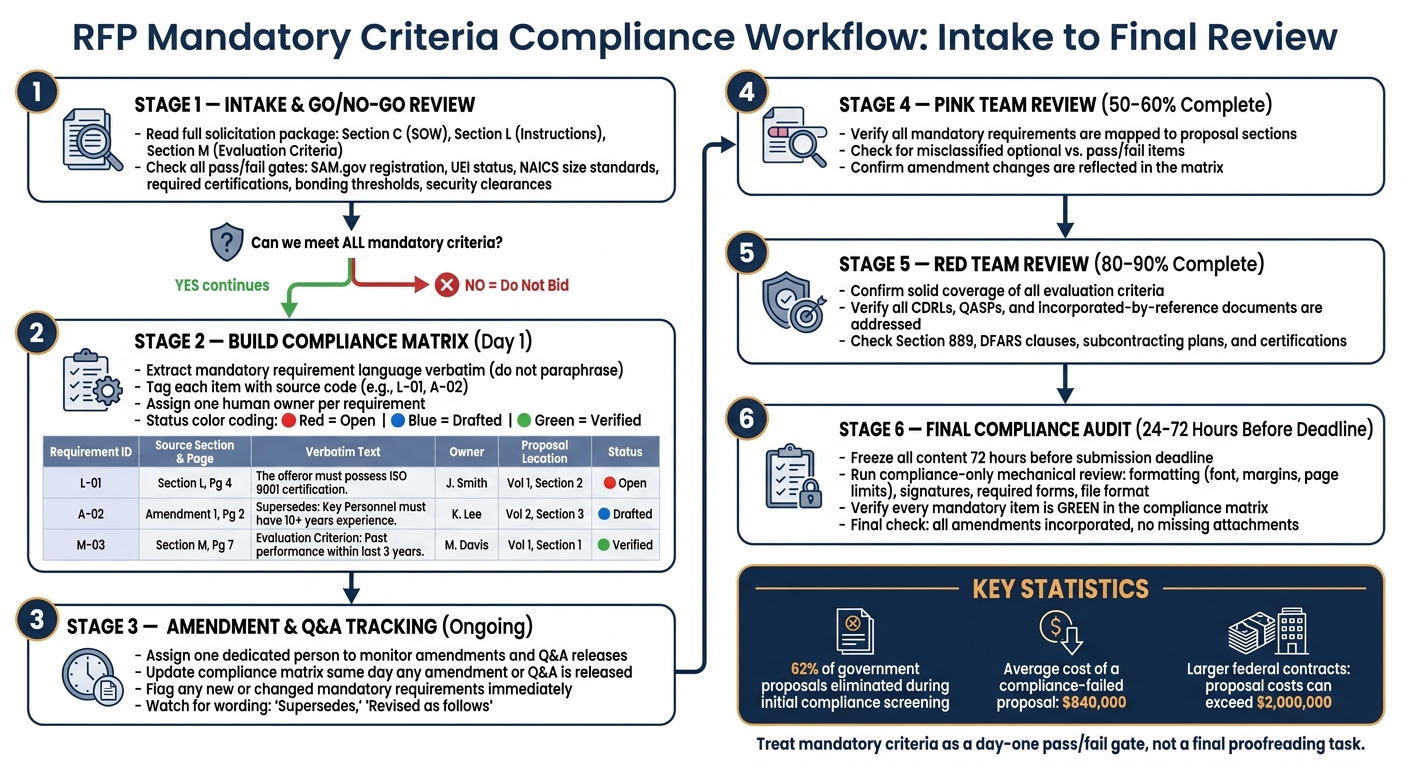
RFP Mandatory Criteria Compliance Workflow: From Intake to Final Review
1. Misreading Mandatory Requirements Causes Early Compliance Failures
A lot of proposal losses start with a simple mistake: a pass/fail requirement gets treated like a suggestion. When that happens, the first problem usually shows up in the compliance screen.
In 2025, a systems integrator missed Amendment 0003 to a DCMA solicitation, which added DFARS 252.204-7012 cybersecurity controls, and the bid was eliminated before technical evaluation. The problem wasn’t weak writing. It was an outdated compliance matrix.
How to Spot a Mandatory Requirement
Certain words are red flags. If the RFP says "shall", "must", "will", "is required to," or "offerors are required to," treat that language as pass/fail.
These items often cover things like:
- minimum years of experience
- specific licensing
- insurance minimums
- bonding thresholds
- security clearances
- submission rules such as font size, margin widths, page limits, and file format
And here’s the part people miss: these requirements don’t live only in Section L. They can show up across the full solicitation package.
| RFP Section | Common Mandatory Requirements | Wording Cues |
|---|---|---|
| Section C (SOW/PWS) | Deliverables, tasks, and technical capabilities that must be demonstrated | "Must demonstrate", "shall provide" |
| Section L (Instructions) | Page limits, font and margin specs, volume structure, and deadlines | "Shall submit", "Must provide", "Not to exceed" |
| Section H (Special Contract Requirements) | Security clearances, key personnel clauses, mandatory subcontracting plans | "Is required", "Condition of award" |
| Section J (Attachments/Forms) | Required forms and certifications | "Complete and return", "Shall include" |
| Amendments and Q&A | Revised deadlines, changed technical specs, updated evaluation weights, and new mandatory requirements | "Supersedes", "Revised as follows" |
Amendments and Q&A are a common trouble spot because they often add or change pass/fail items.
The fix starts with a process that catches those items before the proposal is packaged and submitted.
How to Prevent Requirement Misclassification
Build the compliance matrix before drafting the outline. Pull requirement language verbatim from the RFP before you rewrite anything. If you paraphrase too soon, a hard requirement can get watered down and start sounding optional.
It also helps to tag each requirement with a source code, like L-01 for Section L item 1 or A-02 for Amendment 2 item 2. That way, every line in the matrix points back to the exact place it came from.
Manual review tends to fall apart first in large solicitations with lots of amendments. Narwin.ai can scan the full solicitation package, flag mandatory clauses, and surface missed requirements in amendments and referenced documents.
After the matrix is built, give every mandatory item a clear owner. A simple status system works well:
- red for open
- blue for drafted
- green for verified
Then run a final compliance-only review in the last 72 hours. That’s often where teams catch formatting mistakes, missing signatures, and other small errors that can knock out an otherwise strong bid.
sbb-itb-bb3960c
2. Ignoring Mandatory Criteria Leads to Disqualification, Lost Revenue, and Wasted Bid Effort
Miss one mandatory item, and the bid is out before scoring even starts. These are hard gates. There’s no partial credit, and there’s no “we’ll make up for it later.” 62% of government proposals are eliminated during initial compliance screening before technical evaluation begins.
That’s why even a small miss can turn into a six-figure hit. Once a bid gets rejected, all that proposal labor, SME time, and bid spend become sunk cost. The average cost to develop a federal proposal that gets eliminated for compliance failures is $840,000. For larger federal contracts, proposal development costs can go past $2,000,000.
In 2025, a mid-tier systems integrator lost a $4.7 million DISA contract after missing font, chart, and section-numbering rules in the required formatting and structure rules.
Go/No-Go Controls That Reduce Avoidable Losses
The best way to cut this kind of loss is simple: screen weak bids before drafting begins. Don’t wait until the team is deep into the technical narrative to find out the pursuit never had a shot. A formal bid/no-bid review at intake should check every pass/fail item, including:
- SAM.gov registration
- UEI status
- NAICS size standards
- required certifications
- bonding thresholds
- security clearances
If a firm can’t meet a mandatory bonding requirement or doesn’t have the required CMMC certification level, strong writing won’t save the bid. Narwin.ai can flag go/no-go gaps, like missing certifications or bonding requirements, before the team spends time and money on a proposal that won’t make it past the first screen.
3. Non-compliance can create legal, audit, and delivery risks after submission
Mandatory criteria can create risk after submission and after award. Miss one certification, clause, or document, and the result may be rejection, audit trouble, or contract action later.
Legal and audit exposure from missing required documentation
Some mandatory requirements are pass/fail gates. They are not just admin boxes to tick.
Under Section 889 of the FY2019 NDAA, for example, if your company represents that it uses prohibited telecommunications equipment, that can make you ineligible for any federal award – not just the one you are bidding on – unless you have an approved waiver. The same goes for cost-reimbursement contracts. The government cannot make an award if your accounting system is found inadequate in a Pre-Award Accounting System Survey (SF 1408).
Post-award risk is just as serious. If a mandatory requirement comes to light after award – such as an inadequate subcontracting plan or a missing security clearance – it can lead to contract termination or a finding of nonresponsibility during contract execution.
There is another problem here too. If an agency waives a mandatory requirement for one bidder, a competitor can file a GAO protest over unequal treatment. At that point, what looked like a small intake mistake can turn into a legal and pricing mess. These failures often show up as:
- Legal disqualifications
- Financial disqualifications
- Technical disqualifications
- Security disqualifications
- Administrative disqualifications
A requirement misread at intake can become a contract problem after award.
The same pattern shows up in delivery documents, where one missed attachment can still sink the bid – or the contract.
Delivery problems caused by overlooked scope and performance requirements
Compliance failures also appear in scope and performance documents. Mandatory criteria can hide in Contract Data Requirements Lists (CDRLs), Quality Assurance Surveillance Plans (QASPs), and attachments that are incorporated by reference. Those are mandatory performance requirements, not optional proposal details.
A contractor was eliminated from a Defense Logistics Agency (DLA) bid after responding to every Performance Work Statement requirement but missing three CDRL deliverables mentioned only in an incorporated document.[2] The RFP required offerors to show they could meet all CDRL requirements, so elimination was mandatory no matter how strong the rest of the proposal was.
That kind of scope gap does not just cost a bid. If it slips into award, it can turn into contract disputes, schedule delays, and margin erosion. Think of it like missing a line in the fine print and then paying for it for months. For example, failing to account for Service Contract Labor Standards or Davis-Bacon Act wage requirements can lead to upward cost adjustments by the government. That can make your pricing look unrealistic and your bid look high-risk.
Every answer that changes scope is a binding solicitation change. If it is not on your checklist, it is a risk.
These risks are preventable with a simple intake-to-final-review compliance workflow.
4. A Repeatable Compliance Process and AI Workflow Can Reduce These Risks
A repeatable workflow cuts down most mandatory-criteria failures that come from scattered files and last-minute reviews. The main trouble spots are pretty clear: late amendment tracking, missed documents, and weak final checks.
Build a Simple Compliance Workflow from Intake to Final Review
The fix is straightforward: use the same workflow every time, from intake through final review. Start by reading the full solicitation package – Section C (Statement of Work), Section L (Instructions), and Section M (Evaluation Criteria) – before you write a single word. Then map every mandatory item to its source, owner, and proposal location.
Your compliance matrix should stay live throughout the process. Include columns for Requirement ID, source section and page number, verbatim text, owner, proposal location, and status. Give each row one human owner. That matters. When everyone owns something, no one owns it.
Amendment tracking is often where manual work falls apart. Put one person in charge of updating the matrix the same day an amendment or Q&A change is released.
Build in three formal review gates:
- A Pink Team review at 50% to 60% completion to check requirement mapping
- A Red Team review at 80% to 90% to confirm solid coverage of all evaluation criteria
- A final mechanical compliance audit 24 to 72 hours before the deadline
Freeze content 72 hours before the deadline and keep that last stretch for compliance checks only. It’s a simple move, but it can save a bid from dying on a technicality.
Where Narwin.ai Fits in the Compliance Workflow
AI helps most in the places where manual review tends to crack: extraction, amendment tracking, and final checks.
Narwin.ai is built for that gap. It monitors federal, provincial, and city-level sources across the U.S. and Canada, including SAM.gov, CanadaBuys, and BCBid, so teams can find relevant opportunities without manual searching. Once an RFP is in the platform, Narwin automatically extracts mandatory requirements, flags high-risk clauses like missing CMMC certifications or Section 889 representations, and generates an AI-assisted compliance matrix that updates when amendments are uploaded.
Drafts also map directly to evaluation criteria. On top of that, Narwin connects with Google Drive, Slack, and major CRM and ERP systems, so compliance data stays in the tools your team already uses.
| Step | Manual Process | AI-Assisted (Narwin.ai) |
|---|---|---|
| Requirement Extraction | 8–12 hours of manual reading | Under 1 hour via automated parsing |
| Amendment Tracking | Version drift; updates missed | Live matrix with auto-updates on amendments |
| Risk Surfacing | Manual tracking of CMMC or Section 889 requirements | Automatically flags high-risk clauses and missing certifications |
A rejected proposal can cost $840,000 to develop, so early compliance checks are cost control, not overhead.
Conclusion: Most compliance risks can be avoided with earlier checks
Every risk covered in this article points back to the same problem: a mandatory criteria got missed, misunderstood, or sat there with no clear owner.
And in most cases, those issues show up at intake, long before the deadline hits.
That matters because disqualification, lost revenue, legal exposure, and delivery risk don’t suddenly appear in the final hours. They start much earlier. So if a team waits until the last minute to check compliance, it’s already playing from behind.
The fix isn’t complicated. Build the compliance matrix on day one. Give each requirement one clear owner. Update the matrix after every amendment or Q&A. Then keep the final 72 hours for compliance review.
Treat mandatory criteria as a day-one pass/fail gate, not a final proofreading task.
FAQs
What counts as a mandatory RFP requirement?
Mandatory RFP requirements are pass/fail conditions. If your proposal misses even one, the bid is often rejected before the technical review starts.
That’s why this part matters so much. These are the items the buyer expects you to meet with no wiggle room.
Look for words like must, shall, and will. They usually point to non-negotiable requirements.
Common examples include:
- eligibility documents
- required certifications or insurance
- file and formatting rules
- signed forms
- bid bonds
- proof that the signer has authority to bind the company
Miss one of these, and your proposal may never make it past the first screening.
Can one missed requirement really disqualify a bid?
Yes. Missing just one mandatory requirement can knock a bid out of the running, because these items are usually judged on a simple pass-or-fail basis.
If a single piece is missing, like a required certification, affidavit, or even a formatting instruction, the bid may be rejected before anyone reviews its technical merits. Narwin.ai helps cut that risk by pulling out requirements and flagging possible compliance gaps before submission.
What is the best way to track mandatory criteria?
Build a compliance matrix before drafting starts. Pull in every requirement, with extra care for mandatory words like shall, must, and will.
Use a structured spreadsheet to track each requirement’s source, proposal location, owner, and status. That gives your team one central source of truth and helps make sure items like certifications, formatting rules, and signature pages don’t get missed.