
Federal contractors, take note: As of May 22, 2024, sustainability is no longer optional in federal procurement. The Federal Acquisition Regulation (FAR) Council updated rules to make sustainable products and services the default for contracts, aligning with the government’s goal of net-zero procurement emissions by 2050.
Here’s what you need to know:
- Sustainability Standards: Agencies now prioritize products meeting statutory programs (e.g., ENERGY STAR, BioPreferred) and EPA recommendations.
- New Clause: FAR 52.223-23 centralizes sustainability requirements, simplifying compliance for contractors.
- Mandatory Justifications: Non-sustainable options require documented justification based on cost, performance, or availability.
- Exemptions: Certain contracts, like those for national security or performed outside the U.S., may qualify for exemptions.
- Class Deviation 2025-05: Temporarily waives some product certifications (e.g., WaterSense, Safer Choice).
To stay compliant, contractors should update proposal templates, verify product certifications, and track requirements using tools like the Green Procurement Compilation. Missing these changes can impact eligibility for federal contracts.
Major Changes in the 2024 FAR Sustainability Rules
The April 2024 update to FAR Part 23 introduces a sweeping overhaul to federal sustainable procurement policies, marking one of the most impactful shifts in recent years. These updates go beyond minor adjustments, fundamentally reshaping how agencies and contractors address environmental responsibility in government contracts.
When the New Rules Take Effect
The final rule was published on April 22, 2024, with the changes taking effect on May 22, 2024. Under the new rules, percentage-based sustainability goals are eliminated. Instead, agencies are required to procure sustainable products and services "to the maximum extent practicable" by default, making sustainability the standard rather than the exception.
"When the changes go into effect on May 22, the FAR will require agencies to procure sustainable products and services ‘to the maximum extent practicable.’" – Natalie Alms, Senior Correspondent, Nextgov/FCW
Contractors can no longer view sustainability as optional. If a contracting officer decides that sustainable procurement isn’t feasible for a specific contract due to price, performance, or scheduling issues, they must document and justify this decision in the contract file. This requirement underscores the seriousness of the new approach, as outlined in the reorganization of FAR Part 23.
How FAR Part 23 Was Reorganized
The reorganization of FAR Part 23 simplifies compliance by consolidating sustainability policies into a new Subpart 23.1, titled "Sustainable Products and Services." Non-environmental items were removed from Part 23, streamlining the framework for contractors.
A significant addition is FAR 52.223-23, a new omnibus contract clause that centralizes sustainability requirements. This clause establishes a clear hierarchy for prioritizing purchases:
- Statutory purchasing programs (e.g., biobased or energy-efficient products) take precedence.
- Multi-attribute products that meet both statutory and Environmental Protection Agency (EPA) standards come next.
- EPA-only programs are prioritized last.
This hierarchy simplifies decision-making for contractors, ensuring they understand which sustainability standards to follow when sourcing products or preparing proposals. By providing a single reference point, the updated structure makes it easier for contractors to meet compliance requirements while aligning with federal sustainability goals.
sbb-itb-bb3960c
What Counts as Sustainable Products and Services
Under FAR 2.101, sustainable products and services are those that align with specific statutory purchasing programs and meet EPA requirements. These guidelines focus on reducing lifecycle impacts and ensuring compliance with federal sustainability standards.
Key programs include the EPA’s Comprehensive Procurement Guidelines (CPG) for recovered materials, ENERGY STAR® certified products, Federal Energy Management Program (FEMP)-designated items, the BioPreferred® program for biobased products, and the EPA’s Significant New Alternatives Policy (SNAP) for ozone-depleting substance alternatives. These programs form the core of federal sustainability requirements.
Sustainability standards are applied when products are delivered to or used by the government, incorporated into public works, or acquired as a direct contract cost. To help identify applicable programs for specific products or services, contractors can use the Green Procurement Compilation (GPC) tool available at sftool.gov.
As of February 15, 2025, Class Deviation (CD) 2025-05 waived the requirement to procure products meeting WaterSense, Safer Choice, and certain EPA Recommendations of Specifications, Standards, and Ecolabels. Although these programs remain valuable for identifying sustainable products, they are no longer mandatory under current policy. Contractors should stay updated on active Class Deviations, as they can temporarily alter certification requirements.
Next, let’s explore the EPA’s role in shaping these certification standards.
EPA Standards and Certifications
The EPA oversees more than 60 standards and ecolabels across 40+ purchasing categories through its EPA Recommendations program. These standards, as defined by FAR 52.223-23, play a key role in determining what qualifies as a sustainable product.
"The Recommendations give preference to multi-attribute/life-cycle based standards/ecolabels that address key impact areas (also known as hotspots) and where a competent third-party certification program can verify product conformance." – US EPA
The EPA focuses heavily on life-cycle based standards that target multiple environmental hotspots – like PFAS (per- and polyfluoroalkyl substances), plastics, and recycled content – rather than relying solely on single-attribute certifications. Recent updates have prioritized reducing PFAS in government purchases, particularly for cleaning products.
Contractors can use the EPA Recommendations search tool to filter by product category and find applicable standards. This tool links directly to product registries and third-party certifications, simplifying the compliance process. It’s crucial that products meet these standards at the time of quote or offer submission.
FAR also prioritizes products that meet multiple sustainability criteria, emphasizing the importance of comprehensive environmental standards.
Products That Meet Multiple Sustainability Criteria
FAR 23.104(c) highlights the preference for multi-attribute products – those that fulfill both statutory mandates and one or more EPA purchasing program requirements. This approach reflects the federal government’s shift toward addressing broader environmental impacts rather than focusing on single-issue certifications.
For instance, a monitor that is both ENERGY STAR certified and meets EPEAT standards will be prioritized over one with only a single certification. Multi-attribute products tackle various environmental issues and life cycle stages, making them a more sustainable choice.
"Part 23.104(c) requires agencies to prioritize multi-attribute sustainable products and services which are those that meet applicable statutory purchasing program requirements and one or more required EPA purchasing programs." – US EPA
To verify if a product meets multiple sustainability criteria, contractors should check tools like the GPC and EPA Recommendations search tool. Additionally, reviewing the Statement of Work (SOW) will help confirm which sustainable purchasing programs apply under FAR 52.223-23.
What Contractors Must Do Under FAR 52.223-23
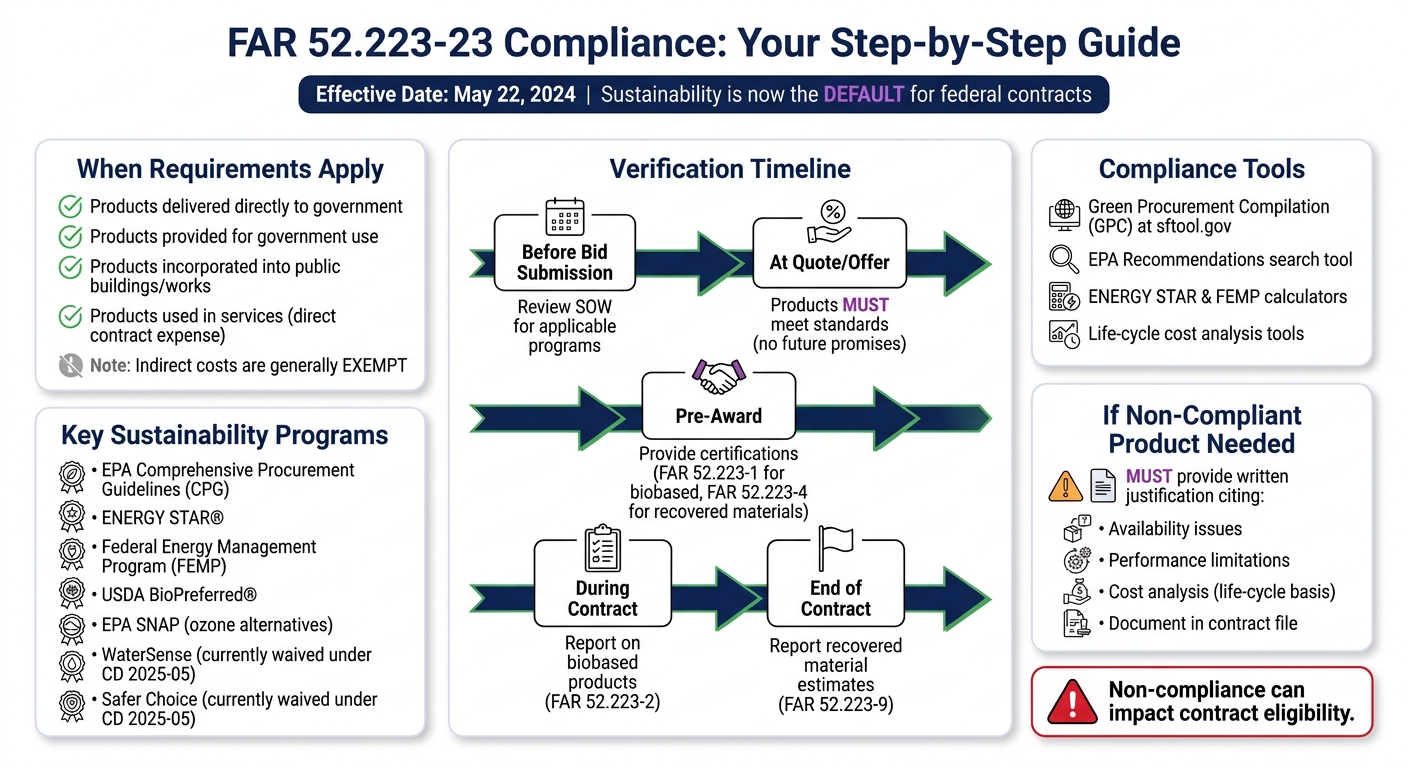
FAR 52.223-23 Sustainability Compliance Checklist for Federal Contractors
FAR 52.223-23 outlines specific responsibilities for contractors working on federal contracts, particularly when it comes to meeting sustainability standards. To stay compliant, contractors must understand when these requirements apply and ensure they meet the necessary standards before submitting bids. Non-compliance can lead to ineligibility or delays.
When Sustainability Requirements Apply
This clause applies in four key scenarios:
- When products are delivered directly to the government
- When products are provided for government use
- When products are incorporated into public buildings or public works
- When products are used in services where their cost is a direct contract expense
It’s important to note that products categorized as indirect costs are generally exempt from these requirements. The Statement of Work (SOW) will specify which sustainable products, services, or purchasing programs are relevant to your contract. Reviewing the SOW for red flags in RFPs before submitting a bid is essential, as it will guide you in identifying the applicable sustainability programs. For additional clarity, consult the Green Procurement Compilation to match products with the correct programs.
Although FAR 52.223-23 doesn’t include a mandatory flow-down clause, the FAR Council advises prime contractors to pass these sustainability requirements down to their subcontractors when necessary to maintain compliance throughout the contract.
Once you’ve determined which sustainability programs apply, it’s time to verify that your products meet the required standards.
How to Verify Compliance
Compliance must be confirmed at the time you submit your bid – there’s no room to promise future adjustments. Your proposed products and services need to align with the relevant standards, specifications, and program requirements from the outset.
For biobased products, you’ll need to provide pre-award certification under FAR 52.223-1, confirming that your products meet USDA recommendations. Similarly, for products made with recovered materials, pre-award certification under FAR 52.223-4 is required to verify compliance with EPA guidelines. Be prepared to supply technical data, such as percentages of recycled or biobased content, if requested.
Service and construction contracts come with additional obligations. FAR 52.223-2 requires contractors to report on biobased products used during the contract, while FAR 52.223-9 mandates reporting estimates of recovered material content at the end of the contract. Establishing tracking and reporting systems before the award is crucial to avoid any interruptions later on.
When Exemptions Apply
With the updated sustainability requirements in place, it’s essential for contractors to understand that exemptions are available under certain conditions.
Not every contract demands sustainable products. The Federal Acquisition Regulation (FAR) acknowledges that there are times when meeting sustainability standards is either impractical or impossible. Knowing when these exemptions apply – and properly documenting them – can help you avoid compliance issues later.
The guiding principle is clear: agencies are required to procure sustainable products and services to the "maximum extent practicable." This means non-sustainable alternatives can be used if sustainable options are unavailable, fail to meet performance needs, or are prohibitively expensive. Agencies must also evaluate life-cycle costs rather than just the upfront price, ensuring flexibility while still aligning with federal sustainability goals.
Categories of Exemptions
Several specific exemptions fall under FAR 23.105. For instance, contracts performed or supplies delivered entirely outside the United States are exempt. Similarly, weapon systems are largely exempt from sustainability requirements, though they still need to adhere to standards for recovered materials and alternatives to ozone-depleting substances unless a written justification is provided. Energy-consuming products designed for combat or combat-related missions, as well as biobased products intended for military equipment, spacecraft systems, or launch support, are also excluded.
Other exemptions cover contracts related to national security, intelligence operations, tactical and space equipment, and emergency response acquisitions. For example, if your contract involves vehicles used in combat support or tactical missions, or if it supports emergency responses to cyber, nuclear, biological, chemical, or radiological threats, you may qualify for an exemption. Additionally, for national security or law enforcement exceptions, agencies must notify the Chair of the Council on Environmental Quality (CEQ) in writing within 30 days of issuing the exemption.
A noteworthy update: Class Deviation 2025-05, effective February 15, 2025, temporarily waives requirements for products that meet WaterSense, Safer Choice, and certain EPA Recommendations of Specifications, Standards, and Ecolabels. Contractors should check if this deviation is relevant to their contracts.
Exemptions for Hydrofluorocarbon Alternatives
Under FAR 23.107-4, the Significant New Alternatives Policy (SNAP) program requires contractors to use alternatives with lower global warming potential instead of hydrofluorocarbons (HFCs). However, there is an exception for "Class I substances" used for essential purposes as outlined in 40 CFR 82.4(n). This typically applies to situations where technical constraints make it impossible to use alternatives in specific manufacturing or cooling processes.
To confirm whether your product qualifies for this exemption, consult the SNAP program listings for acceptable chemical and product alternatives. Since the SNAP program is a statutory purchasing program, it takes precedence over non-statutory EPA initiatives. If you determine that a SNAP-compliant alternative is not feasible, be sure to document the exemption.
How to Document Exemption Justifications
When a sustainable product isn’t an option, contractors must provide a written justification explaining why. This justification can apply to a single product, a specific line item, or an entire contract. The requiring activity prepares the justification and submits it to the contracting officer, who then includes it in the official contract file.
The justification should clearly state why the sustainable option is "not practicable", citing reasons such as availability, performance, or cost. If cost is the issue, include data demonstrating that the product isn’t cost-effective over its life cycle. For instance, if a sustainable alternative has a higher upfront cost, you should show that potential savings – like energy efficiency – don’t make up for the initial expense.
Ensure that the solicitation and contract explicitly identify any products or services exempt from FAR 52.223-23 due to an authorized exception. This transparency protects both contractors and contracting officers from future compliance disputes.
How to Meet FAR Sustainability Requirements
Adapting to FAR’s sustainability standards means rethinking how you approach proposals and compliance processes. With the federal government directing over $700 billion annually toward procurement and sustainability now a standard expectation, contractors who don’t adjust could miss out on key opportunities.
You can tackle compliance effectively by refining your internal systems and leveraging AI-driven tools.
Updating Your Proposal Templates and Checklists
Start by revising your proposal templates to include dedicated sections for sustainability. These should cover certifications like ENERGY STAR, WaterSense, and USDA BioPreferred. Including these details ensures your proposals align with federal sustainability goals.
Your internal checklists also need to reflect the specific sustainability requirements for each solicitation. Federal agencies are now required to specify the "purchasing program and type of product" in their solicitations. To stay on top of this, your proposal team should use a systematic approach to verify compliance, such as referencing the Green Procurement Compilation (GPC) at sftool.gov. Adding checklist items for this step ensures nothing gets overlooked.
For cost templates, incorporate life-cycle cost calculations to justify pricing. Tools from ENERGY STAR and the Federal Energy Management Program (FEMP) can help you calculate and document these costs, which demonstrate compliance with evaluation criteria and support your pricing strategy.
Finally, make sure your templates guide proposal writers on documenting non-practicability justifications. If you can’t obtain a sustainable product due to competitive availability, timing, or cost, you’ll need a written explanation. Your templates should outline the required data points, such as availability issues, performance limitations, or cost comparisons showing why life-cycle savings don’t offset initial costs.
Once your templates are updated, technology can take your compliance efforts to the next level.
Using AI Tools for Compliance
Technology can simplify the complexities of FAR sustainability requirements. AI platforms like Narwin.ai can automate much of the compliance tracking and ensure your proposals meet FAR standards.
FAR’s sustainability rules cover a wide range of programs, including EPA initiatives, statutory mandates, and agency-specific procurement programs. Manually tracking these requirements is time-consuming and prone to error. Narwin.ai addresses this by automatically extracting sustainability requirements from RFPs. It identifies specific purchasing programs and product types – such as recovered materials, biobased products, energy-efficient equipment, and SNAP-compliant alternatives – so your team doesn’t have to sift through documents manually. This automation ensures you catch all relevant clauses early in the bid/no-bid process.
The platform also cross-references these extracted requirements with your company’s capabilities, certifications, and past performance. For example, if an RFP calls for WaterSense-certified plumbing fixtures and your product line doesn’t include them, Narwin.ai flags this during the qualification phase. This gives you time to find compliant alternatives or prepare a non-practicability justification.
For contractors managing subcontractor compliance, Narwin.ai tracks flow-down requirements across your supply chain. Since prime contractors must ensure all products meet sustainability standards, whether supplied directly or through subcontractors, the platform monitors these obligations. It helps ensure FAR 52.223-23 requirements are properly communicated and followed by your subs.
Narwin.ai also integrates seamlessly with tools like Google Drive, Slack, and major CRMs and ERPs. This means your team can access compliance insights alongside other proposal management activities without juggling multiple systems or updating spreadsheets manually. Combining updated processes with advanced tools like these not only simplifies compliance but also strengthens your position in federal procurement.
Conclusion
The 2024 FAR sustainability rules are reshaping how federal agencies spend over $700 billion annually, making environmentally responsible products and services the standard. This marks a major step toward sustainability and introduces new compliance challenges for contractors.
For contractors, staying competitive means updating proposal templates, compliance workflows, and supply chain systems. FAR 52.223-23 requires products to align with standards like EPA, ENERGY STAR, FEMP, and USDA BioPreferred when specified. Agencies can only bypass these requirements with written justification, embedding sustainability into most contract actions.
Managing these complex requirements manually is increasingly unfeasible. Tools like Narwin.ai simplify the process by automating sustainability requirement extraction from RFPs, identifying compliance gaps, and integrating with existing workflows. These solutions save time and reduce errors, making compliance more manageable.
"President Biden has tasked federal agencies with leading by example toward a more sustainable future." – Brenda Mallory, Chair, White House Council on Environmental Quality
Preparing now is essential. Future regulations will require GHG emissions disclosures and science-based targets by 2050. By modernizing compliance processes and leveraging AI tools, contractors can seamlessly adapt to these evolving requirements and maintain access to federal opportunities.
FAQs
Does FAR 52.223-23 apply to my contract?
If your contract involves acquiring products or services that align with sustainability goals, FAR 52.223-23 is likely applicable. This clause is a requirement for procurements under FAR Part 23, which focuses on environmentally friendly acquisitions. Be sure to carefully review your contract terms to ensure you’re meeting the necessary sustainability standards.
How do I prove a product is “sustainable” at bid time?
To show that a product meets "sustainability" standards during the bidding process, you’ll need to provide documentation that confirms compliance with federal sustainability requirements. This can include certifications, test reports, or third-party evaluations that verify the product’s environmental performance and resource efficiency.
Be sure to include specifics about the product’s lifecycle impacts, sourcing methods, and environmental advantages. Support these claims with clear, verifiable data. Demonstrating alignment with federal sustainability guidelines not only enhances your bid but also proves adherence to required standards.
What should I do if no compliant product is available?
If a compliant product isn’t available, you can look into alternative strategies. These might include modifying specifications to better fit available options, submitting a well-supported request for approval of non-compliant products, or seeking other procurement solutions that still meet sustainability standards. Just make sure that any steps you take align with the necessary regulations and guidelines.