
AI Go/No-Go models simplify decision-making for responding to RFPs by using data and automation to save time, reduce costs, and improve win rates. Instead of relying on subjective judgment, these tools analyze RFPs for compliance, risks, and win potential in minutes. Key benefits include:
- Faster Decisions: AI reviews 100+ page RFPs in about 2 minutes compared to 20+ hours manually.
- Improved Accuracy: Flags compliance issues and deal-breakers early, reducing wasted effort.
- Higher Win Rates: Focuses resources on high-probability opportunities, boosting win rates from 30% to 50%.
- Better Resource Allocation: Cuts proposal volume by 38% while increasing award values by 52% annually.
Tools like Narwin.ai provide instant insights, win probability scores, and risk assessments, enabling smarter decisions without overburdening teams. By prioritizing the right opportunities, organizations save time, reduce costs, and achieve better outcomes.
Traditional Go/No-Go Decision Frameworks
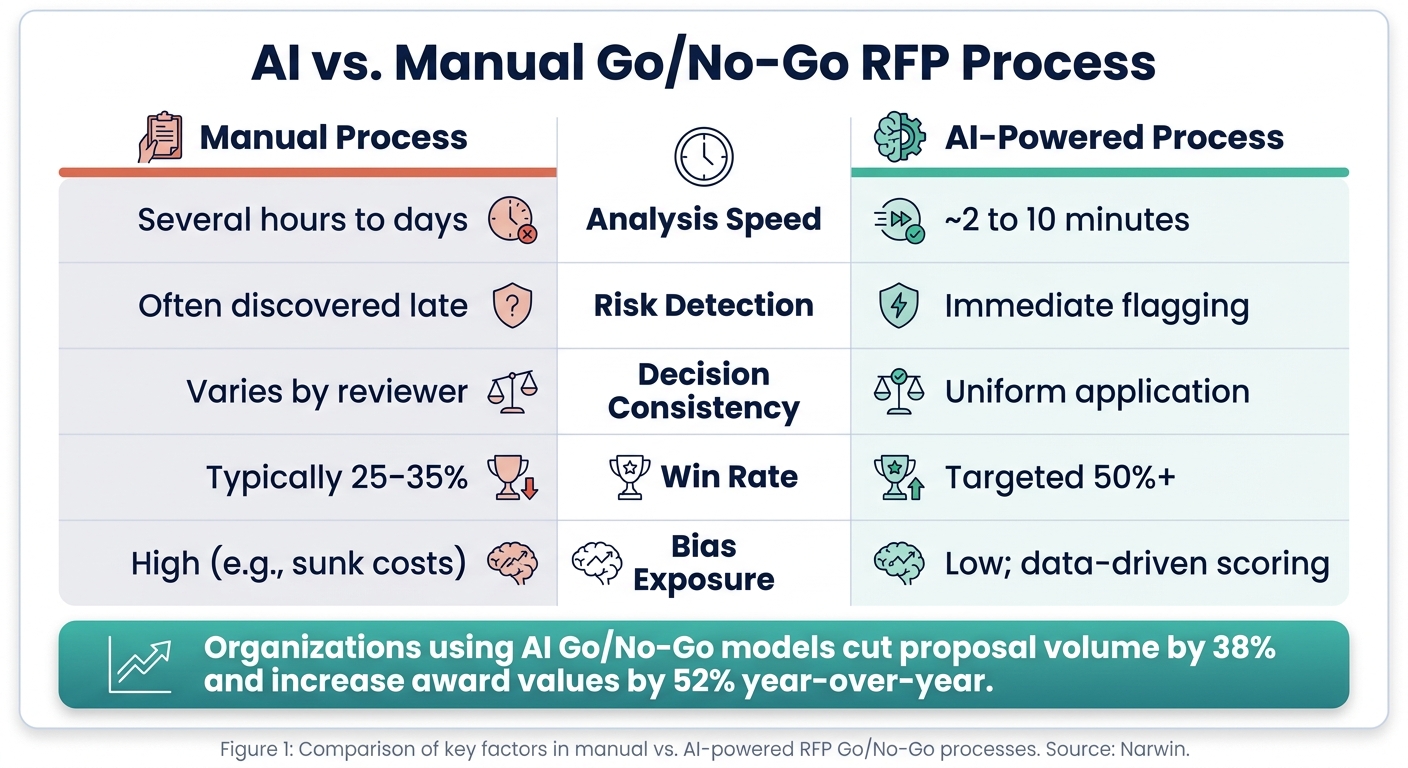
AI vs. Manual Go/No-Go RFP Process: Key Differences
Key Criteria Used in Manual Go/No-Go Decisions
Most organizations rely on a two-stage process for go/no-go decisions. Breaking this down helps highlight why traditional methods often fall short, as we’ll see in the next sections.
The first stage focuses on mandatory eligibility criteria – basic pass/fail conditions that determine whether an opportunity is worth pursuing. These include requirements like certifications, security clearances, financial stability, and the ability to meet delivery demands. If even one of these is unmet, the process stops there.
The second stage shifts to competitive positioning, where teams evaluate the opportunity using factors like incumbent advantages, customer relationships, technical strengths, and alignment with strategic goals. One of the most overlooked – but critical – questions is whether a current supplier already has an edge in the bidding process.
"The key to making good bid decisions is not picking the deals you’re going to win, but discarding the deals you’re going to lose." – Bob Lohfeld, Proposal Expert
Manual reviewers also stay alert for red flags, such as RFPs that seem tailored to a specific vendor (“wired RFPs”), unrealistic timelines, or vague project scopes that hint at a buyer’s lack of clarity. Unfortunately, these deal-breakers often surface only after significant time has already been invested.
Limitations of Manual Go/No-Go Processes
The real issue with manual reviews isn’t the criteria themselves – it’s how they’re applied. On average, an RFP response involves around 28 people, and enthusiasm for high-value contracts often clouds objective judgment. Sales teams, motivated by commissions, may push to pursue every opportunity, while the proposal and technical teams bear the brunt of the workload.
Another challenge is inconsistent decision-making. Without a standardized scoring system, two reviewers might draw completely different conclusions from the same RFP. Worse, manual processes are slow – deal-breakers are often discovered after 20+ hours of work, wasting valuable resources. As a result, organizations without a structured qualification process typically see win rates stuck between 25% and 35%. These inefficiencies highlight the need for a more systematic, data-driven approach.
Where AI Improves on Manual Go/No-Go Criteria
AI doesn’t change the criteria used in manual reviews – it simply applies them with greater speed and consistency. The same factors a senior proposal manager would assess, like eligibility requirements or competitive positioning, can be evaluated by an AI model in mere minutes.
Here’s a side-by-side comparison of manual and AI-powered processes:
| Factor | Manual Process | AI-Powered Process |
|---|---|---|
| Analysis Speed | Several hours to days | ~2 to 10 minutes |
| Risk Detection | Often discovered late | Immediate flagging |
| Decision Consistency | Varies by reviewer | Uniform application |
| Win Rate | Typically 25–35% | Targeted 50%+ |
| Bias Exposure | High (e.g., sunk costs) | Low; data-driven scoring |
AI eliminates the guesswork by using weighted scoring models that are free from fatigue or bias. This leads to decisions that are not only faster but also more reliable and easier to defend. As a result, organizations gain a clearer understanding of which opportunities are worth pursuing. These advantages set the stage for AI-driven models to revolutionize the entire RFP evaluation process. Up next, we’ll dive into how AI streamlines RFP workflows even further.
sbb-itb-bb3960c
How AI-Powered Go/No-Go Models Work
Data Inputs That AI Go/No-Go Models Rely On
To make precise decisions, AI-powered Go/No-Go models rely on a range of inputs. The process begins with the RFP document itself, where the model extracts key details like mandatory requirements, technical specs, compliance criteria, submission deadlines, and evaluation standards. But the analysis doesn’t stop there. The model also pulls in data like historical performance, company profiles (e.g., certifications and capabilities), and external market trends. By factoring in financial details – such as project margins and strategic alignment – the model builds a robust foundation for its decision-making. These inputs are then analyzed through several layers to deliver a comprehensive assessment.
AI Methods Used to Analyze RFPs
Once the data is gathered, the model applies a three-step analytical process:
- Binary Gate Filter: This initial step quickly eliminates non-viable opportunities. It checks for hard disqualifiers like missing security clearances or impossible deadlines. These "Gate 0" checks save time by filtering out unqualified bids almost instantly.
- Natural Language Processing (NLP): Using advanced NLP, the model scans the RFP for critical terms like "shall", "must", and "required." This ensures no obligations are overlooked. The model then compares these requirements with your company’s capabilities, identifying strengths, gaps, and potential risks.
- Weighted Scoring Algorithm: Finally, the model calculates a Probability of Win (Pwin) using a scoring system. This considers factors like incumbent advantage, compliance readiness, technical fit, competitive positioning, and resource availability. For example, incumbent advantage often carries a weight of 25–35%, reflecting the fact that incumbents win the majority of recompetes in regulated markets – anywhere from 60% to 90%.
"A strong go no go decision protects win rate, margin, and team capacity. A weak decision process does the opposite: teams chase too many bids, quality drops, and delivery risk increases." – Javi, Founder, DeepRFP
This layered analysis ensures that only the most promising opportunities move forward.
What AI Go/No-Go Models Produce as Output
The output of these models is more than just a simple yes or no. At its core, you receive a clear Go, No-Go, or Conditional Go recommendation. Supporting this is a detailed Pwin scorecard, which breaks down how each factor influenced the final score. Typically, a score of 3.5 out of 5.0 or higher signals a "Go", while anything below 2.5 suggests a no-bid.
In addition to the scorecard, the model generates:
- Risk Logs: These highlight potential legal, financial, or delivery risks, ranked by severity and likelihood, along with suggested mitigation strategies.
- Gap Analysis: This identifies missing certifications or capability gaps and includes questions to clarify with the buyer before committing resources.
Every recommendation is backed by evidence from the RFP, making it easy to verify or adjust decisions. Tools like Narwin.ai provide this complete decision package, offering instant Go/No-Go recommendations, win probability scores, and risk assessments. What used to take hours – just to locate relevant RFP sections – now happens in moments, giving teams the clarity they need to act decisively.
Benefits of AI Go/No-Go Models for Businesses
Faster and More Consistent Bid Decisions
In competitive bidding, time is everything. When an RFP hits your inbox, every hour spent deciding whether to move forward is time lost on crafting a winning proposal. AI Go/No-Go models slash decision times dramatically – processing lengthy documents (sometimes over 100 pages) for deal-breakers in just 2 minutes. Compare that to the 20+ hours a manual review often requires.
Consistency is another major advantage. Human decision-making can be swayed by factors like sales pressure, overconfidence, or differing interpretations among team members. AI models, on the other hand, rely on standardized scoring systems applied uniformly to every opportunity. Whether it’s the first RFP of the quarter or the fiftieth, the evaluation criteria remain steady, unaffected by external pressures or team dynamics. This streamlined approach ensures resources are allocated strategically for the next steps.
Better Resource Allocation and Higher Bid Success Rates
Responding to RFPs demands significant resources, and without a clear qualification process, efforts can easily be wasted on low-probability bids. For companies without structured frameworks, average win rates hover between 5% and 20% – a costly inefficiency.
"The secret to a higher win rate isn’t just writing better proposals. It’s about getting better at saying ‘no.’" – Sagee Moyal, Proposal Expert
AI shifts this equation. Teams using structured Go/No-Go frameworks have seen their total proposal volume drop by 38%, while win rates have climbed to 50%. Even better, the total value of awarded contracts has grown by 52% year-over-year. By focusing only on bids with real potential, teams not only improve proposal quality but also achieve better outcomes. Tools like Narwin.ai enhance this process by delivering instant Go/No-Go evaluations and win probability scores, helping teams prioritize high-value opportunities. Plus, early identification of compliance risks ensures resources aren’t wasted on doomed bids.
Early Risk and Compliance Identification
AI models don’t just speed up decision-making – they also help teams avoid costly mistakes. Compliance issues are a frequent cause of rejection, with 40% of RFP submissions failing due to overlooked mandatory requirements. These problems often hide in dense technical sections that manual reviewers might miss.
AI tackles this by conducting compliance checks as soon as an RFP is received. It flags critical requirements – like FedRAMP authorization, SOC 2 certification, CMMC compliance, or specific data residency rules – immediately. Beyond these must-haves, the models also identify subtler risks, such as legal liability clauses, unrealistic deadlines, or language favoring an incumbent provider. Spotting these red flags early allows teams to make informed decisions and avoid last-minute surprises that could derail a submission.
Implementing AI Go/No-Go Models in RFP Workflows
Preparing Your Organization Before AI Integration
Before diving into AI integration, it’s crucial to establish a solid groundwork. This ensures smoother adoption and maximizes benefits like quicker decisions, better use of resources, and early risk identification. Lay this foundation first.
Start by setting your hard gates – non-negotiable criteria that will immediately disqualify an RFP. Examples include missing essential security clearances (e.g., Top Secret), lacking required certifications (like FedRAMP or SOC 2), or not meeting specific business size classifications (such as an 8(a) set-aside).
Next, develop a weighted scoring model based on factors that have historically driven success. Below is a common industry example:
| Pwin Factor | Suggested Weight | What It Measures |
|---|---|---|
| Incumbent Advantage | 25–35% | Strength of your existing relationship with the buyer |
| Compliance Readiness | 20–25% | Whether you hold all mandatory certifications |
| Technical/Capability Fit | 20% | How well your offering matches the stated requirements |
| Competitive Positioning | 15–20% | Your differentiation against likely rivals |
| Resource Availability | 15% | Team capacity to deliver a quality response by the deadline |
Analyze your last 20 wins and losses to fine-tune these weights for your specific market. What works for the industry may not align perfectly with your team’s experiences. Bring in insights from Sales, Engineering, Finance, and Delivery teams to ensure your framework is grounded in reality.
"A decision framework built before you need it is infrastructure. One built in the middle of a hot pursuit is rationalization." – Tribble
Once your framework is ready, you can integrate AI tools to make these decisions actionable.
Embedding AI Tools into Day-to-Day RFP Operations
To incorporate AI effectively, use a multi-stage gate process like the one below:
| Gate | Timing | Goal |
|---|---|---|
| Gate 0 | Within hours of receipt | Eliminate obvious non-starters using hard gates |
| Gate 1 | Within 24 hours | Complete full weighted go/no-go scoring |
| Gate 2 | After Q&A period | Reassess based on new information |
| Gate 3 | 24–48 hours pre-submission | Final readiness check before committing to submit |
Tools like Narwin.ai simplify this process by integrating with platforms like Google Drive, Slack, and major CRMs or ERPs. Narwin’s AI scans the RFP, extracts key requirements, and delivers an instant go/no-go signal along with a win probability score. This reduces the time for Gate 0 and Gate 1 from days to just minutes.
Aim to complete your initial go/no-go scoring within 48 hours of receiving an RFP. Delaying this step wastes resources on opportunities that should have been declined early.
Tracking Performance and Refining AI Decisions Over Time
A feedback loop is essential to ensure your AI model delivers accurate predictions and adapts over time. With your gate process in place, track performance using these key metrics:
| KPI | What It Tells You |
|---|---|
| Win/Loss Rate on "Go" Decisions | Whether the model is selecting the right opportunities |
| Pwin Score vs. Actual Outcome | How well predicted probabilities align with real results |
| Proposal Volume Reduction | Whether the model is filtering out low-probability bids |
| Decision Cycle Time | How quickly your team is qualifying new opportunities |
| Compliance Incident Rate | Whether the AI is catching hard-stop red flags before submission |
Evaluate AI outcomes monthly and adjust your scoring thresholds as needed. For instance, if opportunities scored above 80% are only converting 30% of the time, you may need to increase the weight for incumbent advantage or decrease the weight for competitive positioning. Revisit your scoring criteria quarterly and conduct a full review annually to account for shifts in your market or organizational capacity.
In 2025, App Growth Network, a Vancouver-based marketing agency, used Narwin.ai to refine their qualification process. By focusing only on high-probability opportunities flagged by AI, they saved over 15 hours of manual work and brought in more than $25,000 in revenue. In one case, they identified a poor-fit opportunity and referred it to a competitor for a referral fee, turning a no-go decision into a revenue source.
Lastly, document every no-bid decision with a brief explanation. Over time, this log will highlight patterns in declined bids, inform partnership opportunities, and provide data to justify resource allocation decisions to leadership.
Conclusion: Making Smarter RFP Decisions with AI Go/No-Go Models
Here’s the bottom line: winning more RFPs means focusing on the opportunities that matter most. Companies that try to chase every bid often end up overextending their teams, sacrificing proposal quality, and seeing little improvement in win rates. On the flip side, businesses that use structured, AI-powered qualification frameworks can cut proposal volume by 38%, boost win rates to nearly 50%, and increase median award values by up to 52% year-over-year.
AI go/no-go models take the guesswork out of the process. By leveraging objective, weighted scoring and comprehensive data, these tools quickly identify compliance requirements, flag disqualifiers in minutes, using natural language processing and highlight risks that manual reviews might overlook. The result? Teams spend their time on bids that truly align with their strengths, working smarter instead of harder. This shift from gut-based decisions to data-driven strategies is key to making better RFP choices.
As Dean Shu, Co-Founder & CEO of Arphie, aptly puts it:
"Saying no to the wrong opportunities creates capacity to say yes to the right ones." – Dean Shu
By building a strong feedback loop that fine-tunes thresholds and tracks decisions, you can turn your qualification process into a strategic advantage that evolves over time.
This approach is brought to life with tools like Narwin.ai. Narwin.ai simplifies the entire workflow by providing instant go/no-go signals, win probability scores, and risk assessments tailored to your company’s certifications, past performance, and capabilities. Whether you’re in IT consulting, construction, or government procurement, it equips your team with the insights needed to focus on bids that are worth pursuing – and confidently pass on those that aren’t.
FAQs
What data do AI go/no-go models need to score an RFP?
AI-powered go/no-go models assess a range of data points to evaluate RFPs. These include compliance requirements, technical questions, evaluation criteria, and deadlines. Beyond that, they factor in elements like past performance, strategic alignment, profitability, buyer behavior, resource availability, and competitive positioning. By bringing all this information together, these models deliver a clear, data-driven recommendation on whether an RFP matches your organization’s strengths and objectives.
How do you set go/no-go thresholds and factor weights for your team?
Making go/no-go decisions requires a clear, data-driven process. Start by identifying the key criteria – such as technical fit, compliance requirements, strategic alignment, and resource availability. Each of these factors should then be assigned a weight based on its relative importance to the overall decision.
Once the criteria and their weights are established, evaluate each one using a scoring system, like a 1-to-5 scale. Multiply the scores by their respective weights, and then sum them up to calculate a total score. To ensure consistency, set a specific threshold (for example, 65-75%) as the cutoff for moving forward. This approach not only ensures decisions are objective but also helps streamline the evaluation process.
How can you validate and improve AI win-probability scores over time?
To make AI-generated win-probability scores more reliable, set up a system to compare predicted probabilities with actual bid outcomes – whether the bid was won, lost, or no-bid. Regularly evaluate critical factors such as compliance readiness and competitive positioning, tweaking their importance using historical data. By analyzing insights from at least 10-15 completed bids and conducting post-bid reviews, the AI can align better with real-world outcomes, improving its accuracy over time.