
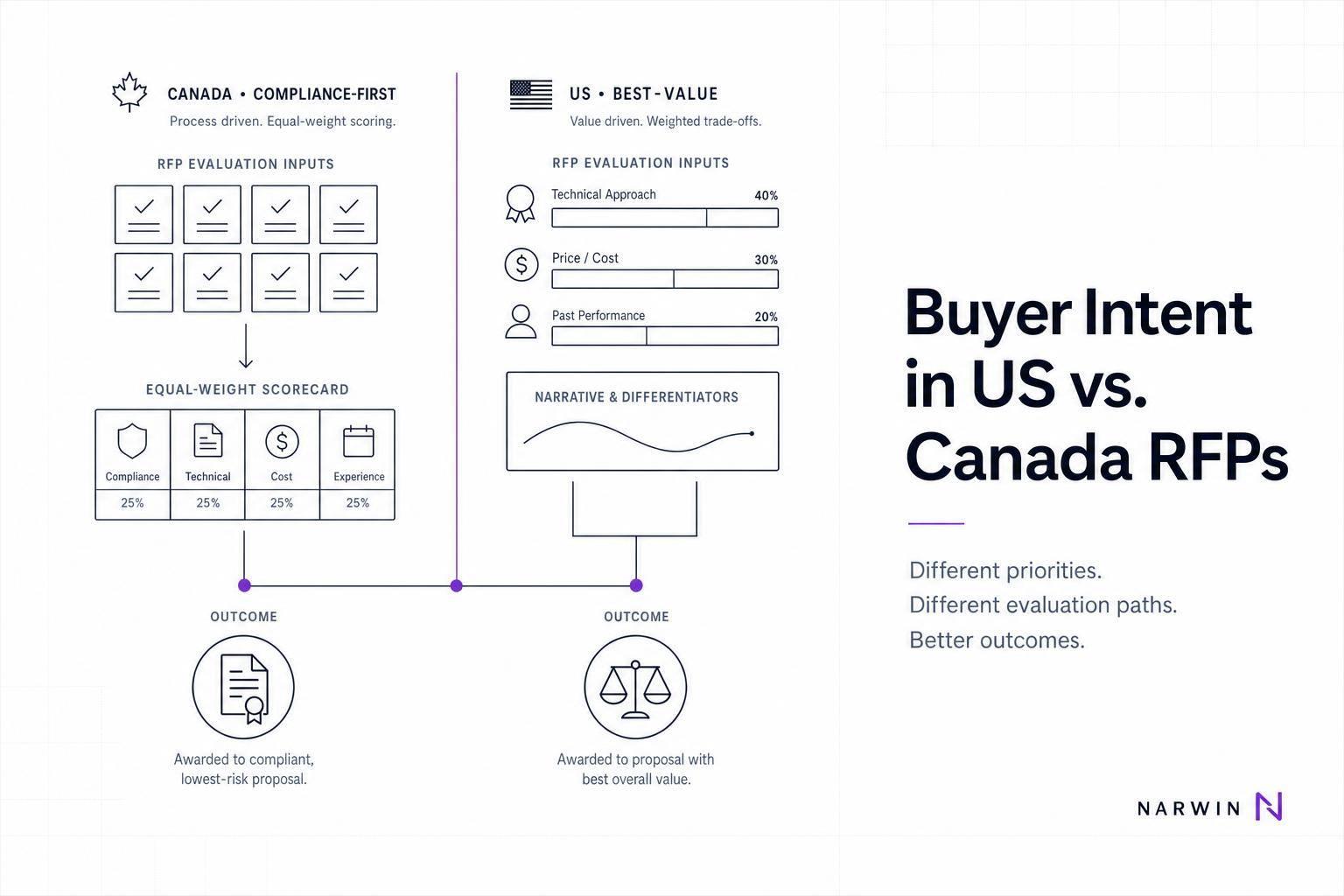
If you read U.S. and Canadian RFPs the same way, you can waste hours on bids you were never likely to win.
I see the split like this: Canada is stricter on compliance, while the U.S. gives evaluators more room for judgment. That changes how I read buyer intent, how I score bid/no-bid, and where I spend time in the response.
Here’s the short version:
- In the U.S., I look first at Section M, contract vehicle limits, set-asides, short turnaround times, and whether the buyer may allow discussions.
- In Canada, I look first at mandatory requirements, the Basis of Selection, ACANs, short closing periods, and whether the bid is tied to a Standing Offer or Supply Arrangement.
- Price plays a bigger role in Canada. The article notes that 69% of federal tenders use price alone for award, while only 20% mix technical scoring with price.
- Timing matters more than many teams think. In Canada, 47% of federal tenders close in two to four weeks, and 86% close within two months.
- Pre-RFP access matters in both markets. If vendors helped shape the requirement early, they often start ahead.
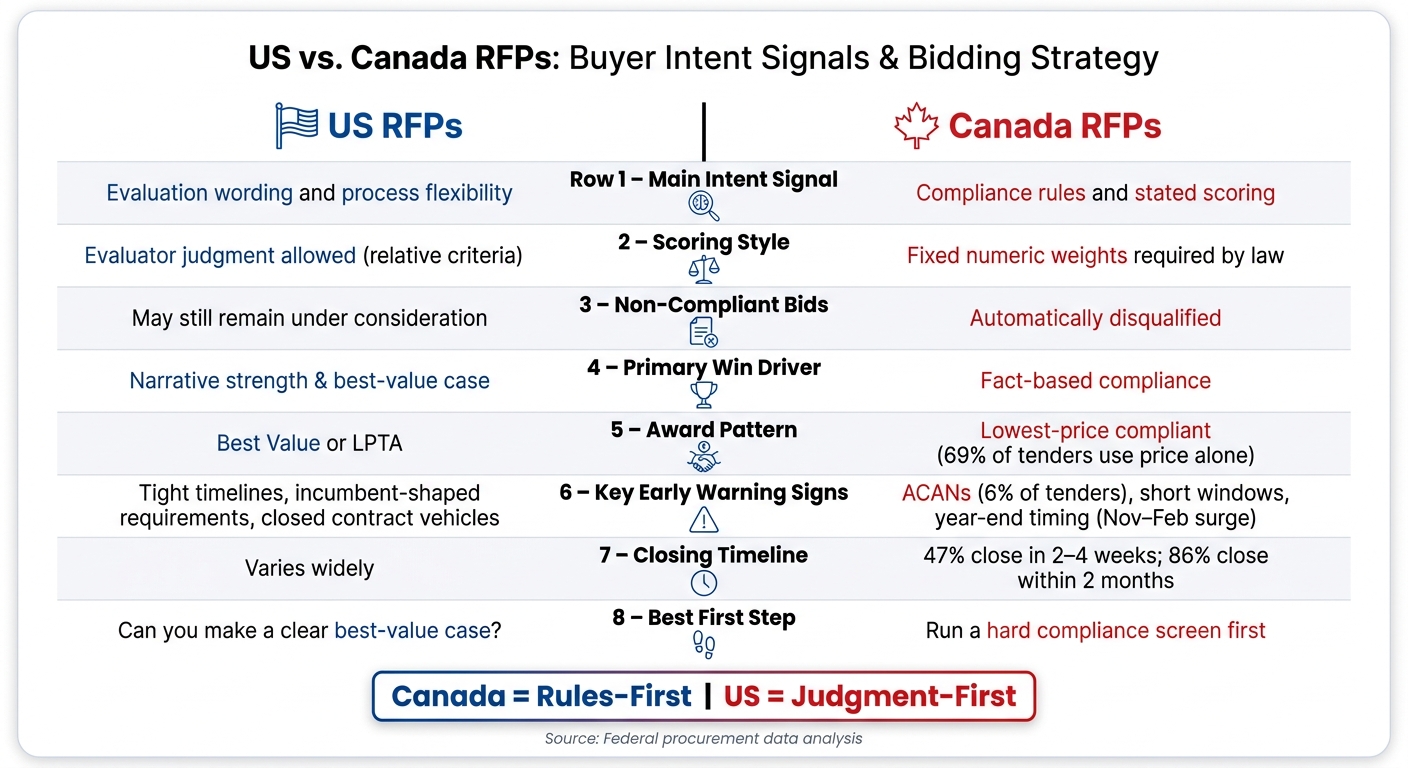
US vs. Canada RFPs: Buyer Intent Signals & Bidding Strategy
Quick Comparison
| Criteria | US RFPs | Canada RFPs |
|---|---|---|
| Main signal of intent | Evaluation wording and process flexibility | Compliance rules and stated scoring |
| Early warning signs | Tight timelines, incumbent-shaped requirements, closed vehicles | ACANs, short windows, year-end timing |
| Scoring style | More room for evaluator judgment | More fixed and rule-based |
| Non-compliant bids | May still stay alive in some cases | Usually out right away |
| Award pattern | Best Value or LPTA | Often lowest-price compliant |
| Best first step | Check if you can make a clear best-value case | Run a hard compliance screen |
My takeaway: if I’m bidding in Canada, I treat the Canadian government procurement lifecycle like a pass/fail screen first. If I’m bidding in the U.S., I ask whether I can make a strong case on fit, risk, and value.
That’s the lens I’d use before putting a single writer, SME, or reviewer on the bid.
sbb-itb-bb3960c
1. United States RFPs
Pre-solicitation signals
One of the clearest signs shows up before the RFP is even released: did vendors help shape the requirement? If they did, they start with a big edge. A proposal sent in with no prior agency contact usually has a hard road.
A tight response window on a complex RFP is another clue. In plain English, it often means the agency expects bids from vendors that already know the requirement well.
Watch the requirements closely, too. If they line up almost exactly with an incumbent’s personnel qualifications, past performance thresholds, or niche capabilities, that’s a strong sign the solicitation may already lean toward that incumbent. Treat that as a red flag unless you can clearly show why your offer stands apart.
If those early clues don’t tell you much, the next place to look is the evaluation language.
Evaluation and compliance language
Section M is usually the clearest guide to how the agency will score proposals. It tells you whether price or quality will carry more weight through Best Value or Lowest Price, Technically Acceptable (LPTA).
Here’s the practical difference:
- Best Value means quality can beat a lower price.
- LPTA means the lowest compliant bid wins.
The scope document matters too. A Statement of Work (SOW) locks in tasks and leaves less room to maneuver. A Performance Work Statement (PWS) focuses on outcomes, which gives bidders more room to propose different delivery methods.
In the U.S., evaluators may accept small departures if the solution still meets the agency’s needs. As Alex McPhail, President & CEO of EXA Consulting Group, notes:
"American evaluators are permitted to accept deviations, or non-compliant bids, if the result would satisfy the purchasing department’s overall needs in the evaluation team’s judgment."
When evaluation weights are broad, win themes start to matter more. You can’t lean on exact point values if the scoring language leaves room for judgment.
And if the RFP allows discussions, the buyer has left space to reshape the field.
Negotiation and process flexibility
Under FAR Part 15, U.S. RFPs can include discussions, clarifications, and revised proposals. That gives the process more room to move than many vendors expect.
Late amendments to scope or evaluation factors can also change the field. An opportunity that looked open at first can shift fast once those updates land.
Then the next step is simple: check whether the competition is still open or whether access is already limited.
Qualification and award likelihood
The clearest intent signal is whether the agency has already narrowed the pool. If the opportunity is limited to vendors on a specific contract vehicle, that’s a strong sign the agency plans to award inside that closed group.
Small business set-asides are even more direct. They are a hard stop for vendors that do not qualify. If an RFP is marked as a set-aside, it is legally limited to qualifying U.S. small businesses.
2. Canada RFPs
Canada tends to show buyer intent through process, not soft wording.
Pre-solicitation signals
The clearest early signal is the Advance Contract Award Notice (ACAN). It points to a preferred supplier and gives other vendors 15 days to challenge. ACANs make up about 6% of federal tenders. That’s a small share, but when one shows up, it tells you a lot. In most cases, the buyer has already narrowed the field.
RFIs and early vendor consultations matter too. If you sit out the market research phase, your chances usually shrink once the RFP goes live.
Timing also gives you clues. Tender volume jumps between November and February as departments move to commit funds before the March 31 fiscal year-end. And when a complex solicitation comes with a very short response window, that’s often a sign the buyer may already have someone in mind. In Canada, that pattern is tied less to habit and more to year-end budget pressure.
From there, intent becomes much easier to spot in the evaluation rules and compliance terms.
Evaluation and compliance language
Canada is stricter and less forgiving than the U.S. A lot of that comes from Contract A, a legally binding framework triggered by the tender process. It requires the buyer to follow the rules laid out in the solicitation and treat bidders fairly. Miss a mandatory criterion – even something small, like a formatting rule – and you’re out automatically.
The Basis of Selection section is where the priorities become clear. In 69% of federal tenders, price alone decides the winner. Only 20% of tenders combine technical merit with price. So if the award goes to the lowest-price compliant bid, polished writing matters less than plain proof that you meet the requirements.
This is one area where Canada differs from the U.S. In U.S. RFPs, you might see broad phrasing like "Criterion X is more important than Y." Canadian RFPs don’t work that way. They must give explicit numeric weights for each evaluation criterion. That makes it much clearer where your time should go.
Once compliance is locked in, the next gate is access.
Qualification and award likelihood
In Canada, speed is a signal by itself. 86% of federal tenders close within two months of being posted, and 47% close within just two to four weeks. If you’re only checking portals once a week, you’re going to miss short-window bids.
Standing Offers and Supply Arrangements screen vendors in advance for repeat government needs, and the lowest compliant bidder often gets the award. If you’re not already qualified, you’re not in the running for that work.
How Suppliers Should Act on Intent Signals
Once you spot the signal, your response should change right away.
In Canada, start with a binary compliance check before anything else. A single missed mandatory requirement can knock out the bid. Once you clear the mandatory requirements, shift to the point-rated criteria. Then answer in the buyer’s exact language and back it up with clear proof.
That same playbook doesn’t carry over neatly across borders.
In the US, the response strategy is different. Start with Section M to see whether the solicitation is LPTA or Best Value. If it’s Best Value, make a short, clear case for fit and lower risk. Map each requirement to a response owner and a proof point. After submission, don’t expect much back-and-forth.
The table below turns the most common intent signals into market-specific actions:
| Intent Signal | Bidder Action (US) | Bidder Action (Canada) |
|---|---|---|
| High compliance burden, limited disclosure | Lead with your strongest differentiators and frame your solution as a low-risk Best Value option | Run a strict compliance check; every mandatory must be met |
| Vague or qualitative evaluation criteria | Use narrative only when the scoring allows judgment | Request clarification; Canadian criteria should be weighted explicitly |
| Short window after a late amendment | Treat it as a go/no-go warning | Treat it as a go/no-go warning |
These patterns get easier to use once you weigh the tradeoffs in each market.
Pros and Cons of Reading Buyer Intent in Each Market
Canada is clearer. The U.S. gives you more room to work. That’s the tradeoff: precision vs. persuasion.
Canada’s biggest edge is transparency. When an RFP includes explicit numeric weights, you can see where points go before you write a single line. That makes planning much simpler. You know what matters, what doesn’t, and where your team needs proof.
The flip side is rigidity. If a bid misses a compliance requirement, it can be rejected no matter how strong the offer looks. A polished story won’t save it. In Canada, fact-based compliance matters more than polish.
That matters because transparency changes how much a bidder can read between the lines. In a Canadian process, you often don’t have to guess as much.
The U.S. market is less explicit. Evaluation criteria are often framed in relative terms, which means the story you tell can shape the outcome in a bigger way. That’s the upside. A better narrative can beat a higher price.
But there’s a catch. If you misread a wired RFP, you can burn time, money, and team energy on a pursuit you were never likely to win. That’s the risk when intent is less direct.
So the day-to-day difference is pretty simple: Canada rewards exact compliance; the U.S. rewards stronger interpretation.
| US RFPs | Canadian RFPs | |
|---|---|---|
| Compliance flexibility | Evaluators can accept non-compliant bids | Non-compliant bids must be rejected |
| Primary win driver | Narrative strength | Fact-based compliance |
These differences shape bid/no-bid decisions and how much effort suppliers should put into each pursuit, especially as AI transforms the RFP process to make bidding more efficient.
Conclusion
Buyer intent shows up all over an RFP: in the evaluation criteria, the scoring weight, the compliance rules, and even the contract vehicle the buyer picks. If you can read those signals well, you can tell the difference between an RFP worth chasing and one that will drain time with little chance of winning.
Those signals shape how you bid in each market. The main split is simple: Canada is rules-first; the U.S. leaves more room for judgment.
That’s why U.S. bids lean so much on win themes and persuasive positioning.
The takeaway is straightforward. For Canadian RFPs, qualify on mandatory compliance first, then treat the technical response like a factual scoring exercise. For U.S. RFPs, qualify on whether you can build a clear best-value case, and use narrative to show fit and lower risk.
For teams working across both markets, that difference matters right at the bid/no-bid stage. Narwin.ai can help teams find U.S. and Canadian bids, assess go/no-go fit, and draft tailored proposals.
FAQs
How do I decide bid or no-bid faster?
Use a consistent, data-backed framework instead of relying on manual review alone. Look at fit, risk, competition, buyer intent, your actual chance of winning, buyer relationships, and your team’s readiness.
Narwin.ai can help move this along with 10-minute qualification reports, win probability scores, and clear Go/No-Go signals. Either way, the goal is simple: focus only on opportunities where you meet every mandatory requirement and have a clear edge over the competition.
What makes a Canadian RFP non-compliant?
In Canada, an RFP is usually treated as non-compliant when it doesn’t strictly follow the rules, limits, or mandatory criteria set out in the tender documents.
This matters because Canadian procurement often involves a binding preliminary contract called Contract A. In plain English, that means evaluators will often have to reject a non-compliant bid, even when it looks like the better deal on price or overall value.
Miss the stated evaluation criteria, the numeric weightings, or the submission instructions, and the result can be automatic disqualification.
How can I spot an incumbent advantage early?
Analyze past procurement data to spot re-competes and find out who holds the contract now. Narwin.ai can help you track agency relationships, award patterns, and past performance records.
It also helps to check whether the incumbent has run into recent protests, picked up weak CPARS ratings, or lost socio-economic eligibility. When you pair that with your bid qualification framework, you get a much clearer read on the opportunity.
In plain terms, you’re trying to answer one thing: Is this deal actually open, or is it leaning hard toward the incumbent?