
The Rule of Two concerns expected competition – not whether two bids arrive. Under FAR 19.502-2, agencies generally must reserve covered acquisitions for small businesses when they reasonably expect offers from at least 2 responsible small businesses and an award at a fair market price.
I separate that agency decision from your bid decision: a set-aside isn’t a reason to bid on its own.
Here’s what I check before committing proposal time:
- The acquisition rules: Current thresholds, total or partial set-asides, program priorities, and solicitation clauses.
- The market research: Whether firms can meet the work requirements at fair market prices – and what happens if only one acceptable offer arrives.
- Your eligibility and fit: Size status, certifications, teaming rules, staffing, and delivery capacity.
- Your bid risks: Pricing, contract terms, proposal instructions, and unresolved requirements.
I also explain where Narwin.ai can help with screening and requirement checks – and why <u>people must make the final bid decision</u>.
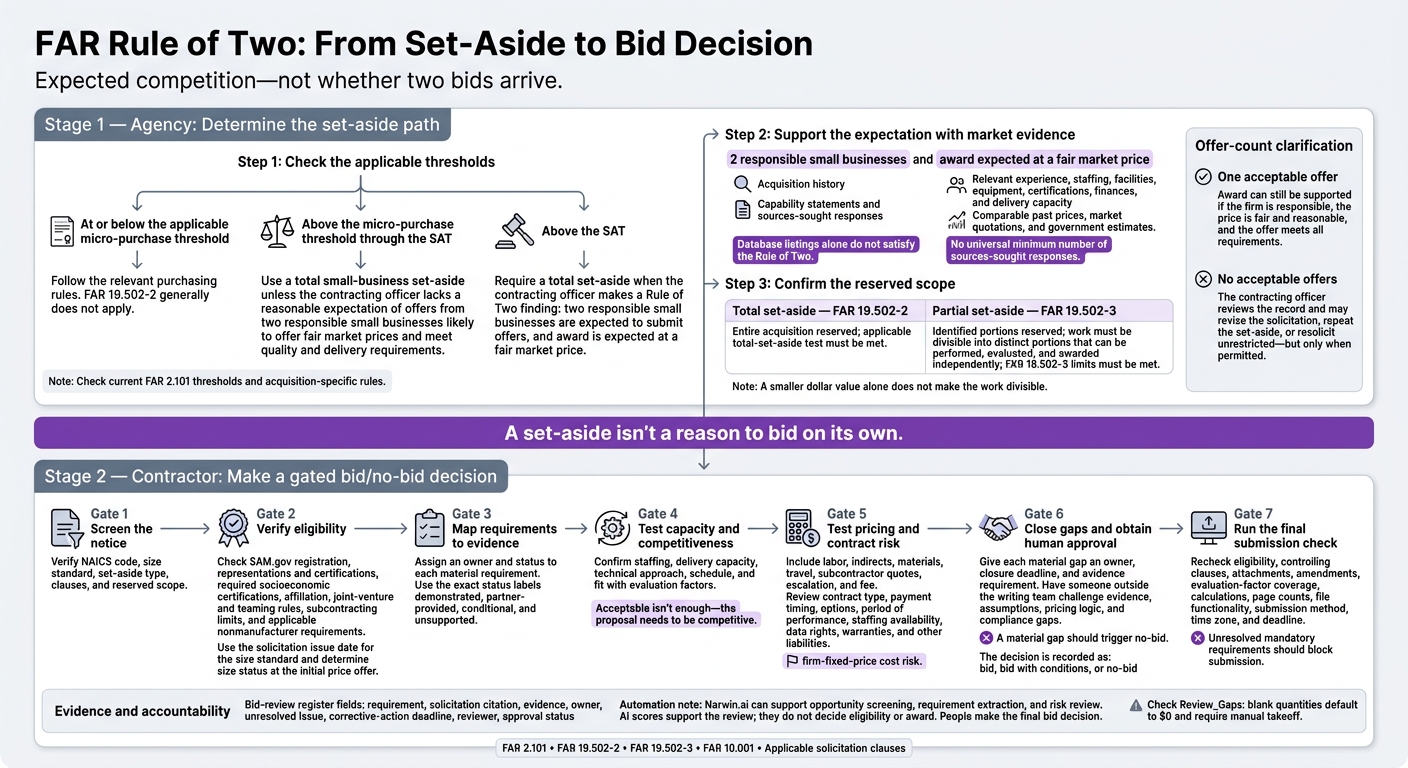
FAR Rule of Two: From Set-Aside to Bid Decision
When Agencies Use Small Business Set-Asides
Thresholds and Set-Aside Rules
Start with the current FAR 2.101 thresholds. Then apply the Rule of Two to determine whether the agency must set aside the acquisition. If the rule applies, determine whether the acquisition must be fully reserved, can be partially reserved, or is exempt from the usual set-aside process.
Check the micro-purchase threshold and simplified acquisition threshold (SAT) that currently apply to the acquisition. Covered construction, services subject to Service Contract Labor Standards, special authorities, and agency rules can have different thresholds.
| Anticipated value | Set-aside decision rule |
|---|---|
| At or below the applicable micro-purchase threshold | Follow the relevant purchasing rules. FAR 19.502-2 generally does not apply. |
| Above the micro-purchase threshold through the SAT | Use a total small-business set-aside unless the contracting officer lacks a reasonable expectation of offers from two responsible small businesses likely to offer fair market prices and meet quality and delivery requirements. |
| Above the SAT | Require a total set-aside when the contracting officer makes a Rule of Two finding: two responsible small businesses are expected to submit offers, and award is expected at a fair market price. |
Database listings alone do not satisfy the Rule of Two. If the requirement can be divided, the agency may reserve only part of the work.
Total vs. Partial Set-Asides
A partial set-aside requires distinct portions that can be performed, evaluated, and awarded independently without undermining the requirement. A smaller dollar value alone does not make the work divisible.
| Comparison | Total set-aside | Partial set-aside |
|---|---|---|
| Governing provision | FAR 19.502-2 | FAR 19.502-3 |
| Reserved scope | Entire acquisition | Identified portions; remainder not set aside |
| Divisibility | No distinct-portion requirement | Must be divisible into distinct portions |
| Conditions and exclusions | Applicable total-set-aside test must be met | FAR 19.502-3 limits must be met |
| Solicitation instructions | Identify the total-set-aside restriction | Identify reserved and nonreserved portions and submission requirements |
For the reserved portion, the agency must reasonably expect two responsible small businesses to compete at fair market prices while meeting quality and delivery requirements.
The solicitation identifies which work is reserved and which rules apply. Bid only the reserved portion designated for your offer, price that scope, and follow its submission instructions.
Set-Aside Types, Notices, and Restrictions
The solicitation controls how you can bid. Check its exact set-aside type, size standard, and clause set. These details determine whether your team can bid, team with others, or submit an offer only on a reserved portion.
Verify the NAICS code, size standard, set-aside type, and key eligibility and submission clauses. These include FAR 52.219-6, Notice of Total Small Business Set-Aside, where applicable. Resolve any conflicting notice terms with the contracting officer before submitting your offer.
sbb-itb-bb3960c
How Contracting Officers Apply the Rule of Two
Capability and Fair Market Price
The contracting officer must use market evidence to support an expectation of offers from two responsible small businesses at fair market prices. That means matching each firm’s experience, staffing, facilities, equipment, certifications, finances, and delivery capacity to the requirement. Comparable past prices, market quotations, acquisition history, and government estimates can support the price analysis.
This assessment is a pre-solicitation planning judgment – not a final responsibility determination or a promise of award. Contractors should address these same factors in their capability statements and sources-sought responses.
Market Research and Sources-Sought Responses
FAR 10.001 requires market research suited to the acquisition. Sources include acquisition history, capability statements, sources-sought responses, and input from small-business specialists. The record should explain who can perform the work and why. There’s no universal minimum number of sources-sought responses that makes the research adequate; the quality of the evidence matters more than the response count.
For bid teams, the task is to connect proof directly to the requirement. Show relevant contracts, available personnel, facilities, certifications, and delivery capacity. Explain teaming arrangements and identify dependencies, such as required licenses or supply-chain constraints. Follow the notice’s requested format and deadline.
A sources-sought response supports market research. It isn’t an offer or a promise of award. Preparing one also helps contractors spot capability gaps to address before bidding.
What Happens With One or No Acceptable Offers
One acceptable offer can still support an award if the firm is responsible, the price is fair and reasonable, and the offer meets all requirements.
If no acceptable offers arrive, the contracting officer reviews the record. The officer may revise the solicitation, repeat the set-aside, or resolicit unrestricted – but only when permitted. For bid teams, a single offer isn’t, by itself, a reason to walk away. Check whether the opportunity still fits.
What Bid Teams Should Check Before Bidding
After the agency makes the set-aside decision, use these checks to decide whether your team should bid.
Create a bid-review register with fields for the requirement, solicitation citation, evidence, owner, unresolved issue, corrective-action deadline, reviewer, and approval status. Track eligibility, capability, compliance, and pricing separately. Approval in one area does not mean approval in another.
Start with eligibility, then move to proposal control.
Small Business Eligibility and Teaming Rules
Record both the solicitation issue date and the date used to determine size status. Use the solicitation issue date for the size standard and determine size status at the initial price offer.
Keep evidence of SAM.gov registration, active representations and certifications, and required socioeconomic certifications. Have the eligibility reviewer check affiliation, joint-venture rules, teaming agreements, and ostensible subcontractor risk.
The bid file should include each partner’s role and workshare, similarly situated subcontractor status, workshare calculations, signed agreements, manufacturer confirmations, and any applicable waiver evidence.
Check limitations on subcontracting and nonmanufacturer requirements against the solicitation’s clauses. Don’t assume the same percentage applies to services, supplies, and construction.
Capability and Proposal Requirements
Map each material requirement to its supporting evidence, owner, and status. In the register, label that support as demonstrated, partner-provided, conditional, or unsupported.
Check the solicitation’s amendments, instructions, evaluation factors, forms, page limits, file formats, question deadlines, submission method, time zone, and due date.
Then test the proposed technical approach, price, and schedule against the stated evaluation factors. Acceptable isn’t enough – the proposal needs to be competitive.
Pricing and Contract Risks
If the team clears eligibility and technical fit, use pricing and contract terms as the final go/no-go test.
Build a priced basis that includes labor, indirects, materials, travel, subcontractor quotes, escalation, and fee. Review the contract type, payment timing, options, period of performance, staffing availability, data rights, warranties, and other liabilities.
Test exposure to wage increases and changes in material costs, travel costs, and subcontractor rates. Pay close attention to firm-fixed-price work, which puts more cost risk on the contractor.
Before committing proposal resources, assign every material gap an owner, a closure deadline, and an evidence requirement. A material gap should trigger no-bid. Record the decision as bid, bid with conditions, or no-bid.
Bid Review Workflow and Final Checks
From Opportunity Screening to Bid Approval
After the eligibility and pricing screen, move the opportunity into final approval. Use a gated bid/no-bid review: screen the notice, confirm the set-aside path, verify eligibility, map requirements, test capacity and pricing, assign owners, and record the decision.
Make the bid-review register your approval matrix. Assign one owner to each unresolved eligibility, technical, pricing-risk, and submission-compliance item. Before leadership approves the bid, have someone outside the writing team challenge the evidence, assumptions, pricing logic, and compliance gaps.
Use automation for triage, but keep the approval decision with people.
Using Narwin.ai for Bid Review
Narwin.ai can help find opportunities, extract requirements, score risk, and support bid/no-bid reviews across major U.S. and Canadian public sources, including SAM.gov. Use it for triage and requirement extraction, then transfer the output to your compliance matrix for human review.
AI scores support the review; they do not decide eligibility or award. They cannot replace the contracting officer’s set-aside determination, confirm SBA certification, settle ambiguous solicitation language, or guarantee a win.
If you use Narwin.ai’s estimation export, check Review_Gaps. Blank quantities default to $0 and require manual takeoff.
If the opportunity still passes review, run one last compliance check before submission.
Final Checks Before Bidding
Immediately before submission, recheck the set-aside type, size status, certifications, and teaming rules. Include affiliation, subcontracting limits, and any nonmanufacturer requirements. Confirm representations and make sure the proposal addresses every evaluation factor.
Verify the controlling FAR provisions, clauses, attachments, and amendments. Check the final proposal against the compliance matrix, validate calculations and page counts, and confirm that every submission file opens correctly. Submit early enough to avoid portal or transmission problems.
Record the final solicitation version, approval date, approver, and owners and deadlines for any open actions. Unresolved mandatory requirements should block submission.
FAQs
Can I challenge an agency’s Rule of Two decision?
Yes. Document any conflict among the solicitation, FAR, SBA rules, or agency supplements, and bring it to the contracting officer or procurement counsel.
Keep a clear record of your analysis of the solicitation’s threshold, applicable NAICS code and size standards, and your firm’s eligibility. If a set-aside appears to have been applied incorrectly or left out, use the agency’s established clarification channels to address your concerns before submitting your proposal.
Does the Rule of Two apply to task orders?
Yes, the Rule of Two can apply to task orders. Under Multiple Award Contracts (MACs), contracting officers must determine whether an order is set aside or issued directly to a small business.
How the rule applies depends on the procurement structure. Bid teams should confirm the order’s set-aside status to understand whether the Rule of Two applies to that requirement.
How do socioeconomic programs affect set-aside decisions?
The 8(a), HUBZone, SDVOSB, and WOSB/EDWOSB programs are separate procurement categories – not a ranked ladder. Above the simplified acquisition threshold, contracting officers must consider these programs before a general small-business set-aside. Their decisions depend on market research, eligibility, and agency goals.
At or below the threshold, the process usually starts with a general small-business set-aside. Awards through socioeconomic programs are still allowed.