
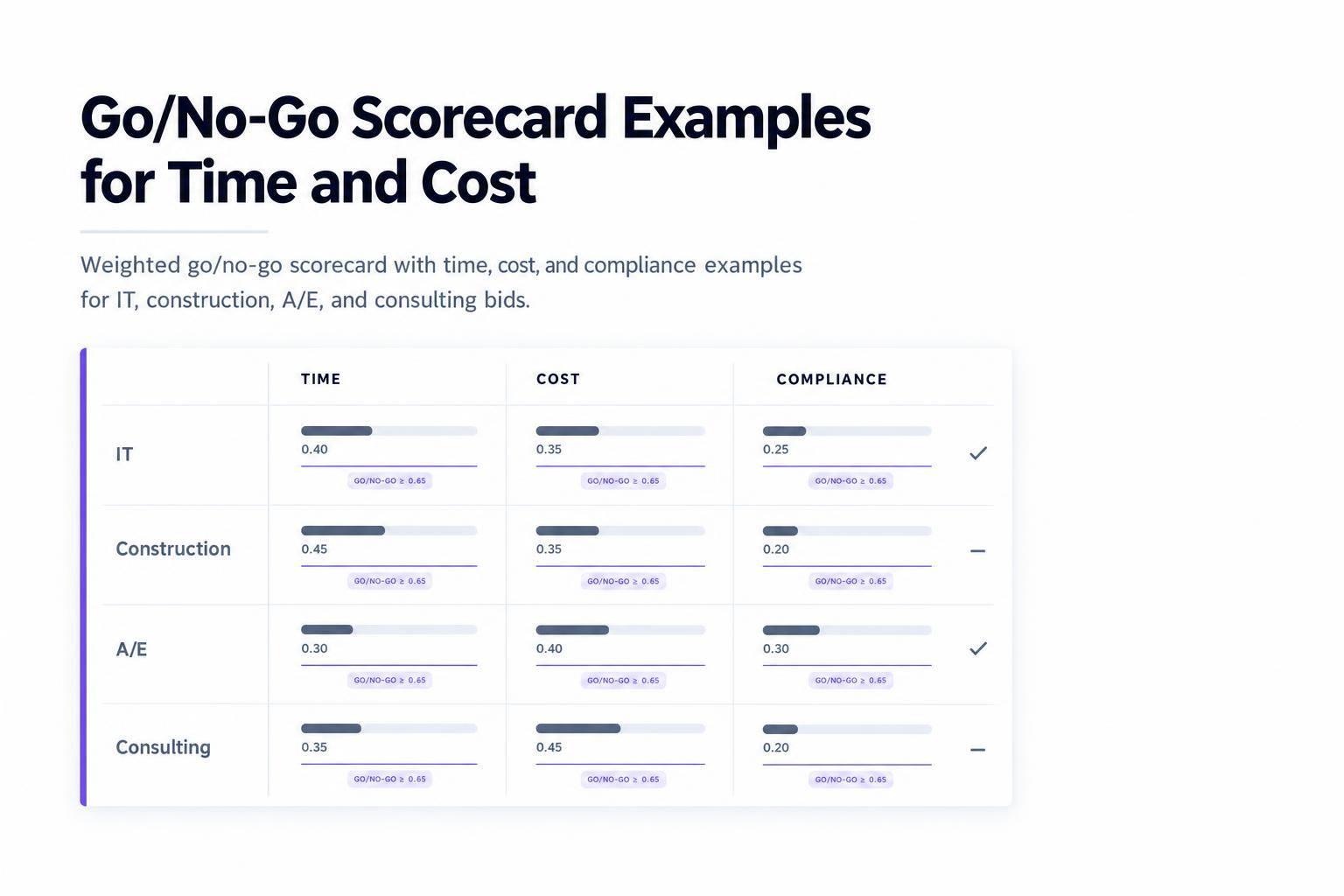
I use a go/no-go scorecard to decide whether a bid is worth the time and money – before proposal work starts. I check eligibility, staff availability, and pursuit cost first. Even a score of 90/100 can’t fix an unmet mandatory requirement.
Here’s what I budget for across four bid types:
- IT services: Solution design, security reviews, integrations, and demos.
- Construction: Takeoffs, subcontractor quotes, bonding checks, and bid forms.
- Architecture and engineering: Qualifications, licensed staff, design work, and interviews.
- Management consulting: Senior-staff time, research, references, and conflict checks.
Quick Comparison
| Bid type | Main time demand | Spending to check |
|---|---|---|
| IT services | Technical and security work | Specialist support and demo costs |
| Construction | Estimating and quote checks | Outside takeoffs and site visits |
| Architecture and engineering | Design and qualifications | Renderings and specialist reviews |
| Management consulting | Research and tailored methods | Research purchases and legal review |
I keep <u>pursuit costs separate from delivery costs</u>, count each staff hour once, and weigh expected margin and win probability – not contract value alone. The examples use hypothetical planning figures, with an 80/100 go threshold only when all gates pass. I then compare actual spending with the budget to improve the next decision.
1. IT Services Bids
Staff Time
Estimate hours by role. IT bids depend on specialist reviews, not just how much writing they require. Allocate time for the solution architect, security and privacy lead, proposal manager or writers, pricing reviewer, and executive approver. Budget demos separately: allow 8–16 hours for a simple demo or 24–60 hours for a scripted workflow.
| Bid type | Total staff hours | Document load | Compliance hours, included in total | Outside spend | Go/no-go gates |
|---|---|---|---|---|---|
| Short commercial response | 20–40 | 5–10 source documents; 10–20-page response | 2–5 | $0–$1,500 | Strong technical fit and a reachable decision-maker or qualified lead |
| Public-sector RFP | 60–120 | 15–40 source documents; 40–100-page response plus forms | 10–25 | $1,000–$7,500 | Mandatory requirements, references, staffing, and submission rules satisfied |
| Complex enterprise or federal pursuit | 150–300+ | 30–100+ source documents; multiple volumes and presentations | 30–75+ | $5,000–$30,000+ | Strong capture position, available certified staff, evidence of compliance, and a clear win path |
Hours climb fastest when the solicitation calls for demos, security evidence, or multiple revisions.
Document Load
Count inputs and outputs separately, and distinguish review time from production time. A single security exhibit can lead to control mappings, resumes, an Accessibility Conformance Report, and a pricing workbook. Each required document adds review, drafting, and revision hours before pricing begins.
Track amendments separately, too. One changed integration requirement can mean reworking the architecture, pricing, and demo. This document load feeds into the compliance score and outside spend below.
Compliance Work
Give technical fit and security the most weight. Delivery gaps and data risks can outweigh price.
| Criterion | Weight | What to assess |
|---|---|---|
| Technical and functional fit | 25 | Coverage of mandatory and high-value requirements, delivery feasibility, scalability, and product maturity |
| Security and privacy | 20 | Relevant certifications or independent reports, control maturity, encryption, data handling, incident response, and privacy terms |
| Integration and architecture | 15 | APIs, identity, data migration, interoperability, system performance, and custom-development risk |
| Certified personnel and delivery capacity | 10 | Required certifications, clearances, named staff, availability, and subcontractor dependence |
| Accessibility and user experience | 5 | Accessibility conformance, testing evidence, design that supports users with differing needs, and remediation capability |
| Customer position and incumbent strength | 10 | Existing relationship, customer access, incumbent advantages, switching barriers, and competitive intelligence |
| Demonstration and proof effort | 5 | Demo preparation, proof-of-concept work, sample data, travel, and stakeholder coordination |
| Commercial fit and margin | 10 | Price competitiveness, delivery cost, contract risk, payment terms, and expected contribution margin |
Use the score to decide whether the effort makes sense, then check mandatory gates before pricing the pursuit.
Score each criterion from 0 to 5, multiply by its weight, and divide by 5. Require evidence of proven APIs, available certified staff, documented security controls, acceptable privacy terms, and accessibility testing. Lower the customer-position score if the incumbent has embedded staff or strong buyer relationships.
Mandatory requirements override the total score. An unavailable clearance or unmet security requirement means no-go. Apply FedRAMP or Section 508 only when the solicitation requires it.
Outside Spend
Illustrative pursuit cost:
Illustrative county modernization pursuit: A three-year cloud application modernization RFP requires API integrations, accessibility requirements, security documentation, three named roles, a live demonstration, and a 30-page technical response. Budget 105 staff hours, including 18 compliance hours, plus $2,500 for security-evidence preparation, proposal support, and demo infrastructure. At $125 per hour, pursuit cost is $15,625. The weighted score is 82/100, supported by 90% functional coverage and proven connectors. Decision: conditional go, pending completed accessibility evidence and confirmed demo resources within two business days. Release the budget only after checking expected contribution and staff availability.
Construction bids shift the burden from software evidence to quantities, subcontractor pricing, and field risk.
sbb-itb-bb3960c
2. Construction Bids
Staff Time
Construction bids put less weight on writing and more on takeoffs, quote coordination, and bid-rule compliance. Start with three planning baselines: a small local renovation, a multi-trade public project, and a design-build pursuit.
These are examples, not industry averages. Replace them with records from your completed bids. Count hours across estimating, project management, operations, design, legal, and admin.
| Bid type | Total staff hours | Documents to review and produce | Compliance hours (included) | Outside spend | Go/no-go checks |
|---|---|---|---|---|---|
| Small local project: $250,000–$750,000 | 40–90 | 20–50 files: drawings, specifications, proposal form, scope clarifications, subcontractor quotes | 5–12 | $500–$3,000 | Before approval, confirm scope, site conditions, labor availability, material pricing, payment history, and target margin |
| Multi-trade public project: $3 million–$10 million | 250–600 | 100–300 files: plans, specifications, addenda, wage rules, forms, bonds, references, safety documents, and subcontractor submissions | 40–100 | $5,000–$25,000 | Before committing resources, verify mandatory forms, bid security, bonding, insurance, schedule, subcontractor coverage, prevailing-wage rules, and payment risk |
| Design-build pursuit: $5 million–$20 million | 500–1,200 | 150–500 files: owner criteria, concepts, narratives, schedules, preliminary calculations, pricing assumptions, resumes, and design deliverables | 60–180 | $20,000–$100,000+ | Before approving the larger pursuit budget, require design-team availability, solution feasibility, estimate confidence, acceptable IP terms and liability, bonding, financing, and expected win value |
Document Load
Track plans, specs, addenda, forms, certifications, trade quotes, and required signatures separately. Do the same for scope modifiers: RFIs, alternates, allowances, unit prices, and exclusions.
File count doesn’t tell the whole story. A short, unclear bid can take longer than a lengthy, standardized one. Use a complexity multiplier, and recheck takeoffs and quotes after addenda. For design-build bids, document assumptions and value-engineering hours – but don’t count unapproved savings as secured margin.
Compliance Work
Use a 100-point scorecard with these weights:
- Estimate confidence: 20; scope completeness: 10; schedule: 10; labor: 10; material-price certainty: 10.
- Margin after risk allowances: 15; owner payment and contract risk: 10; bonding and financial capacity: 10; strategic fit: 5.
Apply the same 0–5 scoring method as above.
Check licensing, required submissions, addenda acknowledgments, insurance limits, bid security, prevailing-wage rules, safety and equal-opportunity forms, references, and surety requirements.
Mandatory failures override the score. Unavailable bonding, an infeasible schedule, or unverified scope means no-go. Check quote expiration dates against purchasing dates. Before approval, also review retainage, payment provisions, and liquidated damages.
Outside Spend
List outside cash costs separately from staff time. Include outside takeoffs, architect/engineer fees, survey, testing, specialty design, legal review, travel, printing, courier services, and proposal production.
Confirm bond costs with the surety. Keep bid-stage spending separate from performance and payment bond premiums due after award.
Architecture and engineering bids shift the work from estimating to qualifications, design judgment, and technical proof.
3. Architecture and Engineering Bids
Staff Time
A/E bids put less emphasis on estimating and more on qualifications and proof of design ability. Treat the figures below as planning ranges, not benchmarks. Track principal, technical, proposal, design, and presentation hours separately. Count each activity once, and include compliance work and unrecoverable design hours in the total.
Budget interview preparation, rehearsal, and attendance as a separate phase. Approve that phase after shortlisting.
| Bid type | Total staff hours | Document load | Compliance hours (included) | Outside spend | Go/no-go checks |
|---|---|---|---|---|---|
| Qualifications submission or RFQ | 40–100 | 5–15 core items: SF 330 or equivalent, resumes, project sheets, team chart, references, forms | 8–20 | $0–$2,500 | Comparable portfolio, eligible licensed team, available key personnel, delivery capacity |
| Full design-services RFP | 120–300 | 15–30 items: technical approach, work plan, schedule, QA/QC plan, fee forms, qualifications | 20–50 | $2,000–$15,000 | Clear scope, viable fee, acceptable site and entitlement risk, consultant availability, interview readiness |
| Design competition | 250–800+ | Concept boards, diagrams, renderings, models, narrative, presentation, required forms | 15–40 | $5,000–$50,000+ | Business value, design quality, likelihood of selection, acceptable unrecoverable design effort |
Document Load
Count customized resumes, project sheets, graphics, and models – not just files. Visual quality takes work; it isn’t just a presentation detail. Mark each deliverable as reusable, reusable with changes, or one-time.
Check page, file-size, font, naming, and formatting limits before estimating production hours. A short qualifications package can need extensive tailoring. A competition may require few forms but plenty of visual work.
Compliance Work
Federal A/E selection under the Brooks Act and FAR Part 36 is usually qualifications-based. Agencies shortlist firms, conduct interviews, then negotiate price with the most qualified firm. Apply the same four tests used elsewhere: staff time, document load, compliance risk, and outside spend.
State and local rules vary. Confirm when price enters the process, check professional and firm eligibility, and secure commitments from named personnel. Missing licenses, unavailable required staff, prohibited teaming, or conflicts can stop the pursuit.
Use a 100-point framework with these weights, applying the established 0–5 scale:
- Portfolio fit: 20
- Licenses, certifications, and geographic eligibility: 15
- Key personnel: 15
- Site, entitlement, and technical fit: 15
- Client relationship and past performance: 10
- Scope and fee viability: 10
- Competitive position and shortlist probability: 10
- Capacity, schedule, and pursuit cost: 5
For qualifications-based selection, give the most weight to portfolio, licenses, key personnel, and past performance. For fee competition, give more weight to scope, staffing, schedule, fee assumptions, and risk.
Score comparable project conditions – not visual similarity. Assess zoning, historic preservation, utilities, environmental review, and permitting demands.
Outside Spend
Budget visualization vendors, specialist consultants, travel, printing, legal review, and proposal software separately from internal labor. For competitions, check the honorarium and whether the owner can use submitted concepts without awarding a commission.
Set separate caps for cash spending and unrecoverable design hours. Approve added presentation spending only after reassessing the chances of selection and the remaining pursuit cost.
Consulting bids shift the workload again – from visuals to senior-staff time, methods, and client-specific proof.
4. Management Consulting Bids
Staff Time
In consulting bids, senior-staff availability often matters more than proposal length. Total hours include compliance work. Consulting usually requires fewer documents than construction, but it places more demand on senior staff than IT bids do.
| Pursuit type | Total staff hours | Document load | Compliance hours included | Outside spend | Score | Pursuit cost* | Decision |
|---|---|---|---|---|---|---|---|
| Short advisory | 30 | 8 source documents; 8–15 response pages | 3 | $500 | 82/100 | $6,500 | Go: strong sector expertise, two available references, and a partner committed to delivery |
| Public-sector strategy | 125 | 32 source documents; 30–80 response pages plus forms | 22 | $2,500 | 68/100 | $30,625 | Conditional go: fix the weak reference and limited partner availability before production |
| Data-heavy transformation | 240 | 48 source documents; 60–120 response pages plus technical exhibits | 40 | $12,000 | 54/100 | $72,000 | No-go: unresolved client conflict and no approved restricted-data plan |
The next section compares these patterns across bid types.
Document Load
Consulting bids vary sharply in document complexity. They’re usually light on forms but require careful tailoring. Advisory work needs a clearly bounded scope. Public-sector strategy adds forms, pricing schedules, and reference checks. Transformation bids add data dictionaries, security responses, and implementation plans.
Research effort should match what the team still needs to learn, not how much material it already has.
Compliance Work
Check mandatory gates before scoring: submission rules, required references, named personnel, contract acceptance, conflicts, and restricted-data access. An unresolved mandatory failure overrides a strong score.
Use the established scoring method with these weights: expertise 20, references 15, research 10, senior availability 15, solution differentiation 15, compliance and delivery readiness 15, and conflict/data controls 10.
Adjust the weights before scoring. When differentiation drives the decision, put more weight on expertise and approach. When price drives it, give price competitiveness and delivery efficiency explicit weight.
Resolve conflict and data-control gaps before approval. Federal rules treat consulting conflicts as a separate risk and may require certifications and auditable mitigation plans. Take security requirements from the solicitation, not a generic checklist.
Senior availability, reference strength, and data-risk readiness – not page count – drive the decision. A low fee cannot make up for unavailable staff or unsafe data handling.
Outside Spend
Budget external research, specialist input, legal review, travel, and security review separately.
*Pursuit cost = staff hours × internal hourly cost + outside spend. The table uses blended opportunity rates of $200, $225, and $250 per hour, respectively.
For the strategy pursuit, 125 × $225 + $2,500 produces the $30,625 estimate.
Treat cost and capacity as separate go/no-go gates. These consulting baselines feed the cross-bid comparison of hours, documents, compliance tasks, and outside spend.
Compare Staff Hours and Document Demands
Compare labor and document loads across four planning examples: a $2.5 million IT bid, an $8 million construction bid, a $1.2 million architecture and engineering bid, and a $3 million consulting bid. Each assumes a U.S. public-sector buyer and a 30-day response period.
These examples separate the labor mix from document demands to show where time and cost pressure comes from. Total hours tell only part of the story. The roles needed and the documents involved also help determine whether a bid is worth pursuing.
Staff Hours by Role
Count each hour once. Proposal management includes scheduling, compliance, production, and submission control. Estimating covers quantities, labor, materials, and subcontractors. Research excludes drafting, while pricing covers rates, fees, and commercial assumptions. Legal hours reflect internal capacity; external counsel belongs in outside spend.
Use the role split to check whether your team has the right specialists – not just enough hours.
Role or capacity item IT services Construction Architecture and engineering Management consulting Proposal management 55 hours 35 hours 30 hours 45 hours Technical/design work 150 hours 20 hours 190 hours 125 hours Estimating 0 hours 210 hours 20 hours 0 hours Research 35 hours 10 hours 25 hours 105 hours Pricing 25 hours 35 hours 15 hours 25 hours Legal review 12 hours 15 hours 10 hours 12 hours Executive approval 8 hours 8 hours 8 hours 8 hours Total internal hours 285 333 298 320 Main effort driver Solution development and technical integration Quantity takeoff and subcontractor coordination Principal involvement and design concept development Senior-staff research and tailored methodology Reusable content Security language, resumes, transition plans Safety plans, project sheets, standard forms, and company qualifications Resumes, project sheets, diagrams, and firm qualifications Frameworks, case studies, resumes, and standard deliverables Hidden effort Architecture workshops, staffing validation, data follow-up, and boilerplate tailoring Drawing revisions, spec conflicts, quote validation, and scope reconciliation Site analysis, design alternatives, rendering, critiques, and designer coordination Stakeholder research, data validation, interview prep, hypothesis development, partner review, and work-plan refinement
Check specialist capacity, not just total availability. Spare proposal-manager hours can’t replace an estimator’s takeoff work or a principal’s design review. Ask each lead for an independent estimate. Investigate differences greater than 25% before approving the budget rather than averaging them away.
Documents to Review and Produce
Track inputs reviewed separately from outputs produced, and state the units. A drawing sheet isn’t a narrative page. One spreadsheet file may hold several pricing worksheets.
Document counts help you plan review time, production work, and amendment risk.
Bid type Documents reviewed Documents produced Approx. pages Preparation hours included in role totals Production effort and hidden checks IT services 1 RFP, 6 amendments, 4 appendices, 12 reference documents 1 technical volume, 1 management volume, 18 resumes, 8 project sheets, 14 forms, 3 pricing schedules, 6 attachments; 51 files 650 reviewed; 180 produced 65 of 285 Tailor reusable security text; check requirement cross-references, diagrams, resume availability, and file rules Construction 1 invitation to bid, 200 drawings, specifications, 7 addenda, 35 subcontractor quotes, 18 forms Bid form, schedule, 6 pricing schedules, 25 subcontractor forms, 8 narratives, 12 certificates and attachments; 60 files plus drawing markups 1,100 specification pages reviewed 45 of 333 Reuse standard forms; reconcile drawing versions, quote exclusions, scope gaps, and upload requirements Architecture and engineering 1 RFQ, 5 addenda, 2 site/program files, 14 reference files 1 qualifications package, 10 resumes, 8 project sheets, 1 design narrative, 6 boards or presentation files, 8 forms 300 reviewed; 70 produced, plus graphics files 110 of 298 Adapt project sheets; allow for rendering, image permissions, file conversion, and presentation rehearsal Management consulting 1 RFP, 8 appendices, 20 reference files 1 technical volume, 1 work plan, 12 resumes, 6 case studies, 9 forms, 4 pricing files; 34 files 900 reviewed; 140 produced 55 of 320 Tailor reusable frameworks; validate evidence, clean data, and reconcile partner edits
Page count shows length, not effort. Track amendments, calculations, required signatures, original analysis, and review cycles separately.
Compare Compliance Tasks and Outside Costs
Once staffing hours and document demands look feasible, check eligibility and out-of-pocket pursuit costs before scoring the bid.
Compliance Tasks and Mandatory Requirements
Eligibility comes before scoring. Record each requirement’s source, owner, evidence, deadline, and consequence of failure. Use the solicitation – not internal judgment – to classify each gap as fixable, conditional, or disqualifying. The compliance hours below are already part of total pursuit labor.
| Bid type | Compliance hours included | Requirements and evidence to verify | Fixable before the deadline | Mandatory failure: score override |
|---|---|---|---|---|
| IT services | 50 | Security, data handling, privacy, accessibility, staff clearances, insurance, licensing, past performance, representations, and required subcontractor security status | Missing resume or unsigned draft form, if the underlying requirement is otherwise met | Missing required cybersecurity status by the solicitation’s specified date |
| Construction | 70 | Bid, payment, and performance bonds; contractor licensing; prevailing-wage rules; safety records; insurance limits; subcontractor disclosures; site access; addenda acknowledgments | Incomplete subcontractor form that can be completed on time | Missing required bid bond or contractor license at the required deadline |
| Architecture and engineering | 55 | State registration, firm authorization, responsible-professional licensing, required seals, insurance, and required specialist or partner commitments | Unsigned availability letter from an otherwise qualified, committed specialist | Required licensed professional or registration unavailable when required |
| Management consulting | 35 | Conflict-of-interest certifications, confidentiality and data-protection terms, key-person availability, financial disclosures, nondisclosure agreements, accessibility, and required socioeconomic or local-partner commitments | Incomplete disclosure or draft nondisclosure agreement that can be resolved | An unwaivable conflict or inability to accept mandatory confidentiality terms |
A missing form doesn’t always rule out a bid. Check the requirement and its supporting evidence separately. For federal work, verify SAM.gov registration requirements at the applicable milestones. For DoD work, check any required CMMC status for the prime and relevant subcontractors.
An unresolved mandatory failure means No-Go, whatever the weighted score, unless a formal buyer clarification or amendment changes the requirement.
Outside Spending and Total Pursuit Cost
The figures below are hypothetical bid-stage allowances covering only pre-award costs. Track external counsel separately from internal legal hours. Keep delivery labor, materials, travel, insurance, and bonding in the delivery budget. For pre-bid site visits, count hours as labor and airfare as outside spend.
| Bid type | Outside-spend allowance | Total |
|---|---|---|
| IT services | Combined allowance for cybersecurity specialist support and external legal review | $3,000 |
| Construction | Specialized estimator: $2,000; pre-bid site visit: $1,500; pursuit-related bonding or surety charges: $1,000 | $4,500 |
| Architecture and engineering | Specialty engineering review: $1,500; pre-bid site visit: $1,000; renderings or visualization: $2,500 | $5,000 |
| Management consulting | External confidentiality/conflict review: $1,200; targeted benchmark research: $800 | $2,000 |
Pursuit cost = sum(role hours × fully loaded hourly rate) + outside spend.
Apply rates to the established role totals. Document and compliance hours are already included, so don’t count them twice. Record foregone billable contribution separately as opportunity cost rather than automatically adding it to this budget.
Time and Cost Trade-Offs by Bid Type
Each bid type has a different mix of labor, paperwork, compliance work, and outside costs. Compare these demands side by side.
| Bid type | Staff hours | Document demand | Compliance hours included | Outside spend | One advantage | One drawback |
|---|---|---|---|---|---|---|
| IT services | 120 | High: technical, security, staffing, and past-performance files | 50 | $3,000 | Security evidence can provide a clear early eligibility check | Missing cybersecurity eligibility can invalidate the bid |
| Construction | 160 | High: schedules, pricing forms, safety, bonds, and subcontractor records | 70 | $4,500 | Site and pricing assumptions can be tested directly | Bonding, public-works, or licensing gaps may be difficult to resolve |
| Architecture and engineering | 110 | Medium-high: narratives, drawings, resumes, forms, and partner commitments | 55 | $5,000 | A strong team and relevant portfolio can help the offer stand out | Registration or required-partner failures can block eligibility |
| Management consulting | 80 | Medium: approach, resumes, references, conflicts, and confidentiality forms | 35 | $2,000 | Lower hypothetical external spend and faster review | Independence or confidentiality conflicts may be disqualifying |
AI Support for Bid Screening
Narwin.ai can help with preliminary go/no-go screening through RFP analysis, requirement extraction, and compliance-gap checks. People must still verify mandatory requirements, licenses, partner commitments, win-probability estimates, and pursuit-budget assumptions. AI output supports that review; it doesn’t make the final decision.
Make the Decision: Score, Budget, and Capacity
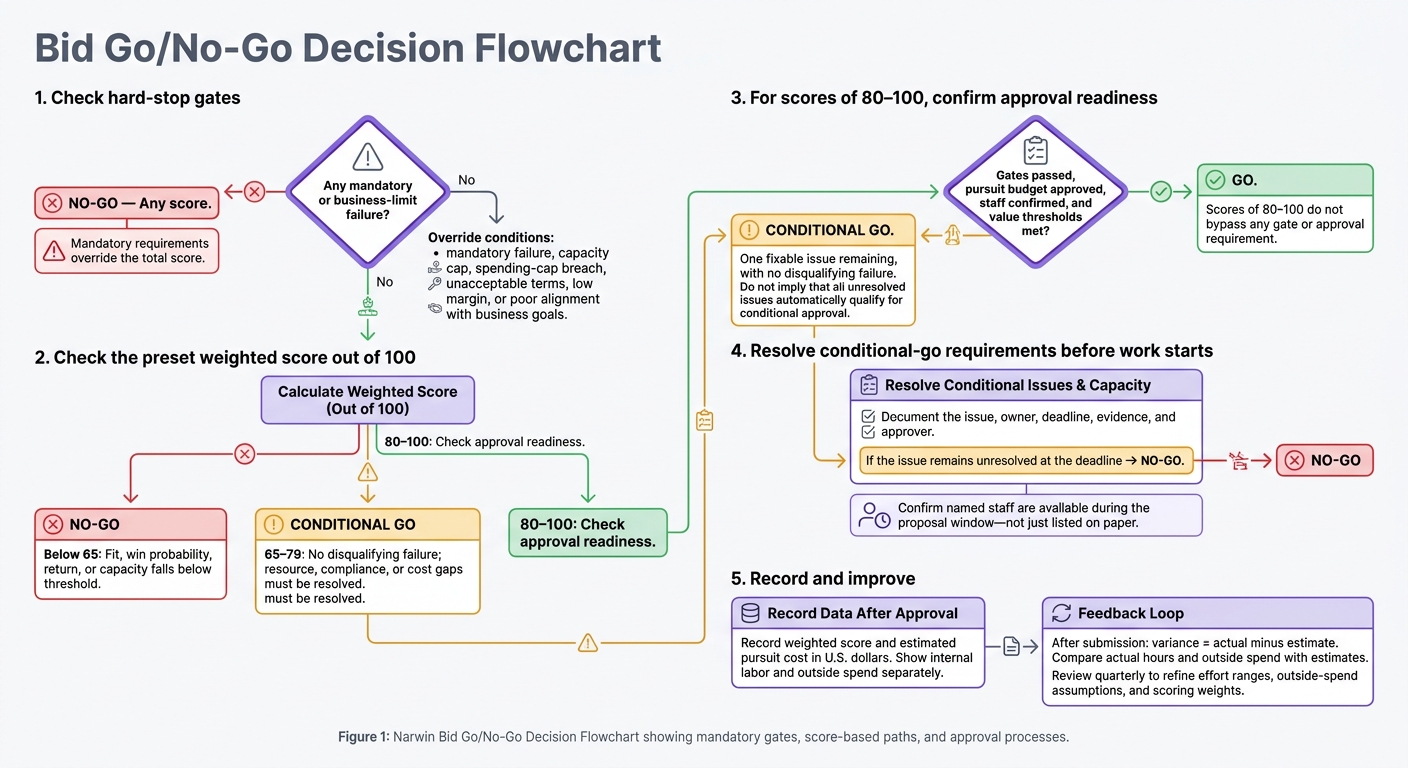
Bid Go/No-Go Decision Flowchart
Turn the staff hours, documents, compliance tasks, and outside spend you’ve compared into a go/no-go decision. Use a preset weighted score out of 100 that draws on the earlier time, cost, and compliance analysis. Give the most weight to the constraint that drives each bid type’s workload – not total proposal length.
| Score | Decision | Decision rule |
|---|---|---|
| 80–100 | Go | Gates passed, pursuit budget approved, staff confirmed, and value thresholds met |
| 65–79; or 80–100 with one fixable issue remaining | Conditional go | No disqualifying failure, but resource, compliance, or cost gaps must be resolved |
| Below 65 | No-go | Fit, win probability, return, or capacity falls below threshold |
| Any score | No-go | Mandatory failure, capacity cap, spending-cap breach, unacceptable terms, low margin, or poor alignment with business goals |
For every conditional go, document the resource, compliance, or cost issue before work starts. Include its owner, deadline, evidence, and approver. If the issue remains unresolved at the deadline, mark the bid no-go.
Record the score and estimated pursuit cost in U.S. dollars, with internal labor and outside spend shown separately. Confirm that named staff are available during the proposal window – not just listed on paper.
After submission, compare actual hours and outside spend with the estimates: variance = actual minus estimate. Review these results quarterly to refine effort ranges, outside-spend assumptions, and scoring weights for future scorecards.
FAQs
How should I calibrate scorecard weights using past bids?
Review past contract awards, submissions, and your firm’s wins and losses to see what consistently drives selection. Look for agency-specific priorities and evaluation trends, including gaps between stated RFP weights and actual award decisions.
Use what you learn to adjust your scorecard weights and compare your past performance against new RFP requirements. Regularly check automated weighting against actual results to keep your scorecard aligned with your firm’s strengths.
How do I compare pursuit cost with expected profit?
Calculate total bid cost first. For proposal managers, writers, subject matter experts, and legal reviewers, multiply each person’s hours by their fully loaded hourly rate. Then add those costs together.
Next, use a structured scorecard to weigh your chance of winning against pursuit cost, expected margin, and return on investment. If the potential return doesn’t justify the investment, make a formal no-go decision or shift resources to opportunities with greater potential.
When should I reassess a bid’s go/no-go decision?
Reassess the bid whenever the solicitation has major amendments, especially changes to the statement of work, evaluation criteria, or deadline extensions. Rerun your win score and analysis right away. These updates can shift compliance requirements or priorities.
Review the bid again if your capacity or team availability changes. Losing key personnel or stretching project managers too thin can turn a promising bid into a no-go.