

Public procurement requires a careful balance between transparency and confidentiality. Transparency ensures fairness and accountability by making processes open and accessible. Confidentiality protects sensitive vendor information like pricing strategies and trade secrets. Striking this balance is critical to encourage participation, maintain trust, and achieve better outcomes.
Key Takeaways:
- Transparency: Publicizes RFP details, evaluation criteria, and contract awards to ensure open competition and public trust.
- Confidentiality: Safeguards sensitive vendor data (e.g., pricing, proprietary methods) to protect competitive advantages.
- Balancing Act: Agencies must disclose necessary information for accountability while securing vendor trust by protecting sensitive details.
This balance supports a fair procurement process that benefits both public agencies and vendors.
Transparency in RFPs: Supporting Fairness and Accountability
What Transparency Means in RFPs
In public procurement, transparency isn’t just a best practice – it’s a legal mandate. Every part of the RFP process must remain open, consistent, and accessible to all potential bidders.
In the U.S., the Federal Acquisition Regulation (FAR) sets the rules. According to FAR 5.002, contracting officers must publicize contract actions to boost competition, encourage broader industry participation, and give small or disadvantaged businesses a fair shot at government contracts. For any contract expected to exceed $25,000, the details must be posted on the Governmentwide Point of Entry (GPE), which is most commonly SAM.gov.
Another critical element is ensuring equal access to information. FAR 15.201(f) states:
"When specific information about a proposed acquisition that would be necessary for the preparation of proposals is disclosed to one or more potential offerors, that information must be made available to the public as soon as practicable… in order to avoid creating an unfair competitive advantage."
By adhering to these rules – posting opportunities on SAM.gov and clearly outlining evaluation criteria in Sections M, L, and C – agencies create a fair and level playing field for all bidders.
Benefits of Transparency
Transparency in procurement delivers advantages for both agencies and vendors.
It fosters competition and ensures fairness. When opportunities are openly advertised and requirements are clearly defined, more vendors – especially small businesses – can participate. This openness prevents manipulation and bias, as evaluators are held to consistent, published standards. FAR 15.201(b) highlights the importance of sharing information to improve "the understanding of Government requirements and industry capabilities, thereby allowing potential offerors to judge whether or how they can satisfy the Government’s requirements."
It builds public trust. Publishing contract awards shows taxpayers exactly how public funds are being used. This openness also reassures vendors that the process is fair. The WTO Agreement on Government Procurement puts it best:
"The integrity and predictability of government procurement systems are integral to the efficient and effective management of public resources, the performance of the Parties’ economies and the functioning of the multilateral trading system."
Transparency is the backbone of a well-functioning procurement process. When vendors trust the system, they’re more willing to invest time and effort into their proposals. This leads to stronger competition and better outcomes for agencies. These benefits lay the groundwork for addressing the next challenge: safeguarding sensitive data.
sbb-itb-bb3960c
Confidentiality in RFPs: Protecting Sensitive Information
Transparency is important in the RFP process, but vendors often share sensitive details – like pricing strategies, proprietary methods, and cost structures – that need to be safeguarded. Without proper confidentiality measures, this information could become a liability instead of an advantage.
What Confidentiality Means in RFPs
In the context of RFPs, confidentiality refers to protecting specific types of sensitive data that vendors provide during the solicitation process. However, not all information in a proposal qualifies for protection, and understanding this distinction is critical.
"Information provided to a potential offeror in response to its request must not be disclosed if doing so would reveal the potential offeror’s confidential business strategy." – Federal Acquisition Regulation (FAR)
The table below highlights the difference between sensitive and non-sensitive proposal information:
| Information Type | Typically Sensitive? | Why |
|---|---|---|
| Detailed cost breakdown | Yes | Reveals profit margins and overhead rates |
| Trade secrets | Yes | Proprietary formulas or processes with economic value |
| Proprietary methodologies | Yes | Unique technical approaches that competitors could copy |
| Business and investment plans | Yes | Reveals how a contractor expects to generate returns |
| Total contract price | No | The public has a right to know how public funds are spent |
| Winning bidder’s name | No | Required for transparency and accountability |
| Key performance indicators | No | Not commercially sensitive |
For information to qualify as a trade secret, it must meet two conditions: it must have independent economic value from not being publicly available, and the company must take reasonable steps to keep it confidential. As the Iowa Supreme Court explained:
"Information kept secret that would be useful to a competitor and require cost, time and effort to duplicate is of economic value."
A real-world example shows how these lines can blur. In fall 2024, Story County, Iowa, issued an RFP for a Climate Action Plan. The winning proposal, submitted by an engineering firm, was 184 pages long, with 45 pages marked confidential for pricing and personnel details. After a public records request by an unsuccessful bidder, the Iowa Public Information Board issued Advisory Opinion 25AO:0006 on July 17, 2025. The board ruled that the firm couldn’t rely on "generic categories" and had to provide "hard facts" to show the redacted sections met the legal definition of a trade secret under Iowa Code § 22.7.
This example underscores the importance of clear definitions and robust confidentiality practices.
Why Confidentiality Matters
Confidentiality isn’t just about data protection – it directly impacts participation and fairness in the RFP process. Vendors are more likely to submit detailed, candid proposals when they trust their sensitive information will remain secure. This trust fosters competition and leads to better outcomes for agencies.
As business attorney Aaron Hall explains:
"Confidentiality serves as a foundational element in the Request for Proposal (RFP) process, ensuring the protection of sensitive information exchanged between organizations and potential vendors."
Without confidentiality, vendors risk having their pricing copied, bids undercut, or intellectual property inadvertently shared – a practice often referred to as "cherry-picking." The European Commission has specifically warned against this risk in complex competitive dialogue RFPs, emphasizing the need for individual discussions with participants to prevent unauthorized idea sharing.
The consequences of confidentiality breaches extend beyond competitive harm. They can lead to lawsuits, tarnish an agency’s reputation, and discourage quality vendors from participating in future RFPs. The result? A smaller, less competitive pool of bidders and reduced value for public funds.
Transparency vs. Confidentiality: A Side-by-Side Comparison
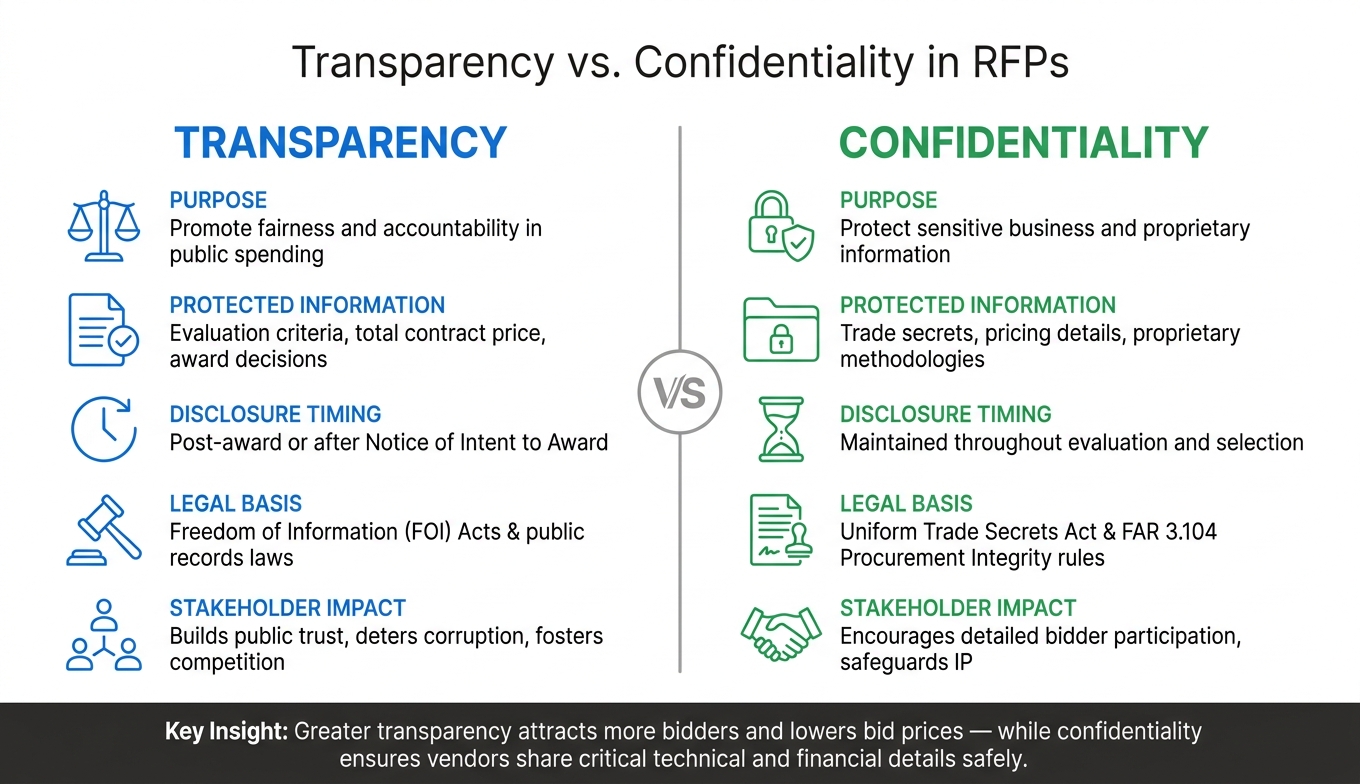
Transparency vs. Confidentiality in RFPs: Key Differences at a Glance
Transparency and confidentiality play distinct but essential roles in the RFP process. By understanding how these principles differ, agencies and vendors can better navigate procurement challenges.
Key Differences Between Transparency and Confidentiality
To grasp the nuances of these principles, it helps to compare them across critical aspects of procurement:
| Aspect | Transparency | Confidentiality |
|---|---|---|
| Purpose | Promote fairness and accountability in public spending | Protect sensitive business and proprietary information |
| Protected Info | Evaluation criteria, total contract price, award decisions | Trade secrets, pricing details, proprietary methodologies |
| Disclosure Timing | Post-award or after a Notice of Intent to Award | Maintained throughout evaluation and selection processes |
| Legal Basis | Freedom of Information (FOI) Acts and public records laws | Uniform Trade Secrets Act and Procurement Integrity rules (FAR 3.104) |
| Stakeholder Impact | Builds public trust, deters corruption, and fosters competition | Encourages detailed bidder participation and safeguards intellectual property |
A key difference lies in when information is disclosed. During active bidding, confidentiality is paramount to ensure a fair process and prevent collusion. However, once a contract is awarded, public records laws mandate disclosure to uphold accountability.
For agencies, transparency fosters trust and deters corruption. Vendors, on the other hand, benefit from confidentiality, which allows them to share detailed data without fear of competitive misuse. As the Open Contracting Partnership highlights:
"Transparency and openness around this spending can help improve the competitiveness, integrity and efficiency of the contracting process." – Open Contracting Partnership
Interestingly, research shows that greater transparency attracts more bidders and lowers bid prices, countering fears that disclosure might discourage competition. At the same time, confidentiality ensures vendors feel secure in providing technical and financial details that might otherwise be withheld.
Transparency is rooted in public accountability laws, while confidentiality is grounded in trade secret protections that require economic value and deliberate safeguarding. Understanding these differences is key to finding the right balance between the two in procurement practices.
How to Balance Transparency and Confidentiality in RFPs
Finding the Middle Ground
Striking the right balance between openness and safeguarding sensitive information is crucial in any RFP process. Transparency and confidentiality often seem at odds, but they can coexist when approached thoughtfully. The key is to decide what to share, when to share it, and with whom.
One effective strategy is to require vendors to clearly identify confidential elements in their proposals. Instead of leaving it to agencies to guess what’s sensitive, vendors can use a confidentiality request form. This form should include an index of confidential pages, a legal justification, and an explanation of potential competitive harm. Avoid vague claims like "the entire proposal is proprietary."
Another safeguard is pre-disclosure notification. If a confidentiality claim is challenged, notify the vendor immediately. This allows them time to seek legal action, such as a court injunction, if necessary.
"The public’s interest in accessing the details of such a bid is based not on the information itself, but rather the transparency of the government body’s decision-making process when choosing how to allocate public funds." – Iowa Public Information Board
These steps create a framework for balancing transparency with confidentiality, laying the groundwork for more detailed practices discussed in the next section.
Examples of Balanced Practices
Practical examples can help clarify how to maintain this balance effectively.
Separate technical and pricing volumes. The Federal Acquisition Regulation (FAR) offers clear guidance on this:
"Clearly advise offerors to keep technical and pricing information separate and not inter-mixed between proposal volumes."
This separation allows agencies to release a pricing summary or total contract award amount for public accountability while protecting sensitive details like a vendor’s methodology or unit pricing. It also simplifies the review process when handling public records requests post-award.
A real-world case study highlights this balance. A court ruling emphasized that while the public has a right to understand how decisions are made, this doesn’t extend to every detail of a vendor’s proprietary business model.
Here’s a breakdown of what typically gets disclosed versus protected:
| Information Category | Typical Status | Reason |
|---|---|---|
| Total contract price | Publicly disclosed | Ensures accountability for public spending |
| Evaluation scorecards | Publicly disclosed | Shows selection was based on fair, criteria-driven processes |
| Proprietary methodology | Confidential | Protects the vendor’s unique approach and competitive advantage |
| Detailed hourly rates | Often confidential | Prevents competitors from using the data to undercut future bids |
| Employee resumes | Partially disclosed | General roles are public; specific project details may be redacted |
Best Practices for Managing Transparency and Confidentiality
Balancing transparency with confidentiality is no easy task, but these strategies can help safeguard sensitive information while meeting transparency requirements.
Protecting Confidential Information
Start by shifting the responsibility to vendors. Require bidders to submit a standardized confidentiality form that specifies the exact pages they want protected, cites relevant laws, and explains the competitive harm disclosure would cause. Blanket claims like "this entire section is proprietary" should not be accepted.
For more complex procurements, such as those involving competitive dialogue or Best and Final Offer (BAFO) processes, use non-disclosure agreements (NDAs) with shortlisted suppliers. This approach helps clearly define pre-existing intellectual property (IP) versus new developments, reducing potential disputes. As the New Zealand Competitive Dialogue Guide advises:
"The best way to do this is to ask your shortlisted suppliers to identify and agree their existing intellectual property (IP) and commercially sensitive information in non-disclosure agreements."
Meeting Transparency Standards
Proactive disclosure beats reactive responses to Freedom of Information (FOI) requests. Research shows that transparency attracts more bidders and reduces the likelihood of single-bid contracts – clear wins for both public agencies and taxpayers.
For practical implementation, publish full evaluation criteria before proposals are due, including the weighting of each factor. Once a Notice of Intent to Award is issued, treat the winning proposal as a public record by default, redacting only the sections legally justified as confidential. Additionally, issue a detailed award notice that includes the winning bidder’s name and the total contract price. These details are generally not considered commercially sensitive. Here’s a quick breakdown of what to disclose versus protect:
| Information Type | Disclose or Protect? | Reason |
|---|---|---|
| Total contract price | Disclose | Public has a right to know how funds are spent |
| Detailed costing/pricing structure | Protect | Reveals profit margins and overhead rates |
| Key Performance Indicators (KPIs) | Disclose | Needed for public monitoring of project outcomes |
| Trade secrets and proprietary methods | Protect | Legally recognized; must show independent economic value |
| Subcontractor names | Disclose | Supports supply chain accountability |
| Records of negotiations | Protect | Disclosing negotiated rates can prejudice future negotiations |
A key point to remember: information already in the public domain cannot be claimed as confidential. For example, if a vendor’s methodology has appeared in court records or uses standardized industry rates, confidentiality claims won’t hold up. Agencies should also document all interactions with vendors – pre-proposal conferences, one-on-one meetings, and written clarifications – and keep these records in the contract file to ensure a clean audit trail.
Conclusion: Balancing Openness and Protection in RFPs
Striking the right balance between transparency and confidentiality is key to ensuring a fair and secure RFP process. This idea ties back to the principles outlined earlier.
It’s important to share public evaluation criteria, award decisions, contract values, and KPIs while also protecting vendors’ proprietary information. As FAR 15.207(b) explains:
"Proposals shall be safeguarded from unauthorized disclosure throughout the source selection process."
By publishing detailed evaluation criteria and providing debriefings, agencies can encourage more participation and minimize the risk of receiving only a single bid. On the other hand, vendors who appropriately mark proprietary data can maintain their competitive advantage while gaining valuable insights through feedback.
Tools like Narwin.ai can simplify this process by automatically identifying compliance requirements and highlighting potential risk areas, ensuring that neither transparency nor confidentiality is compromised.
Maintaining this balance is crucial throughout the government procurement lifecycle, from drafting an RFP to submitting a response. It’s a continuous effort that benefits all parties involved.
FAQs
What RFP details must be public, even if vendors object?
In public procurement, certain details in a Request for Proposal (RFP) must be made public to ensure a level playing field. This includes any information shared with potential offerors that is essential for preparing proposals, as well as general agency needs and anticipated future requirements. Additionally, for contracts exceeding specific thresholds, notices of contract actions and awards must be published. These notices typically outline the scope, requirements, and evaluation criteria, ensuring the process remains transparent and fair.
How do vendors prove something is a trade secret in an RFP?
Vendors can demonstrate a trade secret in an RFP by adding a Confidential/Proprietary/Trade Secret Statement to their proposal. This statement should clearly identify which sections are confidential, such as proprietary techniques, pricing structures, or details about personnel. Additionally, vendors need to establish that the information holds independent economic value and isn’t widely known or easily accessible to others.
What should an agency do when a public records request targets proposal redactions?
When public records requests focus on proposal redactions, agencies need to carefully assess the requested information alongside applicable confidentiality laws. If the proposal contains trade secrets or proprietary information, it’s essential to verify these claims under the relevant statutes. Agencies might also be required to notify third parties or adhere to specific timelines for disclosure. This process ensures they strike a balance between maintaining transparency and safeguarding sensitive details, all while staying within legal boundaries.